
Common krait
Bungarus caeruleus (Schneider, 1801)
Also called Indian krait, Common Indian krait
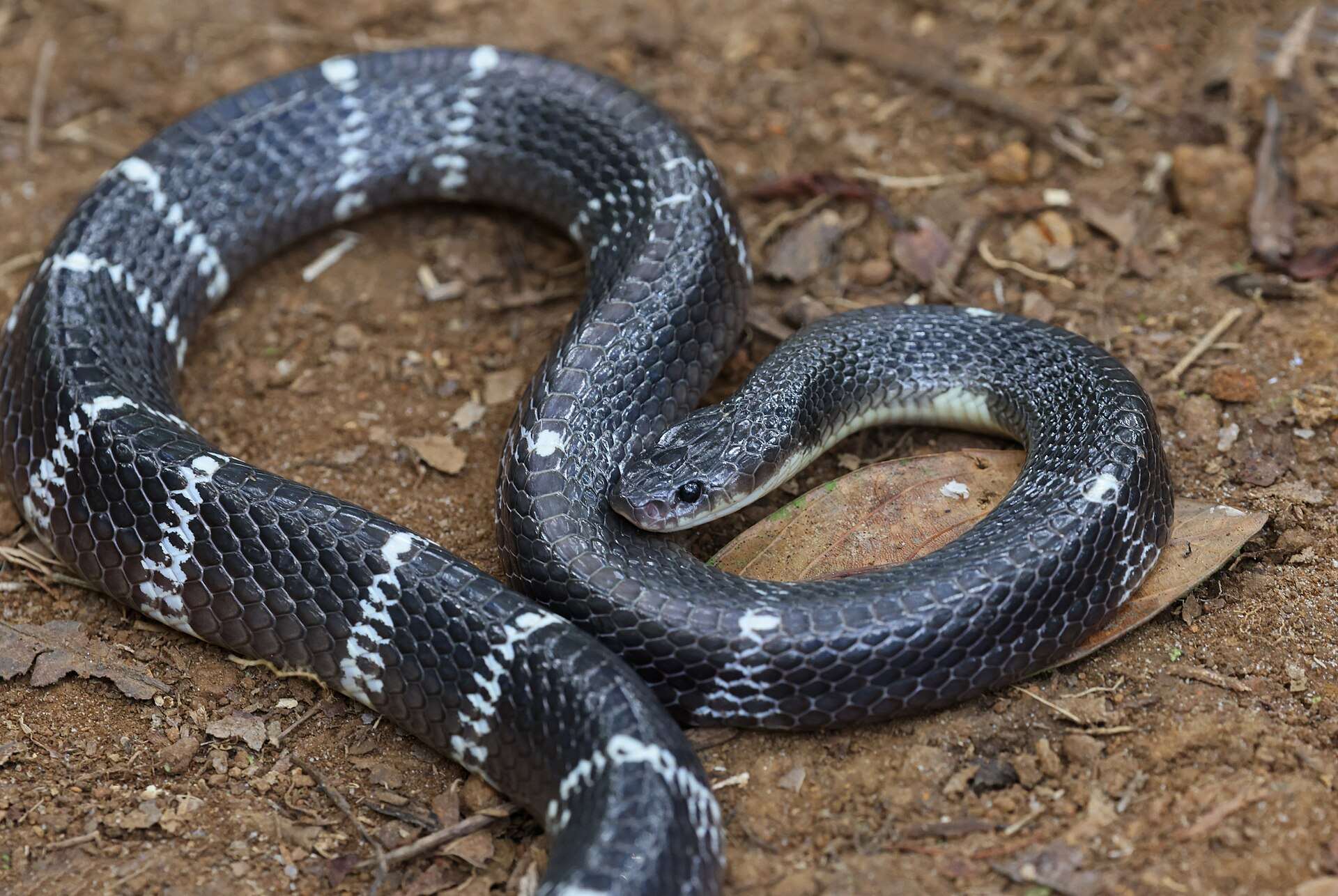
A slender, glossy black snake with thin white bands, active at night across South Asia. It mainly eats other snakes and is one of India's most medically important species.

Is it dangerous?
Yes. Its bite can be almost painless, but the venom can paralyse the muscles used for breathing. Go to a hospital immediately.
Do not approach. If someone is bitten, go to a hospital now.
At a glance
- Length
- 1.0–1.5 m
- Active
- At night
- Found in
- South Asia
- Venom
- Neurotoxic
- Young
- Lays eggs
- Habitat
- Farmland, Gardens, Forest near water
- Diet
- Snakes, Rodents, Lizards
Length shows a typical adult, then the largest recorded.
IUCN Red List status: Least Concern
Country guideSnakes of BangladeshSnakes of IndiaSnakes of Sri LankaSnakes of NepalSnakes of Pakistan
True size
Common wolf snakeNon-venomous
0.92 m at most
About half the height of a 1.7 m adult.
Usual range 0.7–0.92 m, the bar on the ruler.
Common kraitMedically significant
1.5 m at most
About three quarters of the height of a 1.7 m adult.
Usual range 1.0–1.5 m, the bar on the ruler.
Russell's viperMedically significant
1.68 m at most
About as long as a 1.7 m adult is tall.
Usual range 1.2–1.68 m, the bar on the ruler.
Indian cobraMedically significant
2.2 m at most
About 1.5 times the height of a 1.7 m adult.
Usual range 1.25–2.2 m, the bar on the ruler.
Banded kraitMedically significant
2.25 m at most
About 1.5 times the height of a 1.7 m adult.
Usual range 1.35–2.25 m, the bar on the ruler.
Monocled cobraMedically significant
2.3 m at most
About 1.5 times the height of a 1.7 m adult.
Usual range 1.5–2.3 m, the bar on the ruler.
Indian rat snakeNon-venomous
3 m at most
About 2 times the height of a 1.7 m adult.
Usual range 1.8–3.0 m, the bar on the ruler.
King cobraMedically significant
5.5 m at most
About 3 times the height of a 1.7 m adult.
Usual range 3.0–5.5 m, the bar on the ruler.
Each snake is drawn at the longest length in its profile, on the same scale as the adult. Length is to scale; thickness is not.
Identification
The common krait is a slender, smooth snake that is black or bluish-black above with narrow white crossbands, usually arranged more or less in pairs. The bands are faintest on the front part of the body and may be missing there; in older snakes they often break up into rows of small spots. The belly and upper lip are white1.
Kraits have very glossy scales and a row of strongly enlarged scales running along the middle of the back. Large adults measure about 1.2 m in total length, and specimens of about 1.5 m have been recorded but are rare1.
Distribution
The common krait is found in Afghanistan, Pakistan, India, Sri Lanka, Bangladesh and Nepal, and possibly Bhutan2. In India it is widespread and mainly a snake of the plains, although it has been recorded as high as about 1,650 m at Almora in the Himalaya1. In Sri Lanka it is common in the dry zone3.
A krait from Karnataka was described as a new species, Bungarus romulusi, in 2021, but the name was not validly published, so the Reptile Database currently includes these snakes in B. caeruleus2.
Habitat
Kraits live in fairly open country at low elevations. They often visit cultivated land and are frequently found in and around houses and villages1. In western India, common kraits are often found near water in forested areas, but they adapt readily to changed habitats such as farms and gardens4.
During the night they may enter homes while searching for prey5.
Behaviour
The common krait is mainly nocturnal and is often seen at night when it enters houses or crosses roads4. When disturbed it is usually quiet and reluctant to bite; it may coil loosely and hide its head under its body instead of striking1.
Most krait bites in South Asia happen at night to people sleeping in their homes, usually on the floor, when a person rolls onto a krait that has come inside5. WHO guidance notes that sleeping under a mosquito net that is well tucked in also protects against snakes5.
Diet
Kraits feed mainly on other snakes and will eat both harmless and venomous species. Small mammals, lizards and frogs are also taken1. Field reports from India describe common kraits eating snakes, lizards, frogs and mice, and scavenging snakes and rodents killed on roads4.
In 2022 a young common krait in Gujarat, India, was seen swallowing a saw-scaled viper, the first published record of this prey6.
Reproduction
The common krait lays eggs2. A clutch usually holds about 6–10 eggs, laid in holes in the ground or under leaves, and the parent guards them afterwards1.
In India eggs are laid in April and May, and the young hatch from May to July. Hatchlings measure about 26–28 cm and can grow nearly 30 cm in their first year1.
Venom and medical significance
The common krait is one of India’s “big four” medically important snakes5. Its venom is mainly neurotoxic. A krait bite may be almost painless and cause little or no swelling; a sleeping person may not even wake up, and fang marks can be hard to see. Envenoming can cause drooping eyelids and paralysis that spreads through the body and can stop breathing5.
In a Sri Lankan study of 210 people bitten at night while asleep on the floor, abdominal pain was the main early symptom, 48% needed a breathing machine and 7.6% died3. Anyone who may have been bitten must go to hospital immediately, even if they feel no pain5.
Conservation
The common krait is listed as Least Concern on the IUCN Red List (assessed 2021)7. It is common in many parts of India1.
In India it is protected under Schedule II of the Wild Life (Protection) Act, 1972, as amended in 2022, which covers all elapid snakes not listed in Schedule I8.
Similar species
The harmless common wolf snake (Lycodon aulicus) is often confused with the common krait. WHO guidelines note that wolf snakes mimic kraits, and mistaken identification can lead to unnecessary antivenom treatment5.
Some visual differences: the krait is glossy black or bluish-black with thin white bands that are often paired, while the wolf snake is brown or greyish-brown with white bands that widen or fork on the sides. The wolf snake usually has a whitish patch on the back of the head and a flattened snout that projects beyond the lower jaw1. These differences are not a safe basis for handling any snake.
In captivity
The common krait is highly venomous and is not suitable as a pet. In India it is listed in Schedule II of the Wild Life (Protection) Act, 1972 (as amended in 2022), and the Act prohibits hunting animals listed in Schedules I and II8.
Because kraits often enter houses at night, WHO advises checking homes for snakes and removing hiding places such as rubbish heaps and building materials near the house5.
Look-alikes
Don’t confuse it with…
These snakes are often mistaken for each other. Use the differences to learn, never as a reason to handle a snake.
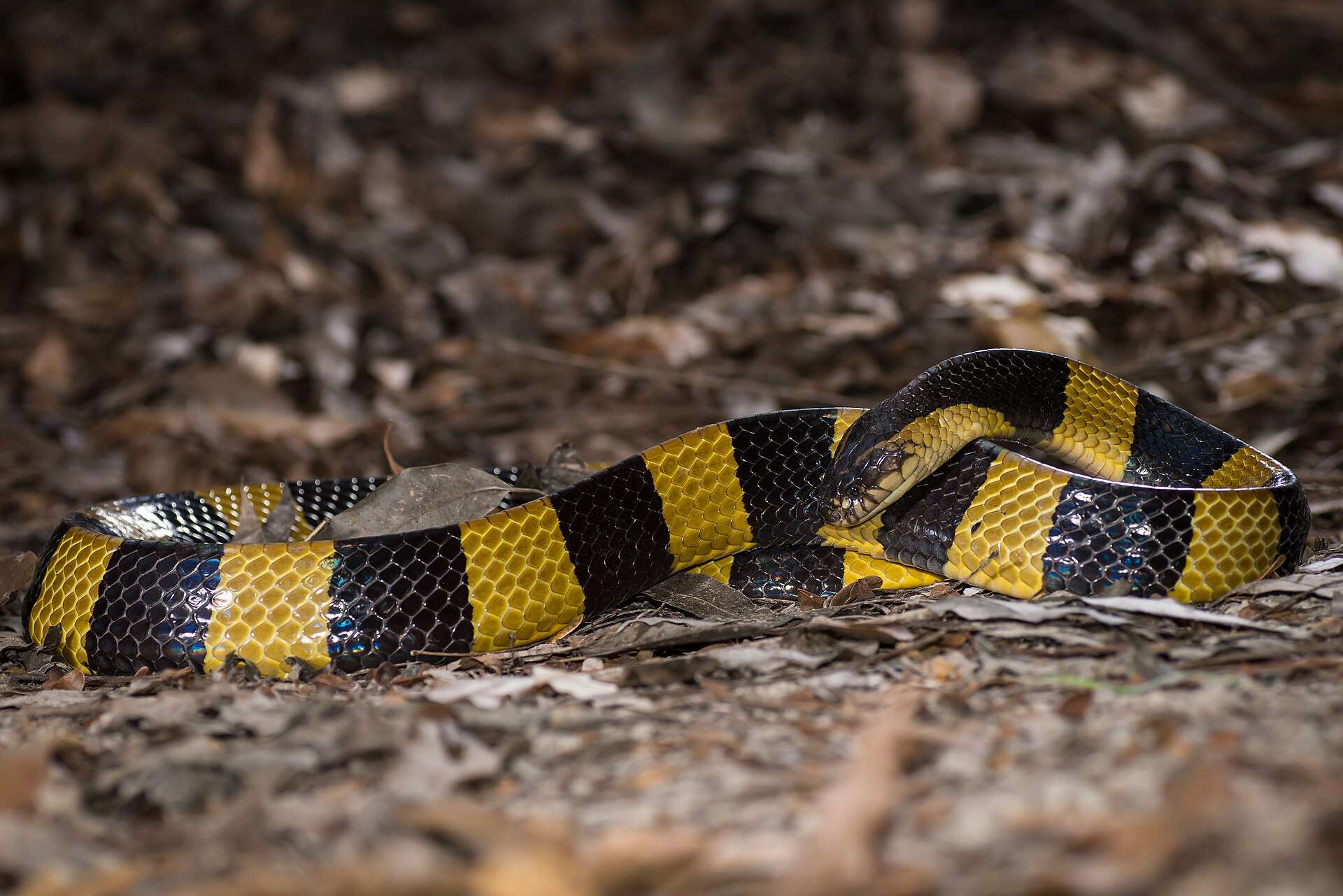
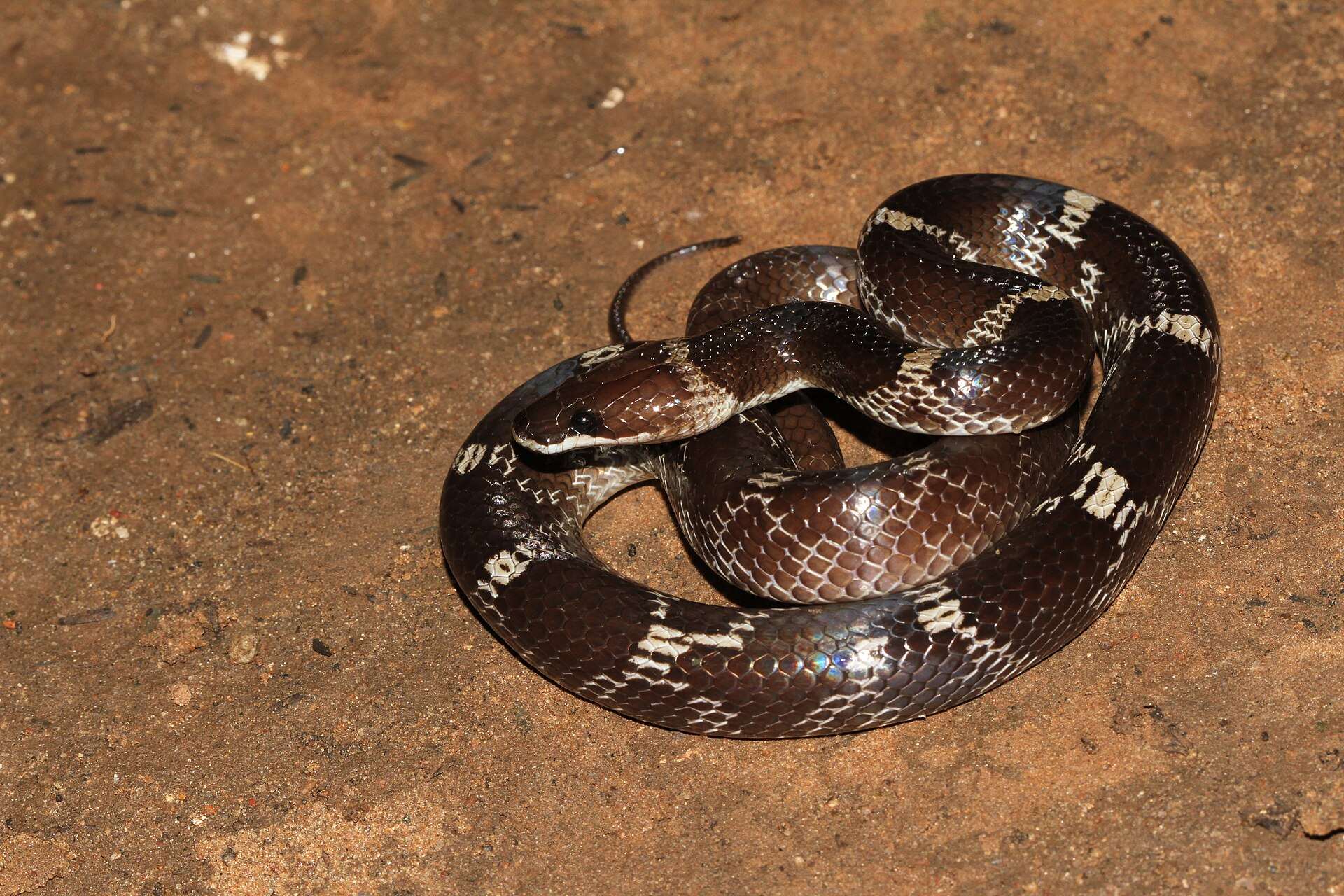
Differences from Smith (1943), cited in both profiles. They help you learn the two apart; they are not a safe basis for handling any snake.
References
- 1
Smith, M.A. (1943). The Fauna of British India, Ceylon and Burma. Reptilia and Amphibia. Vol. III, Serpentes. Taylor and Francis, London. (Genus Bungarus, pp. 407–409; Bungarus caeruleus, pp. 413–415.) archive.org
- 2
Uetz, P. et al. (2026). Bungarus caeruleus (Schneider, 1801). The Reptile Database. reptile-database.reptarium.cz
- 3
Kularatne, S.A.M. (2002). Common krait (Bungarus caeruleus) bite in Anuradhapura, Sri Lanka: a prospective clinical study, 1996–98. Postgraduate Medical Journal 78: 276–280. doi.org
- 4
Dabholkar, P. & Sagar, A. (2024). Scavenging by Indian Kraits, Bungarus caeruleus (Schneider 1801) (Elapidae), in Alibag, Maharashtra, India. Reptiles & Amphibians 31: e19957. doi.org
- 5
World Health Organization, Regional Office for South-East Asia (2016). Guidelines for the management of snakebites, 2nd edition. WHO SEARO, New Delhi. who.int
- 6
Patel, R. (2024). A Common Krait (Bungarus caeruleus) feeding on a Saw-scaled Viper (Echis carinatus). Reptiles & Amphibians 31: e18950. doi.org
- 7
Mohapatra, P. et al. (2021). Bungarus caeruleus. The IUCN Red List of Threatened Species 2021: e.T172702A1369896. iucnredlist.org
- 8
Government of India (2022). The Wild Life (Protection) Amendment Act, 2022 (No. 18 of 2022), Gazette of India; Schedule II, Part C (Reptiles). prsindia.org
Play
Play as the common krait.
Its real pattern is a skin in Snake. Every run ends with a fact.