
Indian rat snake
Ptyas mucosa (Linnaeus, 1758)
Also called Oriental rat snake, Dhaman
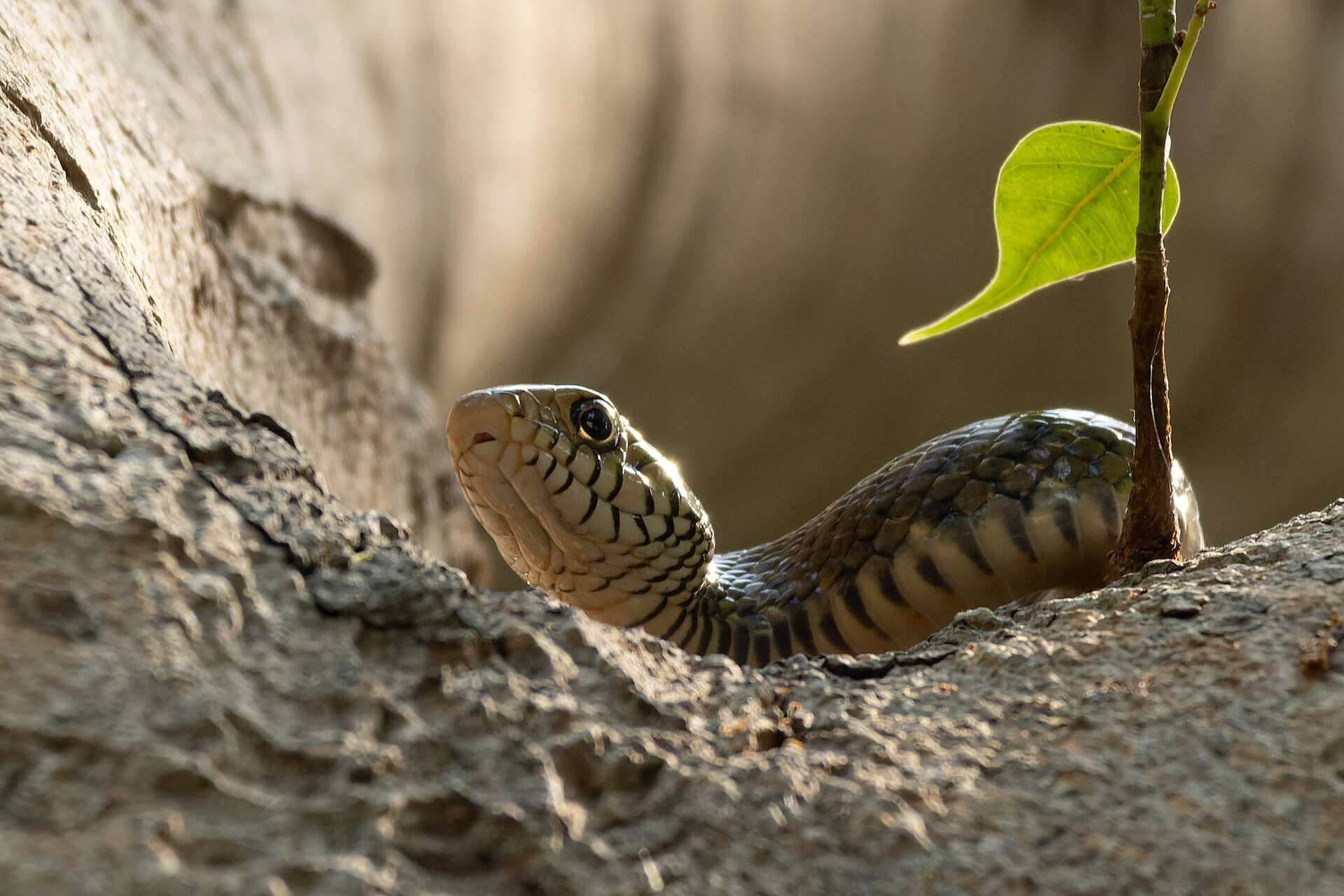
A long, slender, non-venomous daytime snake common across southern Asia. It is often seen near farms and villages hunting rats, and is frequently mistaken for a cobra.

Is it dangerous?
No. It is non-venomous and harmless to people, though a large one may bite hard if grabbed or cornered. Leave it alone.
Harmless to people, but it may bite if handled. Treat any snake you can’t identify as venomous.
Snakebite first aidAt a glance
- Length
- 1.8–3.0 m
- Weight
- About 0.9 on average kg
- Active
- By day
- Found in
- Iran to Indonesia
- Venom
- None
- Young
- Lays eggs
- Habitat
- Farmland, Grassland, Scrub
- Diet
- Rodents, Frogs and toads, Birds
Length shows a typical adult, then the largest recorded.
IUCN Red List status: Least Concern
Country guideSnakes of BangladeshSnakes of IndonesiaSnakes of IndiaSnakes of Sri LankaSnakes of NepalSnakes of Pakistan
True size
Common wolf snakeNon-venomous
0.92 m at most
About half the height of a 1.7 m adult.
Usual range 0.7–0.92 m, the bar on the ruler.
Common kraitMedically significant
1.5 m at most
About three quarters of the height of a 1.7 m adult.
Usual range 1.0–1.5 m, the bar on the ruler.
Javan spitting cobraMedically significant
1.85 m at most
About as long as a 1.7 m adult is tall.
Usual range 1.38–1.85 m, the bar on the ruler.
Indian cobraMedically significant
2.2 m at most
About 1.5 times the height of a 1.7 m adult.
Usual range 1.25–2.2 m, the bar on the ruler.
Banded kraitMedically significant
2.25 m at most
About 1.5 times the height of a 1.7 m adult.
Usual range 1.35–2.25 m, the bar on the ruler.
Monocled cobraMedically significant
2.3 m at most
About 1.5 times the height of a 1.7 m adult.
Usual range 1.5–2.3 m, the bar on the ruler.
Indian rat snakeNon-venomous
3 m at most
About 2 times the height of a 1.7 m adult.
Usual range 1.8–3.0 m, the bar on the ruler.
King cobraMedically significant
5.5 m at most
About 3 times the height of a 1.7 m adult.
Usual range 3.0–5.5 m, the bar on the ruler.
Each snake is drawn at the longest length in its profile, on the same scale as the adult. Length is to scale; thickness is not.
Identification
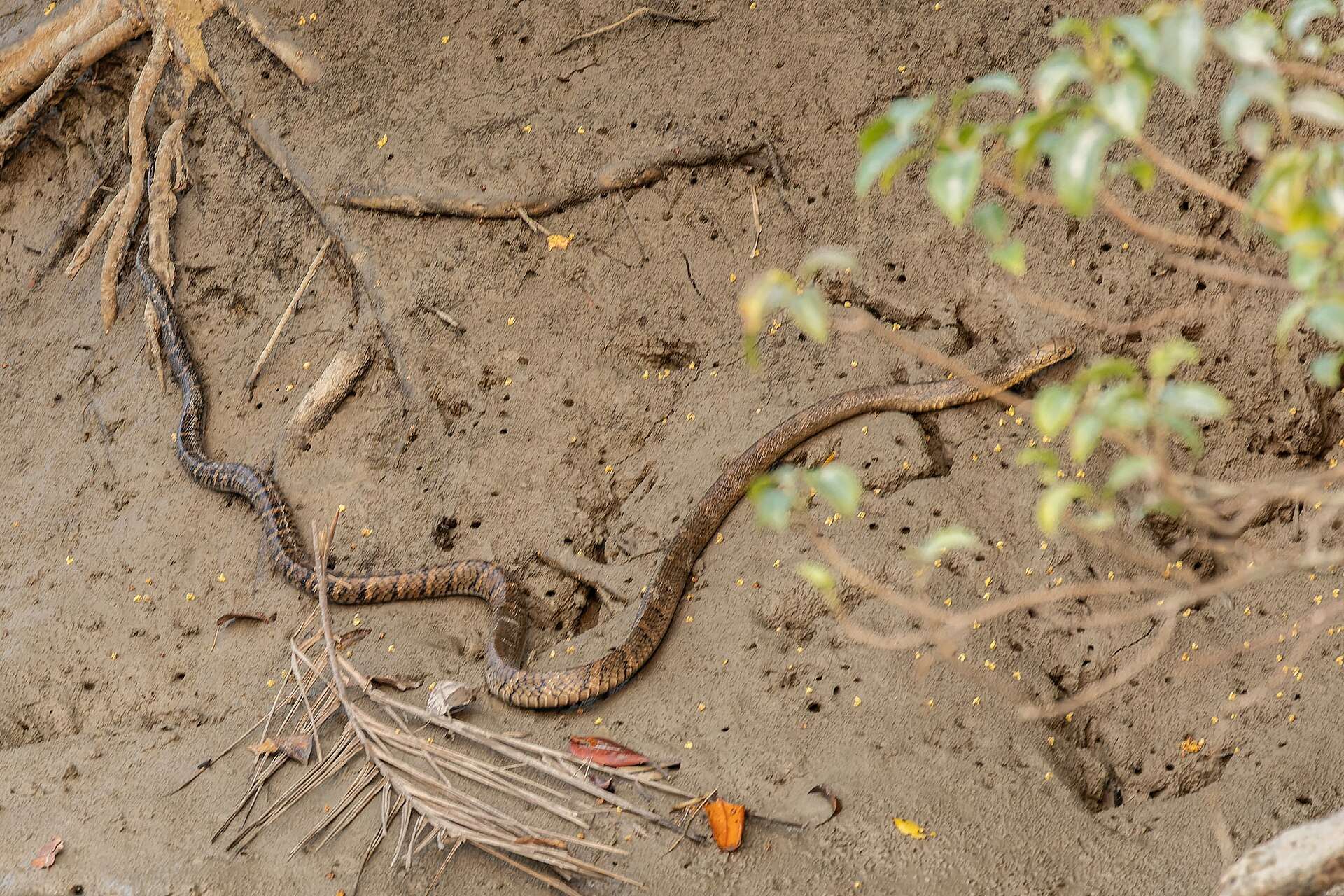
The Indian rat snake is a large, slender snake with a distinct head, a large eye with a golden iris and a long, whip-like tail1,2,3. Its back is yellowish, olive, grey or brown, usually with dark bands towards the tail, and its whitish lip scales are edged with black2,3. Young snakes have light crossbars on the front of the body2.
Most adults are about 1.5–2 m long, and the largest wild snakes usually measure 2–2.5 m2,3. Lengths over 3 m have been reported4. Hatchlings are roughly 30–47 cm long2,3.
Distribution
The Indian rat snake has a very large range. The Reptile Database lists it from Iran, Turkmenistan and Afghanistan, through Pakistan, India, Sri Lanka, Nepal, Bhutan and Bangladesh, to Myanmar, southern China, Taiwan, Thailand, Laos, Cambodia, Vietnam, Malaysia and the Indonesian islands of Sumatra, Java and Bali1. It is found across most of India1.
Habitat
The Indian rat snake lives in many kinds of open country, including farm fields, scrub, grassland and the edges of ponds, reservoirs and rural gardens3. It is abundant in farmland across southern Asia4. On farms it sometimes enters houses while searching for rodents3. It is partly a tree-climber1.
Behaviour
The Indian rat snake is active by day3,5, although it is also known to forage at night at times5. When cornered or caught it defends itself vigorously: it may strike, bite repeatedly and release faeces3.
Diet
The Indian rat snake eats a wide range of animals, mainly frogs and toads, rodents, lizards, birds and other snakes3,5. Large adults are more likely than young ones to eat snakes, and one in Mumbai was seen swallowing a live Indian rock python5. Rat snakes have also been recorded swallowing odd items such as pieces of cloth and plastic5.
Reproduction
The Indian rat snake lays eggs1. In a study in Java, clutches held 7 to 25 eggs, and a later study there found an average of about 12.6 eggs, with bigger females laying more2,4. The eggs hatch after about two months3. Snake collectors in Java report that young rat snakes grow quickly and can mature in about nine months2.
Venom and medical significance
The Indian rat snake is non-venomous and harmless to people3,6. A large, frightened rat snake can still bite hard and repeatedly if it is handled or cornered, so it is best left alone3. Because harmless and dangerous snakes can look alike, anyone bitten by a snake that has not been identified with certainty should seek medical care immediately6.
Conservation
The Indian rat snake is listed as Least Concern on the IUCN Red List (assessed in 2021)7. It is heavily hunted for its skin and meat in parts of South-East Asia, especially Java, but a comparison of harvested snakes taken 25 years apart found no change in their size or breeding traits, suggesting the harvest there has been sustainable2,4. In India it is protected under Schedule I of the Wild Life (Protection) Act8.
Similar species
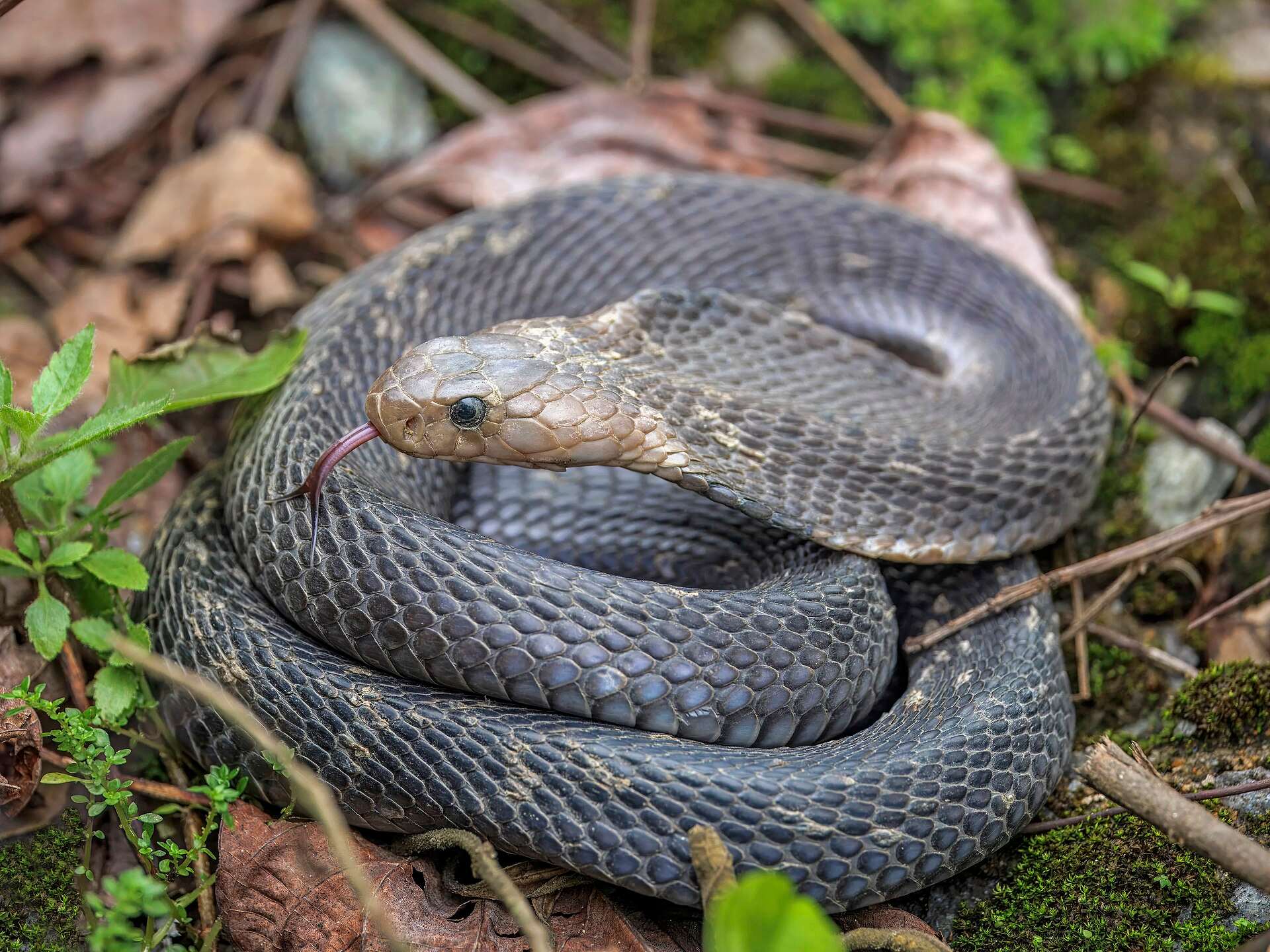
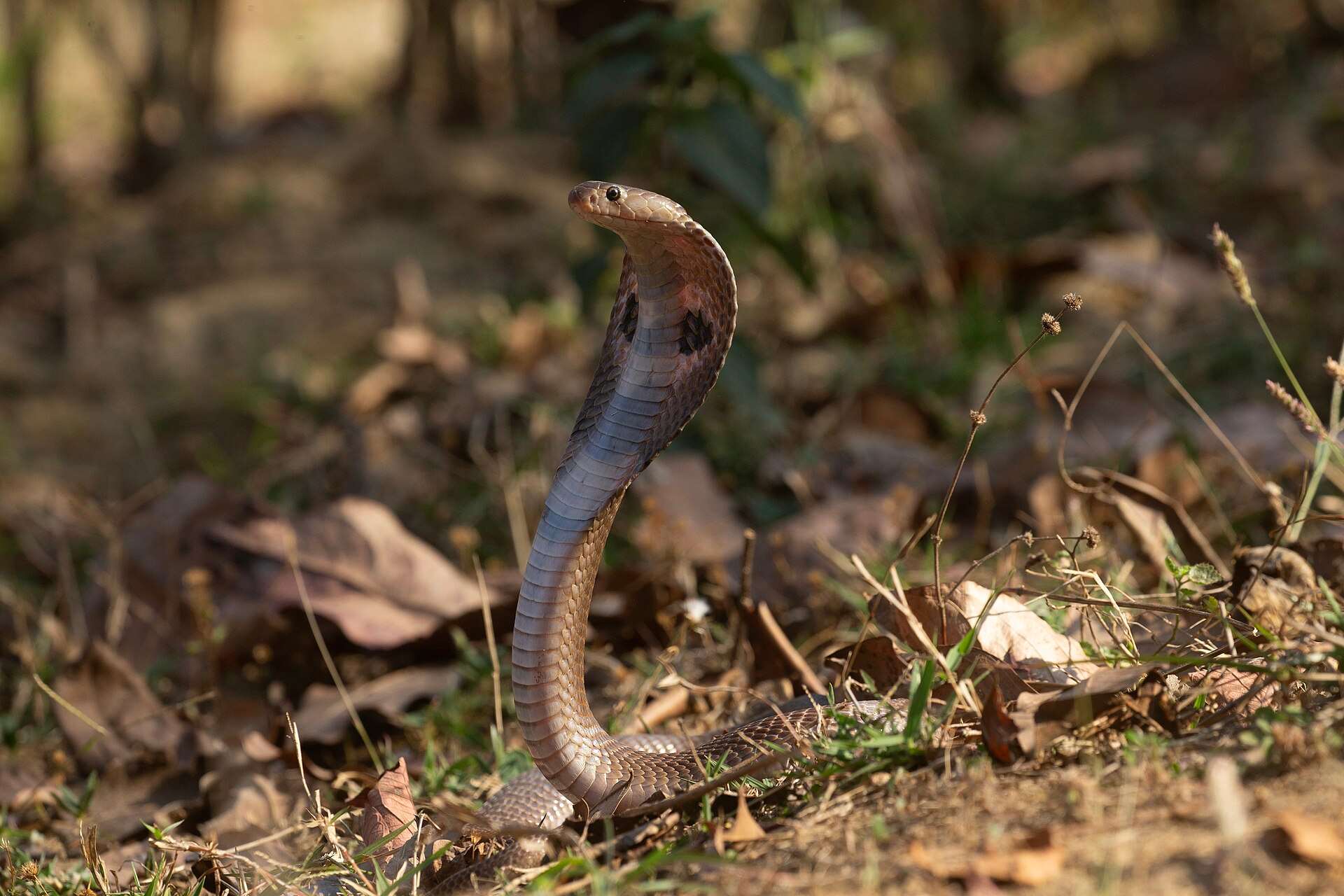
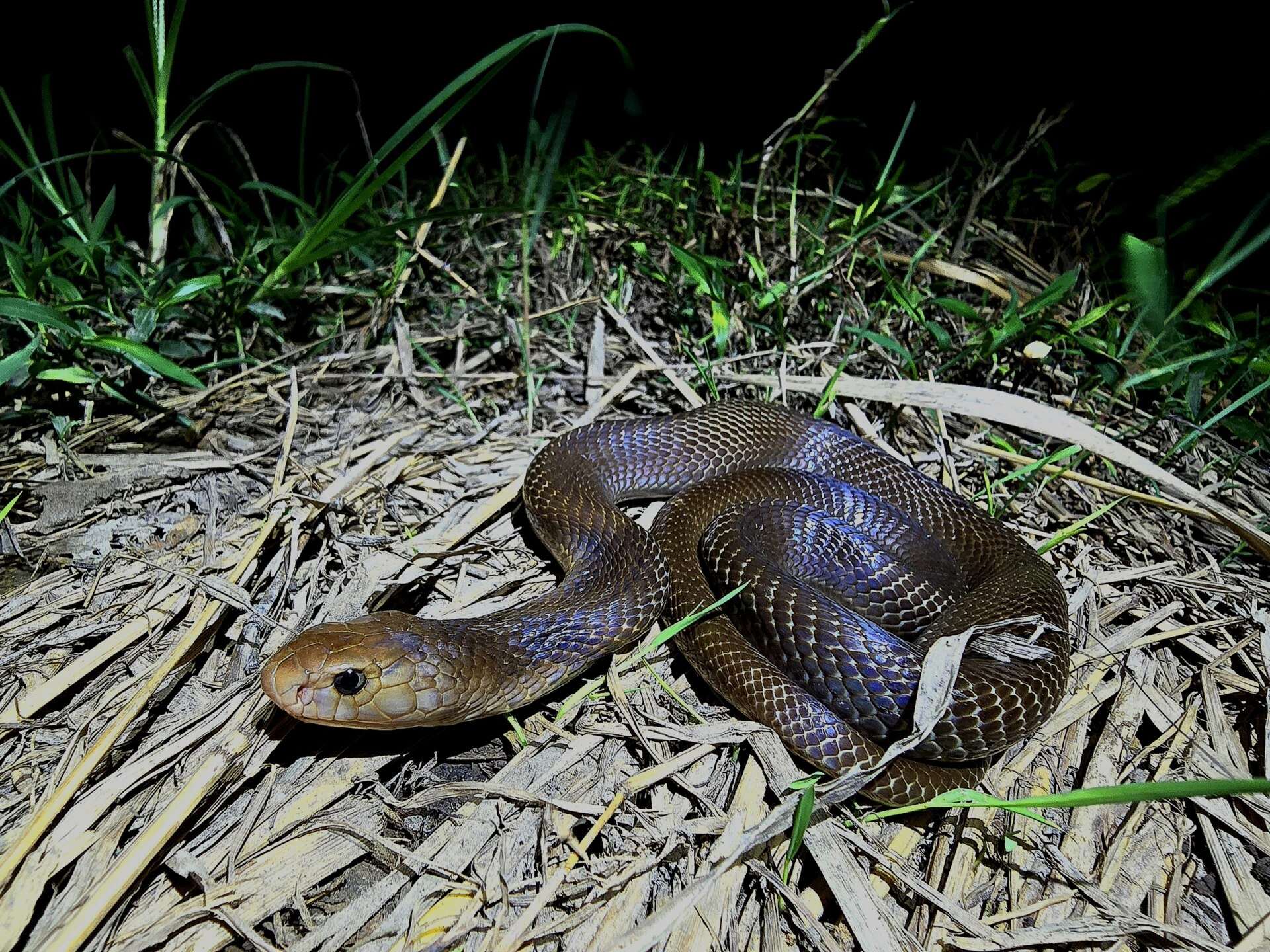
The Indian rat snake can be confused with the Indian cobra (Naja naja). Unlike a cobra, a rat snake cannot spread a hood, and it has a large eye and black-edged lip scales2,3. It also has small loreal scales between the nostril and the eye, which cobras and other elapids lack6. The similar Indo-Chinese rat snake (Ptyas korros) has plain lip scales without black edges2. These differences are not a safe basis for handling any snake. Treat any snake you cannot identify as potentially dangerous.
In captivity
In India the Indian rat snake, also called the dhaman, is listed in Schedule I of the Wild Life (Protection) Act, as amended in 2022, giving it the strongest category of legal protection8. It is a wild animal that should not be caught or kept as a pet.
Look-alikes
Don’t confuse it with…
These snakes are often mistaken for each other. Use the differences to learn, never as a reason to handle a snake.
References
- 1
Uetz, P. et al. (eds.) (2026). Ptyas mucosa (Linnaeus, 1758). The Reptile Database. reptile-database.reptarium.cz
- 2
Auliya, M. (2010). Conservation status and impact of trade on the Oriental Rat Snake Ptyas mucosa in Java, Indonesia. TRAFFIC Southeast Asia. traffic.org
- 3
School of Biological Sciences, The University of Hong Kong. Ptyas mucosus (Linnaeus, 1758), Common Rat Snake. Hong Kong Reptiles. biosch.hku.hk
- 4
Hamidy, A., Arida, E., Maireda, N.L., Herlambang, A.E.N., Riyanto, A., Mumpuni, Shine, R. & Natusch, D.J.D. (2024). Sexual dimorphism and reproductive biology of commercially harvested oriental rat snakes (Ptyas mucosa: Colubridae) from West Java. Australian Journal of Zoology 72(1). doi.org
- 5
Gokarankar, P.K., Hadkar, S.M. & Joshi, P. (2024). Oriental Rat snake Ptyas mucosa (Linnaeus 1758) feeding on an Indian Rock Python Python molurus (Linnaeus 1758) from Mumbai, Maharashtra, India. Hamadryad 41(1&2): 41–42. hamadryad.org
- 6
World Health Organization, Regional Office for South-East Asia (2016). Guidelines for the management of snakebites, 2nd edition. who.int
- 7
Wogan, G. et al. (2021). Ptyas mucosa. The IUCN Red List of Threatened Species 2021: e.T164644A1063584. iucnredlist.org
- 8
Government of India (2022). The Wild Life (Protection) Amendment Act, 2022 (No. 18 of 2022), Schedule I, Part C: Reptiles. prsindia.org
Play
Play as the indian rat snake.
Its real pattern is a skin in Snake. Every run ends with a fact.