Country guide

Snakes of Pakistan

Global estimates published in 2008 suggested that Pakistan has more than 12,000 snakebite envenomings and over 1,000 snakebite deaths a year, although snakebite data for the region remain weak. WHO ranks the common krait, Sind krait, Indian cobra, Central Asian cobra, Russell's viper and saw-scaled viper as the species of highest medical importance in Pakistan.

> 12,000

snakebite envenomings a year (2008 estimate)1

> 1,000

snakebite deaths a year (2008 estimate)1

80%

of bites in a rural Sindh hospital study were on the foot3

If someone is bitten

Call now. Then go to hospital.

Antivenom is given in hospitals. Don’t wait for symptoms.

  • Australia

    Australian first aid for snakebite uses a pressure immobilisation bandage and splint, and advises not washing the bite.

  • Bangladesh

    A 2017 study noted that the Indian polyvalent antivenom used in Bangladesh is not made from the venoms of local species such as the monocled cobra, and it did not prevent local tissue damage from cobra bites.

  • Brazil

    Antivenom is free in Brazil's public health system (SUS), but it is only given in hospital, at reference hospitals chosen by each state.

  • India

    Indian polyvalent antivenom is raised against the 'Big Four' and may not neutralise some regional species, such as the monocellate cobra in the North-East and the hump-nosed pit viper in the south-west.

  • Indonesia

    Indonesia's own antivenom, made by Bio Farma, is raised against only three species (Javan spitting cobra, banded krait and Malayan pit viper), so it may work poorly for bites by other snakes such as green pit vipers.

  • Kenya

    Antivenom is usually stocked only at hospitals and some health centres, so people bitten in rural areas often need to be referred, and delays are common.

  • Mexico

    Mexico's public health system uses two anti-viper antivenoms; one is made from the venoms of the terciopelo and the Mexican west coast rattlesnake.

  • Nepal

    100 is the police emergency number; call 102 for an ambulance.

  • Nigeria

    Antivenoms made from Nigerian snake venoms (EchiTAb G and EchiTAb-Plus-ICP) have proved effective in clinical trials, while some imported antivenoms made from non-African snake venoms have proved ineffective.

  • Pakistan

    Rescue 1122 handles ambulance and fire emergencies; the police number is 15.

  • Philippines

    The only antivenom made in the Philippines is Philippine Cobra Antivenom, raised against the Philippine cobra; there is no locally made antivenom for pit viper bites.

  • South Africa

    112 works for all emergencies from a mobile phone; 10177 is ambulance and fire, and 10111 is police.

  • Sri Lanka

    119 (or 118) is the police emergency number; call 1990 for an ambulance.

  • United States

    For free, expert 24/7 advice you can also call Poison Help on 1-800-222-1222, but call 911 in an emergency.

Not listed? Call your local emergency number.

Look-alikes

Dangerous or harmless?

Harmless snakes are often killed because they look like dangerous ones. Learn the differences, and still never handle a snake.

Spot the difference
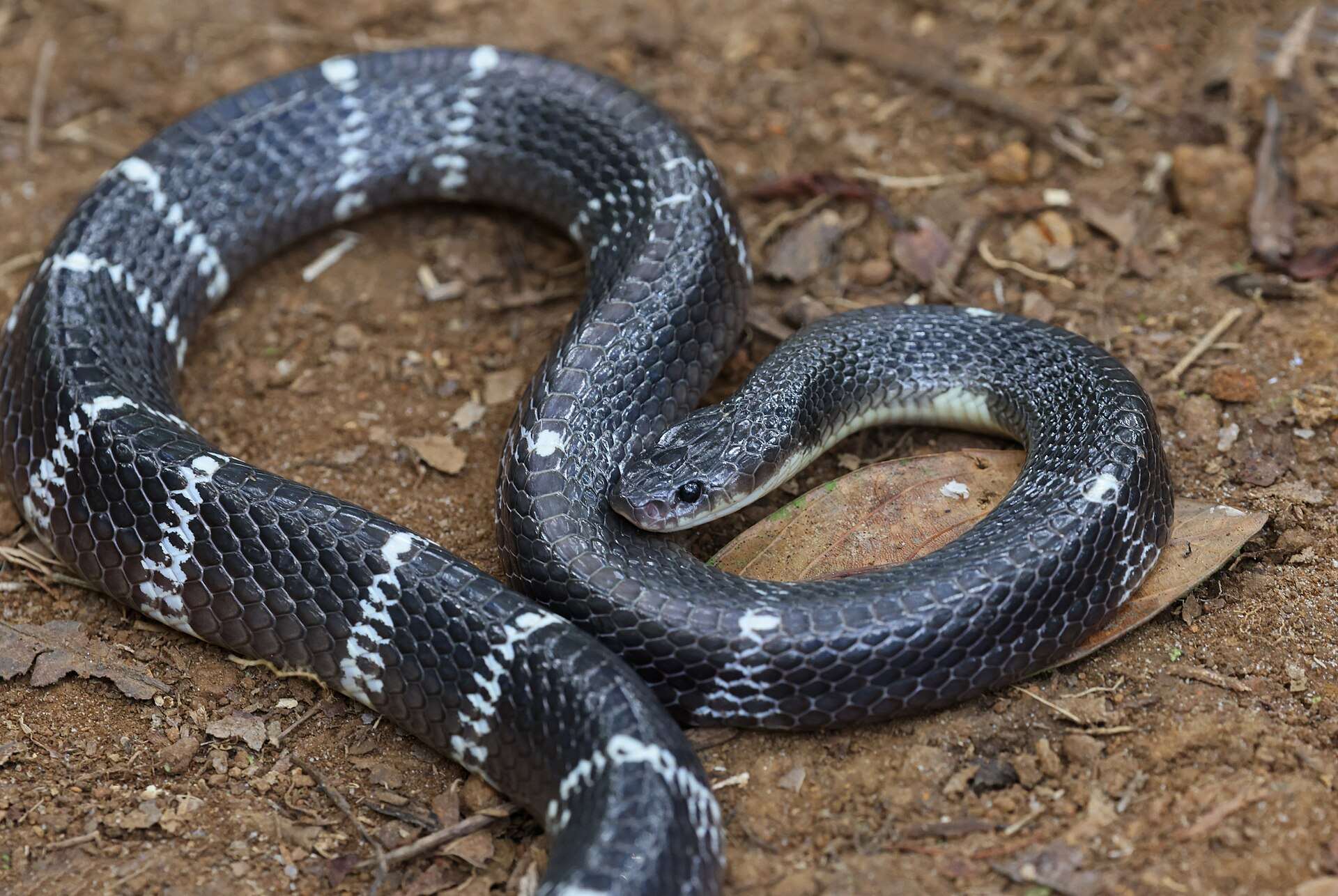
Common krait coiled on bare earth and dry leaves, showing thin white bands on a glossy black body
Medically significant

Common krait

Bungarus caeruleus

Bands
Thin white bands, often in pairs. They fade towards the head.
Colour
Glossy black or bluish-black, with a row of enlarged scales along the middle of the back.
Head
A dark head with a white upper lip.
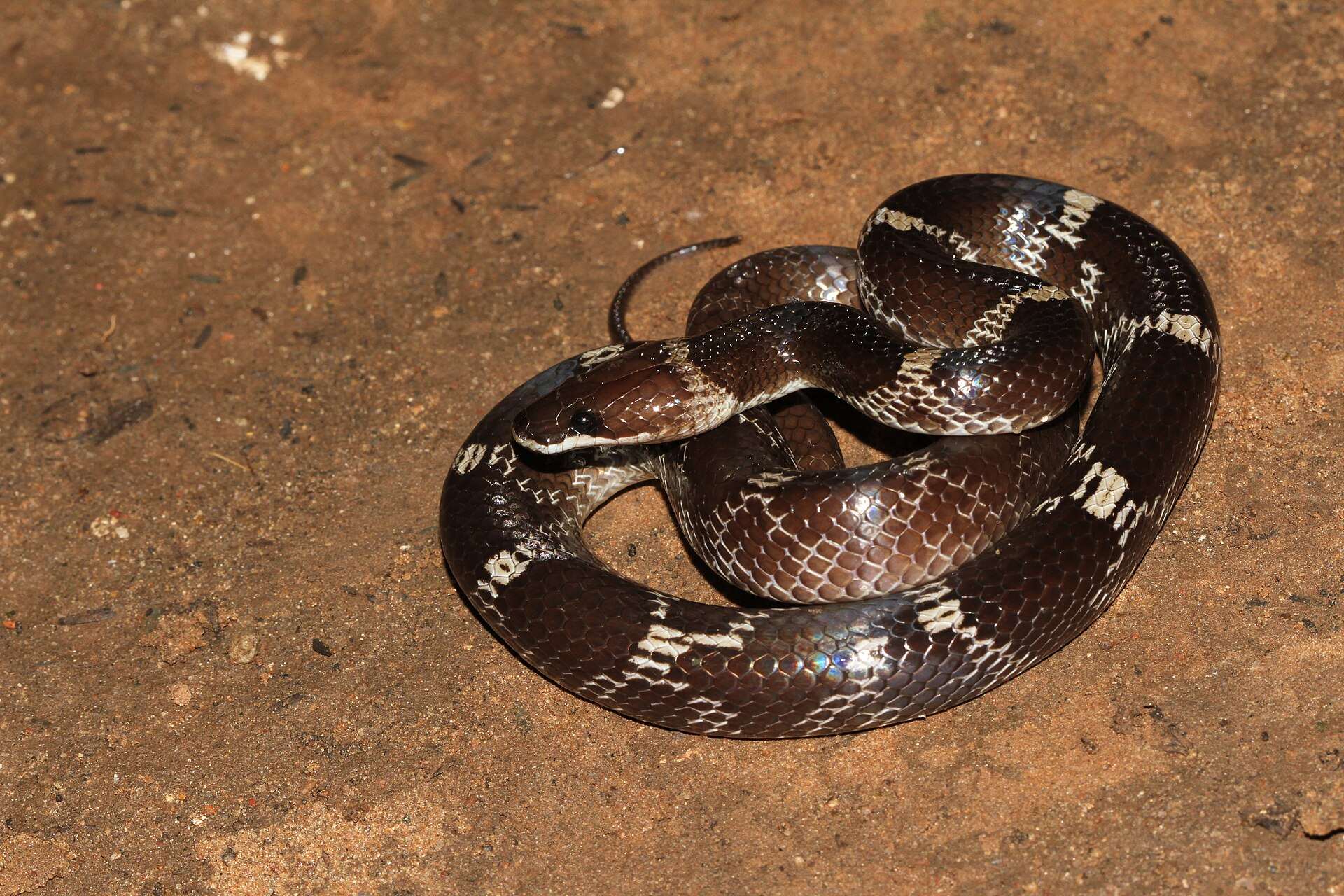
Common wolf snake coiled on reddish soil, showing a dark brown body with white crossbands that widen on the sides
Non-venomous

Common wolf snake

Lycodon aulicus

Bands
White bands that widen or fork on the sides.
Colour
Brown or greyish-brown.
Head
A pale patch behind the head, and a flattened snout that juts past the lower jaw.

Differences from Smith (1943), cited in both profiles. They help you learn the two apart; they are not a safe basis for handling any snake.

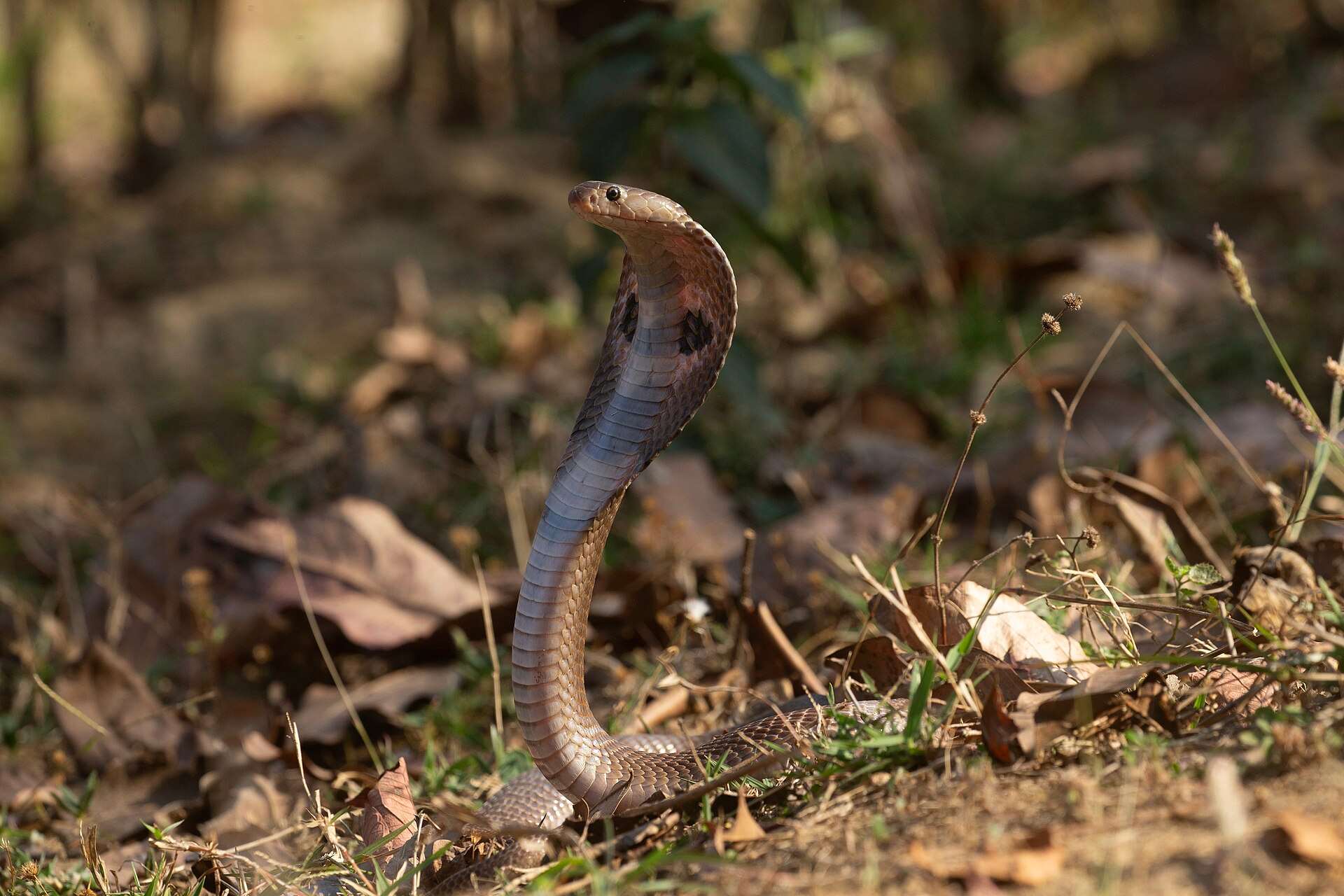
Brown Indian cobra rearing up among dry leaves and grass, its hood spread and dark throat spots visible
Medically significant

Indian cobra

Naja naja

The classic hooded cobra of South Asia. Its colour ranges from grey and brown to black, and its hood often, but not always, carries a spectacle-shaped mark. It is common around farms and villages.

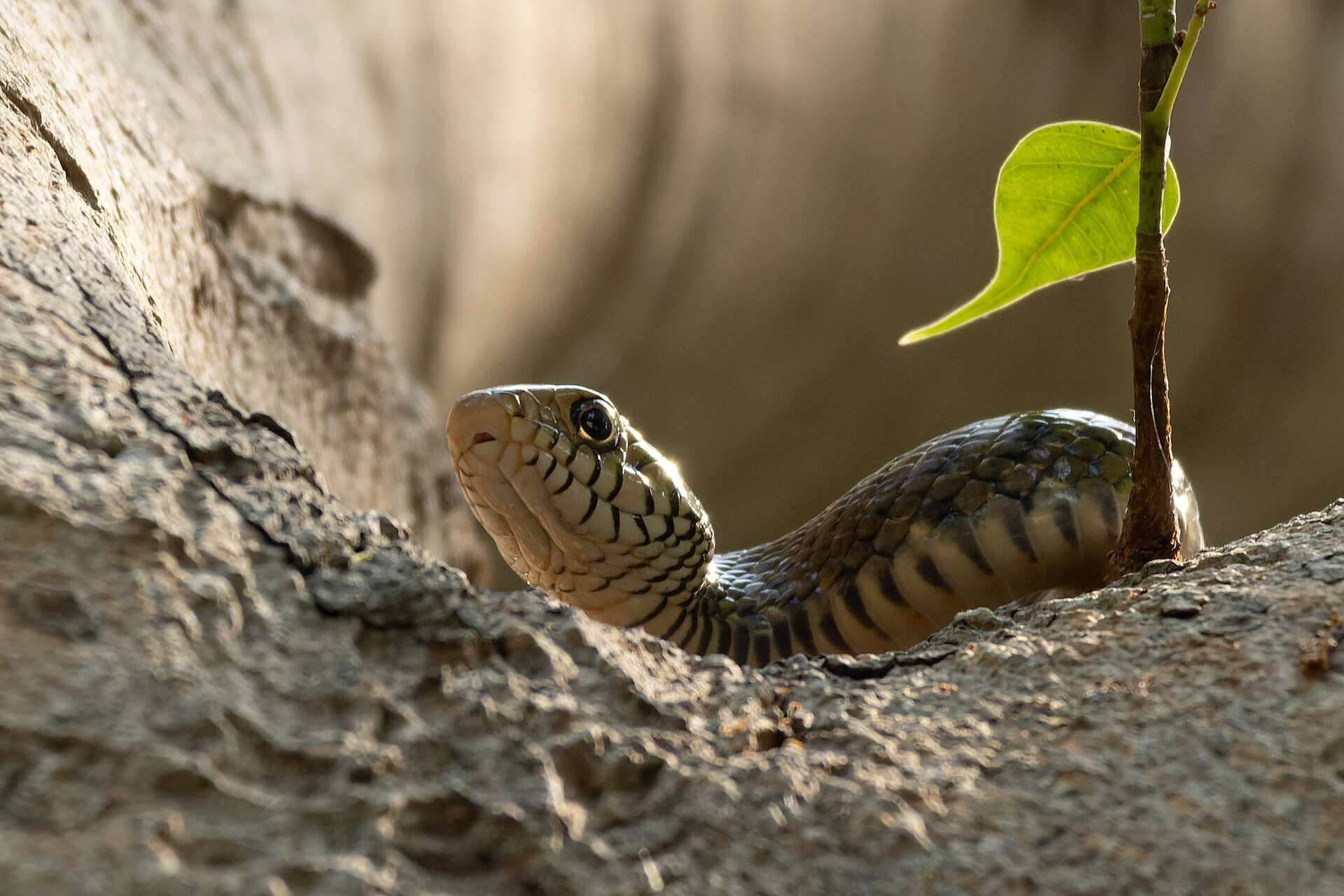
Indian rat snake resting on a tree branch, showing its large eye, black-edged lip scales and dark bands on the body
Non-venomous

Indian rat snake

Ptyas mucosa

A long, slender, non-venomous daytime snake common across southern Asia. It is often seen near farms and villages hunting rats, and is frequently mistaken for a cobra.

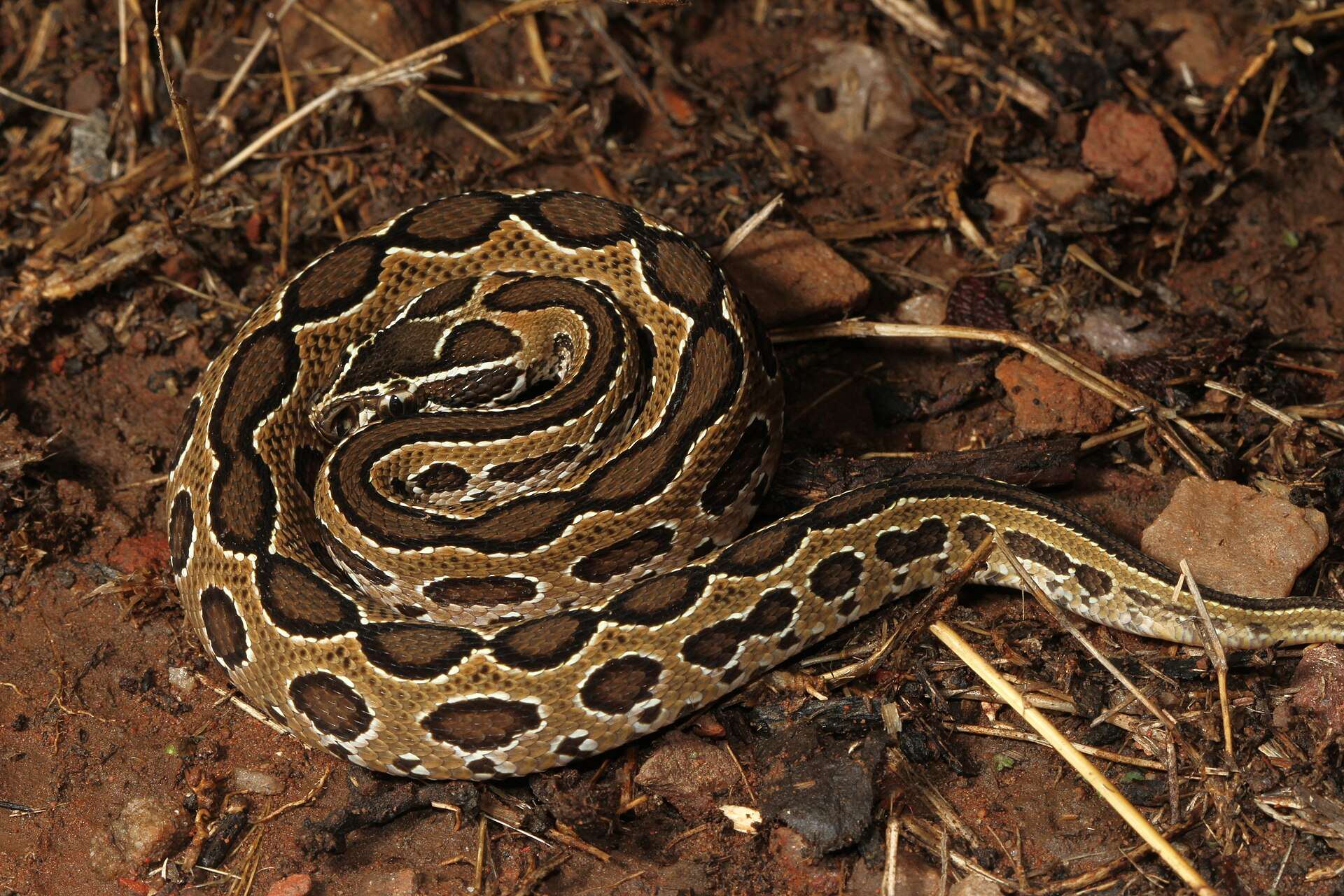
Russell's viper coiled on reddish soil and dry twigs, showing rows of large dark-brown spots edged in black and white
Medically significant

Russell's viper

Daboia russelii

A thick-bodied, brown viper of open country in South Asia, marked with three rows of dark, ringed spots. It is one of the region's most important causes of serious snakebite.

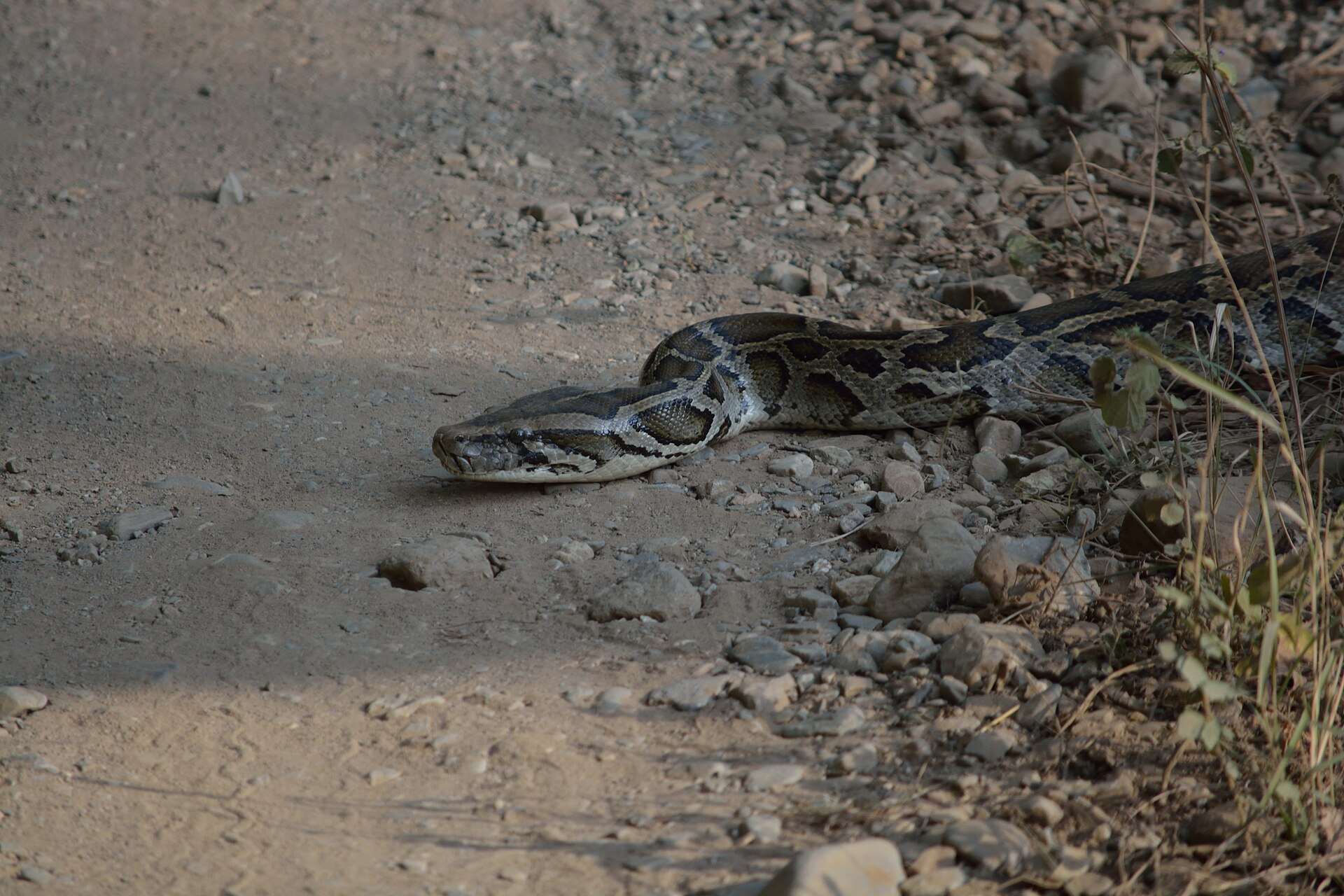
Indian rock python stretched across a stony dirt track in Jim Corbett National Park, showing its patterned head and blotched body
Non-venomous

Indian rock python

Python molurus

A large, heavy-bodied constrictor of South Asia, pale grey to yellowish with big dark-edged blotches. It is not venomous and kills its prey by squeezing.

Every species

All 65 snake species recorded in Pakistan

7 have a full profile so far. The others are listed by family, without a venom status until they have a sourced profile.

Colubridae32
  • Boiga trigonataCommon Cat Snake
  • Coelognathus helenaTrinket Snake
  • Dendrelaphis tristisCommon Indian Bronze-back
  • Eirenis persicusDark-headed Dwarf Racer
  • Fowlea piscatorCheckered Keelback
  • Fowlea sanctijohannisSt. John's Keelback
  • Fowlea schnurrenbergeriBar-necked Keelback
  • Hemorrhois ravergieriSpotted Whip Snake
  • Herpetoreas platycepsHimalayan Keelback
  • Herpetoreas sieboldiiSiebold’s Keelback
  • Lycodon aulicusCommon Wolf Snake
  • Lycodon bicolorMackinnon's Wolf Snake
  • Lycodon striatusBarred Wolf Snake
  • Lycodon travancoricusTravancore Wolf Snake
  • Lytorhynchus maynardiMaynard's Longnose Sand Snake
  • Lytorhynchus paradoxusSind Longnose Sand Snake
  • Lytorhynchus ridgewayiDerafshi Snake
  • Oligodon russelius
  • Oligodon taeniolatusStreaked Kukuri Snake
  • Platyceps kareliniSpotted Desert Racer
  • Platyceps ladacensisLadakh Racer
  • Platyceps noeliBrahui Racer
  • Platyceps pliniiBanded Racer
  • Platyceps sindhensisSindh Racer
  • Platyceps ventromaculatusHardwicke's Rat Snake
  • Rhabdophis plumbicolorGreen Keelback
  • Sibynophis sagittariusCantor’s black-headed snake
  • Spalerosophis arenariusRed-spotted Diadem Snake
  • Spalerosophis atricepsRoyal Snake
  • Spalerosophis diademaDiadem Snake
  • Telescopus rhinopomaIndian Desert Tiger Snake
  • Xenochrophis cerasogasterPainted Keelback
Elapidae12
  • Bungarus caeruleusCommon krait
  • Bungarus sindanusSind Krait
  • Hydrophis caerulescensDwarf Seasnake
  • Hydrophis cyanocinctusAnnulated Sea Snake
  • Hydrophis mamillarisBombay Sea Snake
  • Hydrophis ornatusOrnate Reef seasnake
  • Hydrophis spiralisYellow Sea Snake
  • Hydrophis viperinusViperine Sea Snake
  • Microcephalophis cantorisCantor’s narrow –headed sea snake
  • Microcephalophis graciliscommon small-headed sea snake
  • Naja najaSpectacled cobra
  • Naja oxianaCentral Asian Cobra
Viperidae8
  • Daboia russeliiRussell’s Viper
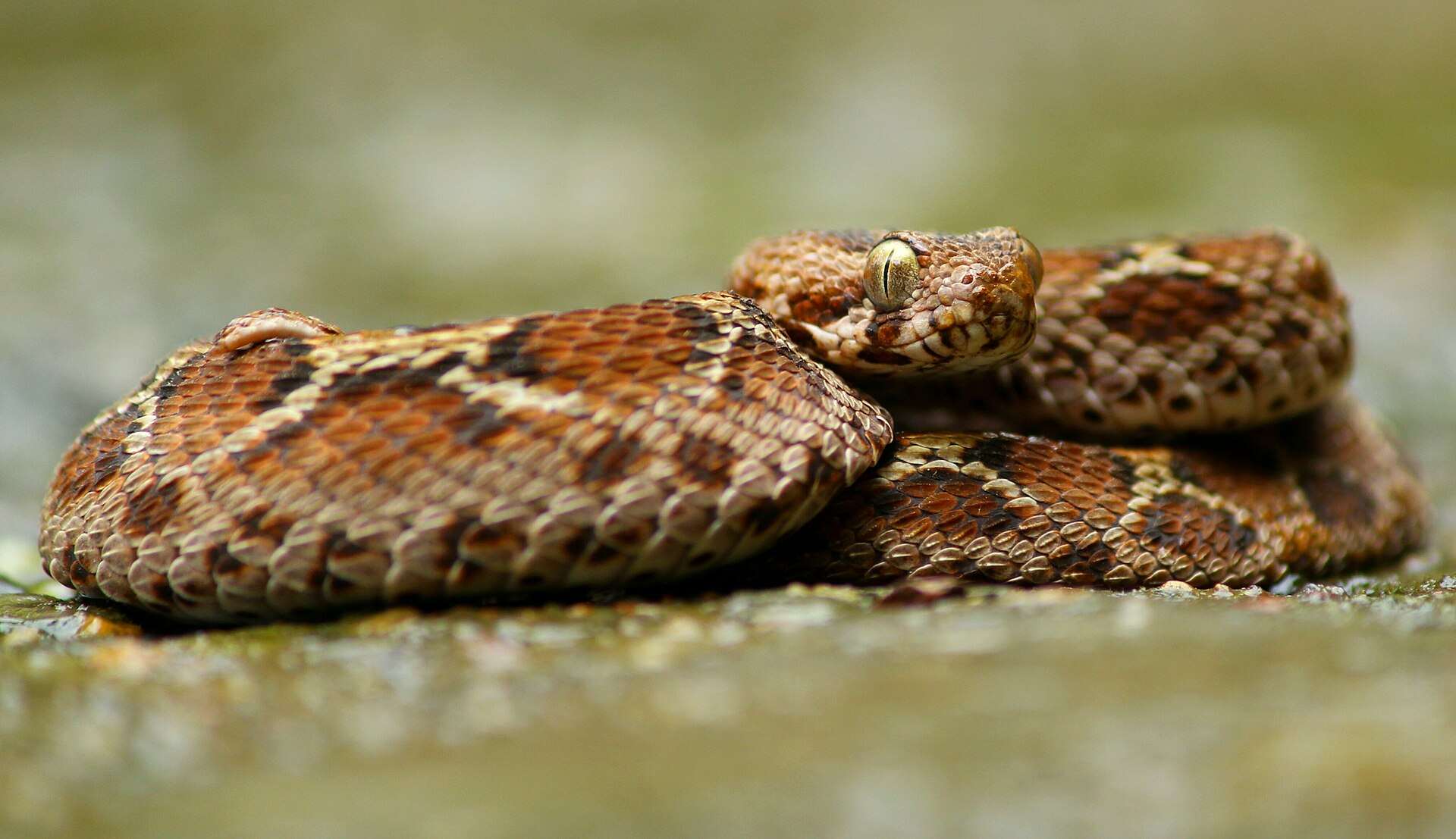
  • Echis carinatusSaw-scaled Viper
  • Eristicophis macmahoniMcMahons Desert Viper
  • Gloydius hazarensisHazara Pitviper
  • Gloydius himalayanusHimalayan Pitviper
  • Gloydius hindukushensisHindu Kush Pitviper
  • Macrovipera lebetinusLevantine Viper
  • Pseudocerastes persicusPersian Horned Viper
Psammophiidae4
  • Psammophis condanarusSand Snake
  • Psammophis leithiiPakistan Sand Racer
  • Psammophis lineolatusSteppe Ribbon Racer
  • Psammophis schokariForskal Sand Snake
Boidae3
  • Eryx conicusCommon Sand Boa
  • Eryx johniiBrown Sand Boa
  • Eryx sistanensisSistan Sand Boa
Typhlopidae3
  • Indotyphlops ahsanai
  • Indotyphlops madgemintonae
  • Pseudoindotyphlops porrectusSlender Worm Snake
Homalopsidae1
  • Mintonophis pakistanicusSind River Mud Snake
Leptotyphlopidae1
  • Myriopholis blanfordiiSindh Thread Snake
Pythonidae1

Source: Uetz, P. et al. (eds.), The Reptile Database, version 2026-06, via the Catalogue of Life (COL26.9). CC BY 4.0. Ranges in the source can be incomplete.

References

  1. 1

    Kasturiratne A, Wickremasinghe AR, de Silva N, et al. The global burden of snakebite: a literature analysis and modelling based on regional estimates of envenoming and deaths. PLoS Med. 2008;5(11):e218 (Tables S1 and S2: Pakistan, 12,784–17,578 envenomings and 1,200–8,264 deaths a year). doi.org

  2. 2

    World Health Organization. Guidelines for the production, control and regulation of snake antivenom immunoglobulins. WHO Technical Report Series No. 1004, Annex 5 (2017), Appendix 1: medically important venomous snakes of Pakistan. cdn.who.int

  3. 3

    Jamali A, Yousif M, Kareem S, Ali S, Salman B, Imtiaz S. Epidemiology and complications of snakebite in rural area of Badin and Thar Sind, Pakistan. J Pak Med Assoc. 2022;72(8):1591–1597 (695 patients, 2017–2020). pubmed.ncbi.nlm.nih.gov

  4. 4

    Alshalah A, Williams DJ, Ferrario A. From fangs to antidotes: a scoping review on snakebite burden, species, and antivenoms in the Eastern Mediterranean Region. PLoS Negl Trop Dis. 2024;18(7):e0012200. doi.org

Try “krait”, “cobra” or Naja. Typos are fine.