
Indian cobra
Naja naja (Linnaeus, 1758)
Also called Spectacled cobra, Common cobra, Indian spectacled cobra
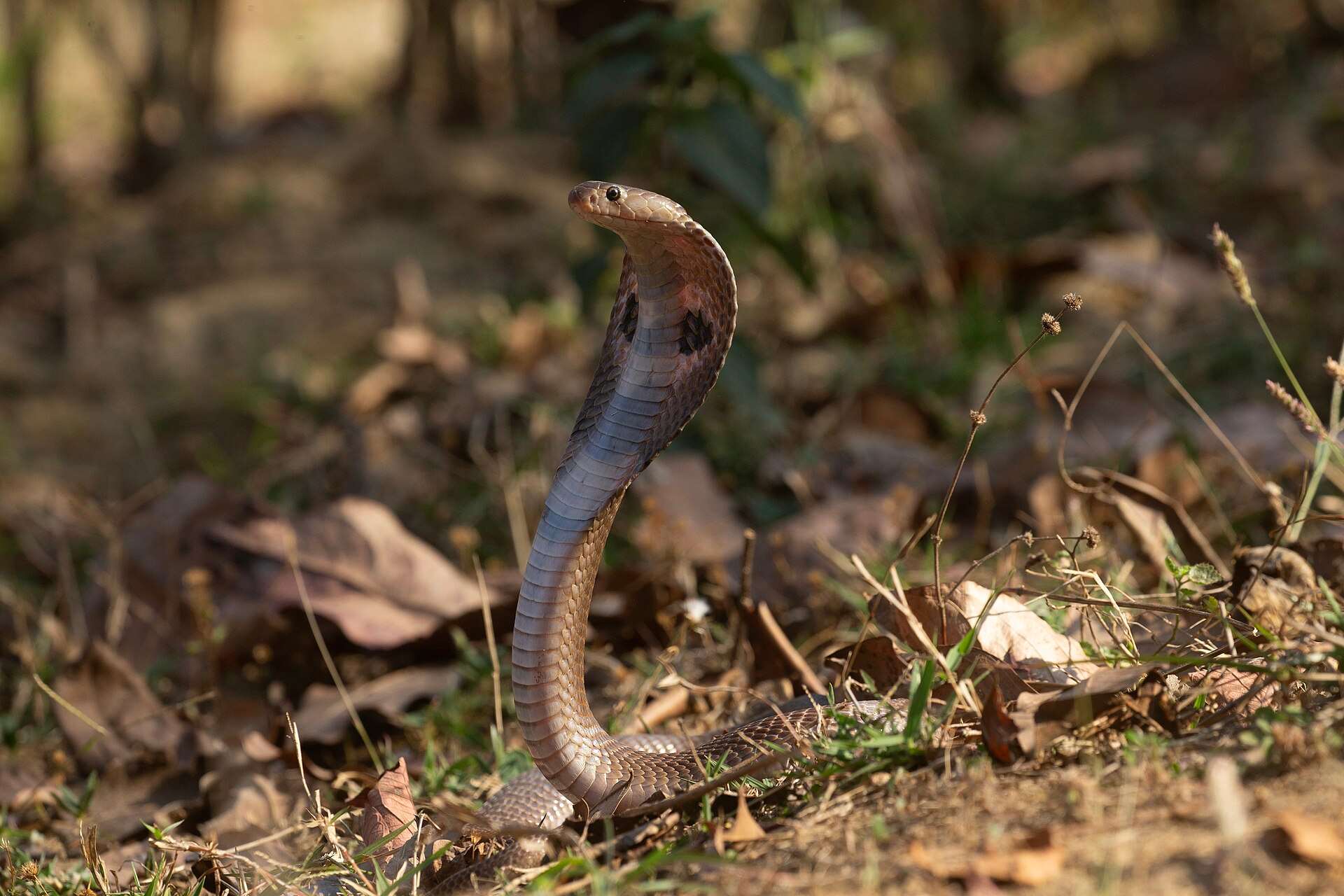
The classic hooded cobra of South Asia. Its colour ranges from grey and brown to black, and its hood often, but not always, carries a spectacle-shaped mark. It is common around farms and villages.

Is it dangerous?
Yes. It is one of South Asia's most important venomous snakes, and its venom can cause paralysis. Anyone bitten should go to hospital immediately.
Do not approach. If someone is bitten, go to a hospital now.
At a glance
- Length
- 1.25–2.2 m
- Active
- Day and night
- Found in
- South Asia
- Venom
- Neurotoxic and cytotoxic
- Young
- Lays eggs
- Habitat
- Farmland, Rice fields, Grassland
- Diet
- Rodents, Frogs and toads, Lizards
Length shows a typical adult, then the largest recorded.
IUCN Red List status: Least Concern
Country guideSnakes of BangladeshSnakes of IndiaSnakes of Sri LankaSnakes of NepalSnakes of Pakistan
True size
Philippine cobraMedically significant
1.41 m at most
About three quarters of the height of a 1.7 m adult.
Usual range 1.0–1.41 m, the bar on the ruler.
Javan spitting cobraMedically significant
1.85 m at most
About as long as a 1.7 m adult is tall.
Usual range 1.38–1.85 m, the bar on the ruler.
Indian cobraMedically significant
2.2 m at most
About 1.5 times the height of a 1.7 m adult.
Usual range 1.25–2.2 m, the bar on the ruler.
Black-necked spitting cobraMedically significant
2.2 m at most
About 1.5 times the height of a 1.7 m adult.
Usual range 1.25–2.2 m, the bar on the ruler.
Monocled cobraMedically significant
2.3 m at most
About 1.5 times the height of a 1.7 m adult.
Usual range 1.5–2.3 m, the bar on the ruler.
Cape cobraMedically significant
2.3 m at most
About 1.5 times the height of a 1.7 m adult.
Usual range 1.2–2.3 m, the bar on the ruler.
Indian rat snakeNon-venomous
3 m at most
About 2 times the height of a 1.7 m adult.
Usual range 1.8–3.0 m, the bar on the ruler.
King cobraMedically significant
5.5 m at most
About 3 times the height of a 1.7 m adult.
Usual range 3.0–5.5 m, the bar on the ruler.
Each snake is drawn at the longest length in its profile, on the same scale as the adult. Length is to scale; thickness is not.
Identification
The Indian cobra is a smooth-scaled snake whose colour varies a lot: it can be grey, yellowish, tan, brown, reddish or black, and adults often have salt-and-pepper speckling1. When alarmed it raises the front of its body and spreads a hood1,2. The hood often shows a “spectacle” mark of two light rings joined by a curved line, but this mark is frequently missing, so it is not a reliable way to tell this cobra from others1.
Most adults are 1–1.5 m long. A few reach about 2.1–2.2 m, especially in Sri Lanka, and hatchlings are usually 25–30 cm1.
Distribution
This cobra lives across the Indian subcontinent: Pakistan, India, Sri Lanka, Bangladesh and Nepal, with reports from Bhutan1,3. In India it occurs almost everywhere, but probably not in Assam, some parts of Kashmir, extreme deserts or areas above about 2,000 m1. It may also reach the Kabul River valley in far eastern Afghanistan1,3. Other cobra species also live in the far north-west, the north-east and the Andaman Islands1.
Habitat
The Indian cobra is highly adaptable. It lives in farmland, especially rice-growing areas, and is often found in and around villages and even cities1. Holes in the banks of rice fields and termite mounds are favourite hiding places. It is reported to be more common in open country than in thick jungle, and in Pakistan it has been said to favour damp grassland1.
Behaviour
This cobra is mainly active by day and around dusk, but it has also been seen moving at night1. It is shy and usually tries to escape. If cornered, it lifts up to a third of its body off the ground, spreads its hood and gives a loud, explosive hiss1. It generally bites only as a last resort, and many defensive strikes are made with the mouth closed. Its fangs are not adapted for spitting venom1.
Diet
Adult Indian cobras mostly eat rats, but they also take frogs and toads, lizards and other snakes, including venomous saw-scaled vipers1. They eat eggs too, and will raid chicken coops for eggs and chicks. Young cobras feed mostly on frogs and toads, as well as other snakes and, in drier areas, lizards1.
Reproduction
The Indian cobra lays eggs. A female lays 12 to 30 eggs, usually between April and July depending on the region1. She is reported to stay with her eggs until they hatch about two months later. Several females sometimes lay their eggs in the same nest site1.
Venom and medical significance
The Indian cobra is highly venomous. It is one of the “big four” species used to make Indian polyvalent antivenom, and the World Health Organization places it in its highest category of medical importance in India, Sri Lanka, Nepal and Bangladesh2. Its bite typically causes paralysis together with swelling around the bite2, and bites by Sri Lankan cobras have also caused tissue damage1.
It is thought to be an important cause of snakebite across much of its range, and in Sri Lanka it is one of the three species causing the most snakebite deaths1. Anyone bitten should go to hospital immediately.
Conservation
The Indian cobra is listed as Least Concern on the IUCN Red List (assessed in 2021)4. It has a very wide range and copes well with farmland and areas near people1,3. In India, every species of the genus Naja is listed in Schedule I of the Wild Life (Protection) Act, which gives the highest level of legal protection5.
Similar species
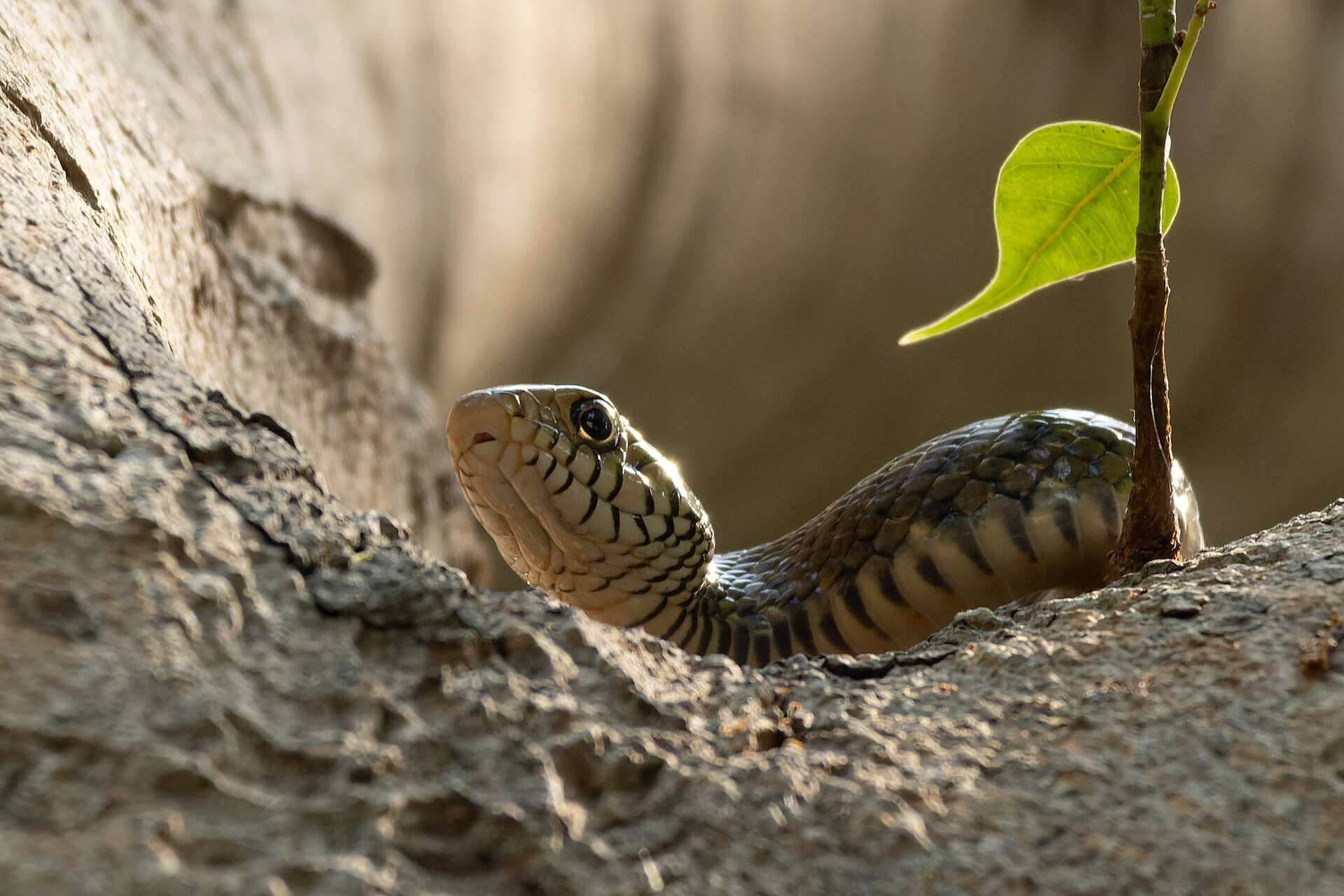
The harmless Indian rat snake (Ptyas mucosa) can be confused with this cobra. A rat snake never spreads a hood, it has a large eye, and its lip scales are edged with black6. It also has small loreal scales between the nostril and the eye, which cobras lack2. The king cobra (Ophiophagus hannah) has a pair of large scales at the back of its head that true cobras do not have2. These differences are not a safe basis for handling any snake. Keep your distance from every snake you cannot identify.
In captivity
The Indian cobra is a dangerous venomous snake and is not suitable as a pet. In India it is listed in Schedule I of the Wild Life (Protection) Act, as amended in 2022, which is the strongest category of legal protection5. It should never be caught or kept by private individuals.
Look-alikes
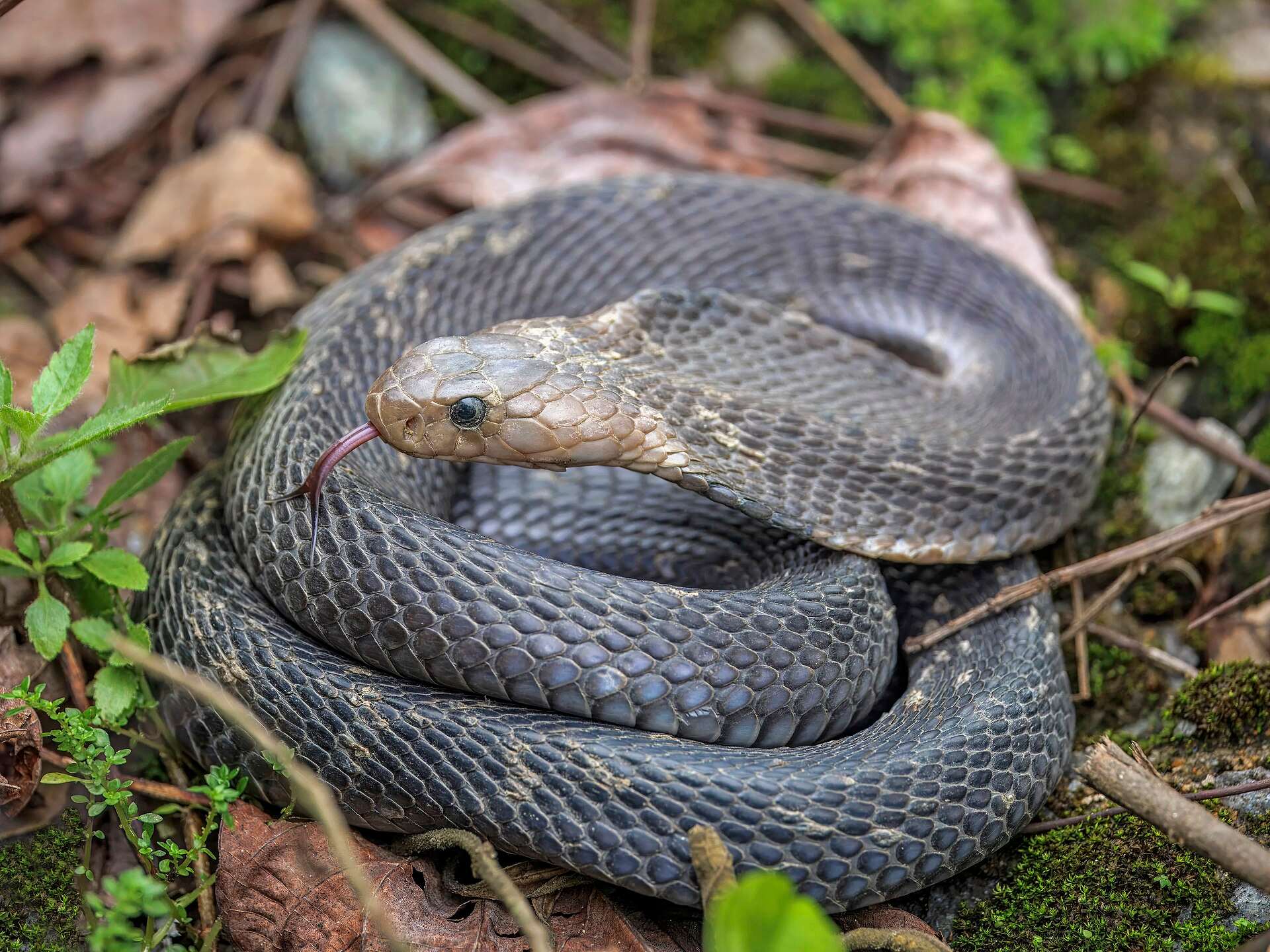
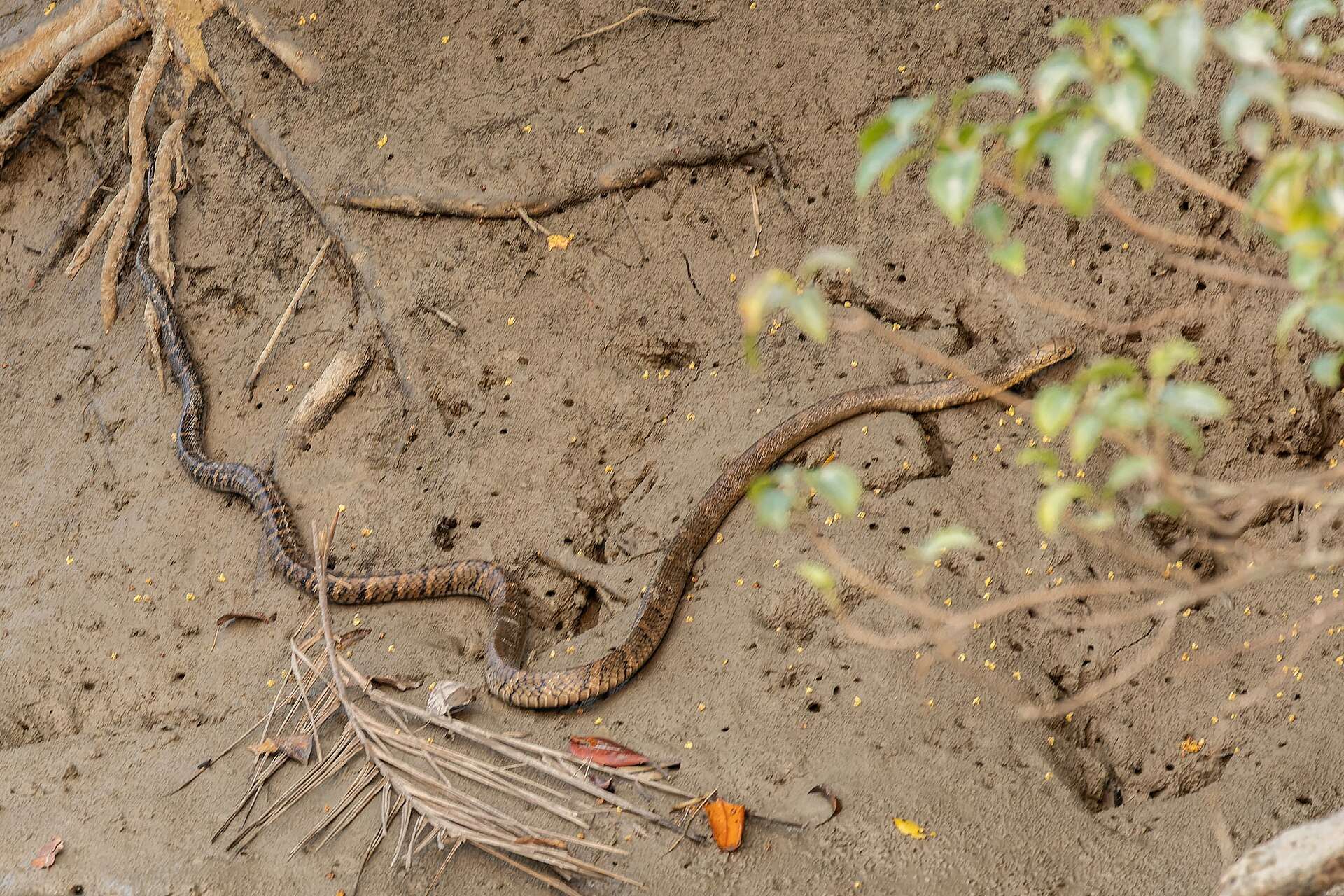
Don’t confuse it with…
These snakes are often mistaken for each other. Use the differences to learn, never as a reason to handle a snake.
References
- 1
Wüster, W. (1998). The cobras of the genus Naja in India. Hamadryad 23(1): 15–32. web.archive.org
- 2
World Health Organization, Regional Office for South-East Asia (2016). Guidelines for the management of snakebites, 2nd edition. who.int
- 3
Uetz, P. et al. (eds.) (2026). Naja naja (Linnaeus, 1758). The Reptile Database. reptile-database.reptarium.cz
- 4
de Silva, A. et al. (2021). Naja naja. The IUCN Red List of Threatened Species 2021: e.T62241A3110222. iucnredlist.org
- 5
Government of India (2022). The Wild Life (Protection) Amendment Act, 2022 (No. 18 of 2022), Schedule I, Part C: Reptiles. prsindia.org
- 6
Auliya, M. (2010). Conservation status and impact of trade on the Oriental Rat Snake Ptyas mucosa in Java, Indonesia. TRAFFIC Southeast Asia. traffic.org
Play
Play as the indian cobra.
Its real pattern is a skin in Snake. Every run ends with a fact.