
King cobra
Ophiophagus hannah (Cantor, 1836)
Also called Northern king cobra, Hamadryad
The world's longest venomous snake, a banded forest-dweller that feeds mainly on other snakes. Since 2024 the name covers only the northern king cobra, from eastern India and the Himalayan foothills to Indochina.

Is it dangerous?
Yes. Its venom can cause paralysis and death, but it usually avoids people and bites are uncommon. Anyone bitten should go to hospital immediately.
Do not approach. If someone is bitten, go to a hospital now.
At a glance
- Length
- 3.0–5.5 m
- Active
- By day
- Found in
- India to Indochina
- Venom
- Neurotoxic
- Young
- Lays eggs
- Habitat
- Forest, Bamboo thickets, Stream banks
- Diet
- Snakes, Other reptiles
- Lifespan
- About 20 years in the wild
Length shows a typical adult, then the largest recorded.
IUCN Red List status: Vulnerable
Country guideSnakes of BangladeshSnakes of IndiaSnakes of Nepal
True size
White-lipped pit viperMedically significant
0.9 m at most
About half the height of a 1.7 m adult.
Usual range 0.5–0.9 m, the bar on the ruler.
Common wolf snakeNon-venomous
0.92 m at most
About half the height of a 1.7 m adult.
Usual range 0.7–0.92 m, the bar on the ruler.
Indian cobraMedically significant
2.2 m at most
About 1.5 times the height of a 1.7 m adult.
Usual range 1.25–2.2 m, the bar on the ruler.
Banded kraitMedically significant
2.25 m at most
About 1.5 times the height of a 1.7 m adult.
Usual range 1.35–2.25 m, the bar on the ruler.
Monocled cobraMedically significant
2.3 m at most
About 1.5 times the height of a 1.7 m adult.
Usual range 1.5–2.3 m, the bar on the ruler.
Indian rat snakeNon-venomous
3 m at most
About 2 times the height of a 1.7 m adult.
Usual range 1.8–3.0 m, the bar on the ruler.
King cobraMedically significant
5.5 m at most
About 3 times the height of a 1.7 m adult.
Usual range 3.0–5.5 m, the bar on the ruler.
Burmese pythonNon-venomous
5.79 m at most
About 3.5 times the height of a 1.7 m adult.
Usual range 2.6–5.79 m, the bar on the ruler.
Each snake is drawn at the longest length in its profile, on the same scale as the adult. Length is to scale; thickness is not.
Identification
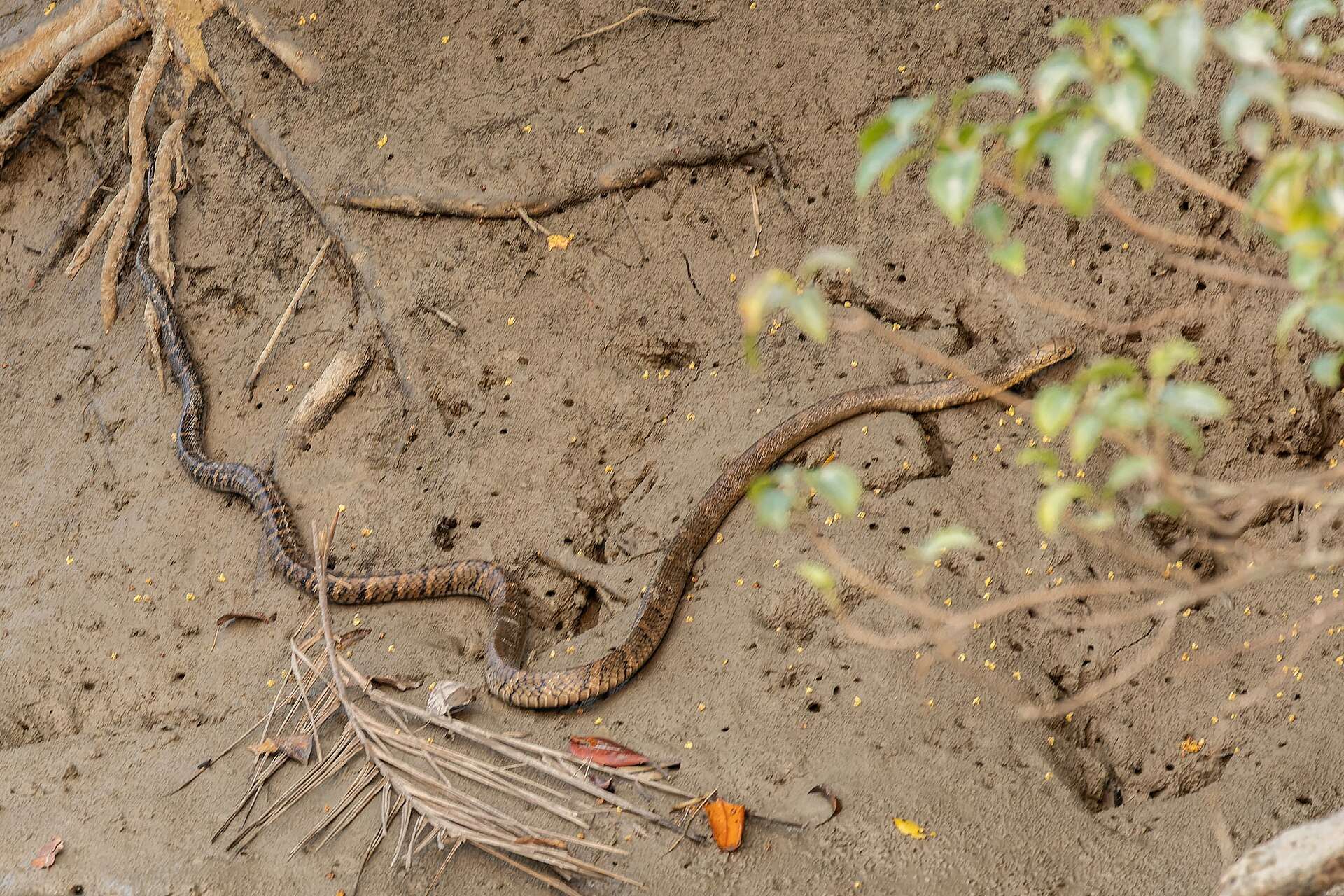
Adult king cobras of this species are mid-brown with 27–48 pale yellowish bands, each edged with dark grey; the first bands on the neck form chevrons, and the tail end is almost black1. The throat is bright yellow, sometimes orange. Young snakes have ivory-white bands, even on the head1. All king cobras have a pair of large occipital scales at the back of the head, which true cobras lack1,2.
Adults are commonly about 3–3.6 m long3. It is the world’s longest venomous snake, reported to reach 5.5–5.6 m1,4. The longest ever measured (5.71 m) came from the Malay Peninsula5, whose king cobras are now a separate species1.
Distribution
Until 2024, all king cobras were treated as one species. A 2024 revision split them into four: the northern king cobra (Ophiophagus hannah), the Western Ghats king cobra (O. kaalinga), the Sunda king cobra (O. bungarus) and the Luzon king cobra (O. salvatana)1. The Reptile Database follows this split4.
As now defined, O. hannah lives from the Himalayan foothills of northern India, Nepal and Bhutan, through eastern India (including the Sundarbans and the Andaman Islands) and Bangladesh, to southern and eastern China, Myanmar, Laos, Vietnam, Cambodia and Thailand, probably north of the Isthmus of Kra1,4. King cobras of India’s Western Ghats are now O. kaalinga1.
Habitat
In the Indian subcontinent, king cobras are mostly found in forests, including hill forests1. They are often found near streams in dense or open forest, in bamboo thickets, in mangrove swamps and in farmland next to forest3. In Bangladesh they occur wherever fairly undisturbed bamboo stands and forests remain2.
Behaviour
The king cobra is active by day3. Like other cobras, it can raise the front of its body off the ground and spread a hood when threatened2. It normally prefers to escape, and it attacks people only when cornered, in self-defence or when guarding its eggs3.
Diet
The king cobra is a specialist snake-eater4. It mainly eats cold-blooded animals, especially other snakes, and can overpower large harmless species such as rat snakes, including the Indian rat snake (dhaman), and pythons3. Its venom stuns the nervous system of its prey3.
Reproduction
The king cobra lays eggs4. It is the only snake known to build a nest and guard it4. The female lays 21 to 40 white, leathery eggs in a nest of leaves, and the heat from the rotting leaves helps to incubate them3. There is also evidence that females can sometimes produce young without mating, which is called facultative parthenogenesis4.
Venom and medical significance
The king cobra’s venom is neurotoxic: it attacks the nerves, especially those that control breathing3. Bites cause swelling at the bite site together with paralysis2. The World Health Organization places it in Category 2 (secondary medical importance) in India and Bangladesh. This category covers highly venomous snakes that are involved in bites less often, or for which data are lacking2. Indian polyvalent antivenom is made against the “big four” snakes, which do not include the king cobra; a specific king cobra antivenom is produced in Thailand2. Anyone bitten by a king cobra should go to hospital immediately.
Conservation
King cobras are listed as Vulnerable on the IUCN Red List6. This assessment was made in 2012, before the 2024 split, so it covers all four species together1,6. Their main threats are habitat destruction and persecution by people3. In India, all species of the genus Ophiophagus are listed in Schedule I of the Wild Life (Protection) Act, the highest level of legal protection7.
Similar species
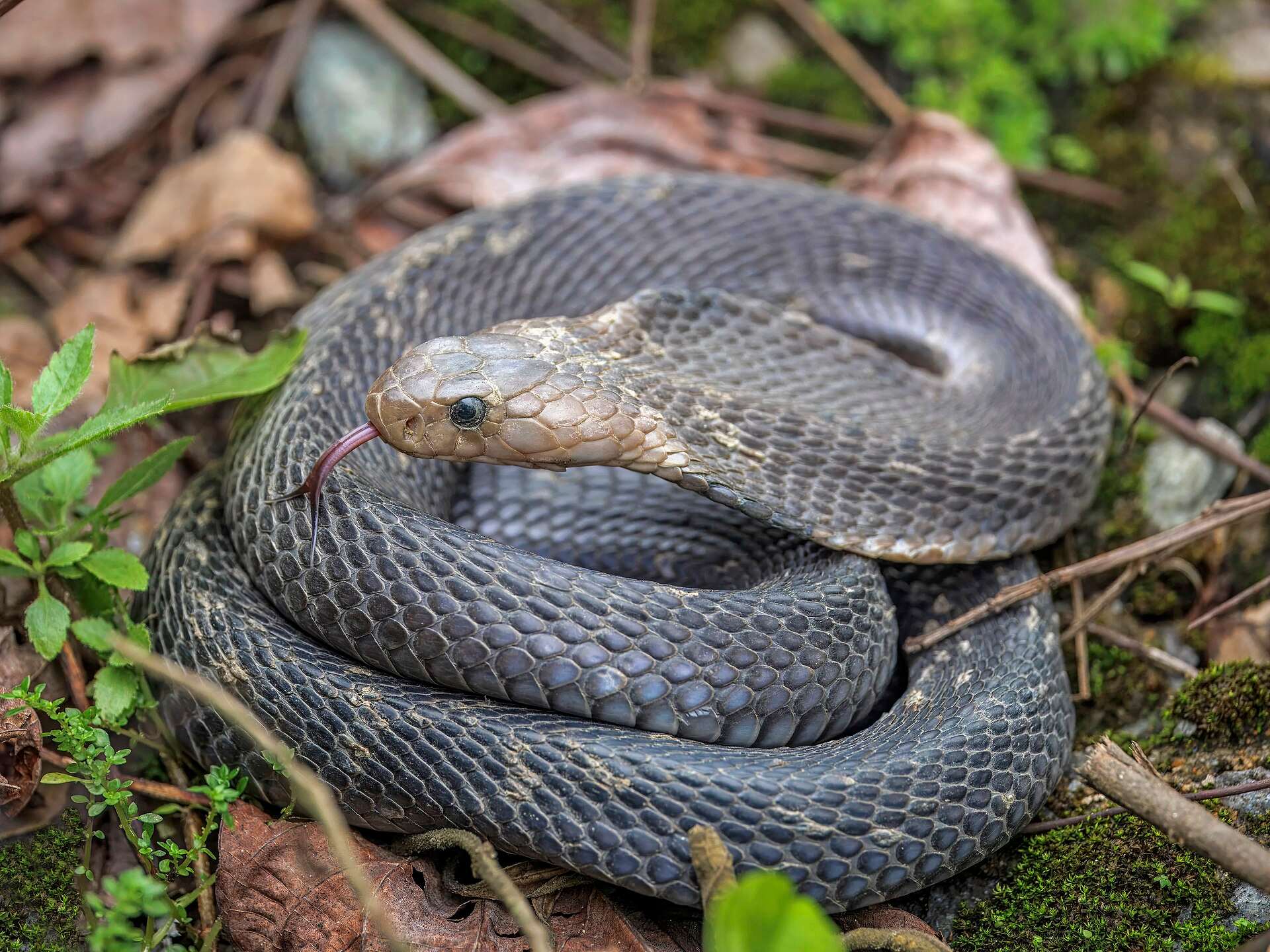
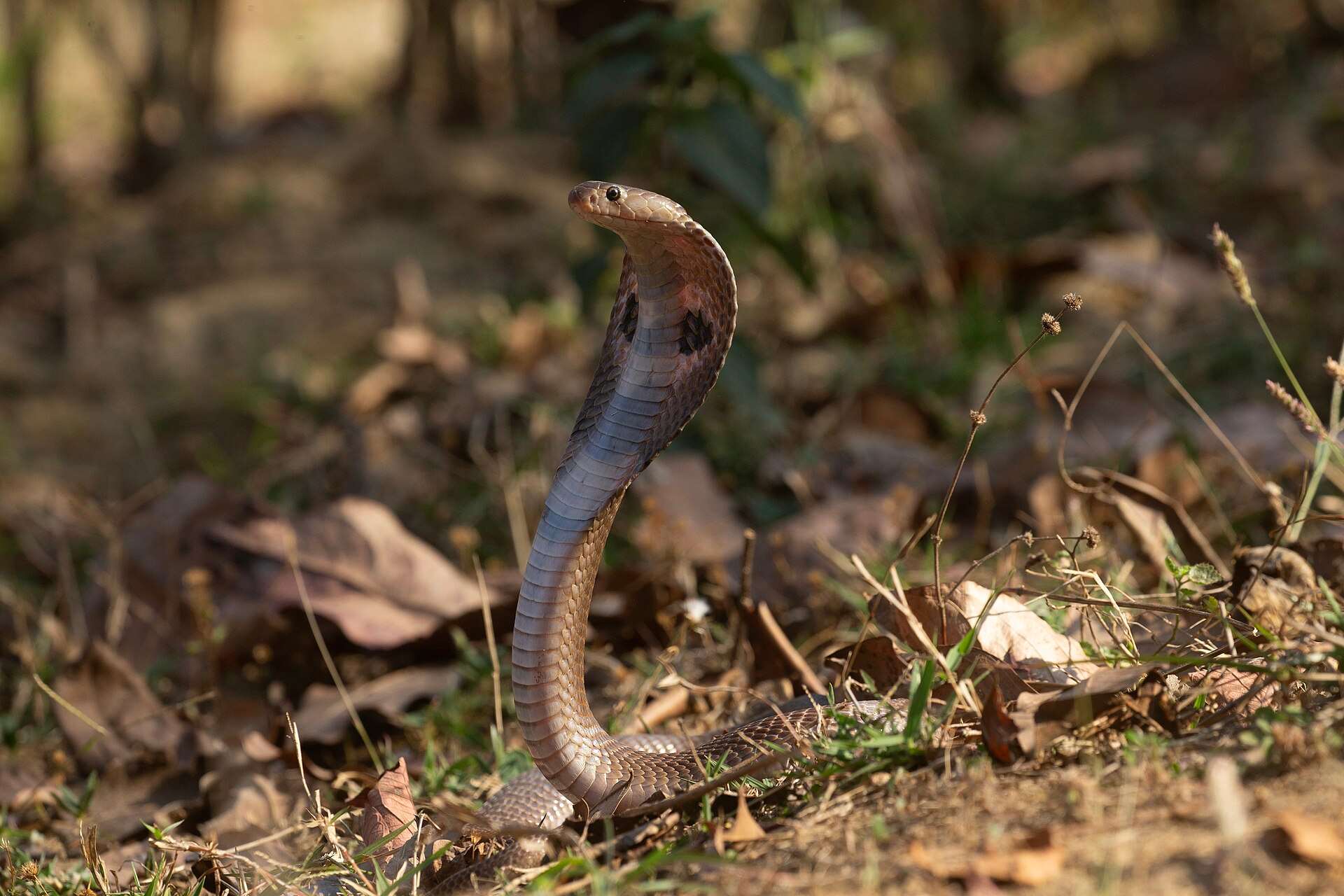
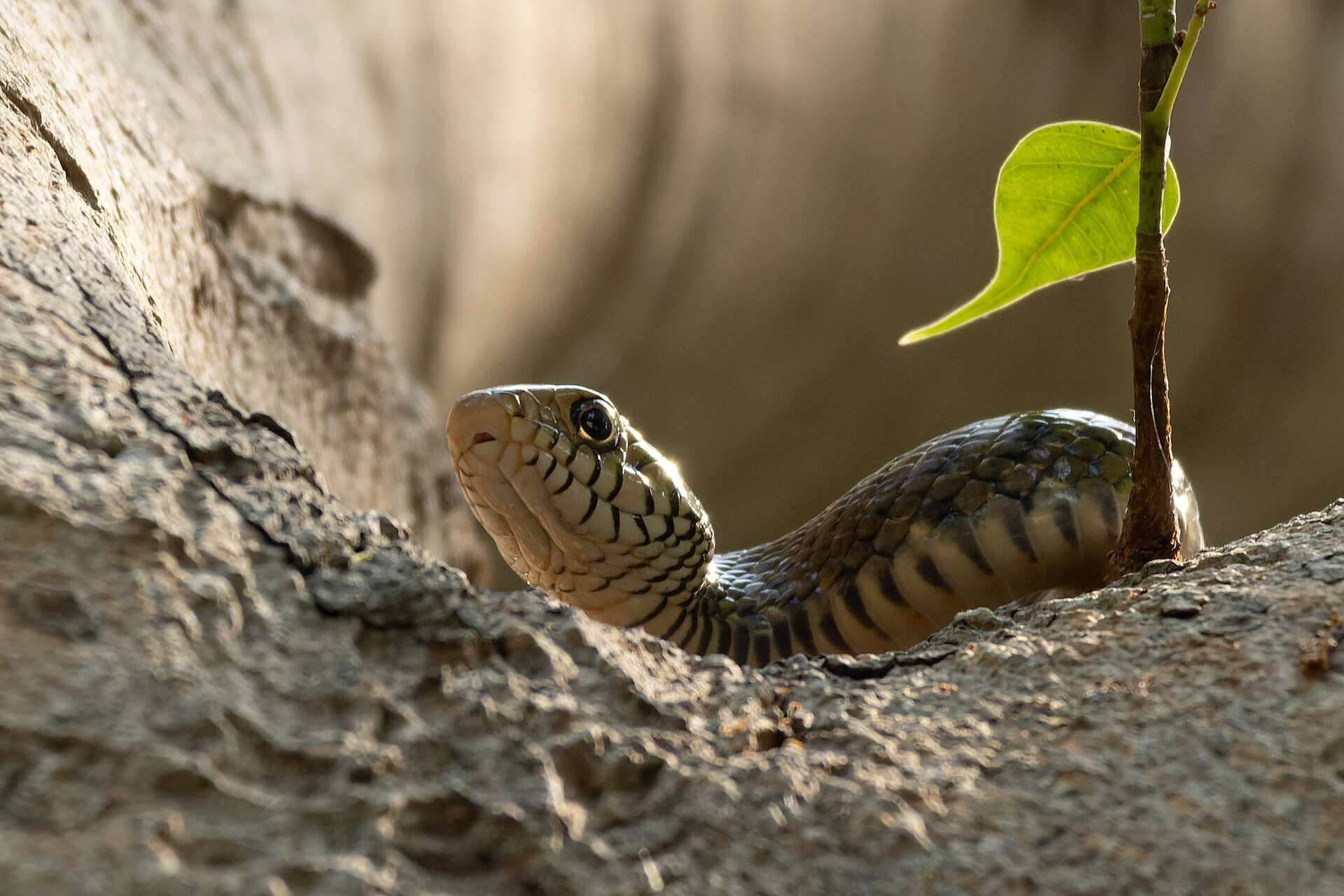
The Indian cobra (Naja naja) also spreads a hood, but it lacks the pair of large occipital scales at the back of the king cobra’s head2. Adult king cobras are also usually far longer, commonly 3–3.6 m3. The Indian rat snake (Ptyas mucosa) cannot spread a hood and has small loreal scales between the nostril and the eye, which elapids such as cobras lack2. In the Western Ghats, the king cobra’s close relative O. kaalinga has pale bands without dark edges1. These differences are not a safe basis for handling any snake. Keep well away from any snake you cannot identify.
In captivity
The king cobra is a large, dangerous venomous snake and is not suitable as a pet. In India it is protected under Schedule I of the Wild Life (Protection) Act, as amended in 2022, which gives it the strongest category of legal protection7. It should never be caught or kept by private individuals.
Look-alikes
Don’t confuse it with…
These snakes are often mistaken for each other. Use the differences to learn, never as a reason to handle a snake.
References
- 1
Das, I., Gowri Shankar, P., Swamy, P., Williams, R.C., Lalremsanga, H.T., Prashanth, P., Sahoo, G., Vijayakumar, S.P., Höglund, J., Shanker, K., Dutta, S.K., Ganesh, S.R. & Wüster, W. (2024). Taxonomic revision of the king cobra Ophiophagus hannah (Cantor, 1836) species complex (Reptilia: Serpentes: Elapidae), with the description of two new species. European Journal of Taxonomy 961: 1–51. doi.org
- 2
World Health Organization, Regional Office for South-East Asia (2016). Guidelines for the management of snakebites, 2nd edition. who.int
- 3
Smithsonian's National Zoo & Conservation Biology Institute. King cobra. nationalzoo.si.edu
- 4
Uetz, P. et al. (eds.) (2026). Ophiophagus hannah (Cantor, 1836). The Reptile Database. reptile-database.reptarium.cz
- 5
Guinness World Records. Longest venomous snake (specimen). guinnessworldrecords.com
- 6
Stuart, B. et al. (2012). Ophiophagus hannah. The IUCN Red List of Threatened Species 2012: e.T177540A1491874. iucnredlist.org
- 7
Government of India (2022). The Wild Life (Protection) Amendment Act, 2022 (No. 18 of 2022), Schedule I, Part C: Reptiles. prsindia.org
Play
Play as the king cobra.
Its real pattern is a skin in Snake. Every run ends with a fact.