
Common wolf snake
Lycodon aulicus (Linnaeus, 1758)
Also called Indian wolf snake
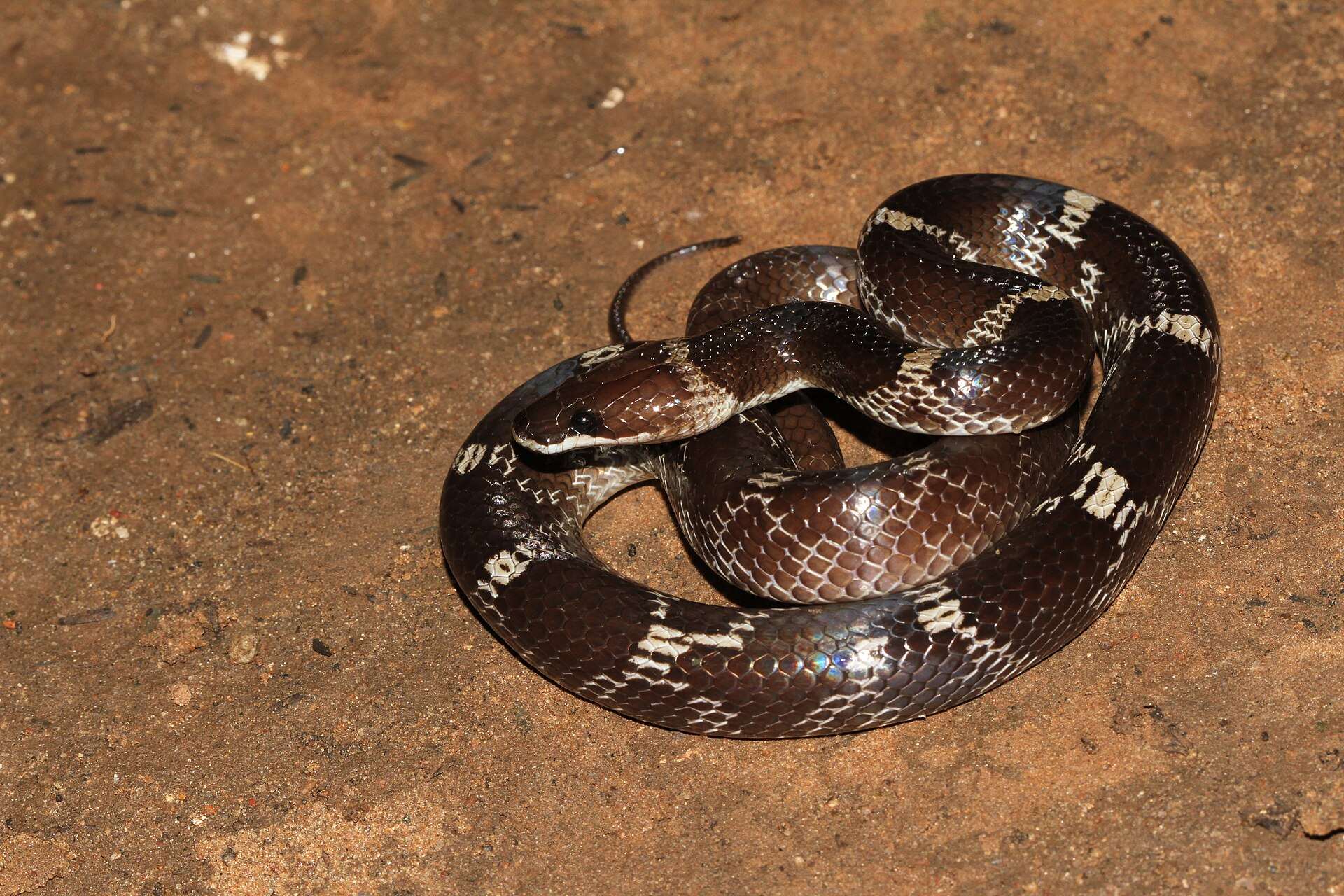
A small, harmless, night-active snake of South Asia, brown with white crossbands. It often lives in and around houses, climbs walls easily and hunts geckos and skinks.

Is it dangerous?
No. It is non-venomous and harmless to people, though it may bite if handled. It is often mistaken for the dangerous common krait.
Harmless to people, but it may bite if handled. Treat any snake you can’t identify as venomous.
Snakebite first aidAt a glance
- Length
- 0.7–0.92 m
- Active
- At night
- Found in
- South Asia
- Venom
- None
- Young
- Lays eggs
- Habitat
- Human settlements, Walls and buildings, Rocky areas
- Diet
- Geckos, Skinks, Rodents
Length shows a typical adult, then the largest recorded.
IUCN Red List status: Least Concern
Country guideSnakes of BangladeshSnakes of IndiaSnakes of Sri LankaSnakes of NepalSnakes of Pakistan
True size
Common wolf snakeNon-venomous
0.92 m at most
About half the height of a 1.7 m adult.
Usual range 0.7–0.92 m, the bar on the ruler.
Common kraitMedically significant
1.5 m at most
About three quarters of the height of a 1.7 m adult.
Usual range 1.0–1.5 m, the bar on the ruler.
Russell's viperMedically significant
1.68 m at most
About as long as a 1.7 m adult is tall.
Usual range 1.2–1.68 m, the bar on the ruler.
Indian cobraMedically significant
2.2 m at most
About 1.5 times the height of a 1.7 m adult.
Usual range 1.25–2.2 m, the bar on the ruler.
Banded kraitMedically significant
2.25 m at most
About 1.5 times the height of a 1.7 m adult.
Usual range 1.35–2.25 m, the bar on the ruler.
Monocled cobraMedically significant
2.3 m at most
About 1.5 times the height of a 1.7 m adult.
Usual range 1.5–2.3 m, the bar on the ruler.
Indian rat snakeNon-venomous
3 m at most
About 2 times the height of a 1.7 m adult.
Usual range 1.8–3.0 m, the bar on the ruler.
King cobraMedically significant
5.5 m at most
About 3 times the height of a 1.7 m adult.
Usual range 3.0–5.5 m, the bar on the ruler.
Each snake is drawn at the longest length in its profile, on the same scale as the adult. Length is to scale; thickness is not.
Identification
The common wolf snake is a small, slender snake that is brown or greyish-brown above with about 12–19 white crossbars. The bars widen or split on the sides of the body, and there is usually a whitish patch on each side of the back of the head. The snout is flattened and projects beyond the lower jaw1.
Like other wolf snakes it has a vertical pupil and several enlarged, fang-like teeth at the front of the upper jaw, which have no venom grooves2. Smith (1943) gave total lengths of about 70–76 cm1; the largest reported adults reach about 84–92 cm3,4.
Distribution
The common wolf snake is found throughout India, and in Pakistan, Nepal, Bhutan, Bangladesh, Sri Lanka, Myanmar and parts of southern China (Fujian and Yunnan)2. In India it occurs on the mainland and in Lakshadweep, but not in the Andaman and Nicobar Islands3. It has also been introduced to Mauritius1.
Older works treated the South-east Asian wolf snakes as a race of this species1. Today these are usually called Lycodon capucinus, and the two are described as almost impossible to tell apart2.
Habitat
This is one of the most abundant and frequently seen snakes of the Indian plains, often found near or even inside human homes3. It likes rough surfaces such as rocks and walls, using holes and cracks as daytime hiding places4, and is partly a climber2.
Its habit of living in buildings, and of being carried in cargo, has probably helped it spread1.
Behaviour
The common wolf snake is strictly nocturnal3. By day it hides in holes and crevices, and at night it often forages among rocks and on walls4.
It is a skilled climber that can scale rough vertical walls with ease; one was even recorded climbing a smooth, painted vertical wall in Maharashtra3. It is itself eaten by predators, including birds such as the Indian roller4.
Diet
Common wolf snakes feed largely on geckos and skinks, and also take rodents and bats3. They hunt at night, often foraging among rocks and on walls and other rough surfaces4.
The genus name Lycodon comes from Greek words meaning “wolf tooth”, after the enlarged teeth at the front of the upper jaw2.
Reproduction
The common wolf snake lays eggs2. Smith (1943) reported clutches of 3–11 eggs and suggested it may breed twice a year; in India gravid females have been found in the first seven months of the year, with eggs laid from February to July1.
A more recent account cited by the Reptile Database reports 8–16 elongated eggs, each about 28 × 12 mm2.
Venom and medical significance
The common wolf snake is non-venomous and harmless to people5. Its enlarged front teeth are not connected to venom glands2. Like many harmless snakes, it may bite if it is picked up or cornered; non-venomous snakes are responsible for many snakebites5.
Its main medical importance is that it can be mistaken for a krait, which may lead to unnecessary antivenom treatment5. If there is any doubt about which snake caused a bite, seek medical care immediately5.
Conservation
The common wolf snake is listed as Least Concern on the IUCN Red List (assessed 2021)6. It remains one of the most frequently encountered snakes in India3.
In India it is protected under Schedule II of the Wild Life (Protection) Act, 1972, as amended in 2022, which covers all colubrid snakes not listed in Schedule I7.
Similar species
The common wolf snake looks very much like the highly venomous common krait (Bungarus caeruleus); WHO guidelines describe wolf snakes as krait mimics5. It is also almost identical to the closely related Lycodon capucinus of South-east Asia2.
Some visual differences from the krait: the wolf snake is brown or greyish-brown rather than glossy black; its white bands widen or fork on the sides instead of staying thin and paired; and it usually has a pale patch behind the head and a flattened, projecting snout1. These differences are not a safe basis for handling any snake.
In captivity
Although harmless, the common wolf snake is a wild animal protected by law in India. It is listed in Schedule II of the Wild Life (Protection) Act, 1972 (as amended in 2022), and the Act prohibits hunting animals listed in Schedules I and II7.
Wolf snakes are often found in houses and can be carried accidentally in cargo1, so people may meet them indoors.
Look-alikes
Don’t confuse it with…
These snakes are often mistaken for each other. Use the differences to learn, never as a reason to handle a snake.
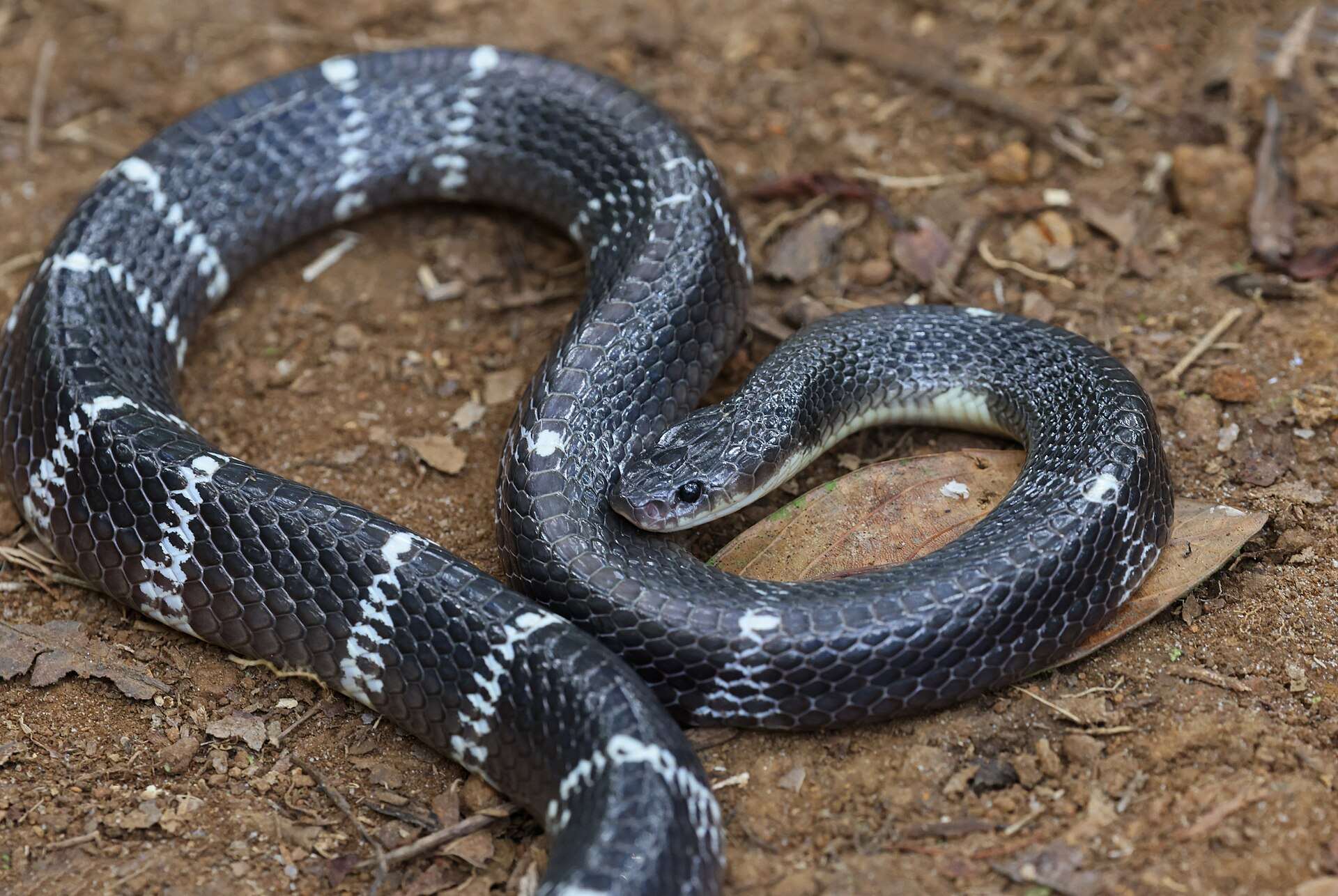
Differences from Smith (1943), cited in both profiles. They help you learn the two apart; they are not a safe basis for handling any snake.
References
- 1
Smith, M.A. (1943). The Fauna of British India, Ceylon and Burma. Reptilia and Amphibia. Vol. III, Serpentes. Taylor and Francis, London. (Lycodon aulicus, pp. 263–266; Bungarus caeruleus, pp. 413–415.) archive.org
- 2
Uetz, P. et al. (2026). Lycodon aulicus (Linnaeus, 1758). The Reptile Database. reptile-database.reptarium.cz
- 3
Deshmukh, R.V., Deshmukh, S.A. & Badhekar, S.A. (2018). Unusual climbing ability by a Common Wolfsnake Lycodon aulicus (Linnaeus 1758) in India. IRCF Reptiles & Amphibians 25(1): 44–45. doi.org
- 4
Vishnu, S.N. & Ramesh, C. (2021). Predation on a Common Wolfsnake, Lycodon aulicus (Colubridae), by an Indian Roller, Coracias benghalensis (Coraciidae), in the Sathyamangalam Tiger Reserve, Tamil Nadu, India. Reptiles & Amphibians 28(1): 157–158. doi.org
- 5
World Health Organization, Regional Office for South-East Asia (2016). Guidelines for the management of snakebites, 2nd edition. WHO SEARO, New Delhi. who.int
- 6
Wogan, G. et al. (2021). Lycodon aulicus. The IUCN Red List of Threatened Species 2021: e.T172705A1371194. iucnredlist.org
- 7
Government of India (2022). The Wild Life (Protection) Amendment Act, 2022 (No. 18 of 2022), Gazette of India; Schedule II, Part C (Reptiles). prsindia.org
Play
Play as the common wolf snake.
Its real pattern is a skin in Snake. Every run ends with a fact.