
Monocled cobra
Naja kaouthia Lesson, 1831
Also called Monocellate cobra
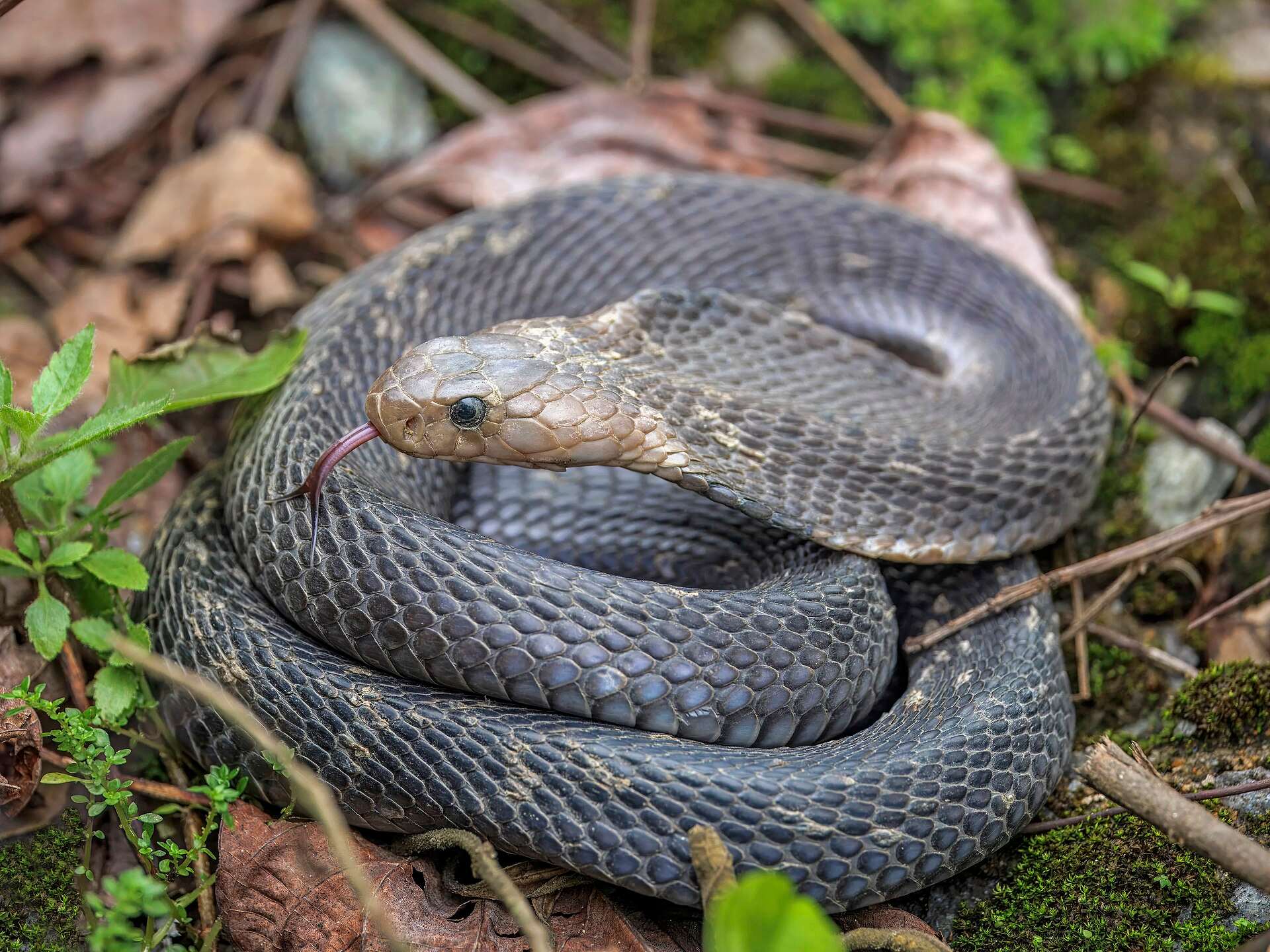
A hooded cobra of eastern South Asia and South-East Asia, brown, grey or blackish, with a single pale ring on the back of its hood. It is common in rice fields and a major cause of snakebite.

Is it dangerous?
Yes. Its venom can cause paralysis and serious tissue damage around the bite. Anyone bitten should go to hospital immediately.
Do not approach. If someone is bitten, go to a hospital now.
At a glance
- Length
- 1.5–2.3 m
- Active
- Dawn and dusk
- Found in
- Eastern South Asia and South-East Asia
- Venom
- Neurotoxic and cytotoxic
- Young
- Lays eggs
- Habitat
- Rice fields, Wetlands, Farmland
- Diet
- Frogs and toads, Small mammals, Snakes
Length shows a typical adult, then the largest recorded.
IUCN Red List status: Least Concern
Country guideSnakes of BangladeshSnakes of IndiaSnakes of Nepal
True size
Philippine cobraMedically significant
1.41 m at most
About three quarters of the height of a 1.7 m adult.
Usual range 1.0–1.41 m, the bar on the ruler.
Javan spitting cobraMedically significant
1.85 m at most
About as long as a 1.7 m adult is tall.
Usual range 1.38–1.85 m, the bar on the ruler.
Indian cobraMedically significant
2.2 m at most
About 1.5 times the height of a 1.7 m adult.
Usual range 1.25–2.2 m, the bar on the ruler.
Black-necked spitting cobraMedically significant
2.2 m at most
About 1.5 times the height of a 1.7 m adult.
Usual range 1.25–2.2 m, the bar on the ruler.
Monocled cobraMedically significant
2.3 m at most
About 1.5 times the height of a 1.7 m adult.
Usual range 1.5–2.3 m, the bar on the ruler.
Cape cobraMedically significant
2.3 m at most
About 1.5 times the height of a 1.7 m adult.
Usual range 1.2–2.3 m, the bar on the ruler.
Indian rat snakeNon-venomous
3 m at most
About 2 times the height of a 1.7 m adult.
Usual range 1.8–3.0 m, the bar on the ruler.
King cobraMedically significant
5.5 m at most
About 3 times the height of a 1.7 m adult.
Usual range 3.0–5.5 m, the bar on the ruler.
Each snake is drawn at the longest length in its profile, on the same scale as the adult. Length is to scale; thickness is not.
Identification
The monocled cobra is a smooth-scaled cobra that rears up and spreads a hood when alarmed1,2. Most are medium to dark brown, grey-brown or blackish and many are plain, but snakes from Bengal and the Gangetic Plain often have pale bands that split into a net-like pattern towards the tail2.
Its name comes from the single pale ring with a dark centre on the back of its hood, which looks like a monocle; this mark is almost always present, though it can be faint or shaped more like a mask2. The throat is pale with a small dark spot on each side, usually followed by a dark band1,2.
Most adults measure 1.1–1.5 m, and a typical total length is given as 1.5 m1,2. The record is about 2.3 m2.
Distribution
The monocled cobra ranges from north-eastern India, Bangladesh and Bhutan through Myanmar and southern China to Thailand, Laos, Cambodia, Vietnam and northern Peninsular Malaysia1. In India it lives in the Gangetic Plain, Bengal, Odisha and the north-east, and it shares much of northern India with the Indian cobra2. It also occurs in Nepal, where the World Health Organization lists it among the most medically important snakes3,6.
In Bangladesh it is found throughout the country and is the only cobra in the south-east, including Chittagong and Cox’s Bazar3. Genetic studies suggest that one population may be a separate, still unnamed species1.
Habitat
Where it lives alongside other cobras, the monocled cobra tends to occupy lower, wetter ground2. It is common in rice-growing areas, where it shelters in rodent burrows in the banks between fields, and in some places it has become almost semi-aquatic2. Plantations are another favourite haunt, and it adapts well to living near people unless it is heavily persecuted2.
It is the commonest venomous snake around the Sundarbans in West Bengal, where wet paddy fields are a favoured habitat7.
Behaviour
The monocled cobra is most active at dusk and in the evening, but it can be met at other times2. In a study of 70 bites in south-eastern Bangladesh, most happened in the early morning or evening, and only 12% of the victims were asleep4.
Like other cobras, it usually flees and faces an attacker only when cornered2. It was long thought not to spit venom, but spitting has now been recorded in West Bengal and Assam in India and in Nepal5,6.
Diet
Young monocled cobras eat mostly frogs and toads, while adults also take small mammals2. Snakes and fish are eaten occasionally2.
Reproduction
Like all cobras, the monocled cobra lays eggs, and the female generally stays with them2. Egg-laying is often given as January to March, and incubation takes about 50 days7.
The season varies by region: near the Sundarbans, females have been seen guarding eggs in late July and August, and young cobras measuring 28–36 cm from snout to vent were rescued from October to early December7.
Venom and medical significance
The monocled cobra is highly venomous, and the World Health Organization places it in its highest category of medical importance in Bangladesh, Nepal, Myanmar, Thailand and eastern India3. In Bangladesh it causes most cobra bites3.
In a study of 70 people bitten in south-eastern Bangladesh, 58 developed severe paralysis, usually starting with drooping eyelids; 19 developed blistering and tissue death around the bite, 11 needed a breathing machine and two died in hospital4. The Indian polyvalent antivenom used there, which is not made with this cobra’s venom, reversed paralysis in most patients but did not prevent tissue damage, and most patients had reactions to it4.
WHO notes that Indian antivenoms may not neutralise this species, while the Thai Red Cross and Myanmar produce specific monocled cobra antivenoms3. Anyone bitten should go to hospital immediately.
Conservation
The monocled cobra is listed as Least Concern on the IUCN Red List (2012 assessment)8. It has a large range and adapts well to farmland and villages1,2. In India, every species of the genus Naja is listed in Schedule I of the Wild Life (Protection) Act, as amended in 2022, which gives the highest level of legal protection9.
Similar species
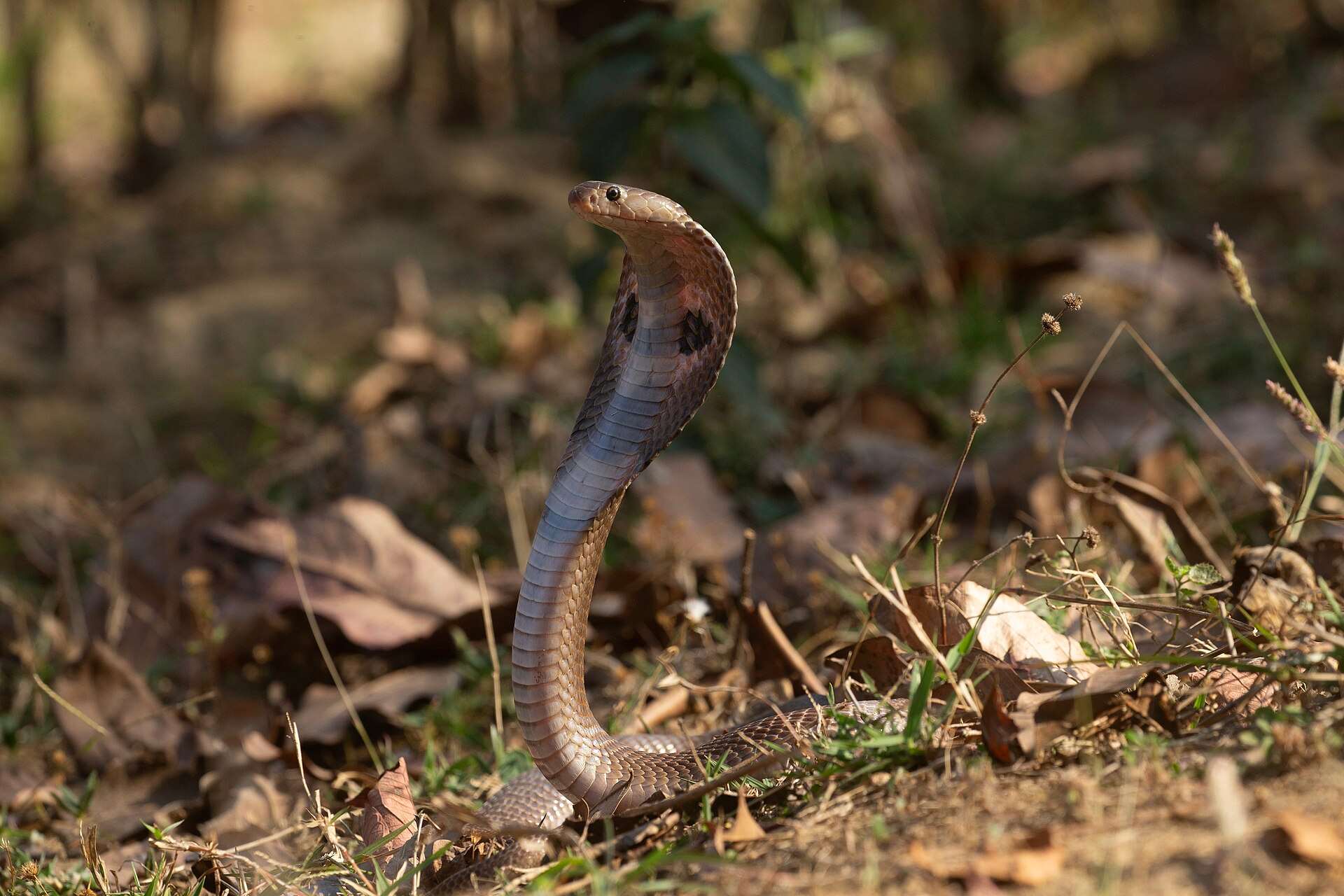
The Indian cobra (Naja naja) overlaps with the monocled cobra in northern and north-eastern India and around and west of Dhaka in Bangladesh2,3. Its hood mark is spectacle-shaped or missing, whereas the monocled cobra’s is a single ring or mask that is almost never absent, and its throat pattern is often indistinct2.
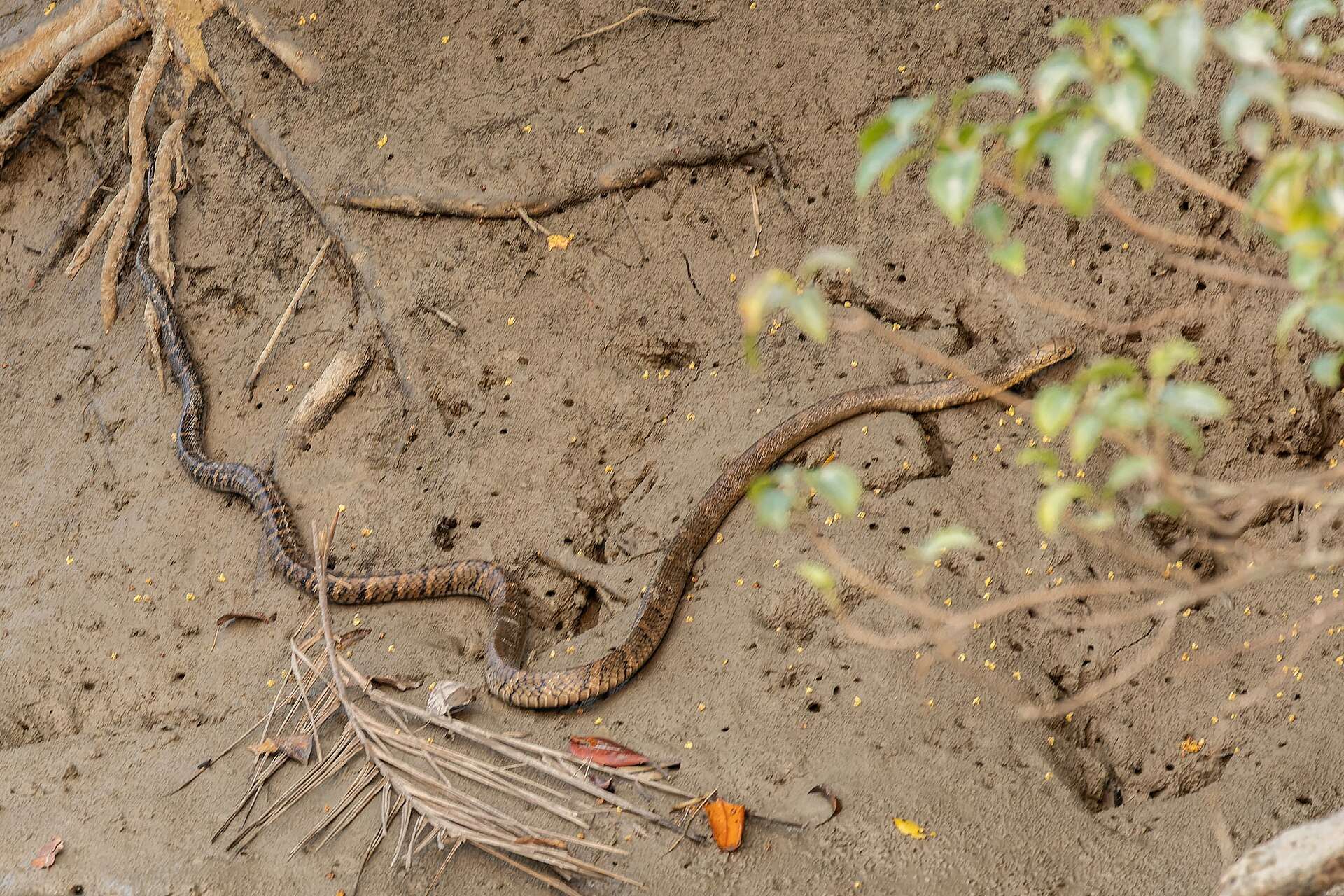
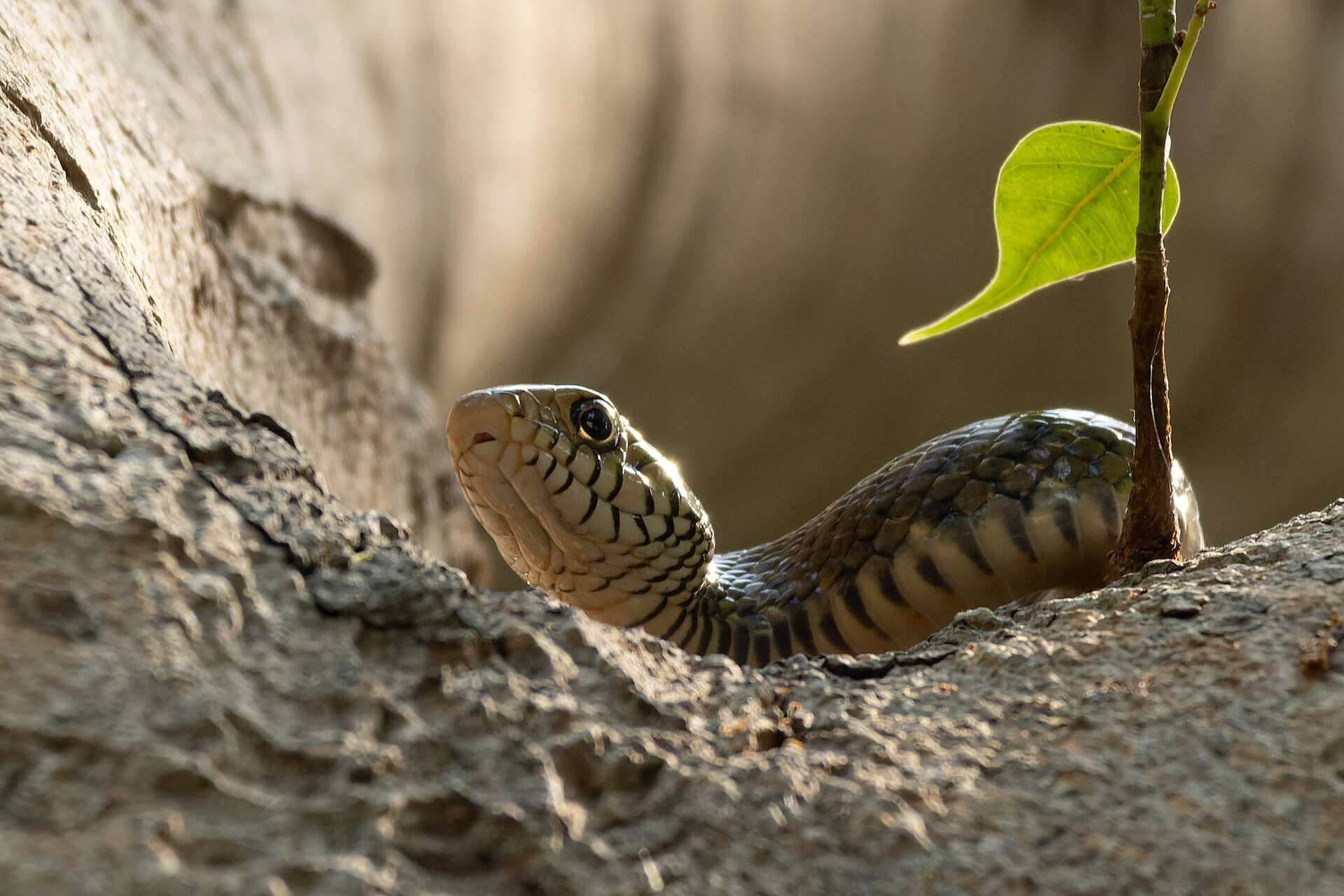
The king cobra (Ophiophagus hannah) has a pair of large scales at the back of its head that true cobras lack3. The harmless Indian rat snake (Ptyas mucosa) has small loreal scales between the nostril and the eye; cobras and other elapids have none3. These differences are not a safe basis for handling any snake. Keep your distance from every snake you cannot identify.
In captivity
The monocled cobra is a dangerous venomous snake and is not suitable as a pet. In India it is protected under Schedule I of the Wild Life (Protection) Act, as amended in 20229. It should never be caught or kept by private individuals.
Look-alikes
Don’t confuse it with…
These snakes are often mistaken for each other. Use the differences to learn, never as a reason to handle a snake.
References
- 1
Uetz, P. et al. (eds.) (2026). Naja kaouthia Lesson, 1831. The Reptile Database. reptile-database.reptarium.cz
- 2
Wüster, W. (1998). The cobras of the genus Naja in India. Hamadryad 23(1): 15–32. (Naja kaouthia, pp. 24–27.) web.archive.org
- 3
World Health Organization, Regional Office for South-East Asia (2016). Guidelines for the management of snakebites, 2nd edition. WHO SEARO, New Delhi. who.int
- 4
Faiz, M.A., Ahsan, M.F., Ghose, A., Rahman, M.R., Amin, R., Hossain, M., Tareq, M.N.U., Jalil, M.A., Kuch, U., Theakston, R.D.G., Warrell, D.A. & Harris, J.B. (2017). Bites by the monocled cobra, Naja kaouthia, in Chittagong Division, Bangladesh: epidemiology, clinical features of envenoming and management of 70 identified cases. American Journal of Tropical Medicine and Hygiene 96(4): 876–884. doi.org
- 5
Bhattacharjee, R., Purkayastha, J., Tamang, C.B. & Medhi, M. (2022). Another case of venom spitting in the Monocled Cobra, Naja kaouthia Lesson 1831, from Assam, India. Reptiles & Amphibians 29(1): 372–373. doi.org
- 6
Giri, R., Baral, R., Giri, R., Shah, K.B. & Tillack, F. (2021). First records of the spitting behavior of monocled cobra (Naja kaouthia) from Nepal. Russian Journal of Herpetology 28(2): 122–124. doi.org
- 7
Das, S. & Biswas, A. (2017). Notes on the breeding ecology of monocled cobras (Naja kaouthia) from areas adjacent to Sundarban, India. The Herpetological Bulletin 140: 33–34. thebhs.org
- 8
Stuart, B. & Wogan, G. (2012). Naja kaouthia. The IUCN Red List of Threatened Species 2012: e.T177487A1488122. iucnredlist.org
- 9
Government of India (2022). The Wild Life (Protection) Amendment Act, 2022 (No. 18 of 2022), Schedule I, Part C: Reptiles. prsindia.org
Play
Play as the monocled cobra.
Its real pattern is a skin in Snake. Every run ends with a fact.