
Banded krait
Bungarus fasciatus (Schneider, 1801)
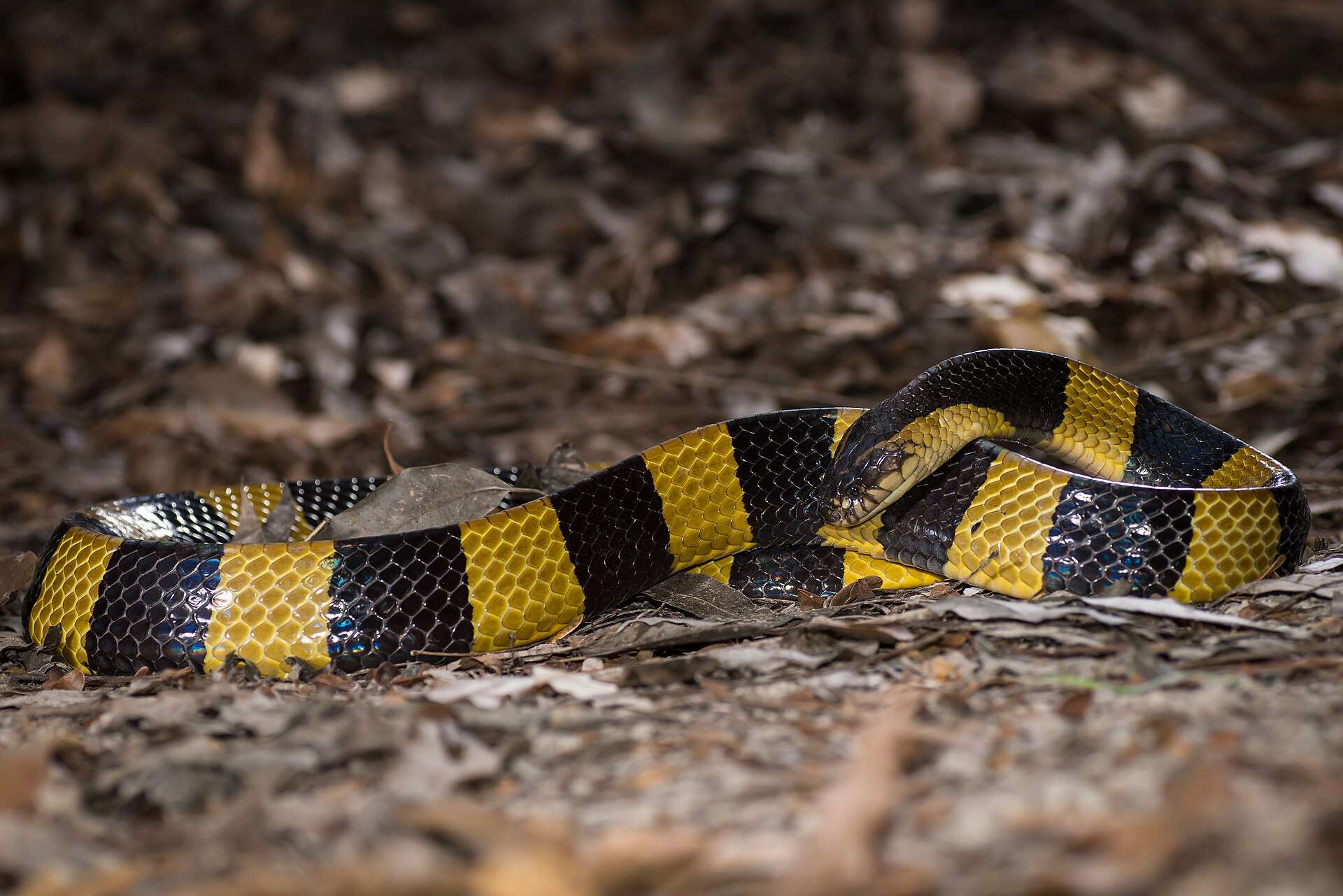
A long, glossy krait boldly ringed with broad black and yellow bands, with a ridge along its back and a blunt tail. It is active at night and lives from eastern India to southern China and Indonesia.

Is it dangerous?
Yes. It is a highly venomous krait whose bite can cause paralysis, though it is shy and bites are uncommon. Anyone bitten should go to hospital immediately.
Do not approach. If someone is bitten, go to a hospital now.
At a glance
- Length
- 1.35–2.25 m
- Active
- At night
- Found in
- Eastern South Asia to South-East Asia and southern China
- Venom
- Neurotoxic
- Young
- Lays eggs
- Habitat
- Marshes and pond edges, Rice fields and farmland, Shrubland
- Diet
- Snakes, Lizards
Length shows a typical adult, then the largest recorded.
IUCN Red List status: Least Concern
Country guideSnakes of BangladeshSnakes of IndonesiaSnakes of IndiaSnakes of Nepal
True size
Malayan pit viperMedically significant
0.87 m at most
About half the height of a 1.7 m adult.
Usual range 0.7–0.87 m, the bar on the ruler.
White-lipped pit viperMedically significant
0.9 m at most
About half the height of a 1.7 m adult.
Usual range 0.5–0.9 m, the bar on the ruler.
Common kraitMedically significant
1.5 m at most
About three quarters of the height of a 1.7 m adult.
Usual range 1.0–1.5 m, the bar on the ruler.
Indian cobraMedically significant
2.2 m at most
About 1.5 times the height of a 1.7 m adult.
Usual range 1.25–2.2 m, the bar on the ruler.
Banded kraitMedically significant
2.25 m at most
About 1.5 times the height of a 1.7 m adult.
Usual range 1.35–2.25 m, the bar on the ruler.
Monocled cobraMedically significant
2.3 m at most
About 1.5 times the height of a 1.7 m adult.
Usual range 1.5–2.3 m, the bar on the ruler.
King cobraMedically significant
5.5 m at most
About 3 times the height of a 1.7 m adult.
Usual range 3.0–5.5 m, the bar on the ruler.
Burmese pythonNon-venomous
5.79 m at most
About 3.5 times the height of a 1.7 m adult.
Usual range 2.6–5.79 m, the bar on the ruler.
Each snake is drawn at the longest length in its profile, on the same scale as the adult. Length is to scale; thickness is not.
Identification
The banded krait is ringed along its whole length with alternating black and yellow bands, the black bands about as broad as the yellow ones2,5. A black mark on the nape runs forward to a point between the eyes, and snakes from the Malay Peninsula can have very pale, almost white bands2.
A high ridge along the spine gives the body a triangular cross-section, and in Thailand it is known as the “triangular snake”2,3. The short tail ends bluntly, and the scales are smooth and glossy2,3.
Adults average about 1.05–1.35 m, and snakes over 1.8 m are rare2,3. The species can reach 2.25 m4.
Distribution
The banded krait has a very large range, occurring in India (mainly in the east and north-east), Nepal, Bhutan and Bangladesh, and through Myanmar, southern China (including Hong Kong, Macau and Hainan), Thailand, Laos, Cambodia and Vietnam to Malaysia, Singapore, Brunei and Indonesia1. In Bangladesh it is found throughout the country5. A population in Micronesia may have been introduced by people1.
Genetic studies have found three distinct lineages within the species, which may prove to be separate species; if so, the name Bungarus fasciatus would stay with the snakes of eastern and north-eastern India and Myanmar1,4.
Habitat
This krait favours low-lying areas with good plant cover and water, such as marshes, cultivated fields and shrubland3. It is also found in primary forest, farmland and gardens, up to about 2,300 m above sea level4. It is often found near houses and villages2.
In West Bengal, India, nests have been found in burrows and under rubble on the banks of village ponds4.
Behaviour
The banded krait is strictly nocturnal and almost never bites during the day3. It is usually quiet and reluctant to bite2. When caught it seldom tries to escape; instead it throws its body into loose coils and hides its head beneath them2.
After dark it is more alert3.
Diet
Like other kraits, the banded krait feeds mainly on other snakes, and it will eat both harmless and venomous species2,3. It also eats lizards3.
Reproduction
The banded krait lays eggs, and the female stays with them1,2. Older accounts give clutches of 8–11 eggs, and the Hong Kong population lays 6–142,3.
In West Bengal, a female was found coiled around a clutch of 19 eggs in a burrow on a pond bank in May; the eggs hatched in June, and the hatchlings measured about 32–35 cm from snout to vent4.
Venom and medical significance
The banded krait is highly venomous, and like other kraits its venom attacks the nerves and can cause paralysis5,6. The World Health Organization places it in Category 2, secondary medical importance, in Bangladesh, India, Nepal, Bhutan, Thailand and Indonesia, and in 2016 described it as rarely, if ever, biting people5.
Bites do happen, however: a Thai case series of krait bites included nine by this species, and it is thought to be one of the three kraits responsible for most krait bites in South-East Asia6. Krait bites often cause paralysis within hours, and many patients need days on a breathing machine6.
Antivenom against it is made by the Queen Saovabha Memorial Institute (Thai Red Cross) in Thailand and by Biofarma in Indonesia5,6. Anyone bitten should go to hospital immediately.
Conservation
The banded krait is listed as Least Concern on the IUCN Red List (2013 assessment)7. In China it is listed as Endangered on the national red list3. In India it is protected under Schedule II of the Wild Life (Protection) Act, which covers all elapid snakes not listed in Schedule I8.
Similar species
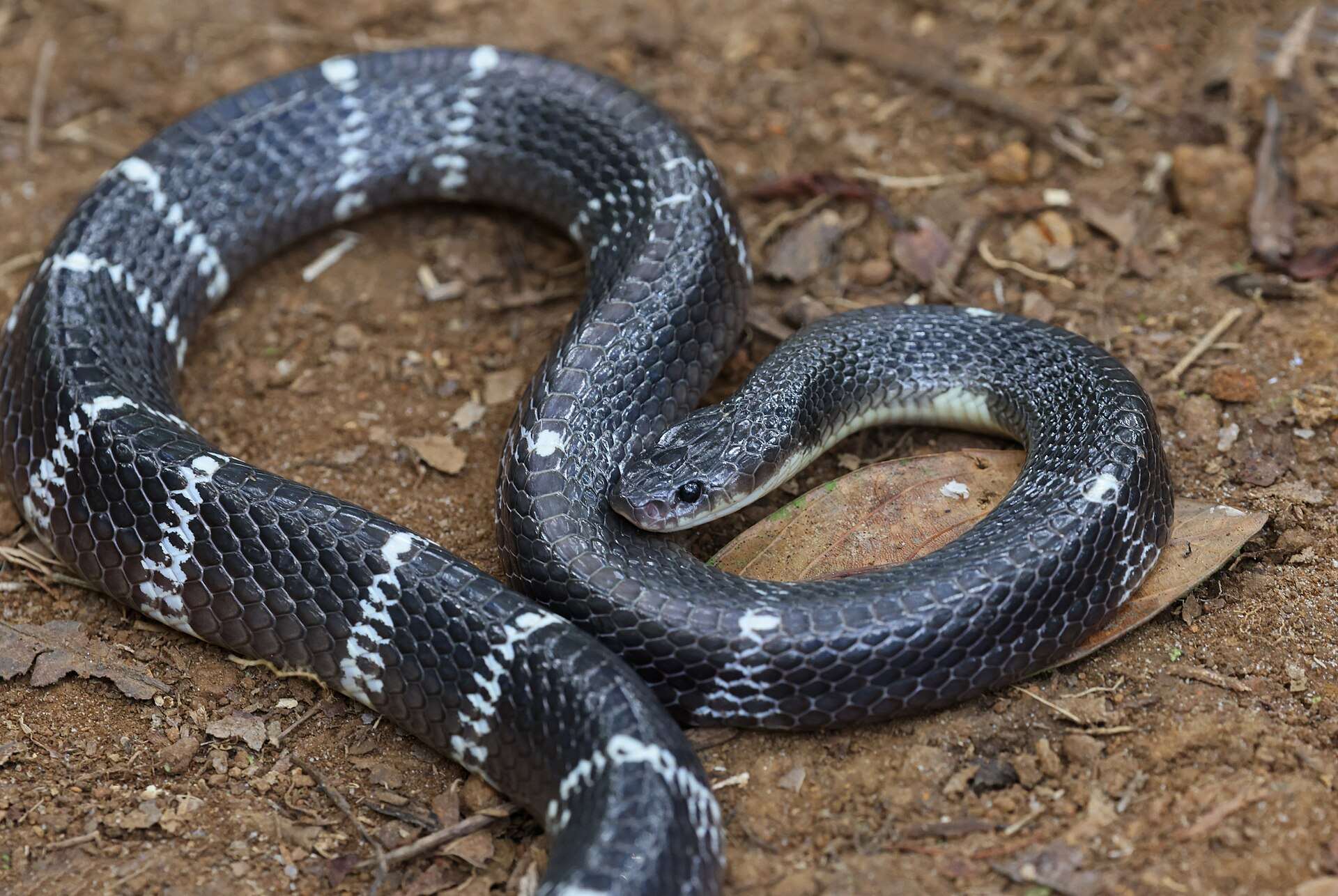
The common krait (Bungarus caeruleus) has narrow white bands instead of broad yellow ones5. The Malayan krait (Bungarus candidus) of South-East Asia has black saddle-shaped markings and a pure white belly, whereas the banded krait’s black and yellow bands run right around the body5. These differences are not a safe basis for handling any snake. Keep your distance from every snake you cannot identify.
In captivity
The banded krait is a dangerous venomous snake and is not suitable as a pet. In India it is protected under Schedule II of the Wild Life (Protection) Act, as amended in 20228. It should never be caught or kept by private individuals.
Look-alikes
Don’t confuse it with…
These snakes are often mistaken for each other. Use the differences to learn, never as a reason to handle a snake.
References
- 1
Uetz, P. et al. (eds.) (2026). Bungarus fasciatus (Schneider, 1801). The Reptile Database. reptile-database.reptarium.cz
- 2
Smith, M.A. (1943). The Fauna of British India, Ceylon and Burma. Reptilia and Amphibia. Vol. III, Serpentes. Taylor and Francis, London. (Genus Bungarus, pp. 407–409; Bungarus fasciatus, pp. 411–413.) archive.org
- 3
School of Biological Sciences, The University of Hong Kong. Bungarus fasciatus (Schneider, 1801), Banded Krait. Reptiles of Hong Kong. biosch.hku.hk
- 4
Biakzuala, L., Lalremsanga, H.T., Santra, V., Dhara, A., Ahmed, M.T., Mallick, Z.B., Kuttalam, S., Amarasinghe, A.A.T. & Malhotra, A. (2023). Molecular phylogeny reveals distinct evolutionary lineages of the banded krait, Bungarus fasciatus (Squamata, Elapidae) in Asia. Scientific Reports 13: 2061. doi.org
- 5
World Health Organization, Regional Office for South-East Asia (2016). Guidelines for the management of snakebites, 2nd edition. WHO SEARO, New Delhi. who.int
- 6
Blessmann, J. & Kreuels, B. (2024). Urgent administration of antivenom following proven krait bites in Southeast Asia irrespective of neurotoxic symptoms. PLOS Neglected Tropical Diseases 18(4): e0012079. doi.org
- 7
Stuart, B., Nguyen, T.Q., Thy, N., Vogel, G., Wogan, G., Srinivasulu, C., Srinivasulu, B., Das, A., Thakur, S. & Mohapatra, P. (2013). Bungarus fasciatus. The IUCN Red List of Threatened Species 2013: e.T192063A2034956. iucnredlist.org
- 8
Government of India (2022). The Wild Life (Protection) Amendment Act, 2022 (No. 18 of 2022), Schedule II, Part C: Reptiles (all Elapidae not listed in Schedule I). prsindia.org
Play
Play as the banded krait.
Its real pattern is a skin in Snake. Every run ends with a fact.