
Russell's viper
Daboia russelii (Shaw & Nodder, 1797)
Also called Daboia, Western Russell's viper
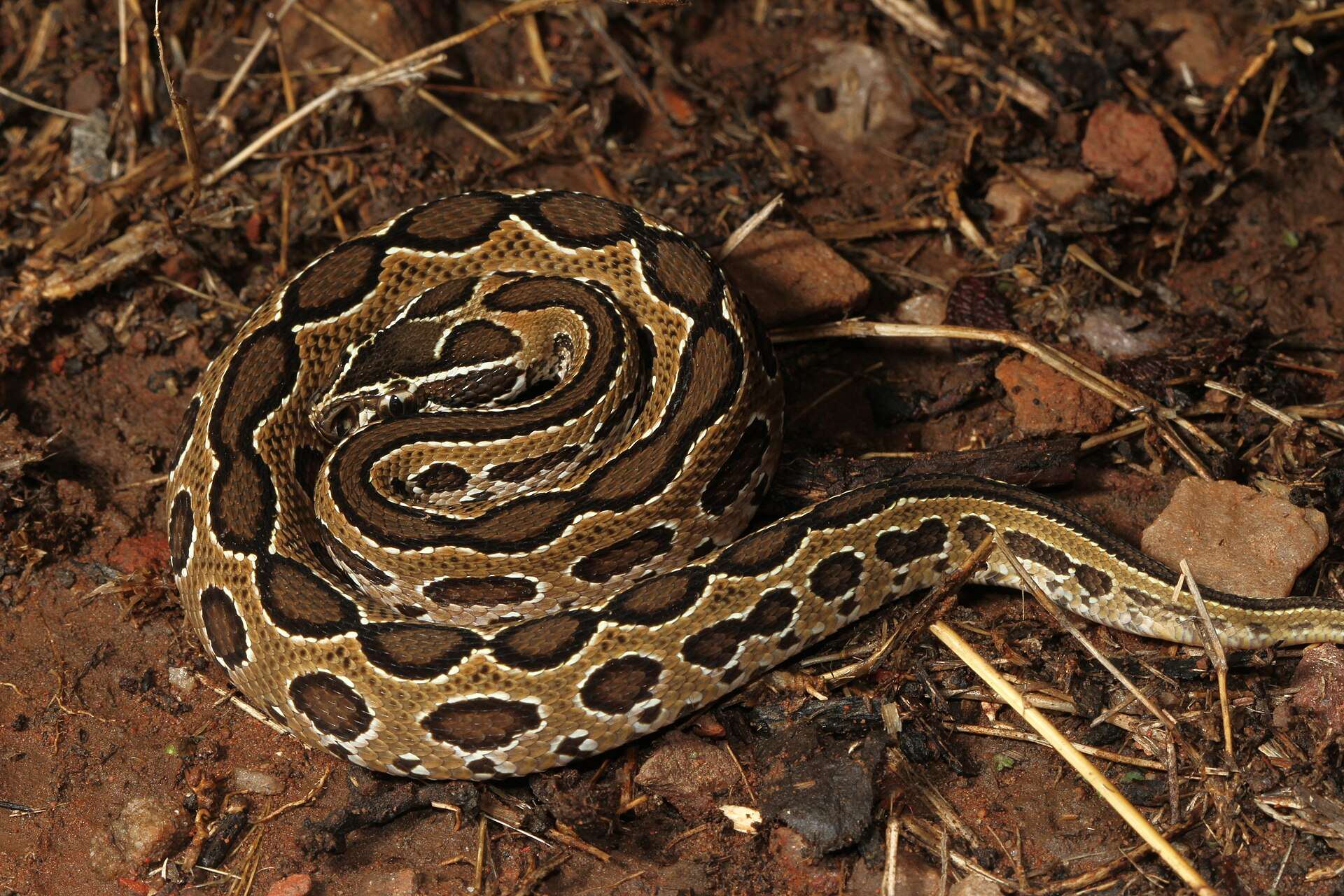
A thick-bodied, brown viper of open country in South Asia, marked with three rows of dark, ringed spots. It is one of the region's most important causes of serious snakebite.

Is it dangerous?
Yes. Its venom can cause serious bleeding and kidney damage. Keep well away, and go to a hospital immediately if bitten.
Do not approach. If someone is bitten, go to a hospital now.
At a glance
- Length
- 1.2–1.68 m
- Active
- At night
- Found in
- South Asia
- Venom
- Haemotoxic and cytotoxic
- Young
- Live young
- Habitat
- Open grassland, Scrub, Farmland
- Diet
- Rats, Mice, Squirrels
Length shows a typical adult, then the largest recorded.
IUCN Red List status: Least Concern
Country guideSnakes of BangladeshSnakes of IndiaSnakes of Sri LankaSnakes of NepalSnakes of Pakistan
True size
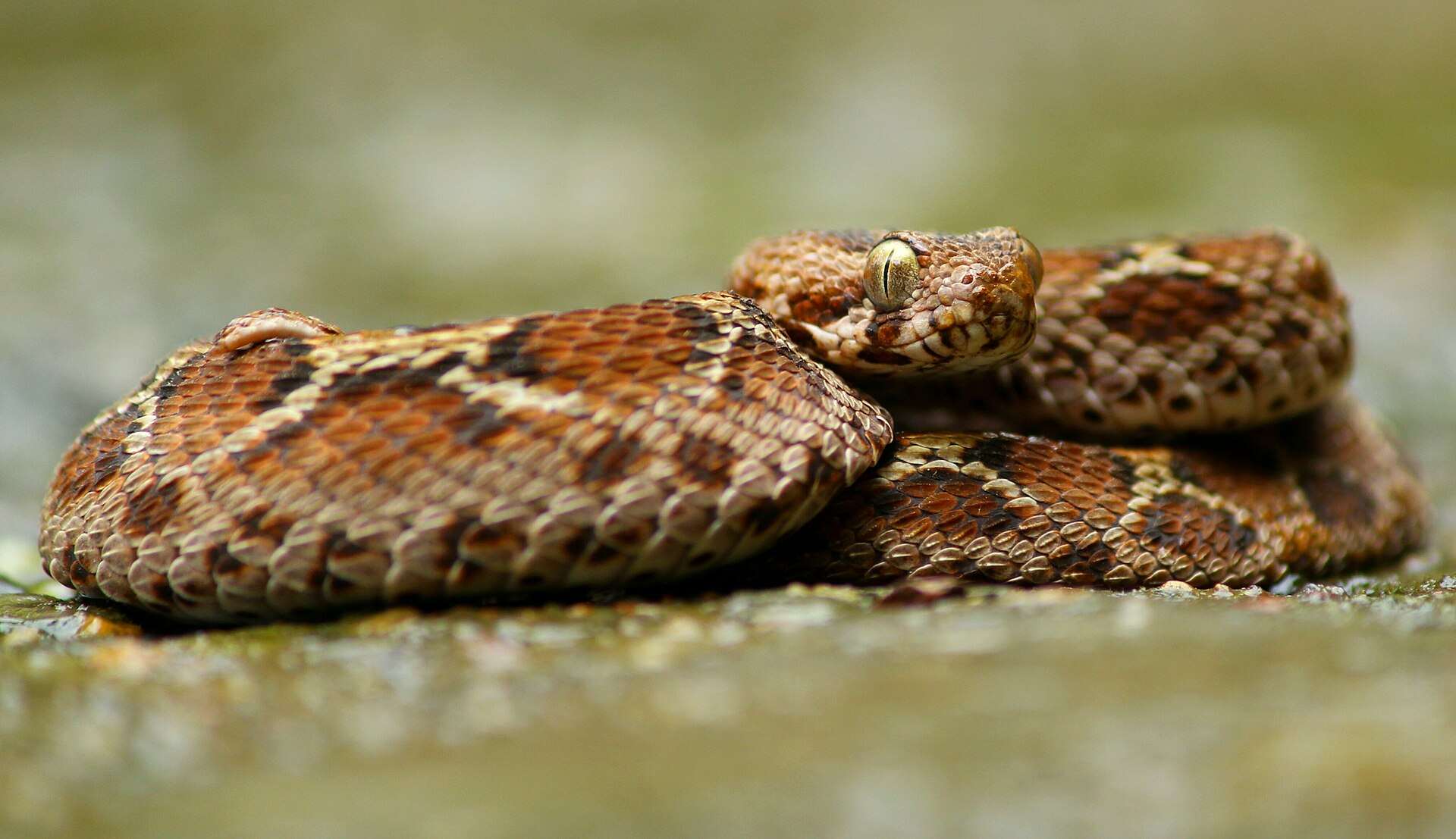
Hump-nosed viperMedically significant
0.6 m at most
About a third of the height of a 1.7 m adult.
Usual range 0.48–0.6 m, the bar on the ruler.
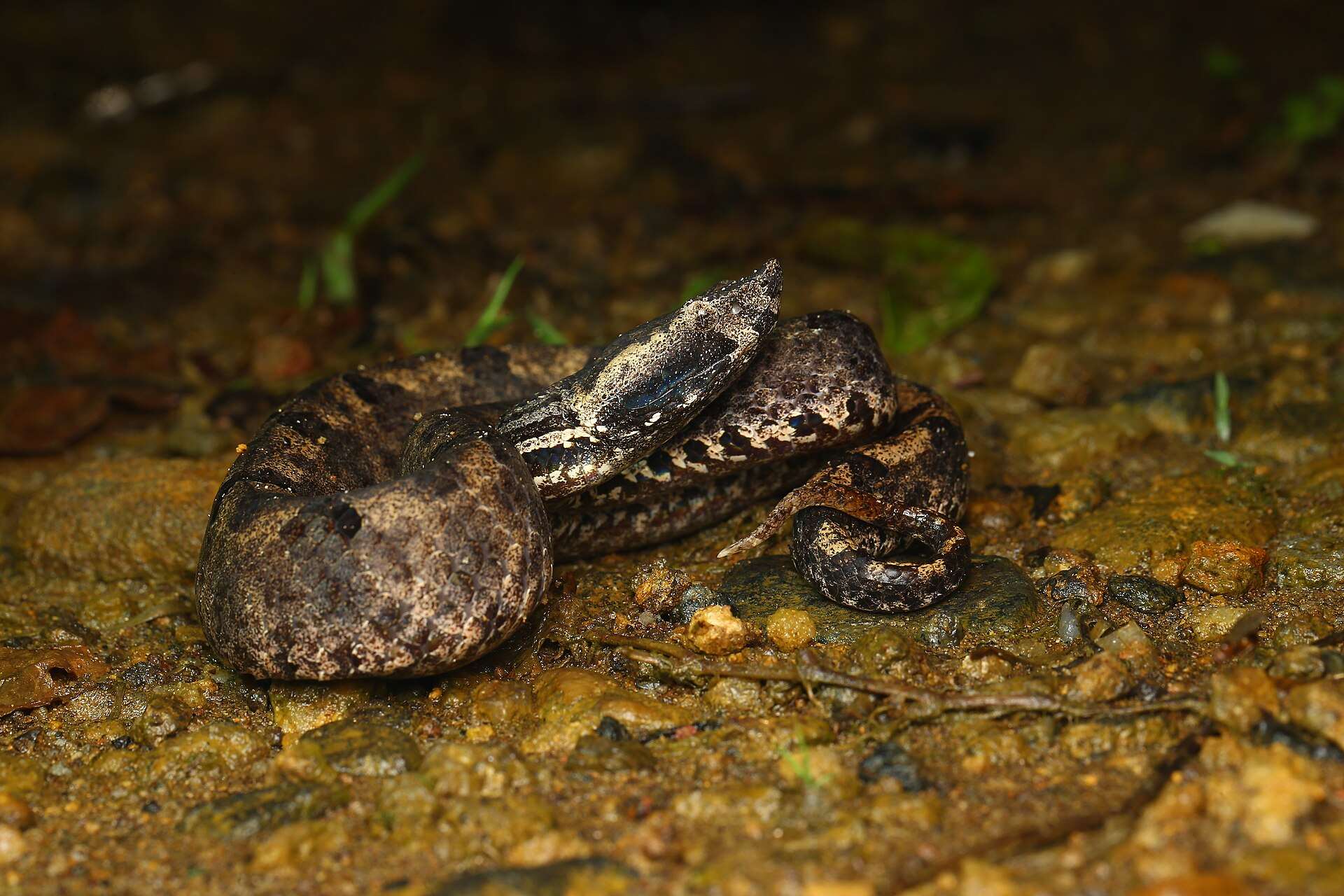
Saw-scaled viperMedically significant
0.76 m at most
About half the height of a 1.7 m adult.
Usual range 0.5–0.76 m, the bar on the ruler.
Common wolf snakeNon-venomous
0.92 m at most
About half the height of a 1.7 m adult.
Usual range 0.7–0.92 m, the bar on the ruler.
Common kraitMedically significant
1.5 m at most
About three quarters of the height of a 1.7 m adult.
Usual range 1.0–1.5 m, the bar on the ruler.
Russell's viperMedically significant
1.68 m at most
About as long as a 1.7 m adult is tall.
Usual range 1.2–1.68 m, the bar on the ruler.
Indian cobraMedically significant
2.2 m at most
About 1.5 times the height of a 1.7 m adult.
Usual range 1.25–2.2 m, the bar on the ruler.
Indian rat snakeNon-venomous
3 m at most
About 2 times the height of a 1.7 m adult.
Usual range 1.8–3.0 m, the bar on the ruler.
Indian rock pythonNon-venomous
4.3 m at most
About 2.5 times the height of a 1.7 m adult.
Usual range 3.0–4.3 m, the bar on the ruler.
Each snake is drawn at the longest length in its profile, on the same scale as the adult. Length is to scale; thickness is not.
Identification
Russell’s viper is a stout snake with a broad, flat head much wider than its neck. The head is covered in small, rough (keeled) scales, the nostrils are large and the pupils are vertical. There is no pit between the nostril and the eye1. The body is light brown with three lengthwise rows of large brown spots, each ringed with black and sometimes edged in white. The middle row can join up into a chain-like stripe1,2. The belly is whitish or yellowish1.
Adults over 1.2 m are not unusual, but snakes over 1.5 m are rare; the longest specimens Wall reported measured about 1.68 m2.
Distribution
This species lives in Pakistan, India, Nepal, Sri Lanka and Bangladesh, and may also occur in Bhutan1. It is described as possibly the most common dangerously venomous snake in southern Asia1.
Russell’s vipers further east, from Myanmar into South-East Asia, were once treated as a subspecies. They are now a separate species, the eastern Russell’s viper (Daboia siamensis), so D. russelii refers only to the South Asian populations1,3.
Habitat
Russell’s viper prefers open, sunny country such as grassland, scrub and farmland, and it avoids dense forest2. During the day it usually lies coiled quietly among grass or other low plants2. It lives from the plains into the hills, and in Sri Lanka it is found up to about 1,500 m above sea level1.
Across South and South-East Asia, most snakebites happen to farm workers and are on the feet and ankles, so care is needed when walking through fields, especially after dark3.
Behaviour
Russell’s viper is mainly active at night. By day it is usually found resting in grass, but after dark it moves about, crosses roads and sometimes enters houses2. It is slow-moving and often holds its ground rather than fleeing2.
When disturbed it heaves its body in and out and gives a deep, loud hiss, made by blowing air out through its large nostrils2. WHO guidelines list it among the more “irritable” snakes that strike readily when threatened, so it should always be given plenty of space3.
Diet
Small mammals, especially rats and mice, make up most of this viper’s diet2. Early records also include squirrels, shrews, small birds, lizards and frogs2. In captivity, young Russell’s vipers have been seen attacking and eating one another2.
Reproduction
Russell’s viper gives birth to live young rather than laying eggs1,2. The Reptile Database gives litters of 5–50 young1, and Wall noted that broods of 30–40 were frequent, with up to 63 recorded2. Newborn snakes are about 20–28 cm long2. They are venomous from birth and can kill small prey within seconds2.
Venom and medical significance
Together with the Indian cobra, common krait and saw-scaled viper, it is one of the “big four” species traditionally considered the most dangerous in India3,4. In Sri Lanka it causes about 30% of snakebites3.
A typical serious bite causes swelling at the bite site together with problems in blood clotting. This can lead to dangerous bleeding, shock and acute kidney injury3. In Sri Lanka and India bites can also cause muscle weakness and muscle damage3. Some survivors later develop long-term hormone problems from damage to the pituitary gland3. A bite is a medical emergency: go to a hospital immediately.
Conservation
The IUCN Red List classes Russell’s viper as Least Concern (assessed 2021)5. It is widespread and often common1.
In India it is protected under Schedule I of the Wild Life (Protection) Act, as revised in 20226. India’s population is also listed in Appendix III of CITES, which covers international trade in wildlife6.
Similar species
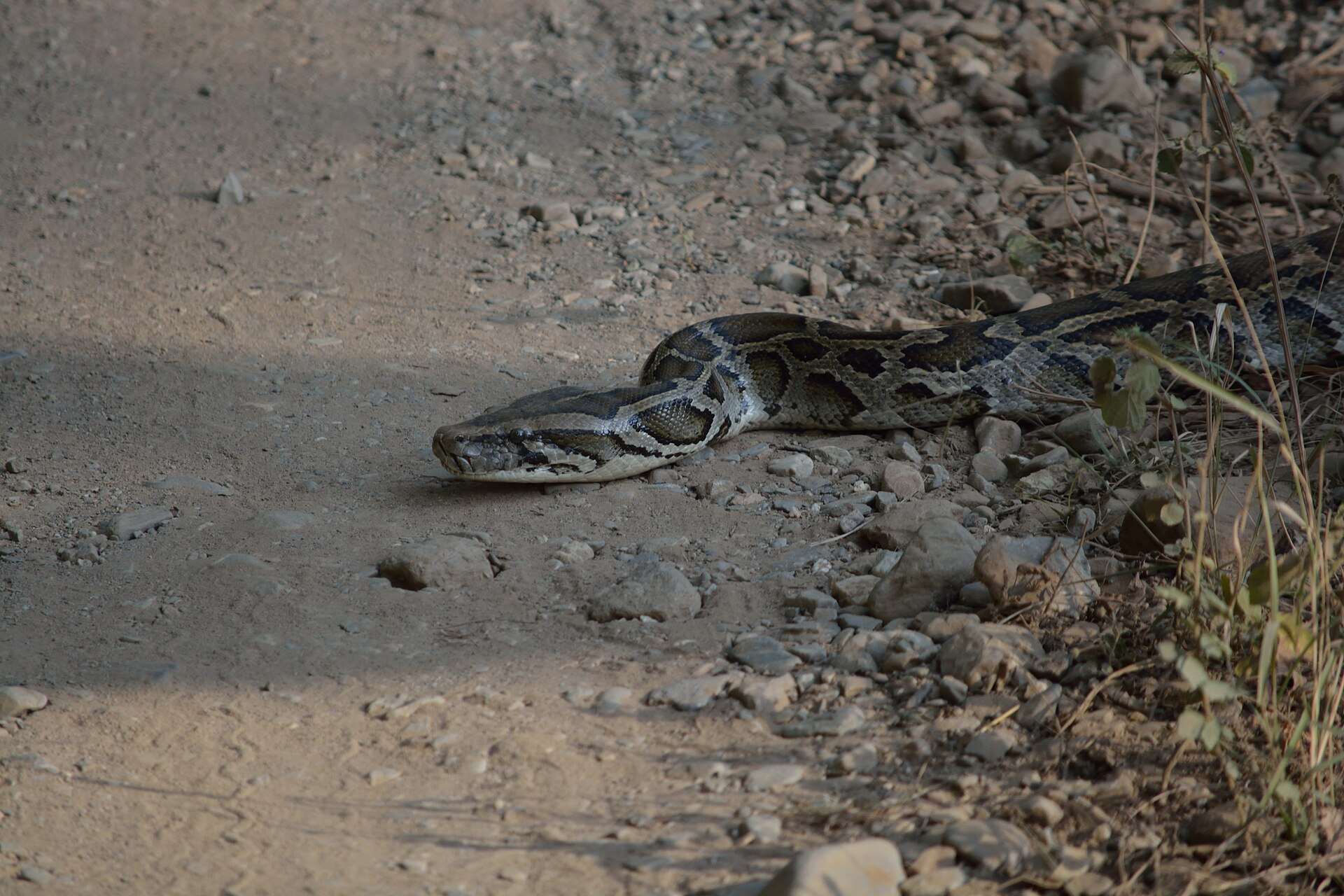
The Indian rock python (Python molurus) also has large, dark-edged blotches on a pale body, so the two can look alike1,2. The viper has strongly keeled, rough-looking scales in 27–33 rows, while the python has smooth scales in more than 60 rows1,2. The viper’s spots are neat, dark-ringed ovals in three rows; the python has larger, squarish blotches and a spear-shaped mark on the head1,2. Pythons also have small pits on the front lip scales, which the viper lacks1,2.
These differences are not a safe basis for handling any snake. Russell’s viper is dangerously venomous3, so treat every unidentified snake as dangerous.
In captivity
Russell’s vipers have long been kept in Indian museums and zoos, where many feed well, although some refuse food2. Antivenoms are made using Russell’s viper venom, and venom from one region may not match bites from another3. In India the species is protected under Schedule I of the Wild Life (Protection) Act6. It is a dangerously venomous snake and should never be kept as a pet or handled by anyone without training.
Look-alikes
Don’t confuse it with…
These snakes are often mistaken for each other. Use the differences to learn, never as a reason to handle a snake.
References
- 1
Uetz, P. et al. (eds.) (2026). Daboia russelii (Shaw & Nodder, 1797). The Reptile Database. reptile-database.reptarium.cz
- 2
Wall, F. (1921). Ophidia Taprobanica or the Snakes of Ceylon. Colombo Museum; H.R. Cottle, Government Printer, Colombo. Account of Vipera russelli (= Daboia russelii). archive.org
- 3
World Health Organization, Regional Office for South-East Asia (2016). Guidelines for the Management of Snakebites, 2nd edition (Warrell, D.A., ed.). New Delhi: WHO SEARO. iris.who.int
- 4
Mohapatra, B., Warrell, D.A., Suraweera, W. et al. (2011). Snakebite mortality in India: a nationally representative mortality survey. PLOS Neglected Tropical Diseases 5(4): e1018. doi.org
- 5
Suraj, M., Narayanan, S., Srinivasulu, C., Mohapatra, P., Giri, V., Murthy, B.H.C., de Silva, A., Ukuwela, K. & Kannishka, S. (2021). Daboia russelii. The IUCN Red List of Threatened Species 2021: e.T172710A1372376. iucnredlist.org
- 6
Government of India (2022). The Wild Life (Protection) Amendment Act, 2022 (No. 18 of 2022). The Gazette of India, Extraordinary, Part II, Section 1. Schedule I, Part C (Reptiles); Schedule IV (CITES Appendices). prsindia.org
Play
Play as the russell's viper.
Its real pattern is a skin in Snake. Every run ends with a fact.