
Javan spitting cobra
Naja sputatrix Boie, 1827
Also called Indonesian cobra, Indonesian spitting cobra
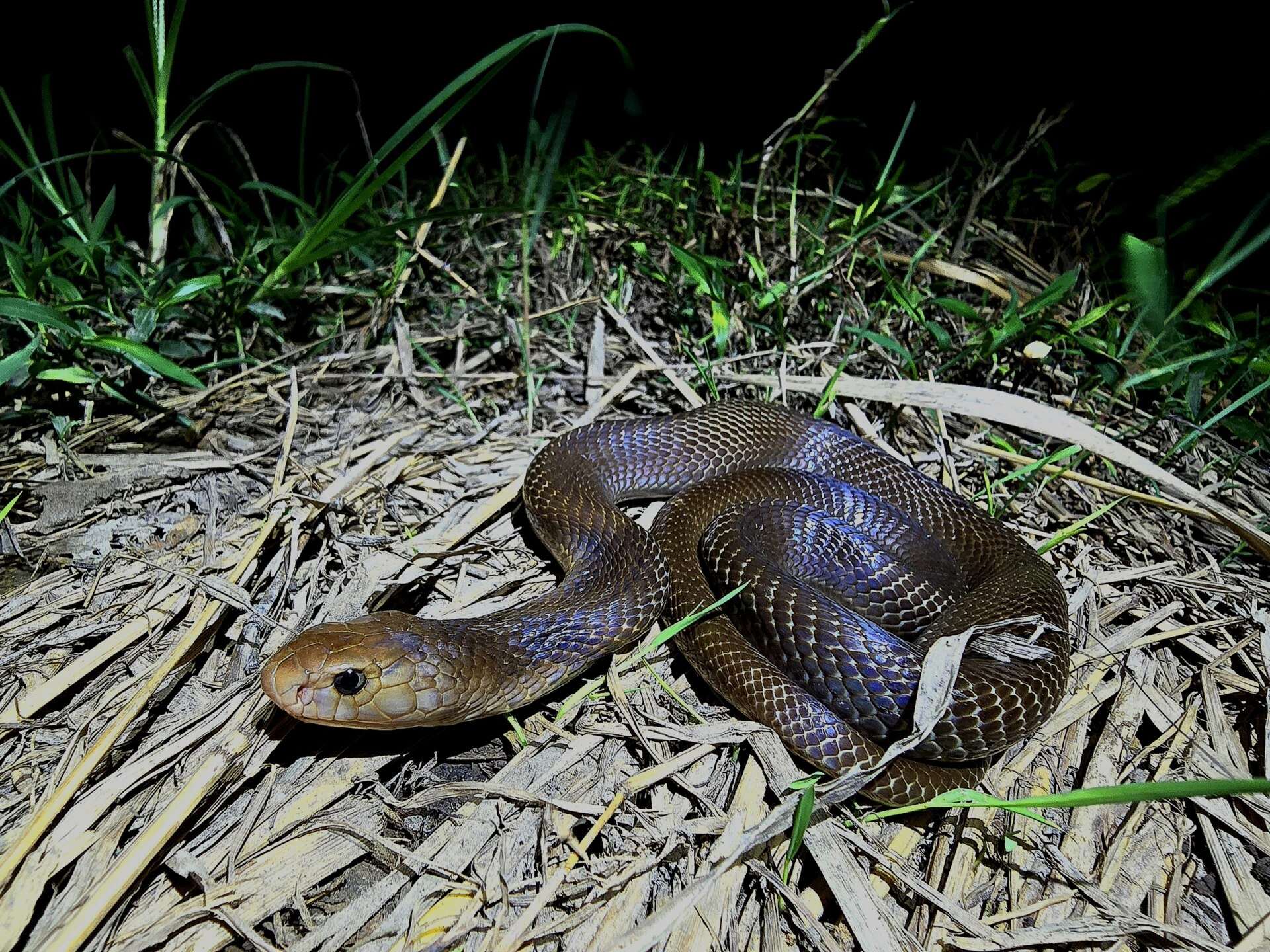
A large, mostly dark brown spitting cobra of Java, Bali and the Lesser Sunda Islands. It is common in rice fields, farmland and towns, and it can spray venom towards the eyes of a threat.

Is it dangerous?
Yes. Its bite can cause paralysis, and venom spat into the eyes causes intense pain. Anyone bitten or spat at should go to hospital immediately.
Do not approach. If someone is bitten, go to a hospital now.
At a glance
- Length
- 1.38–1.85 m
- Active
- Day and night
- Found in
- Java, Bali and the Lesser Sunda Islands
- Venom
- Neurotoxic and cytotoxic
- Young
- Lays eggs
- Habitat
- Rice fields, Farmland, Secondary forest
- Diet
- Rats, Frogs
Length shows a typical adult, then the largest recorded.
IUCN Red List status: Least Concern
Country guideSnakes of Indonesia
True size
Philippine cobraMedically significant
1.41 m at most
About three quarters of the height of a 1.7 m adult.
Usual range 1.0–1.41 m, the bar on the ruler.
Mozambique spitting cobraMedically significant
1.8 m at most
About as long as a 1.7 m adult is tall.
Usual range 1.2–1.8 m, the bar on the ruler.
Javan spitting cobraMedically significant
1.85 m at most
About as long as a 1.7 m adult is tall.
Usual range 1.38–1.85 m, the bar on the ruler.
Indian cobraMedically significant
2.2 m at most
About 1.5 times the height of a 1.7 m adult.
Usual range 1.25–2.2 m, the bar on the ruler.
Black-necked spitting cobraMedically significant
2.2 m at most
About 1.5 times the height of a 1.7 m adult.
Usual range 1.25–2.2 m, the bar on the ruler.
Monocled cobraMedically significant
2.3 m at most
About 1.5 times the height of a 1.7 m adult.
Usual range 1.5–2.3 m, the bar on the ruler.
Cape cobraMedically significant
2.3 m at most
About 1.5 times the height of a 1.7 m adult.
Usual range 1.2–2.3 m, the bar on the ruler.
Indian rat snakeNon-venomous
3 m at most
About 2 times the height of a 1.7 m adult.
Usual range 1.8–3.0 m, the bar on the ruler.
Each snake is drawn at the longest length in its profile, on the same scale as the adult. Length is to scale; thickness is not.
Identification
The Javan spitting cobra is a large, smooth-scaled cobra that rears up and spreads a hood when threatened2,4. Most Javan specimens are dark brown above, and the earliest description called it chestnut-brown with a broad head2,3. Young snakes may show a faint spectacle-like mark on the neck2.
Adult females grow larger than males: in a sample of 159 snakes from West Java, adults averaged about 1.18 m (females) and 1.05 m (males) from snout to vent, and the largest was a male of 1.85 m from snout to vent, not counting the tail3. A museum specimen collected on Java around 1820 measures 1.38 m in total length2.
Distribution
This cobra is found only in Indonesia: on Java, Bali, Lombok, Sumbawa, Flores, Komodo, Alor and Lomblen1. An old record from Sulawesi is doubtful, and recent authors do not consider cobras part of that island’s fauna1,2. Earlier reports from the Malay Peninsula were mistaken1.
The spitting cobras of Sumatra and Borneo are a separate species, the Sumatran spitting cobra (N. sumatrana)2,7. WHO notes that this cobra is suspected, but not confirmed, in Timor-Leste4.
Habitat
The Javan spitting cobra is abundant in secondary forest and farmland, often close to people3. The West Java snakes in one study came from an area of rice paddies, irrigation canals and fish ponds3. It has also been described as partly arboreal1.
It copes well with towns: in rescue records from Greater Jakarta in 2015–2019, it was the snake most often found around homes, accounting for 204 of 656 reported encounters (31%)5. Snakes were found in kitchens and bathrooms, gardens, chicken coops and rubbish piles5.
Behaviour
Like other spitting cobras, it can squeeze venom out of the tips of its fangs as a fine spray aimed at the eyes of a perceived enemy, reaching a metre or more4. Its scientific name means “the spitter”: around 1820, a live cobra on Java spat venom when an artist tried to sketch it2. Cobras rear up, spread a hood, hiss and strike repeatedly when they feel threatened4.
Diet
In rice fields in Central Java, Javan spitting cobras feed mainly on rats and frogs3. Their broad diet is one reason the species copes well with farmland and commercial harvesting3.
Reproduction
The Javan spitting cobra lays eggs1. In West Java, females carried eggs in September–October and in February, suggesting that they lay during the wet season3. Clutches averaged 14 eggs and ranged from 6 to 233. Females become mature at about 0.9–1 m from snout to vent3.
Venom and medical significance
The Javan spitting cobra is highly venomous and a significant cause of snakebite, and the World Health Organization places it in its highest category of medical importance on Java and the Lesser Sunda Islands3,4. About two-thirds of its venom consists of three-finger toxins, including tissue-damaging cytotoxins and short neurotoxins that cause paralysis6.
Venom spat into the eyes causes immediate, intense burning pain, heavy watering, swollen eyelids and blurred vision; corneal scarring is known after spits by African spitting cobras but has not been described in Asia4.
Indonesia’s only locally made antivenom, Biofarma’s SABU, is raised partly against this species, but laboratory tests found that it neutralises the venom only weakly, especially the paralysing neurotoxins, and a Thai antivenom performed better4,6,7. Anyone bitten or spat at should go to hospital immediately.
Conservation
The Javan spitting cobra is listed as Least Concern on the IUCN Red List (2012 assessment)8. It is harvested commercially for its skin and meat3. A 2026 study concluded that its use of farmland, broad diet, high fecundity and strong venom make it resilient to current levels of harvest3.
Similar species
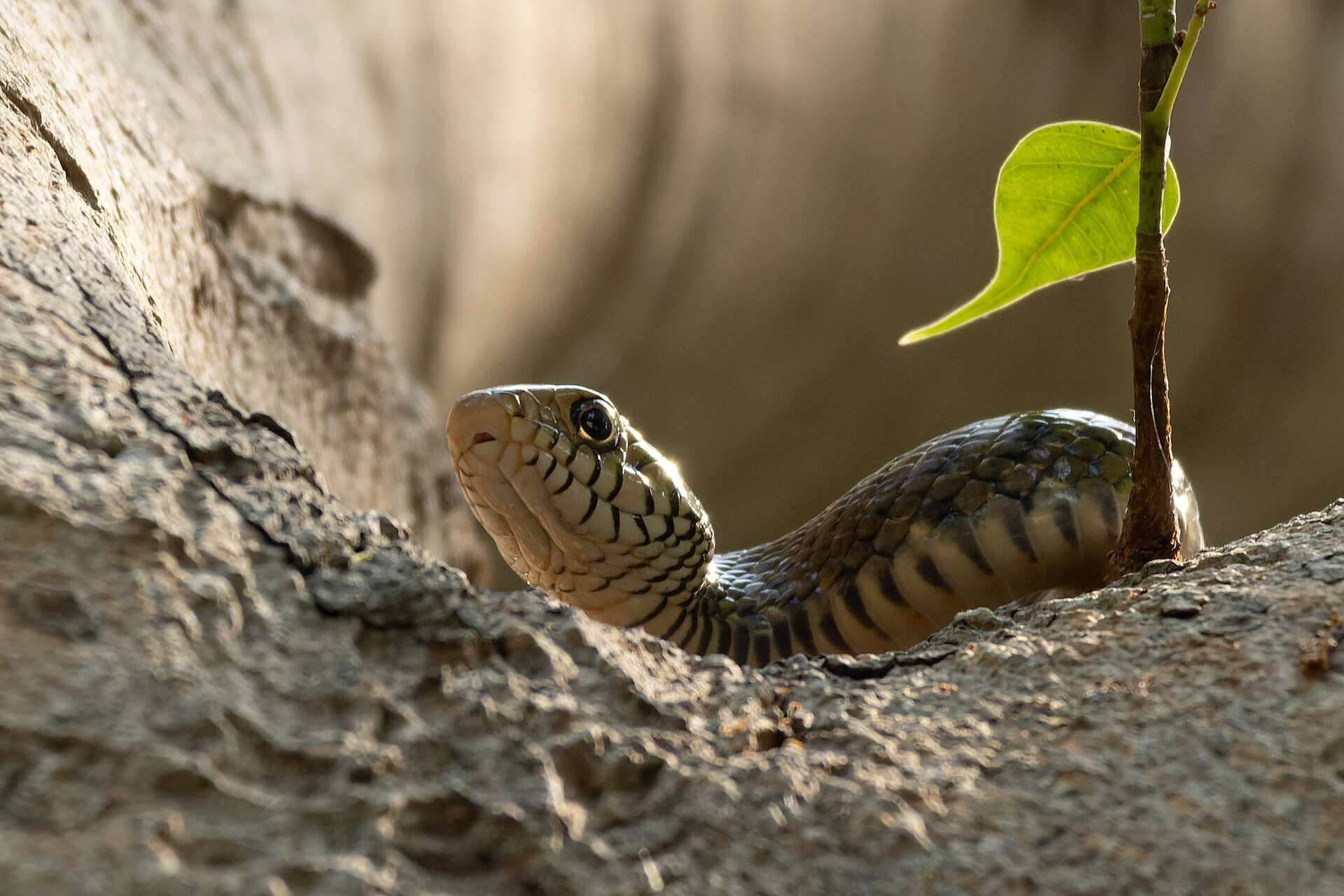
Rat snakes, including the Indian rat snake (Ptyas mucosa), have small loreal scales between the nostril and the eye, which cobras lack4. King cobras, which also live on Java, have a pair of large scales at the back of the head that true cobras do not have4. These differences are not a safe basis for handling any snake. Keep your distance from every snake you cannot identify.
In captivity
The Javan spitting cobra is a dangerous venomous snake that can spit venom into the eyes, and it is not suitable as a pet4. It should never be caught or kept by private individuals.
Look-alikes
Don’t confuse it with…
These snakes are often mistaken for each other. Use the differences to learn, never as a reason to handle a snake.
References
- 1
Uetz, P. et al. (eds.) (2026). Naja sputatrix Boie, 1827. The Reptile Database. reptile-database.reptarium.cz
- 2
Denzer, W., Dondorp, E., Kaiser, H. & Wüster, W. (2025). Notes on the type series of the Javan Spitting Cobra, Naja sputatrix Boie, 1827, and designation of a lectotype for Naja tripudians sondaica Schlegel, 1844. Zootaxa 5679(4): 585–599. doi.org
- 3
Arida, E., Maireda, N.L., Herlambang, A.E.N., Riyanto, A., Hamidy, A., Shine, R. & Natusch, D.J.D. (2026). Sexual dimorphism and reproductive biology of commercially harvested Indonesian Spitting Cobras (Naja sputatrix, Elapidae) from West Java. Australian Journal of Zoology 74(4): ZO25054. doi.org
- 4
World Health Organization, Regional Office for South-East Asia (2016). Guidelines for the management of snakebites, 2nd edition. WHO SEARO, New Delhi. who.int
- 5
Khoerunisa, I., Kusrini, M.D. & Mardiastuti, A. (2021). Diversity of snake rescued from residential areas in Greater Jakarta Metropolitan Area, Indonesia. Media Konservasi 26(3): 231–238. doi.org
- 6
Tan, N.H., Wong, K.Y. & Tan, C.H. (2017). Venomics of Naja sputatrix, the Javan spitting cobra: a short neurotoxin-driven venom needing improved antivenom neutralization. Journal of Proteomics 157: 18–32. doi.org
- 7
Tan, C.H., Liew, J.L., Tan, K.Y. & Tan, N.H. (2016). Assessing SABU (Serum Anti Bisa Ular), the sole Indonesian antivenom: a proteomic analysis and neutralization efficacy study. Scientific Reports 6: 37299. doi.org
- 8
Iskandar, D., Auliya, M., Inger, R.F. & Lilley, R. (2012). Naja sputatrix. The IUCN Red List of Threatened Species 2012: e.T192197A2054180. iucnredlist.org
Play
Play as the javan spitting cobra.
Its real pattern is a skin in Snake. Every run ends with a fact.