
Philippine cobra
Naja philippinensis Taylor, 1922
Also called Northern Philippine cobra
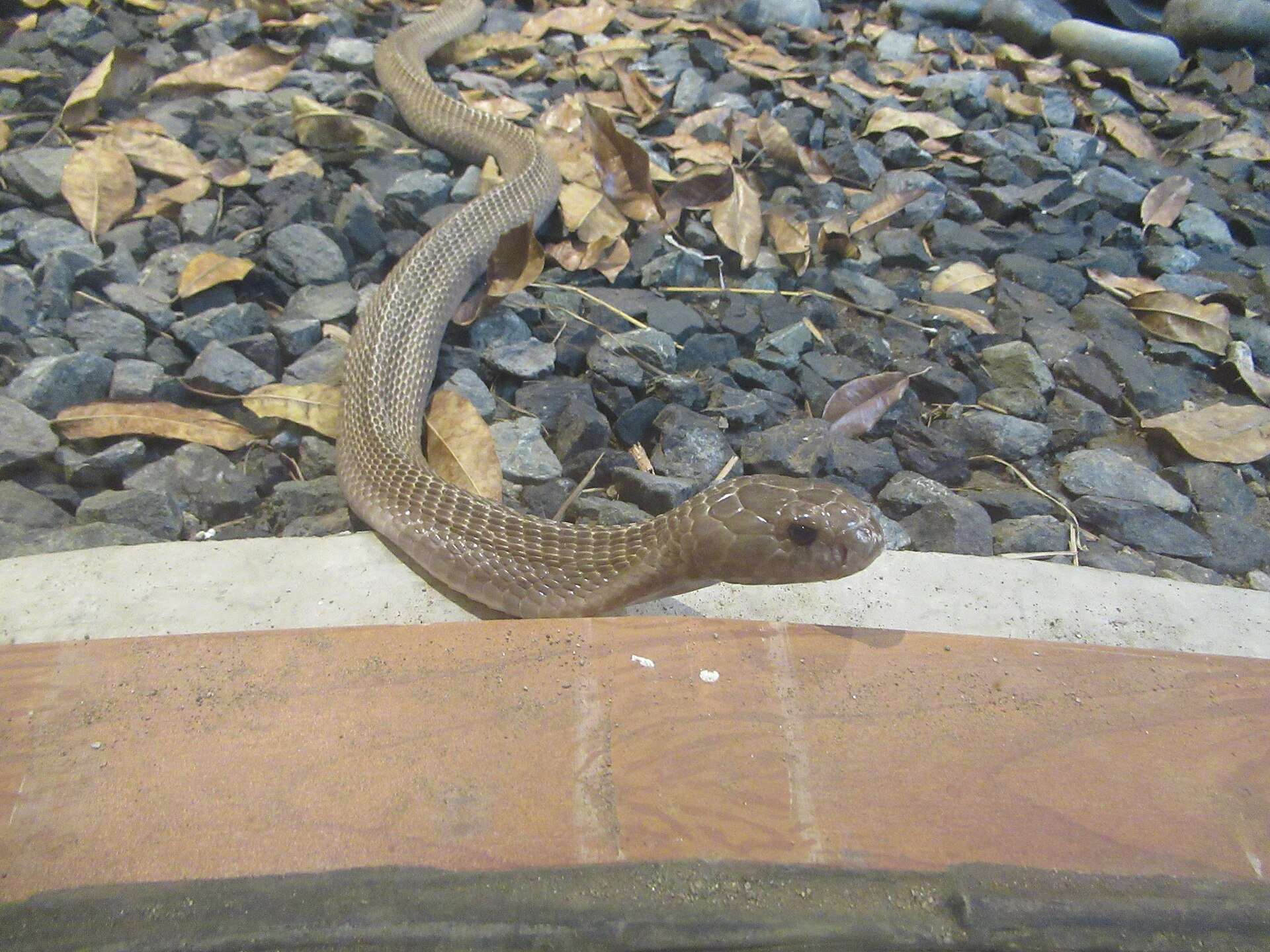
A plain light brown to olive cobra found only in the northern Philippines. It spreads a hood when alarmed, can spit venom, and is often met on farmland near villages.

Is it dangerous?
Yes. It is a dangerous spitting cobra whose venom can quickly paralyse breathing. Anyone bitten, or sprayed in the eyes, should go to hospital immediately.
Do not approach. If someone is bitten, go to a hospital now.
At a glance
- Length
- 1.0–1.41 m
- Active
- Day and night
- Found in
- Northern Philippines
- Venom
- Neurotoxic
- Young
- Lays eggs
- Habitat
- Farmland, Rice fields, Villages
- Diet
- Frogs, Small snakes
Length shows a typical adult, then the largest recorded.
IUCN Red List status: Near Threatened
Country guideSnakes of the Philippines
True size
Philippine cobraMedically significant
1.41 m at most
About three quarters of the height of a 1.7 m adult.
Usual range 1.0–1.41 m, the bar on the ruler.
Mozambique spitting cobraMedically significant
1.8 m at most
About as long as a 1.7 m adult is tall.
Usual range 1.2–1.8 m, the bar on the ruler.
Javan spitting cobraMedically significant
1.85 m at most
About as long as a 1.7 m adult is tall.
Usual range 1.38–1.85 m, the bar on the ruler.
Indian cobraMedically significant
2.2 m at most
About 1.5 times the height of a 1.7 m adult.
Usual range 1.25–2.2 m, the bar on the ruler.
Black-necked spitting cobraMedically significant
2.2 m at most
About 1.5 times the height of a 1.7 m adult.
Usual range 1.25–2.2 m, the bar on the ruler.
Banded kraitMedically significant
2.25 m at most
About 1.5 times the height of a 1.7 m adult.
Usual range 1.35–2.25 m, the bar on the ruler.
Monocled cobraMedically significant
2.3 m at most
About 1.5 times the height of a 1.7 m adult.
Usual range 1.5–2.3 m, the bar on the ruler.
Cape cobraMedically significant
2.3 m at most
About 1.5 times the height of a 1.7 m adult.
Usual range 1.2–2.3 m, the bar on the ruler.
Each snake is drawn at the longest length in its profile, on the same scale as the adult. Length is to scale; thickness is not.
Identification
The Philippine cobra is a medium-sized cobra with smooth scales and round pupils2. Adults are plain light brown to olive brown above and cream to yellowish brown below, with no bands or other markings on the front of the body2,3,4. Some adults are a uniform dark grey3. Young snakes look quite different: they are dark brown to black, covered with a network of light olive-yellow4. Like other cobras, it rears up and spreads a hood when alarmed4.
The adult female that Taylor used to describe this cobra in 1922 was 1.0 m long4. The largest on record is a male of about 1.41 m: 1.22 m from snout to vent, plus a 19 cm tail2.
Distribution
This cobra is found only in the northern Philippines, on Luzon, Mindoro, Masbate, Marinduque, Catanduanes and Lubang1,3. It was first described in 1922 as a subspecies of the Indian cobra, Naja naja philippinensis, and is now treated as a species of its own1,4. The southern Philippines have a different cobra, the Samar cobra (Naja samarensis), and Palawan has the equatorial spitting cobra (Naja sumatrana)2. In the Sierra Madre of north-eastern Luzon it appears to be widespread and common5.
Habitat
The Philippine cobra is often found on farmland and around villages3,5. In north-eastern Luzon, cobras have been found hiding on agricultural land, and one was probably caught by residents in farmland around a settlement3,5. The dangerously venomous land snakes of the Philippines can all swim, and some regularly live near houses, on farms and around water such as flooded rice fields, rivers and streams2. Cobra bites are an important cause of death among rice farmers8.
Behaviour
This is a spitting cobra: when threatened it can spray venom towards an attacker’s eyes3,6. It also rears up, spreads its hood and hisses4. In captivity, hatchlings did this before they had even left the egg, rearing up with the hood spread to hiss and strike at nearby objects4. Cobras found near homes and fields are often killed by local people3,5.
Diet
In captivity in the early 1900s, some cobras readily took frogs and small snakes, while others refused all food4. Newly hatched young did not eat until after their first shed of skin4.
Reproduction
The Philippine cobra lays eggs1. One captive female laid 12 eggs, which hatched after about seven weeks in moist earth4. The hatchlings stayed partly inside their eggs for three or four days before leaving them4.
Venom and medical significance
The Philippine cobra is dangerously venomous. In a study of 39 people envenomed by this cobra, 38 developed signs of nerve poisoning, and 19 developed paralysis of the breathing muscles, in 3 cases within 30 minutes of the bite7. Swelling was usually slight, though 3 people developed tissue death (necrosis), and 14 people with serious general symptoms had no local swelling at all7. Its venom is almost purely neurotoxic, which is unusual for a spitting cobra6.
A study published in 1987 estimated that cobra bites killed up to 107 people per 100,000 each year in one rice-farming area, and only 8% of the victims studied had reached a hospital8. A specific antivenom, Philippine Cobra Antivenom, is made in the Philippines by the Research Institute for Tropical Medicine, and it is the only antivenom produced in the country9,10. Anyone bitten should go to hospital immediately.
Conservation
The Philippine cobra is listed as Near Threatened on the IUCN Red List (assessed in 2022)11. Persecution and exploitation by people have been identified as possible threats5. Cobras found near homes are often killed by residents3.
Similar species
The Samar cobra (Naja samarensis) of the southern Philippines is darker, with a few pale yellow belly scales behind the head followed by a black band2. The equatorial spitting cobra (Naja sumatrana) lives on Palawan and Culion, outside the Philippine cobra’s range2. Luzon is also home to the Luzon king cobra (Ophiophagus salvatana)12. King cobras have no more than 15 rows of scales around the middle of the body, while the Philippine cobra has 21–232. These differences are not a safe basis for handling any snake. Keep your distance from every snake you cannot identify.
In captivity
The Philippine cobra is a dangerous venomous snake and is not suitable as a pet. Cobras are kept at the antivenom production facility of the Research Institute for Tropical Medicine3, and in the early 1900s they were kept in Manila to collect venom for making antivenom4. They should never be caught or kept by private individuals.
References
- 1
Uetz, P. et al. (eds.) (2026). Naja philippinensis Taylor, 1922. The Reptile Database. reptile-database.reptarium.cz
- 2
Leviton, A.E., Brown, R.M. & Siler, C.D. (2014). The dangerously venomous snakes of the Philippine Archipelago, with identification keys and species accounts. In: Williams, G.C. & Gosliner, T.M. (eds.), The Coral Triangle: The 2011 Hearst Philippine Biodiversity Expedition. California Academy of Sciences, San Francisco, pp. 473–530. cameronsiler.com
- 3
Sy, E.Y. & Taggueg, J.B. (2018). Melanism in Northern Philippine Cobra Naja philippinensis from Isabela Province, Luzon Island, Philippines. Southeast Asia Vertebrate Records 2018: 056–057. ecologyasia.com
- 4
Taylor, E.H. (1922). The Snakes of the Philippine Islands. Bureau of Science Monograph 16. Bureau of Printing, Manila. (Naja naja philippinensis, pp. 265–267; snakebite deaths, introduction.) archive.org
- 5
Brown, R.M., Siler, C.D., Oliveros, C.H., Welton, L.J., Rock, A., Swab, J., Van Weerd, M., van Beijnen, J., Jose, E., Rodriguez, D., Jose, E. & Diesmos, A.C. (2013). The amphibians and reptiles of Luzon Island, Philippines, VIII: the herpetofauna of Cagayan and Isabela Provinces, northern Sierra Madre Mountain Range. ZooKeys 266: 1–120. doi.org
- 6
Kazandjian, T.D. et al. (2021). Convergent evolution of pain-inducing defensive venom components in spitting cobras. Science 371(6527): 386–390. pmc.ncbi.nlm.nih.gov
- 7
Watt, G., Padre, L., Tuazon, M.L., Theakston, R.D.G. & Laughlin, L. (1988). Bites by the Philippine cobra (Naja naja philippinensis): prominent neurotoxicity with minimal local signs. American Journal of Tropical Medicine and Hygiene 39(3): 306–311. doi.org
- 8
Watt, G., Padre, L., Tuazon, M.L. & Hayes, C.G. (1987). Bites by the Philippine cobra (Naja naja philippinensis): an important cause of death among rice farmers. American Journal of Tropical Medicine and Hygiene 37(3): 636–639. doi.org
- 9
Palasuberniam, P., Chan, Y.W., Tan, K.Y. & Tan, C.H. (2021). Snake venom proteomics of Samar cobra (Naja samarensis) from the southern Philippines: short alpha-neurotoxins as the dominant lethal component weakly cross-neutralized by the Philippine cobra antivenom. Frontiers in Pharmacology 12: 727756. doi.org
- 10
Castillo, D.A.E., Seneci, L., Chowdhury, A., Rimando, M.G. & Fry, B.G. (2025). Bite first, bleed later: how Philippine Trimeresurus pit viper venoms hijack blood clotting. Toxins 17(4): 185. pmc.ncbi.nlm.nih.gov
- 11
dela Cruz, C., Lagat, R., Salinas, R., Pitogo, K., Santos, G., Sarmiento, M. & Sy, E. (2022). Naja philippinensis. The IUCN Red List of Threatened Species 2022: e.T169768A180845902. iucnredlist.org
- 12
Das, I. et al. (2024). Taxonomic revision of the king cobra Ophiophagus hannah (Cantor, 1836) species complex (Reptilia: Serpentes: Elapidae), with the description of two new species. European Journal of Taxonomy 961: 1–51. doi.org
Play
Play as the philippine cobra.
Its real pattern is a skin in Snake. Every run ends with a fact.