
Cape cobra
Naja nivea (Linnaeus, 1758)
Also called Yellow cobra, Geelslang, Koperkapel
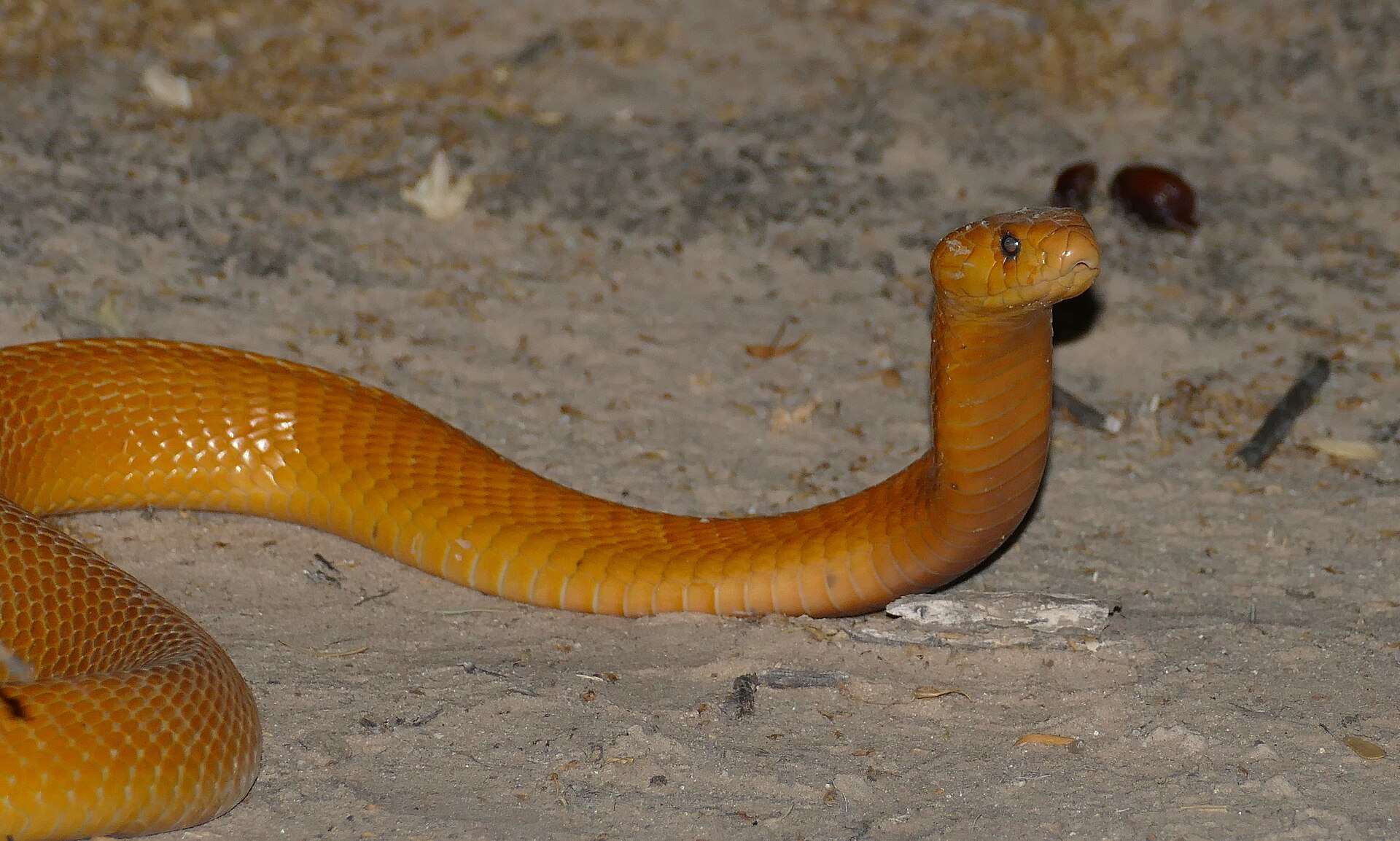
A non-spitting cobra of the dry south-west of southern Africa, usually yellow, copper or brown and often speckled. It spreads a hood when threatened, and its fast-acting venom can cause paralysis.

Is it dangerous?
Yes. Its fast-acting venom affects the nerves and can cause paralysis and breathing failure. Anyone bitten should go to hospital immediately.
Do not approach. If someone is bitten, go to a hospital now.
At a glance
- Length
- 1.2–2.3 m
- Active
- By day
- Found in
- South-western southern Africa
- Venom
- Neurotoxic
- Young
- Lays eggs
- Habitat
- Karoo scrub, Kalahari sands, Fynbos
- Diet
- Rodents, Birds and eggs, Snakes
Length shows a typical adult, then the largest recorded.
IUCN Red List status: Least Concern
Country guideSnakes of South Africa
True size
Philippine cobraMedically significant
1.41 m at most
About three quarters of the height of a 1.7 m adult.
Usual range 1.0–1.41 m, the bar on the ruler.
Mozambique spitting cobraMedically significant
1.8 m at most
About as long as a 1.7 m adult is tall.
Usual range 1.2–1.8 m, the bar on the ruler.
Javan spitting cobraMedically significant
1.85 m at most
About as long as a 1.7 m adult is tall.
Usual range 1.38–1.85 m, the bar on the ruler.
Black-necked spitting cobraMedically significant
2.2 m at most
About 1.5 times the height of a 1.7 m adult.
Usual range 1.25–2.2 m, the bar on the ruler.
Indian cobraMedically significant
2.2 m at most
About 1.5 times the height of a 1.7 m adult.
Usual range 1.25–2.2 m, the bar on the ruler.
Cape cobraMedically significant
2.3 m at most
About 1.5 times the height of a 1.7 m adult.
Usual range 1.2–2.3 m, the bar on the ruler.
Monocled cobraMedically significant
2.3 m at most
About 1.5 times the height of a 1.7 m adult.
Usual range 1.5–2.3 m, the bar on the ruler.
Black mambaMedically significant
4.5 m at most
About 2.5 times the height of a 1.7 m adult.
Usual range 2.5–4.5 m, the bar on the ruler.
Each snake is drawn at the longest length in its profile, on the same scale as the adult. Length is to scale; thickness is not.
Identification
The Cape cobra is one of four non-spitting cobras in southern Africa2. Its colour varies a lot, from light or rich yellow to copper, brown or almost black, and it is often speckled with brown and orange2,3. Young snakes have one or two dark bands across the throat2. Like other cobras it has smooth scales12, and when threatened it lifts its head and spreads a broad hood2. It has short, fixed fangs at the front of the mouth and bites rather than spits2.
Adults are usually about 1.2 m long2,6, and the largest reach about 2.3 m4.
Distribution
The Cape cobra is found only in southern Africa2. The Reptile Database lists it from central and southern Namibia, south-western Botswana, western South Africa and Lesotho1. In South Africa it is widespread in the Western and Northern Cape and extends into the Eastern Cape, Free State, North West and western Gauteng2.
Habitat
This cobra mainly lives in dry, open country, such as the sandy Karoo and Kalahari, grassland and fynbos2. It also turns up in informal settlements and semi-urban areas2,6, and it is often met in suburbs where rodents are plentiful5. It shelters in old termite mounds and rodent burrows6. In the Kalahari, radio-tracked females used home ranges of about 75 ha on average and males about 147 ha9.
Behaviour
The Cape cobra is usually active by day, but in very hot weather it switches to the twilight and early evening2. It lives mainly on the ground but climbs into trees and shrubs to raid birds’ nests2. Like most snakes it would rather flee than bite2. When threatened it raises its head, spreads its hood and may hiss, and if the person stands still it will usually drop down and move away2. If cornered or approached closely, it is quick to hood and will bite readily3,5.
Diet
The Cape cobra is a generalist hunter7,8. A review of 101 feeding records found that it eats mammals, birds, reptiles and amphibians, including many other snakes7. Rodents and birds are its staple food2, and in the Kalahari it often hunts in the huge shared nests of sociable weavers, taking eggs and chicks2,6. Unlike some other southern African cobras, its diet does not change much as it grows8.
Reproduction
The Cape cobra lays eggs1. Mating usually takes place in September and October2. In summer the female lays about 8 to 20 eggs in a burrow, an old termite mound or under a rock2,6. The hatchlings are up to about 40 cm long and look after themselves from the start2. Males grow as large as females8.
Venom and medical significance
The Cape cobra’s venom is strongly neurotoxic and acts fast2,5. Early symptoms can include tingling of the lips, nausea, sweating, drooping eyelids and difficulty swallowing, followed by paralysis and breathing failure, and in severe cases victims can become unresponsive within an hour5. Together with the black mamba, it causes most of the fatal snakebites in South Africa3. The World Health Organization lists it among the snakes of highest medical importance (Category 1) in South Africa, Lesotho and Namibia10. South Africa’s SAVP polyvalent antivenom is made using Cape cobra venom, but its production has stalled in recent years, and an imported polyvalent antivenom (PANAF) is now also used11. Anyone bitten should go to hospital immediately.
Conservation
The Cape cobra is listed as Least Concern on the IUCN Red List, in an assessment published in 202114. It is one of the most common snakes around Karoo farms, where many farmers value it for controlling rodent pests2.
Similar species
The harmless mole snake (Pseudaspis cana) is often mistaken for the Cape cobra3,13. It is a muscular, black, brown or brick-red snake that spends much of its time in rodent burrows, and it is not venomous, although its bite can need stitches13. In the far west, the black spitting cobra (Naja nigricincta woodi) is a shiny, pitch-black cobra that can be confused with a dark Cape cobra, but it spits its venom, which the Cape cobra does not2,12.
These differences are not a safe basis for handling any snake. Keep your distance from every snake you cannot identify.
In captivity
The Cape cobra is not suitable as a pet. Any bite from it is life-threatening and needs urgent medical care2. Cape cobras can live a long time in captivity: one at San Diego Zoo lived for more than 15 years6.
References
- 1
Uetz, P. et al. (eds.) (2026). Naja nivea (Linnaeus, 1758). The Reptile Database. reptile-database.reptarium.cz
- 2
South African National Biodiversity Institute (SANBI) (2018). Animal of the week: Cape cobra. sanbi.org
- 3
African Snakebite Institute. Cape Cobra (Naja nivea) species account. africansnakebiteinstitute.com
- 4
African Snakebite Institute (2022). Cape Cobra (Naja nivea) species sheet. africansnakebiteinstitute.com
- 5
African Snakebite Institute (2024). Snakebite profile: Cape Cobra, Naja nivea. africansnakebiteinstitute.com
- 6
Iziko Museums of South Africa. Naja nivea (Cape cobra). Biodiversity Explorer. biodiversityexplorer.info
- 7
Layloo, I., Smith, C. & Maritz, B. (2017). Diet and feeding in the Cape Cobra, Naja nivea. African Journal of Herpetology 66(2): 147–153. doi.org
- 8
Shine, R., Branch, W.R., Webb, J.K., Harlow, P.S., Shine, T. & Keogh, J.S. (2007). Ecology of cobras from southern Africa. Journal of Zoology 272(2): 183–193. doi.org
- 9
Scholtz, K.J., Alexander, G.J., Beck, T.F., Maritz, R., Briner, J. & Maritz, B. (2026). Movement patterns and home range size of Cape cobras (Naja nivea) in the Kalahari, South Africa. Journal of Herpetology 60(4). doi.org
- 10
World Health Organization (2017). Guidelines for the production, control and regulation of snake antivenom immunoglobulins. WHO Technical Report Series No. 1004, Annex 5. cdn.who.int
- 11
African Snakebite Institute (2025). Antivenom 'crisis'. africansnakebiteinstitute.com
- 12
African Snakebite Institute (2019). Spitting snakes of southern Africa. africansnakebiteinstitute.com
- 13
African Snakebite Institute. Mole Snake (Pseudaspis cana) species account. africansnakebiteinstitute.com
- 14
Alexander, G.J. & Maritz, B. (2021). Naja nivea. The IUCN Red List of Threatened Species 2021: e.T110168750A139749003. iucnredlist.org
Play
Play as the cape cobra.
Its real pattern is a skin in Snake. Every run ends with a fact.