
Black-necked spitting cobra
Naja nigricollis Reinhardt, 1843
Also called Black-necked cobra, Spitting cobra
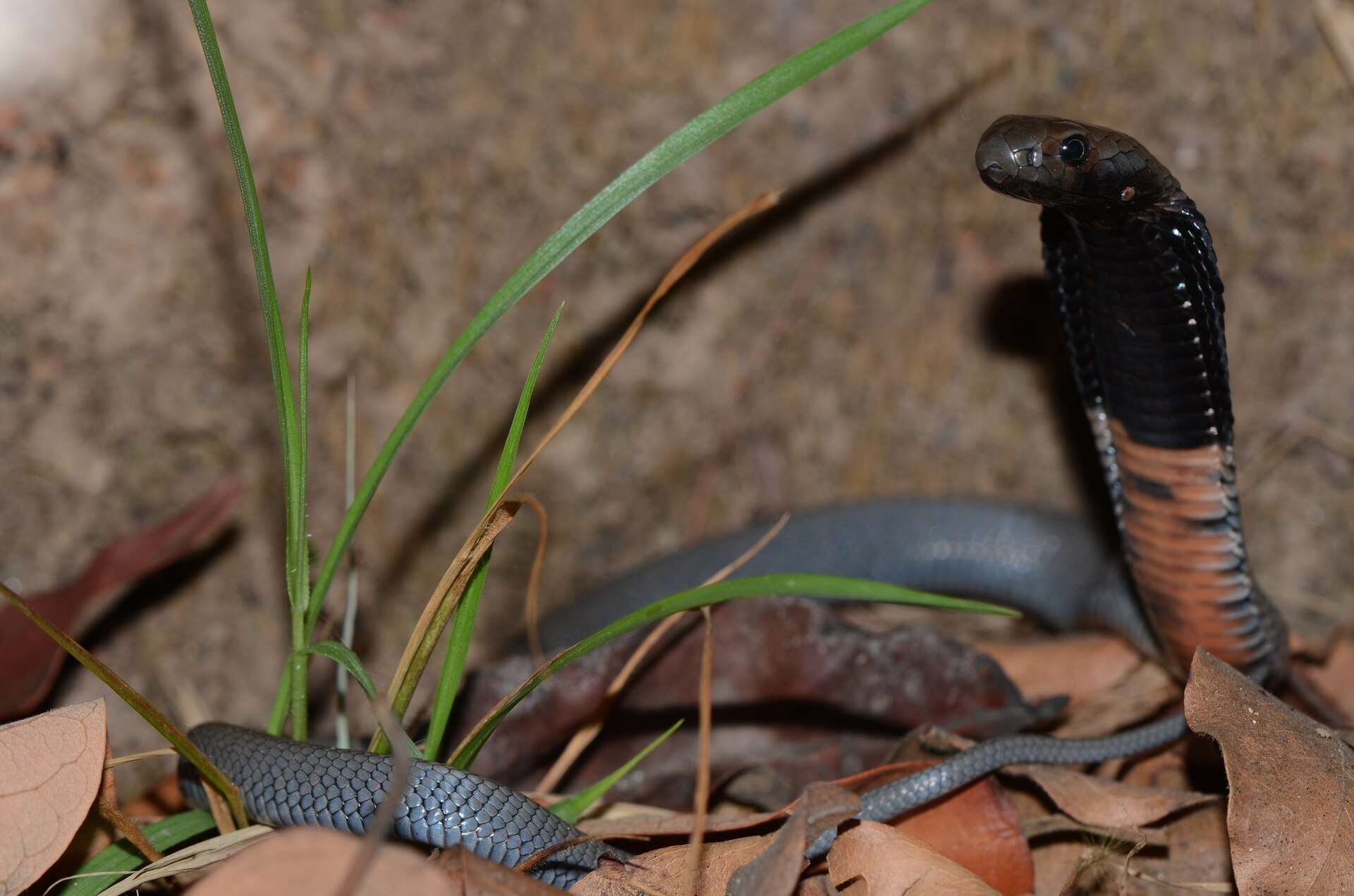
A large African cobra that rears up, spreads a hood and spits venom towards the face of anyone who comes too close. West African snakes are dark grey or black with pinkish-red bands on the throat.

Is it dangerous?
Yes. Its bite destroys tissue, and venom it spits into the eyes can cause blindness. Anyone bitten, or with venom in the eyes, should go to hospital immediately.
Do not approach. If someone is bitten, go to a hospital now.
At a glance
- Length
- 1.25–2.2 m
- Active
- Day and night
- Found in
- Sub-Saharan Africa
- Venom
- Cytotoxic
- Young
- Lays eggs
- Habitat
- Savanna, Farmland, Villages and suburbs
- Diet
- Lizards, Rodents, Birds and eggs
Length shows a typical adult, then the largest recorded.
IUCN Red List status: Least Concern
Country guideSnakes of KenyaSnakes of Nigeria
True size
Philippine cobraMedically significant
1.41 m at most
About three quarters of the height of a 1.7 m adult.
Usual range 1.0–1.41 m, the bar on the ruler.
Mozambique spitting cobraMedically significant
1.8 m at most
About as long as a 1.7 m adult is tall.
Usual range 1.2–1.8 m, the bar on the ruler.
Javan spitting cobraMedically significant
1.85 m at most
About as long as a 1.7 m adult is tall.
Usual range 1.38–1.85 m, the bar on the ruler.
Black-necked spitting cobraMedically significant
2.2 m at most
About 1.5 times the height of a 1.7 m adult.
Usual range 1.25–2.2 m, the bar on the ruler.
Indian cobraMedically significant
2.2 m at most
About 1.5 times the height of a 1.7 m adult.
Usual range 1.25–2.2 m, the bar on the ruler.
Cape cobraMedically significant
2.3 m at most
About 1.5 times the height of a 1.7 m adult.
Usual range 1.2–2.3 m, the bar on the ruler.
Monocled cobraMedically significant
2.3 m at most
About 1.5 times the height of a 1.7 m adult.
Usual range 1.5–2.3 m, the bar on the ruler.
Black mambaMedically significant
4.5 m at most
About 2.5 times the height of a 1.7 m adult.
Usual range 2.5–4.5 m, the bar on the ruler.
Each snake is drawn at the longest length in its profile, on the same scale as the adult. Length is to scale; thickness is not.
Identification
The black-necked spitting cobra is a large cobra that rears up and spreads a hood when threatened4. In West Africa it is dark grey, black or brown above and below, with pinkish-red bands across the throat; in East Africa this dark colour is replaced by yellowish or pale brown2. Its name nigricollis means “black neck” in Latin1. Like other African spitting cobras, its fangs are adapted for spitting venom1.
Adults are usually 100–150 cm long, and the largest recorded reached 220 cm2.
Distribution
This cobra lives in the savannas of Africa from Senegal east to Kenya and south to Angola, Zambia and Tanzania1. The Reptile Database lists 30 countries, from Senegal, the Gambia and Mauritania in the west to Ethiopia and Somalia in the east and Angola and Zambia in the south1.
Habitat
The black-necked spitting cobra is mainly a savanna snake2. In the forest zone of southern Nigeria it is often found in strongly altered places, including suburbs and plantations5. As the rainforest there has been cleared, it has become common and widespread, even in mature secondary forest, while the forest cobra (Naja melanoleuca) has declined6. Around homes, poultry runs are a favourite haunt7.
Behaviour
This cobra is active both by day and at night, may travel some distance in search of food and climbs well4. When threatened it spreads its hood and spits venom, and if pressed it will bite4. Reported spitting distances are about 0.8–2 m3. In experiments with photographs, most black-necked spitting cobras spat at a moving human face rather than at a hand, and the venom landed between the eyes or on one eye3. Many bites happen at night inside homes while people are asleep2.
Diet
The black-necked spitting cobra is a flexible hunter that takes prey on the ground, in trees and even in water5. In southern Nigeria, young cobras eat almost only lizards, mainly the common rainbow agama (Agama agama), while adults eat small mammals, birds and lizards5. It also eats frogs and other snakes, including puff adders4, and bird eggs1. In southern Nigeria it eats much less at the height of the dry season6.
Reproduction
The black-necked spitting cobra lays eggs1. A study in southern Nigeria found that its reduced feeding in the dry season affected adults and juveniles of both sexes alike, and could not be explained by breeding6.
Venom and medical significance
Spitting cobras, including this species, are among the commonest causes of serious snakebite in the West African savanna2. Their bites cause severe local tissue damage rather than paralysis: there is immediate pain and spreading swelling, with blistering in about 60% and tissue death in about 70% of envenomed patients, which can lead to lasting ulcers, scars or loss of function2. In a community study in Malumfashi, northern Nigeria, 5% of people bitten died and 19% of survivors had a lasting disability2. Venom spat into the eyes causes intense pain, swollen eyelids and watering; in Nigeria, more than half of the people spat at had damage to the cornea, and infection of these injuries can cause permanent blindness2,3.
Antivenoms that cover this species include EchiTAb-Plus-ICP, which was raised partly against its venom2,8. Anyone bitten, or with venom in the eyes, should go to hospital immediately.
Conservation
The black-necked spitting cobra is listed as Least Concern on the IUCN Red List (assessed in 2021)9. It has spread into cleared forest areas in southern Nigeria, where it is now very common6.
Similar species
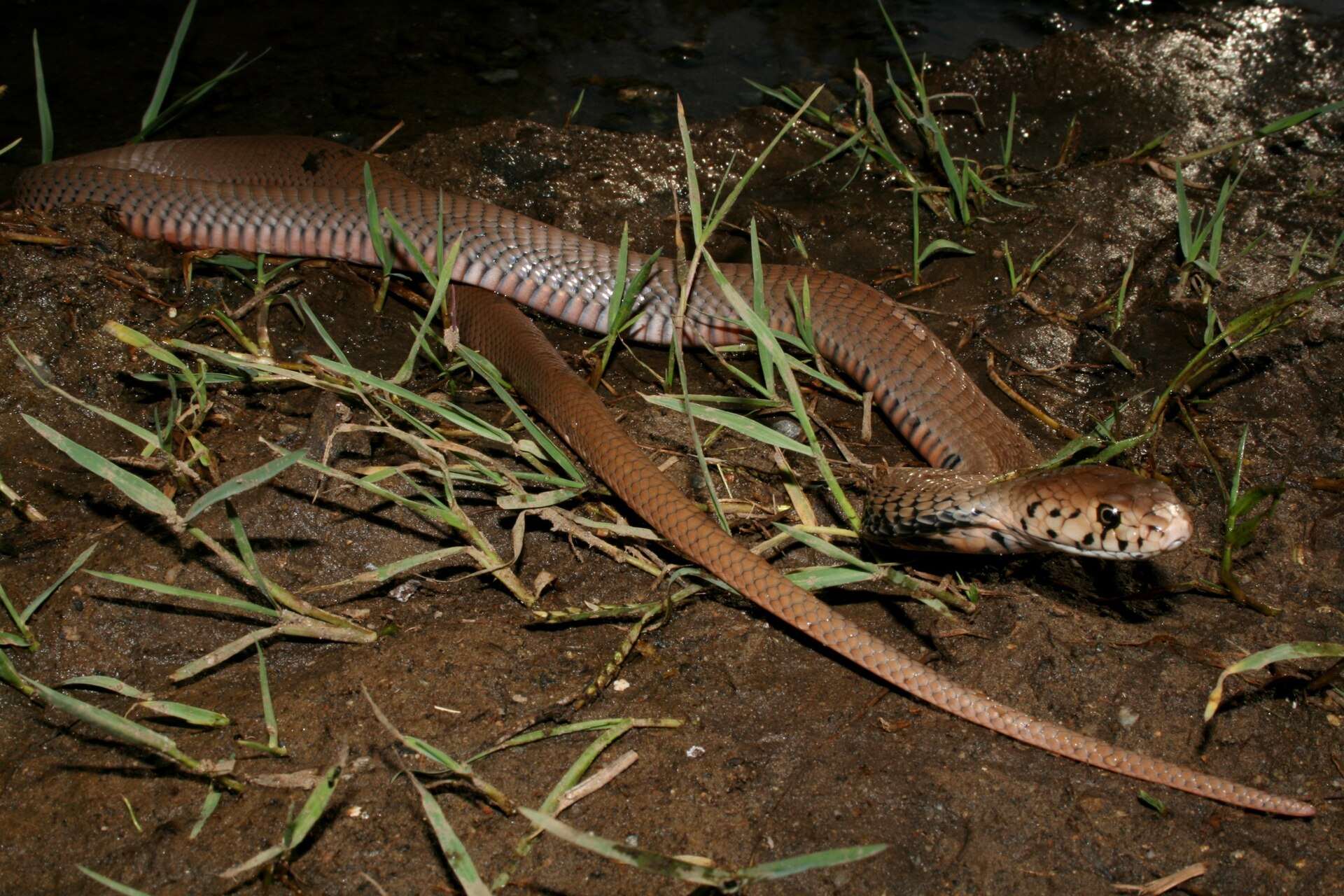
Further south and east, the Mozambique spitting cobra (Naja mossambica) is grey, olive or brown with dark-edged scales and a pale or salmon-pink belly with black bars and blotches on the neck and throat2. The West African black-necked spitting cobra is dark grey, black or brown above and below, with pinkish-red throat bands2. Other cobras in its range, such as the Egyptian cobra (Naja haje) and the forest cobra (N. melanoleuca), do not spit and their bites cause paralysis2. These differences are not a safe basis for handling any snake. Keep your distance from every snake you cannot identify.
In captivity
The black-necked spitting cobra is dangerously venomous and is not suitable as a pet. Captive spitting cobras are a hazard even to experienced keepers: a snake handler in California was left with a mild, long-term loss of sight after an imported black-necked spitting cobra spat into his eye3.
Look-alikes
Don’t confuse it with…
These snakes are often mistaken for each other. Use the differences to learn, never as a reason to handle a snake.
References
- 1
Uetz, P. et al. (eds.) (2026). Naja nigricollis Reinhardt, 1843. The Reptile Database. reptile-database.reptarium.cz
- 2
World Health Organization, Regional Office for Africa (2010). Guidelines for the prevention and clinical management of snakebite in Africa. WHO/AFR/EDM/EDP/10.01, Brazzaville. (Sections 2.1.3, 3.2, 7.3, 7.5, 7.7, 13.5 and Annex 1.) iris.who.int
- 3
Chang, K.-C., Huang, Y.-K., Chen, Y.-W., Chen, M.-H., Tu, A.T. & Chen, Y.-C. (2020). Venom ophthalmia and ocular complications caused by snake venom. Toxins 12(9): 576. doi.org
- 4
African Snakebite Institute. Black-necked Spitting Cobra (Naja nigricollis) species account. africansnakebiteinstitute.com
- 5
Luiselli, L., Angelici, F.M. & Akani, G.C. (2002). Comparative feeding strategies and dietary plasticity of the sympatric cobras Naja melanoleuca and Naja nigricollis in three diverging Afrotropical habitats. Canadian Journal of Zoology 80: 55–63. doi.org
- 6
Luiselli, L. (2002). Life-history correlates of suboptimal adaptation to rainforest biota by spitting cobras, Naja nigricollis, in southern Nigeria: comparative evidences with sympatric forest cobras, Naja melanoleuca. Revue d'Écologie (La Terre et La Vie) 57: 123–133. doi.org
- 7
Habib, A.G. (2013). Public health aspects of snakebite care in West Africa: perspectives from Nigeria. Journal of Venomous Animals and Toxins including Tropical Diseases 19: 27. doi.org
- 8
Abubakar, I.S., Abubakar, S.B., Habib, A.G., Nasidi, A. et al. (2010). Randomised controlled double-blind non-inferiority trial of two antivenoms for saw-scaled or carpet viper (Echis ocellatus) envenoming in Nigeria. PLoS Neglected Tropical Diseases 4(7): e767. doi.org
- 9
Jallow, M., Luiselli, L., Penner, J., Rödel, M.-O., Segniagbeto, G., Niagate, B., Spawls, S., Howell, K., Msuya, C.A. & Ngalason, W. (2021). Naja nigricollis. The IUCN Red List of Threatened Species 2021: e.T13265913A13265918. iucnredlist.org
Play
Play as the black-necked spitting cobra.
Its real pattern is a skin in Snake. Every run ends with a fact.