
Saw-scaled viper
Echis carinatus (Schneider, 1801)
Also called Phoorsa
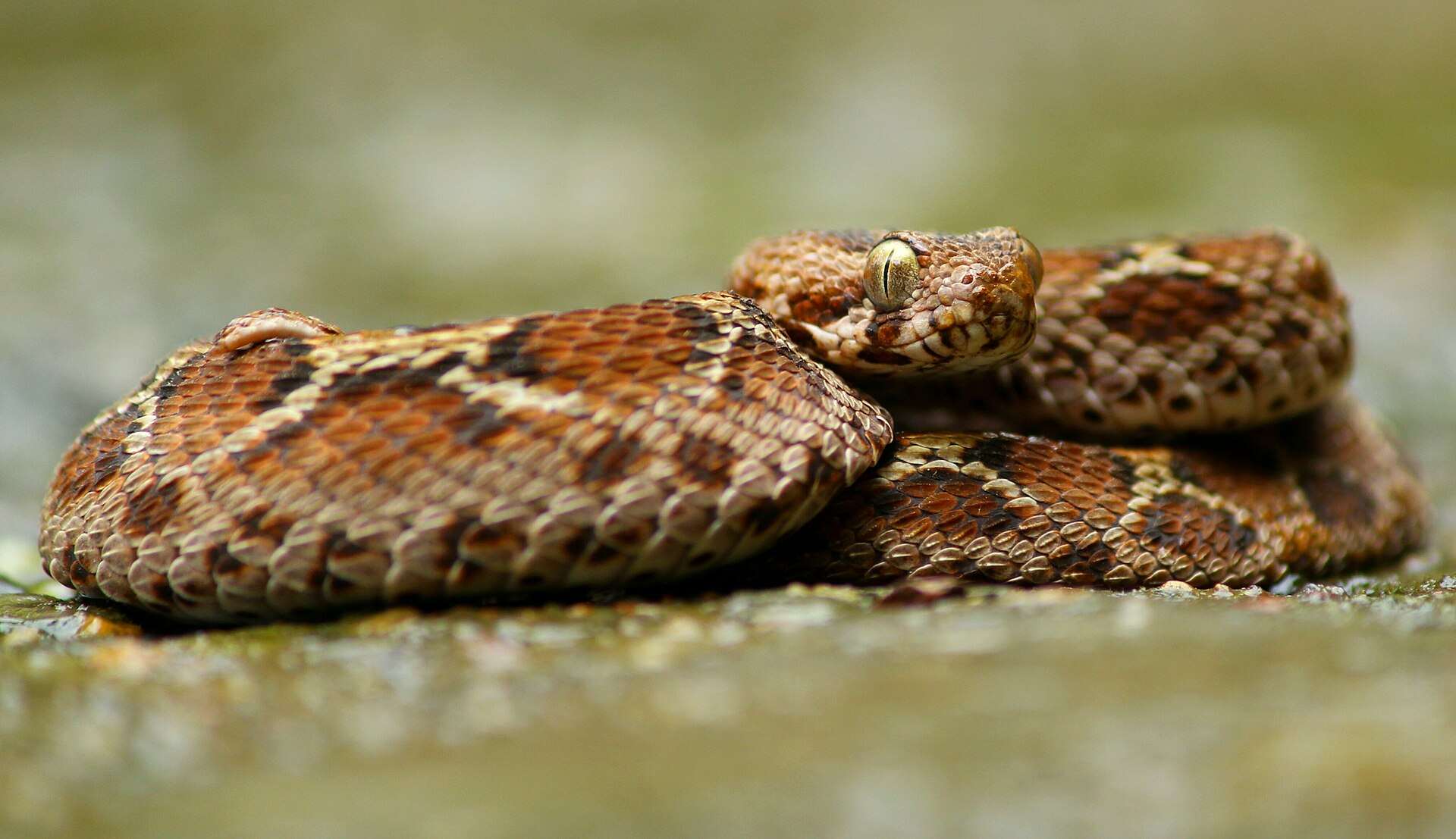
A small, sandy-brown viper of dry country from India and Sri Lanka to Arabia and Central Asia. When threatened it makes a rasping sound with its scales, and it is one of India's most medically important snakes.

Is it dangerous?
Yes. Its venom can stop the blood from clotting and cause serious bleeding. Anyone bitten needs hospital care immediately.
Do not approach. If someone is bitten, go to a hospital now.
At a glance
- Length
- 0.5–0.76 m
- Active
- At night
- Found in
- India to Arabia
- Venom
- Haemotoxic
- Young
- Live young
- Habitat
- Dry scrub, Semi-desert, Rocky areas
- Diet
- Rodents, Lizards, Frogs
Length shows a typical adult, then the largest recorded.
IUCN Red List status: Least Concern
Country guideSnakes of IndiaSnakes of Sri LankaSnakes of Pakistan
True size
Hump-nosed viperMedically significant
0.6 m at most
About a third of the height of a 1.7 m adult.
Usual range 0.48–0.6 m, the bar on the ruler.
West African carpet viperMedically significant
0.7 m at most
About a third of the height of a 1.7 m adult.
Usual range 0.4–0.7 m, the bar on the ruler.
Saw-scaled viperMedically significant
0.76 m at most
About half the height of a 1.7 m adult.
Usual range 0.5–0.76 m, the bar on the ruler.
Common wolf snakeNon-venomous
0.92 m at most
About half the height of a 1.7 m adult.
Usual range 0.7–0.92 m, the bar on the ruler.
Common kraitMedically significant
1.5 m at most
About three quarters of the height of a 1.7 m adult.
Usual range 1.0–1.5 m, the bar on the ruler.
Russell's viperMedically significant
1.68 m at most
About as long as a 1.7 m adult is tall.
Usual range 1.2–1.68 m, the bar on the ruler.
Indian cobraMedically significant
2.2 m at most
About 1.5 times the height of a 1.7 m adult.
Usual range 1.25–2.2 m, the bar on the ruler.
Indian rat snakeNon-venomous
3 m at most
About 2 times the height of a 1.7 m adult.
Usual range 1.8–3.0 m, the bar on the ruler.
Each snake is drawn at the longest length in its profile, on the same scale as the adult. Length is to scale; thickness is not.
Identification
The saw-scaled viper is a small viper with a short, rounded snout, large eyes and strongly keeled scales. It is pale brown, grey or sandy above, with a row of pale, dark-edged spots along the back and a wavy light line along each side. There is usually a whitish cross- or arrow-shaped mark on top of the head1.
Colour varies from brown and olive to reddish, orange or greyish, and the eyes have vertical pupils2. Adults are usually up to about 60 cm long; the largest recorded in Smith’s (1943) account measured about 76 cm1.
Distribution
The saw-scaled viper is found in India, Sri Lanka, Pakistan, Afghanistan, Iran, Oman, the United Arab Emirates, Qatar, Turkmenistan, Uzbekistan and Tajikistan3. It is not known from Bangladesh3.
Two subspecies are recognised. E. c. carinatus lives in peninsular India and Sri Lanka, while E. c. sochureki occurs in northern and north-western India, Pakistan, Afghanistan, Iran and parts of Arabia. Some researchers have proposed treating sochureki as a separate species, but this is still debated3. WHO guidelines describe sochureki as the larger, northern subspecies4.
Habitat
This is mainly a snake of dry country. It is common in semi-desert areas with sandy, poor soil and sparse vegetation, but avoids dense jungle. It shelters under stones and in cracks in rocks, and has been found up to about 1,800 m in Baluchistan1.
In southern India it lives in dry deciduous forest, scrub jungle, grassland and rocky areas, usually hiding under rocks and around small bushes2.
Behaviour
The saw-scaled viper is mainly nocturnal2, but it may also lie in the sun, even in very hot weather1. It can move quickly to escape and strikes very fast when provoked1.
When alarmed it bends its body into coils shaped almost like a figure 8 and rubs them together. The saw-edged keels on its side scales make a rasping, hissing sound1. WHO guidelines describe this “grating rasp” as a warning sound that can identify the snake even in the dark, and list the species among snakes that are quick to strike when disturbed4.
Diet
The saw-scaled viper eats a wide range of prey, including rodents, lizards, frogs and many arthropods such as scorpions, centipedes and large insects5.
In the Thar Desert of Rajasthan, the stomachs of two road-killed E. c. sochureki contained an Indian desert gerbil and a large camel spider, showing that these small vipers can take surprisingly varied prey5.
Reproduction
Unlike other Echis species, which lay eggs, the saw-scaled viper gives birth to live young3. Smith (1943) reported 3–12 young per litter, born in April to June in the Bombay region1.
Litters of up to 23 have been reported from Iran. Newborn snakes measure about 11.5–15 cm. In August 2018, a female in Madurai, Tamil Nadu, was found with nine newborn young under a rock2.
Venom and medical significance
The saw-scaled viper is one of India’s “big four” medically important snakes, with the Indian cobra, common krait and Russell’s viper4. Its bite typically causes local pain and swelling and problems with blood clotting. Its venom contains enzymes that activate prothrombin, using up clotting factors so that the blood may not clot, which can lead to dangerous bleeding4.
About 5–10% of bites cause no symptoms of envenoming4, but every bite must be treated as serious. Bites by the northern subspecies E. c. sochureki may need larger antivenom doses4, and some have responded poorly to the current Indian polyvalent antivenom5. Anyone bitten must go to hospital immediately.
Conservation
The saw-scaled viper is listed as Least Concern on the IUCN Red List (assessed 2021)6. Smith (1943) described it as incredibly common in many districts of India1.
In India it is protected under Schedule II of the Wild Life (Protection) Act, 1972, as amended in 2022, which covers all vipers not listed in Schedule I7.
Similar species
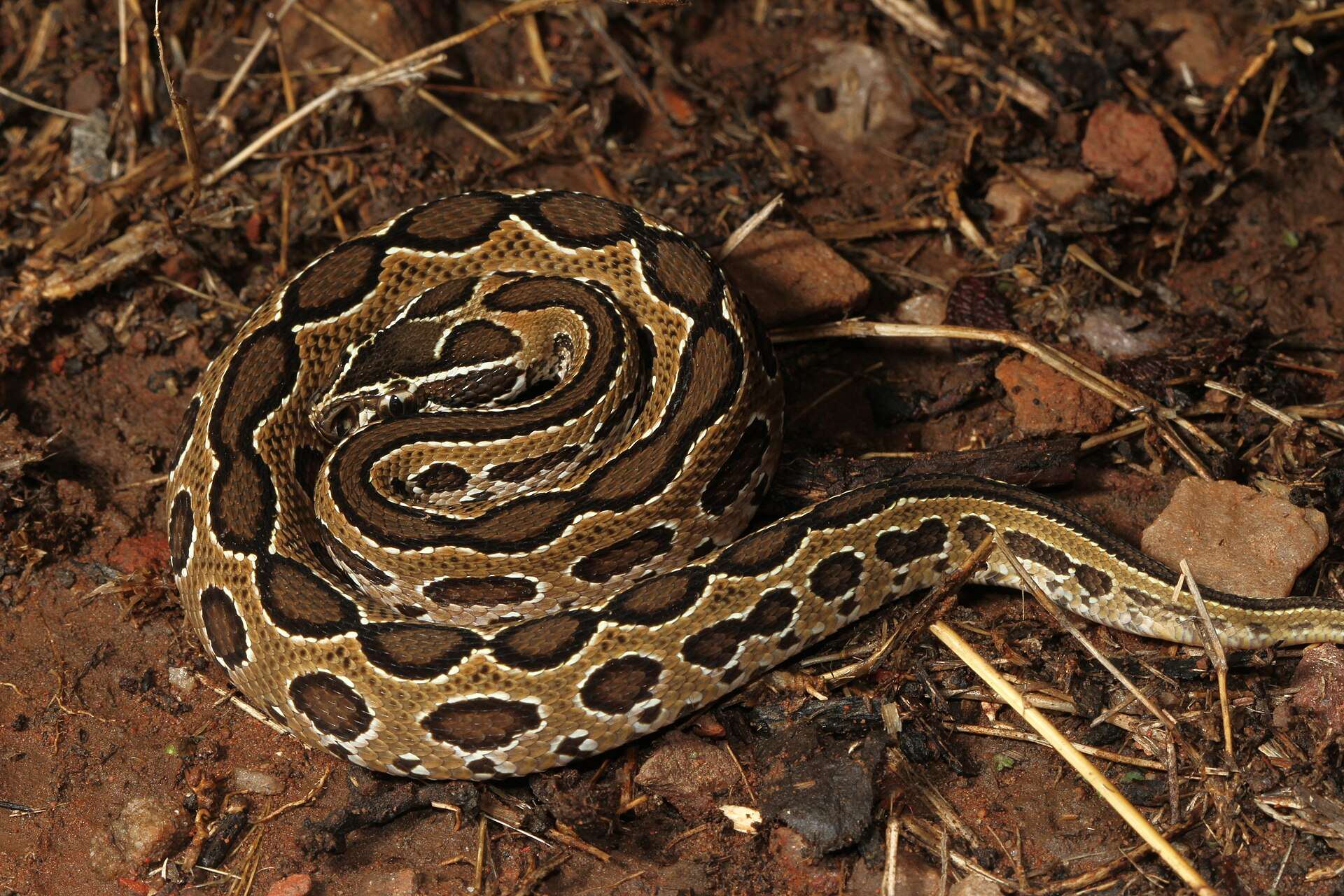
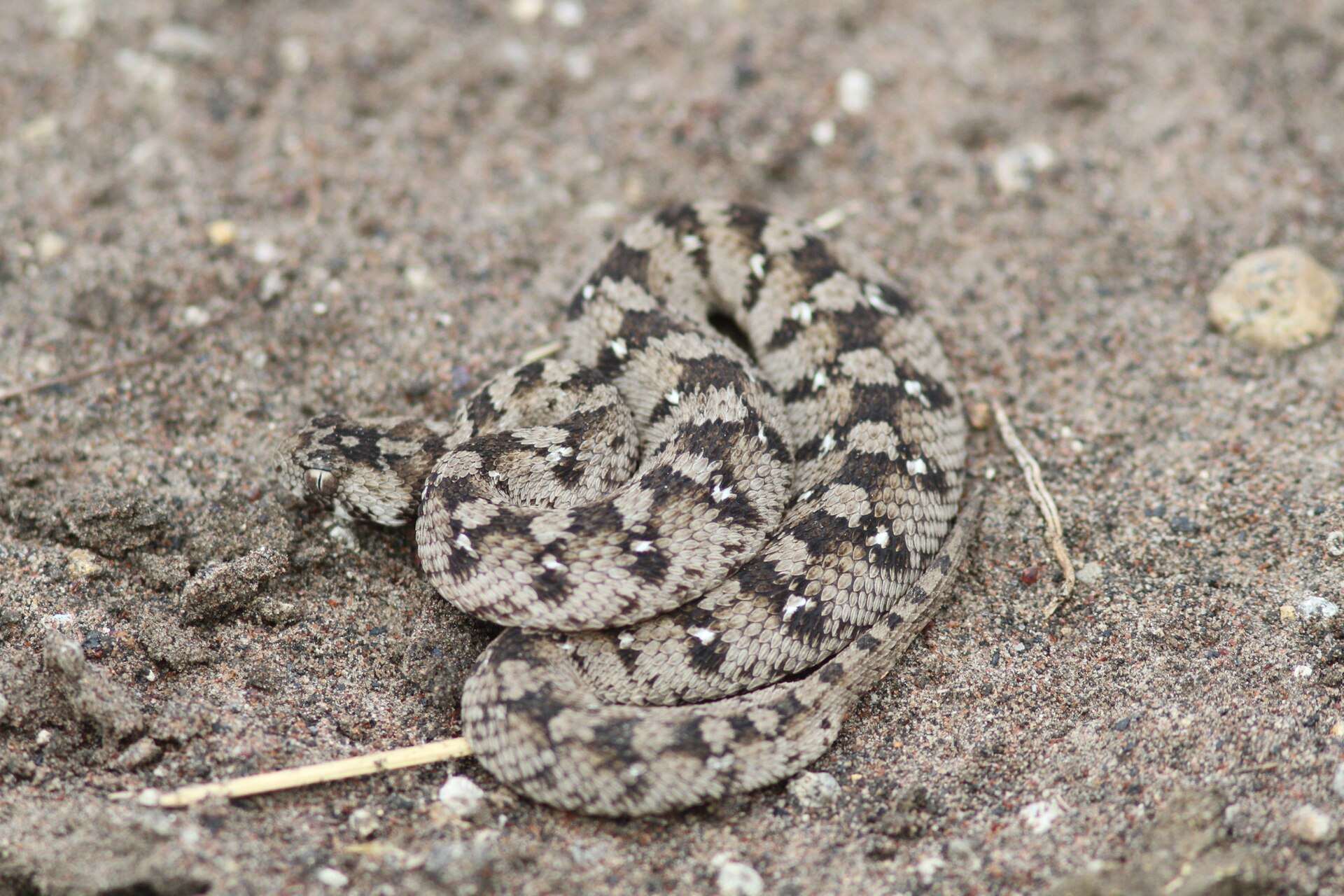
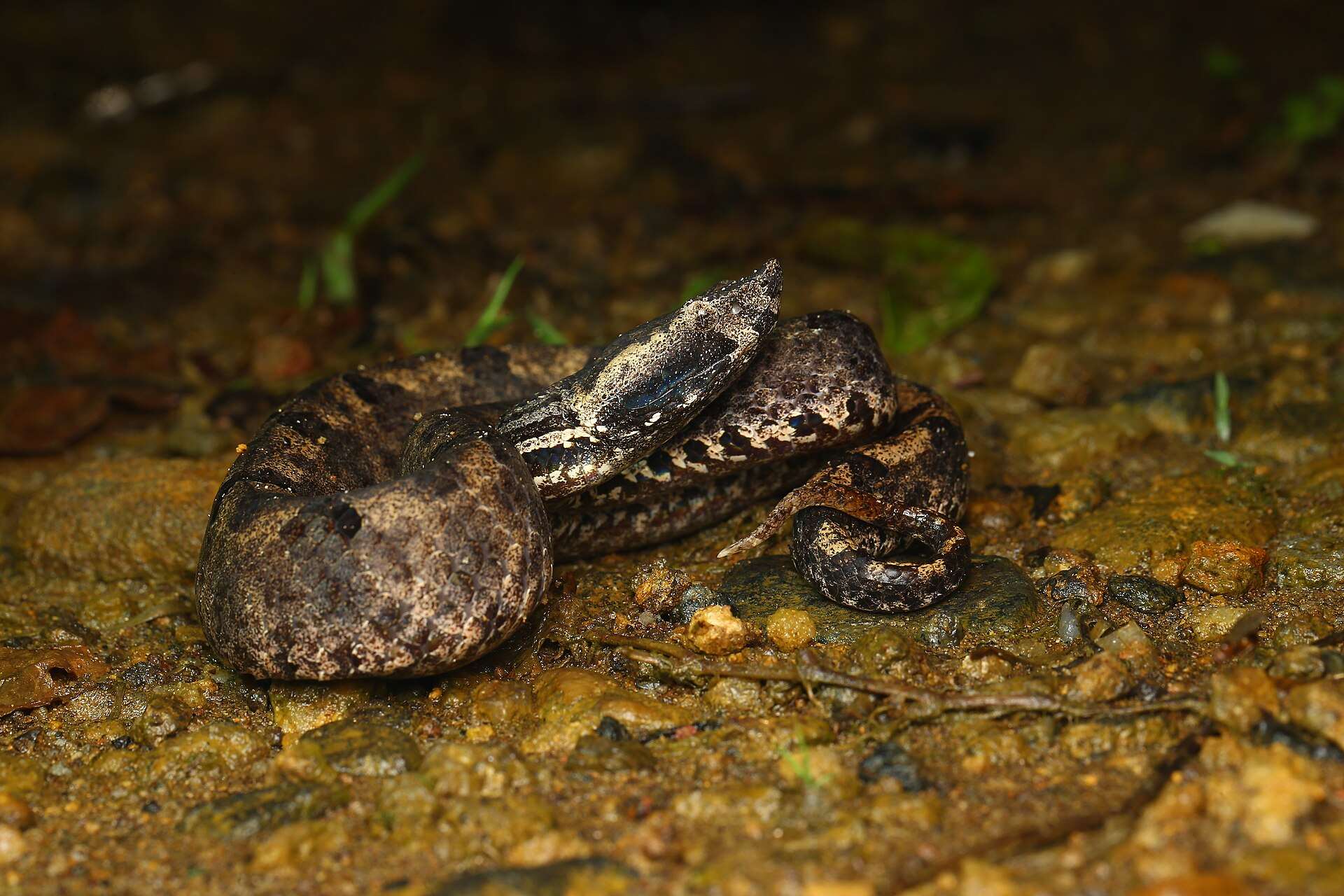
The saw-scaled viper can be confused with other brown vipers, such as Russell’s viper (Daboia russelii), and WHO guidelines note that bites by the hump-nosed pit viper (Hypnale hypnale) have been mistaken for saw-scaled viper bites4.
Some differences: Russell’s viper has neat rows of large, dark-rimmed, pale-centred spots, and it gives a blowing hiss rather than the rasping sound of the saw-scaled viper4. The saw-scaled viper is small, has rough, strongly keeled scales and a pale cross- or arrow-shaped mark on its head1. These differences are not a safe basis for handling any snake.
In captivity
The saw-scaled viper is dangerously venomous and is not suitable as a pet. In India it is listed in Schedule II of the Wild Life (Protection) Act, 1972 (as amended in 2022), and the Act prohibits hunting animals listed in Schedules I and II7.
Look-alikes
Don’t confuse it with…
These snakes are often mistaken for each other. Use the differences to learn, never as a reason to handle a snake.
References
- 1
Smith, M.A. (1943). The Fauna of British India, Ceylon and Burma. Reptilia and Amphibia. Vol. III, Serpentes. Taylor and Francis, London. (Echis carinatus, pp. 487–490.) archive.org
- 2
Samson, K., Abinesh, A., Vishnu, C.S. & Vishwanath, P.R. (2024). An observation on neonate litter size of the venomous Saw-scaled Viper from Madurai, India. Reptile Rap #246, Zoo's Print 39(2): 6–8. zoosprint.org
- 3
Uetz, P. et al. (2026). Echis carinatus (Schneider, 1801). The Reptile Database. reptile-database.reptarium.cz
- 4
World Health Organization, Regional Office for South-East Asia (2016). Guidelines for the management of snakebites, 2nd edition. WHO SEARO, New Delhi. who.int
- 5
Kuttalam, S. et al. (2025). An Indian Desert Gerbil (Meriones hurrianae) and a Camel Spider (Galeodes sp.) as prey of Sindh Saw-scaled Vipers, Echis carinatus sochureki Stemmler 1969, from Rajasthan, India. Reptiles & Amphibians 32: e23070. doi.org
- 6
Ananjeva, N.B. et al. (2021). Echis carinatus. The IUCN Red List of Threatened Species 2021: e.T164694A1068235. iucnredlist.org
- 7
Government of India (2022). The Wild Life (Protection) Amendment Act, 2022 (No. 18 of 2022), Gazette of India; Schedule II, Part C (Reptiles). prsindia.org
Play
Play as the saw-scaled viper.
Its real pattern is a skin in Snake. Every run ends with a fact.