
Indian rock python
Python molurus (Linnaeus, 1758)
Also called Indian python
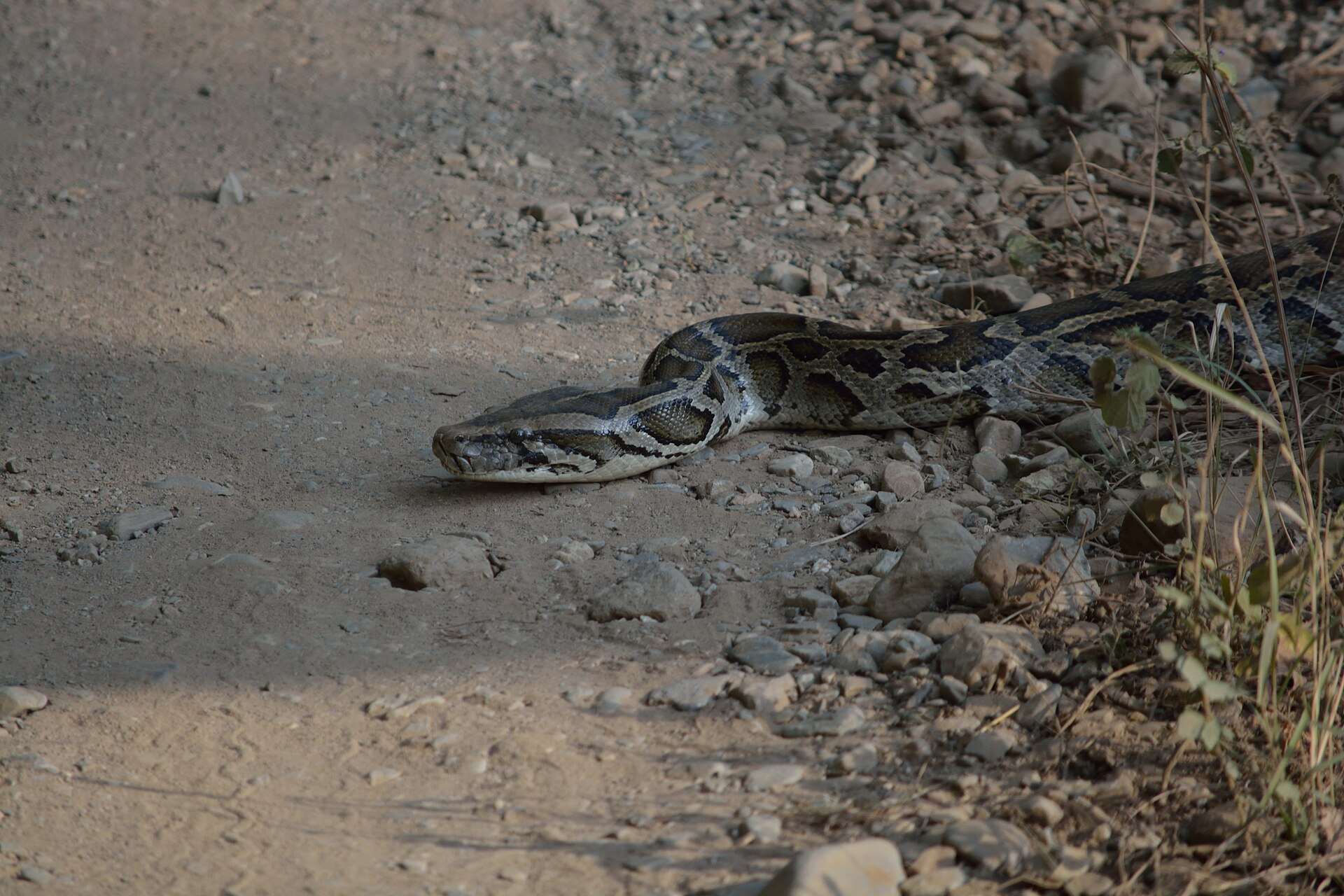
A large, heavy-bodied constrictor of South Asia, pale grey to yellowish with big dark-edged blotches. It is not venomous and kills its prey by squeezing.

Is it dangerous?
No. It has no venom, but it is a large, strong constrictor that can bite if handled. Leave it alone.
Harmless to people, but it may bite if handled. Treat any snake you can’t identify as venomous.
Snakebite first aidAt a glance
- Length
- 3.0–4.3 m
- Active
- Day and night
- Found in
- South Asia
- Venom
- None
- Young
- Lays eggs
- Habitat
- Forest, Rocky hillsides, Rivers and marshes
- Diet
- Deer, Rodents, Other mammals
Length shows a typical adult, then the largest recorded.
IUCN Red List status: Near Threatened
Country guideSnakes of BangladeshSnakes of IndiaSnakes of NepalSnakes of Pakistan
True size
Common wolf snakeNon-venomous
0.92 m at most
About half the height of a 1.7 m adult.
Usual range 0.7–0.92 m, the bar on the ruler.
Common kraitMedically significant
1.5 m at most
About three quarters of the height of a 1.7 m adult.
Usual range 1.0–1.5 m, the bar on the ruler.
Russell's viperMedically significant
1.68 m at most
About as long as a 1.7 m adult is tall.
Usual range 1.2–1.68 m, the bar on the ruler.
Ball pythonNon-venomous
1.83 m at most
About as long as a 1.7 m adult is tall.
Usual range 1.2–1.83 m, the bar on the ruler.
Indian cobraMedically significant
2.2 m at most
About 1.5 times the height of a 1.7 m adult.
Usual range 1.25–2.2 m, the bar on the ruler.
Indian rock pythonNon-venomous
4.3 m at most
About 2.5 times the height of a 1.7 m adult.
Usual range 3.0–4.3 m, the bar on the ruler.
Burmese pythonNon-venomous
5.79 m at most
About 3.5 times the height of a 1.7 m adult.
Usual range 2.6–5.79 m, the bar on the ruler.
Central African rock pythonNon-venomous
7.6 m at most
About 4.5 times the height of a 1.7 m adult.
Usual range 4.0–7.6 m, the bar on the ruler.
Each snake is drawn at the longest length in its profile, on the same scale as the adult. Length is to scale; thickness is not.
Identification
The Indian rock python is a very large, heavy snake with smooth scales in more than 60 rows around the middle of the body1,2. It is grey, whitish or yellowish, with a row of large, roughly square blotches along the back that are sharply outlined in dark brown or black. Smaller blotches run along the sides2. The head has a spear-shaped mark on top and a dark band from the eye to the corner of the mouth2. Small pits on the front lip scales and tiny claw-like spurs beside the vent are typical of pythons1,2.
In a study in Keoladeo National Park, India, pythons measured 1.5–4.3 m long3.
Distribution
The Indian rock python lives in Pakistan, India, Nepal and Bangladesh1. The Reptile Database also lists Bhutan, but notes that the 2021 IUCN assessment excludes Bhutan and Sri Lanka1. Older works, such as Wall’s 1921 book on the snakes of Ceylon, included Sri Lanka in its range2.
The Burmese python of South-East Asia was once treated as a subspecies of this snake. It became a separate species, Python bivittatus, in 2009. Pythons from Thailand and the invasive pythons of Florida belong to that species, not to P. molurus1.
Habitat
This python lives in many kinds of country, from dense forest to sparse woodland on rocky, low hills. Where there is little forest, it stays close to rivers and marshes2. It is very much at home in water and can stay fully under the surface for many minutes2.
In Keoladeo National Park, a seasonal wetland in Rajasthan, pythons spend the winter in ground burrows, often shared with Indian porcupines3. Females have nested in a hollow in a termite mound and in an old jackal burrow4.
Behaviour
Indian rock pythons are slow, calm snakes. Wall described them as among the most sluggish of snakes, rarely trying to escape and seldom fighting back even when attacked2. They swim strongly and can climb trees2.
In Keoladeo, pythons stayed within a few metres of their burrows during the cold months and were often seen basking in daylight3,4. They did not feed in winter, and seemed to rest through the hot, dry months of April to June3. Young pythons in the same park left their nests at night4.
Diet
The Indian rock python kills its prey by holding it in its coils and squeezing2. It mainly eats mammals3. In Keoladeo, 79% of food items were mammals, 17% birds and 4% reptiles3. Spotted deer were the most common prey, found in about 43% of droppings. Other prey included rhesus macaques, jungle cats, mongooses, rats and Bengal monitor lizards3.
Pythons can go a long time between meals. One kept in Trivandrum (now Thiruvananthapuram) fasted for over a year and still looked healthy2.
Reproduction
The Indian rock python lays eggs2,4. In Keoladeo, a 3.9 m female laid 37 eggs and a 3.3 m female laid 19 eggs4. Each female coiled around her eggs and did not eat while guarding them. By shivering, she kept her body at about 32.5 °C even as the air temperature rose and fell4.
The females left their nests after 61 days, and the eggs hatched after 74 days. About 95% of the eggs hatched, and the hatchlings were about 60 cm long4.
Venom and medical significance
The Indian rock python has no venom and is not dangerous to people who leave it alone2. Wall knew of no authentic case of this species swallowing a person2.
Like any large snake, it can give a painful bite if caught or handled, and big pythons are very strong. WHO notes that large pythons, mainly the reticulated python of Indonesia, have occasionally attacked people5. Anyone bitten should seek medical care.
Conservation
The IUCN Red List classes the Indian rock python as Near Threatened (assessed 2021) because of a likely population decline caused by habitat loss and over-exploitation6. In Keoladeo, golden jackals and striped hyenas killed some pythons, others were found dead with porcupine quills in their bodies, and 17% of the dead pythons found had been hit by vehicles3.
In India the species is protected under Schedule I of the Wild Life (Protection) Act4,7. The Indian subspecies is also listed in Appendix I of CITES, which covers international trade in wildlife7.
Similar species
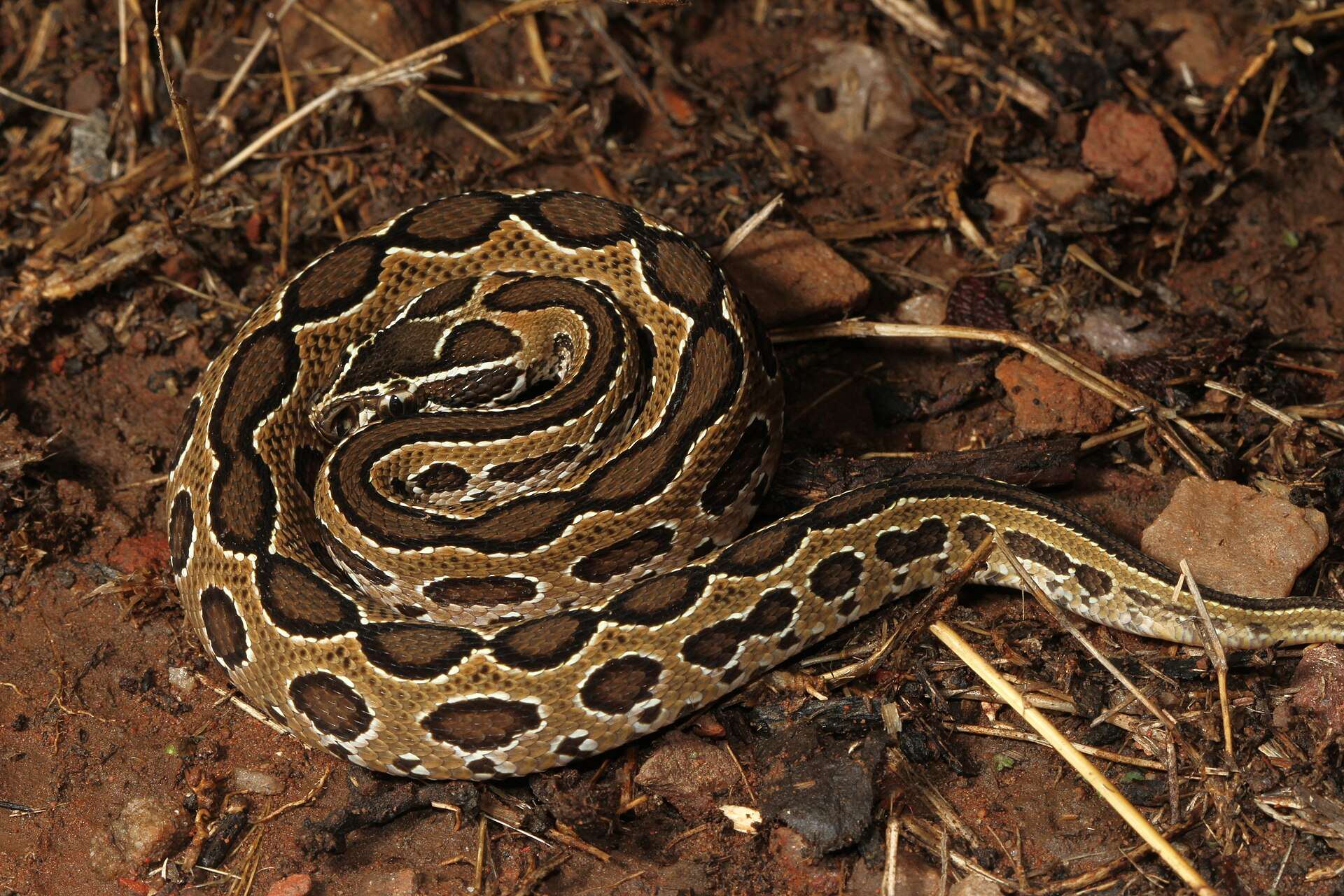
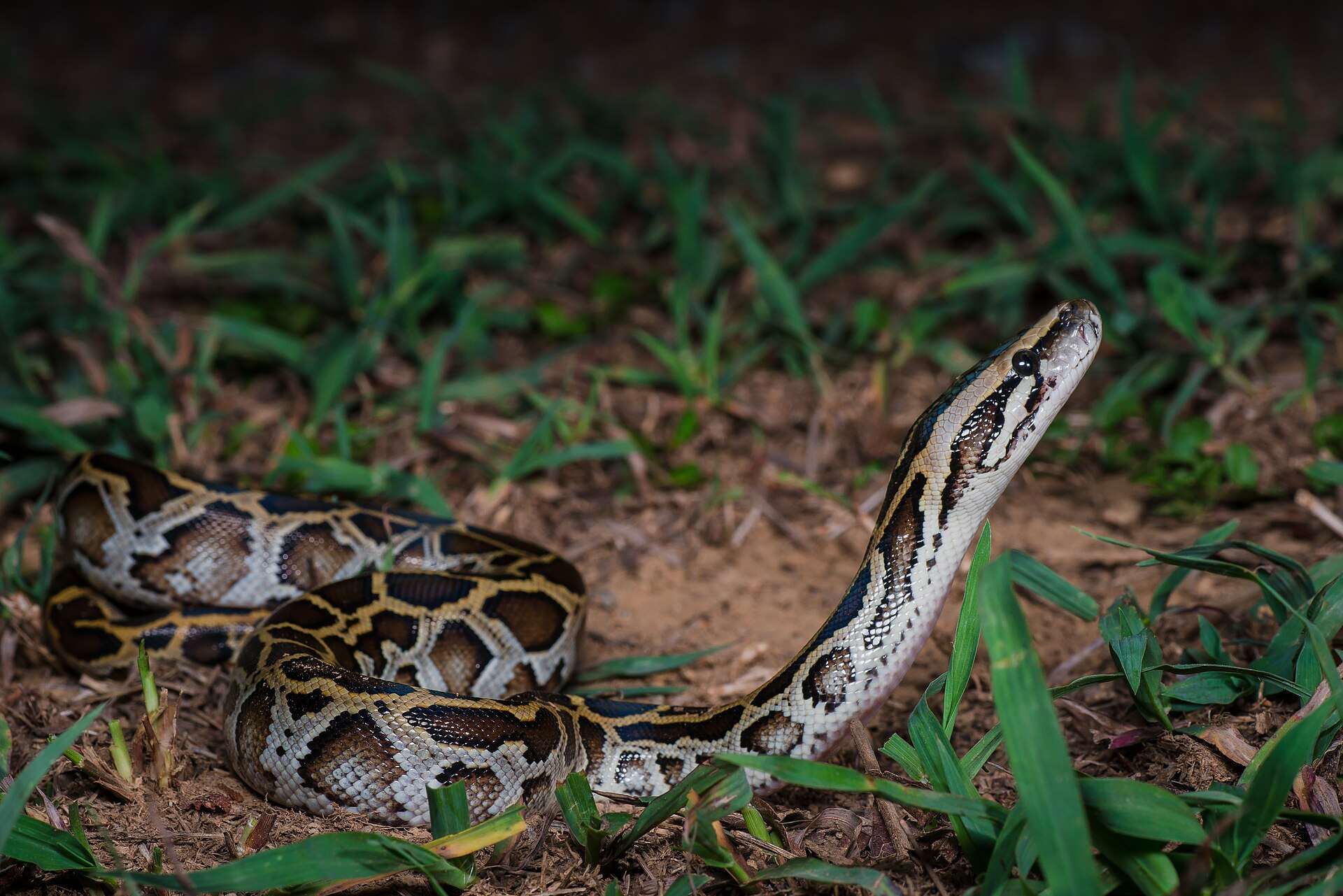
The dangerously venomous Russell’s viper (Daboia russelii) also has large, dark-edged blotches on a pale brown body2,8. The python has smooth scales, while the viper’s scales are strongly keeled and look rough2,8. The viper’s spots are neat, dark-ringed ovals in three rows; the python’s blotches are larger and squarish, with a spear-shaped mark on the head2,5,8. Adult pythons are also much bigger and longer3,8.
These differences are not a safe basis for handling any snake. Russell’s viper is dangerously venomous5, so treat every unidentified snake as dangerous.
In captivity
The Indian rock python is one of the most common snakes in zoos and has often been bred in captivity4. In India it is protected under Schedule I of the Wild Life (Protection) Act, and the Indian subspecies is listed in CITES Appendix I7. Its large size and strength, together with this legal protection, make it unsuitable as a pet3,7.
Look-alikes
Don’t confuse it with…
These snakes are often mistaken for each other. Use the differences to learn, never as a reason to handle a snake.
References
- 1
Uetz, P. et al. (eds.) (2026). Python molurus (Linnaeus, 1758). The Reptile Database. reptile-database.reptarium.cz
- 2
Wall, F. (1921). Ophidia Taprobanica or the Snakes of Ceylon. Colombo Museum; H.R. Cottle, Government Printer, Colombo. Account of Python molurus. archive.org
- 3
Bhupathy, S., Ramesh, C. & Bahuguna, A. (2014). Feeding habits of Indian rock pythons in Keoladeo National Park, Bharatpur, India. Herpetological Journal 24: 59–64. thebhs.org
- 4
Ramesh, C. & Bhupathy, S. (2010). Breeding biology of Python molurus molurus in Keoladeo National Park, Bharatpur, India. Herpetological Journal 20: 157–163. thebhs.org
- 5
World Health Organization, Regional Office for South-East Asia (2016). Guidelines for the Management of Snakebites, 2nd edition (Warrell, D.A., ed.). New Delhi: WHO SEARO. iris.who.int
- 6
Aengals, A., Das, A., Mohapatra, P., Srinivasulu, C., Srinivasulu, B., Shankar, G. & Murthy, B.H.C. (2021). Python molurus. The IUCN Red List of Threatened Species 2021: e.T58894358A1945283. iucnredlist.org
- 7
Government of India (2022). The Wild Life (Protection) Amendment Act, 2022 (No. 18 of 2022). The Gazette of India, Extraordinary, Part II, Section 1. Schedule I, Part C (Reptiles); Schedule IV (CITES Appendices). prsindia.org
- 8
Uetz, P. et al. (eds.) (2026). Daboia russelii (Shaw & Nodder, 1797). The Reptile Database. reptile-database.reptarium.cz
Play
Play as the indian rock python.
Its real pattern is a skin in Snake. Every run ends with a fact.