
Ball python
Python regius (Shaw, 1802)
Also called Royal python
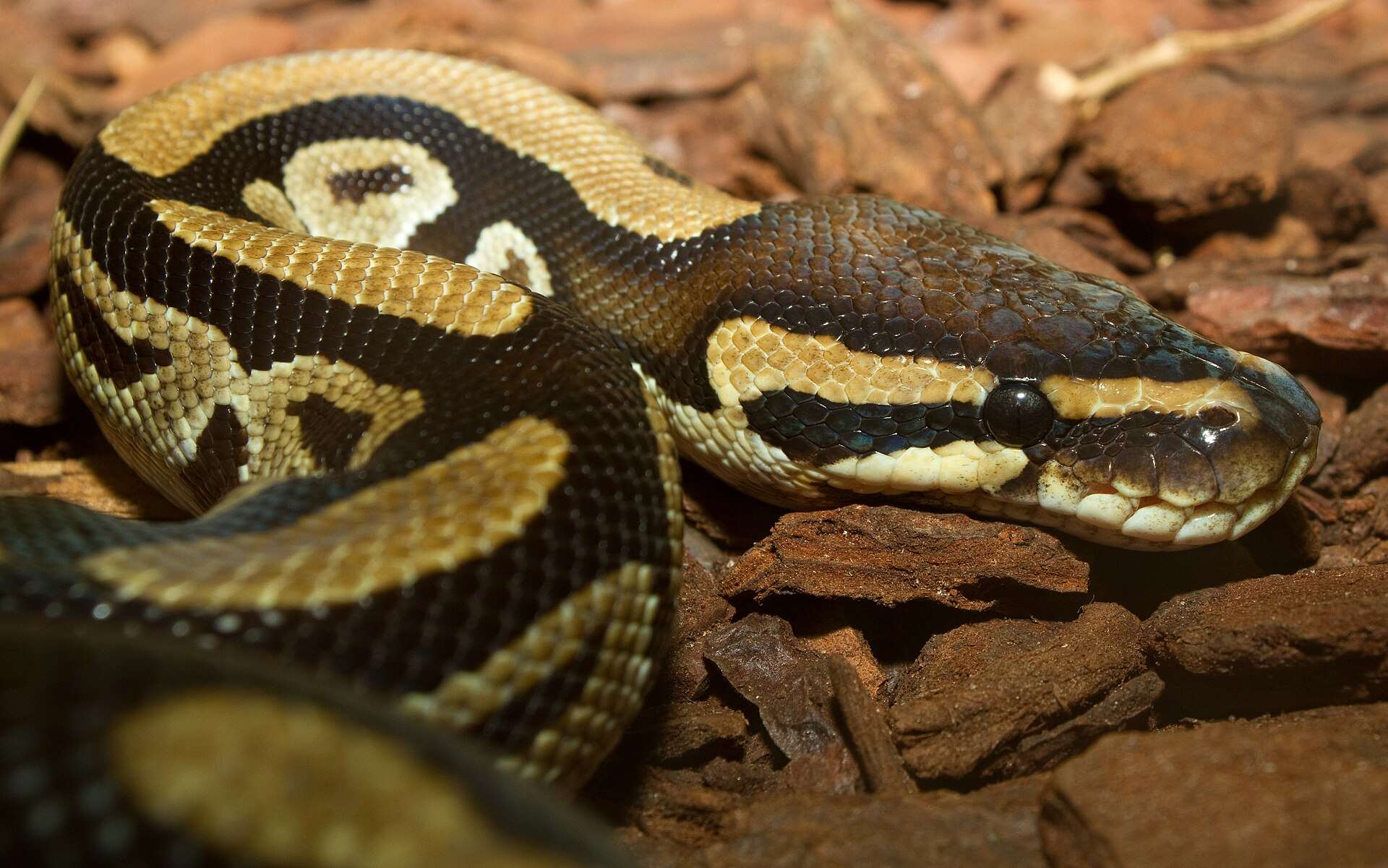
A small, stocky python of West and Central Africa, dark brown with large tan blotches. It curls into a tight ball when threatened, is harmless to people and is one of the world's most popular pet snakes.

Is it dangerous?
No. It has no venom and kills its prey by constriction. It usually curls into a tight ball when threatened, but it may bite if handled roughly.
Harmless to people, but it may bite if handled. Treat any snake you can’t identify as venomous.
Snakebite first aidAt a glance
- Length
- 1.2–1.83 m
- Active
- At night
- Found in
- West and Central Africa
- Venom
- None
- Young
- Lays eggs
- Habitat
- Savanna, Open woodland, Forest edges
- Diet
- African giant rats, Black rats, Grass mice
- Lifespan
- About 20 years in captivity
Length shows a typical adult, then the largest recorded.
IUCN Red List status: Near Threatened
Country guideSnakes of Nigeria
GuidesBall python care
True size
Gaboon viperMedically significant
1.75 m at most
About as long as a 1.7 m adult is tall.
Usual range 1.0–1.75 m, the bar on the ruler.
Ball pythonNon-venomous
1.83 m at most
About as long as a 1.7 m adult is tall.
Usual range 1.2–1.83 m, the bar on the ruler.
Puff adderMedically significant
1.9 m at most
About as long as a 1.7 m adult is tall.
Usual range 0.8–1.9 m, the bar on the ruler.
Black-necked spitting cobraMedically significant
2.2 m at most
About 1.5 times the height of a 1.7 m adult.
Usual range 1.25–2.2 m, the bar on the ruler.
BoomslangMedically significant
2.3 m at most
About 1.5 times the height of a 1.7 m adult.
Usual range 1.3–2.3 m, the bar on the ruler.
Indian rock pythonNon-venomous
4.3 m at most
About 2.5 times the height of a 1.7 m adult.
Usual range 3.0–4.3 m, the bar on the ruler.
Burmese pythonNon-venomous
5.79 m at most
About 3.5 times the height of a 1.7 m adult.
Usual range 2.6–5.79 m, the bar on the ruler.
Central African rock pythonNon-venomous
7.6 m at most
About 4.5 times the height of a 1.7 m adult.
Usual range 4.0–7.6 m, the bar on the ruler.
Each snake is drawn at the longest length in its profile, on the same scale as the adult. Length is to scale; thickness is not.
Identification
The ball python is a small, heavy-bodied python whose head is noticeably wider than its fairly slender neck2. Wild-type snakes have large dark brown markings with lighter brown or tan patches between them, often a yellowish stripe running from the nostril through the eye, and an ivory-white belly2. Adult females are larger than males2. Pet ball pythons are often bred into unusual colour and pattern forms called “morphs”, which can look very different from wild snakes5.
Hatchlings are 25–43 cm long, and adults are usually 1–1.5 m2. The RSPCA gives a typical adult length of around 150 cm8, and there are reports of wild ball pythons reaching 1.83 m2.
Distribution
The ball python is native to western Africa and the northern parts of central and eastern Africa, from Senegal to South Sudan and Uganda3. The Reptile Database lists Senegal, the Gambia, Guinea-Bissau, Guinea, Sierra Leone, Côte d’Ivoire, Ghana, Togo, Benin, south-western Niger, Burkina Faso, Mali, Nigeria, Cameroon, the Central African Republic, northern Democratic Republic of the Congo, South Sudan and Uganda1. It also lists Liberia, but notes a 2014 study that found the species does not occur there1.
Habitat
Ball pythons live in a wide range of savanna habitats, including open woodland, rainforest edges, mixtures of forest and plantations, and farmland3. They are also found in grassland and in areas cleared for farming, often near open water2. By day they rest in old rodent burrows, termite mounds, under dead oil palms or in piles of grass and leaves, which is where hunters look for them3.
Behaviour
The ball python is mainly active at night2,3. It spends most of its time on or under the ground, often in burrows, although it can climb2.
When threatened, it rolls into a tight ball with its head hidden in the middle, which gives the species its common name2. Other defences include camouflage, trying to escape, bluffing and, less often, biting2. Its scientific name regius means “kingly”; it is said to have been kept as a pet by African kings and other rulers1.
Diet
The ball python is an ambush hunter that waits at a good spot and strikes quickly at passing prey2. It kills larger prey by constriction and feeds almost entirely on rodents, including African giant rats, black rats, shaggy rats and grass mice2. It eats infrequently, and its gut can adjust to long periods between meals2.
Reproduction
The ball python lays eggs2. Mating takes place mainly from mid-September to mid-November, and eggs are laid in the second half of the dry season, from mid-February to early April2. A clutch holds 1–11 eggs, usually about 72.
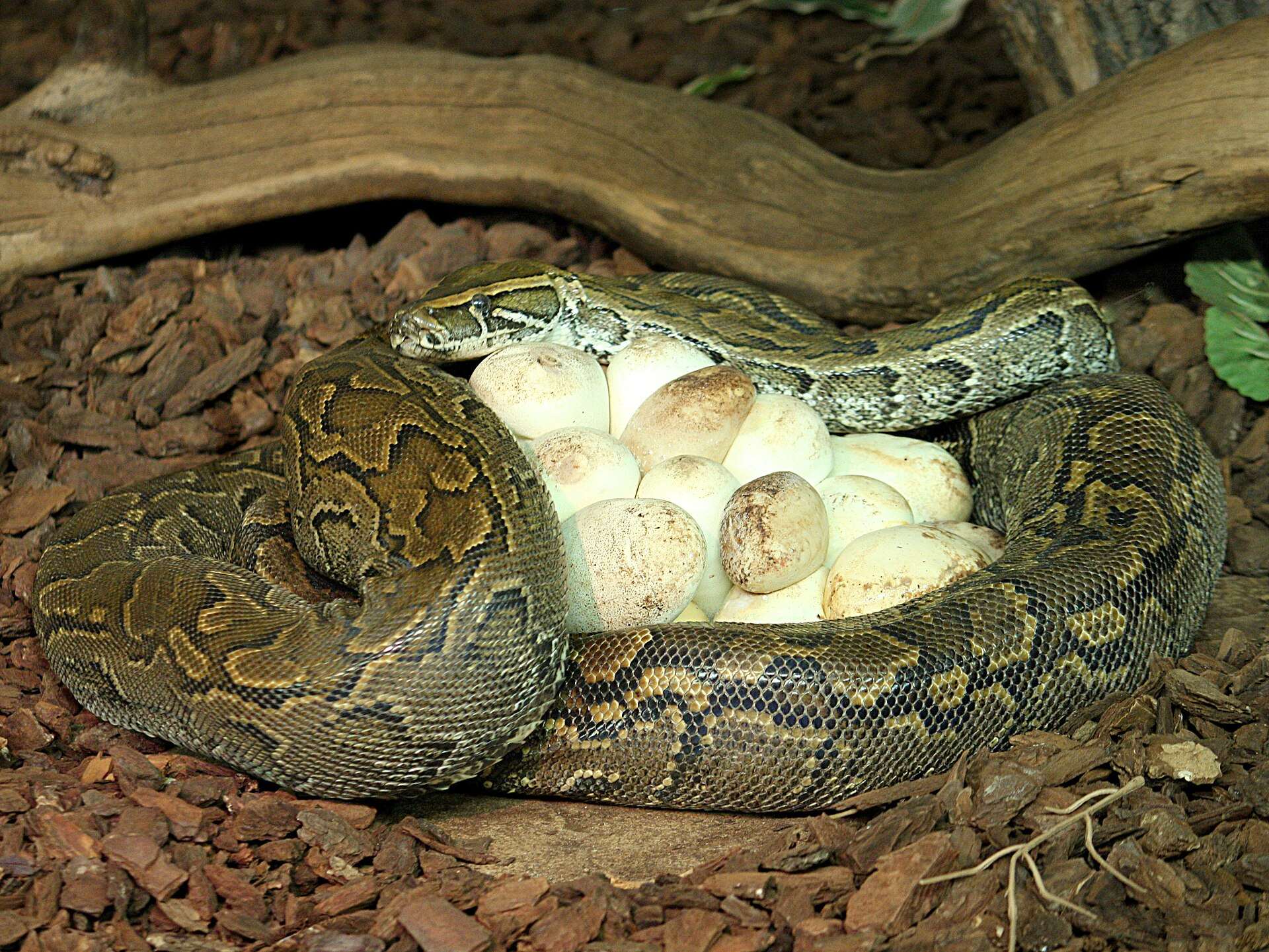
The female coils around her eggs until they hatch about two months later2. A study in Togo found that brooding barely changed egg temperature but greatly reduced water loss, and brooded eggs produced larger, more active young4. Hunters collect gravid females and eggs, mostly from January to March, to supply snake farms3.
Venom and medical significance
The ball python has no venom; it kills its prey by constriction8. It is a small python, and adults rarely grow longer than about 1.5 m2,8. Its usual response to a threat is to curl into a ball rather than strike, although it may bite in defence2.
Conservation
The ball python is listed as Near Threatened on the IUCN Red List (2022 assessment)7. It is the most traded CITES-listed live animal exported from Africa, and the species is listed in Appendix II of CITES3. Up to 2017, about one million live ball pythons had been exported from each of Benin, Ghana and Togo, more than 99% of them for commercial use3. Most exports now come from “ranching”, in which eggs and young are taken from the wild and reared on farms3. Three-quarters of hunters surveyed in Togo said there were fewer snakes than five years earlier3.
Similar species
Young African rock pythons (Python sebae) can be mistaken for ball pythons. The rock python has a staircase-like pattern of dark blotches, a pale spearhead mark on top of the head and a yellow, inverted V under each eye, and adults grow to 3–5 m9. The ball python has large brown blotches with lighter patches, often a yellowish stripe through the eye, and rarely exceeds 1.5 m2. These differences are not a safe basis for handling any snake. Keep your distance from every snake you cannot identify.
In captivity
The ball python is one of the most commonly kept pet reptiles, and its popularity is partly due to its docile nature6. Captive ball pythons live about 20 years on average, with reports of individuals living to about 50 years2. The RSPCA recommends an enclosure at least as long as the snake, several hides and a water bowl large enough to bathe in5,8, but a survey of breeders and pet expos in Europe and North America found most snakes were kept in conditions below these minimum recommendations5.
Look-alikes
Don’t confuse it with…
These snakes are often mistaken for each other. Use the differences to learn, never as a reason to handle a snake.
References
- 1
Uetz, P. et al. (eds.) (2026). Python regius (Shaw, 1802). The Reptile Database. reptile-database.reptarium.cz
- 2
Graf, A. (2011). Python regius. Animal Diversity Web, University of Michigan Museum of Zoology. animaldiversity.org
- 3
Harrington, L.A., Green, J., Muinde, P., Macdonald, D.W., Auliya, M. & D'Cruze, N. (2020). Snakes and ladders: a review of ball python production in West Africa for the global pet market. Nature Conservation 41: 1–24. doi.org
- 4
Aubret, F., Bonnet, X., Shine, R. & Maumelat, S. (2005). Why do female ball pythons (Python regius) coil so tightly around their eggs? Evolutionary Ecology Research 7: 743–758. hal.science
- 5
D'Cruze, N., Paterson, S., Green, J., Megson, D., Warwick, C., Coulthard, E., Norrey, J., Auliya, M. & Carder, G. (2020). Dropping the ball? The welfare of ball pythons traded in the EU and North America. Animals 10(3): 413. doi.org
- 6
Green, J., Coulthard, E., Megson, D., Norrey, J., Norrey, L., Rowntree, J.K., Bates, J., Dharmpaul, B., Auliya, M. & D'Cruze, N. (2020). Blind trading: a literature review of research addressing the welfare of ball pythons in the exotic pet trade. Animals 10(2): 193. doi.org
- 7
D'Cruze, N., Wilms, T., Penner, J., Luiselli, L., Jallow, M., Segniagbeto, G., Niagate, B. & Schmitz, A. (2022). Python regius. The IUCN Red List of Threatened Species 2022: e.T177562A220378972. iucnredlist.org
- 8
RSPCA. Royal python care. rspca.org.uk
- 9
Sherman, P. (2006). Python sebae. Animal Diversity Web, University of Michigan Museum of Zoology. animaldiversity.org
Play
Play as the ball python.
Its real pattern is a skin in Snake. Every run ends with a fact.