
Burmese python
Python bivittatus Kuhl, 1820
Also called Burmese rock python
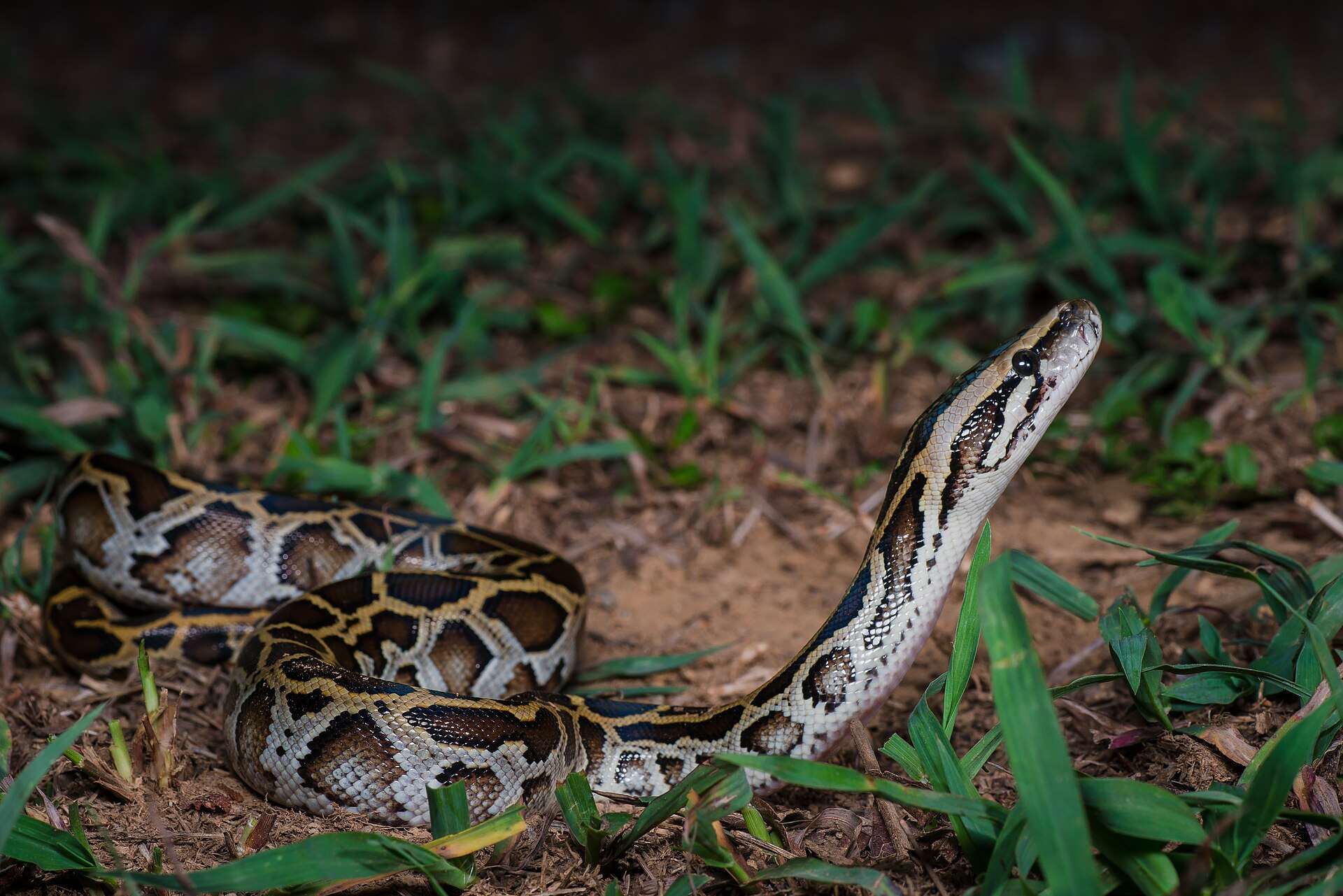
A huge, heavy-bodied python of South and South-East Asia, tan with large dark-edged brown blotches and an arrow-shaped mark on its head. It is not venomous, and an invasive population now lives in southern Florida.

Is it dangerous?
No. It has no venom, but it is a huge, strong constrictor that can give a painful bite. Wild ones very rarely harm people; leave it alone.
Harmless to people, but it may bite if handled. Treat any snake you can’t identify as venomous.
Snakebite first aidAt a glance
- Length
- 2.6–5.79 m
- Weight
- Up to about 97.5 kg
- Active
- Day and night
- Found in
- South and South-East Asia
- Venom
- None
- Young
- Lays eggs
- Habitat
- Grassland, Swamps and marshes, Open forest
- Diet
- Mammals, Birds, Reptiles
- Lifespan
- 28–34 years in captivity
Length shows a typical adult, then the largest recorded.
IUCN Red List status: Vulnerable
Country guideSnakes of BangladeshSnakes of IndonesiaSnakes of IndiaSnakes of Nepal
True size
Malayan pit viperMedically significant
0.87 m at most
About half the height of a 1.7 m adult.
Usual range 0.7–0.87 m, the bar on the ruler.
Ball pythonNon-venomous
1.83 m at most
About as long as a 1.7 m adult is tall.
Usual range 1.2–1.83 m, the bar on the ruler.
Banded kraitMedically significant
2.25 m at most
About 1.5 times the height of a 1.7 m adult.
Usual range 1.35–2.25 m, the bar on the ruler.
Indian rock pythonNon-venomous
4.3 m at most
About 2.5 times the height of a 1.7 m adult.
Usual range 3.0–4.3 m, the bar on the ruler.
King cobraMedically significant
5.5 m at most
About 3 times the height of a 1.7 m adult.
Usual range 3.0–5.5 m, the bar on the ruler.
Burmese pythonNon-venomous
5.79 m at most
About 3.5 times the height of a 1.7 m adult.
Usual range 2.6–5.79 m, the bar on the ruler.
Central African rock pythonNon-venomous
7.6 m at most
About 4.5 times the height of a 1.7 m adult.
Usual range 4.0–7.6 m, the bar on the ruler.
Reticulated pythonNon-venomous
7.67 m at most
About 4.5 times the height of a 1.7 m adult.
Usual range 2.5–7.67 m, the bar on the ruler.
Each snake is drawn at the longest length in its profile, on the same scale as the adult. Length is to scale; thickness is not.
Identification
The Burmese python is a very large, heavy-bodied snake1. It has large reddish-brown blotches, outlined in cream or gold, on a pale tan, yellowish-brown or grey background2. On top of the head is a clear arrow-shaped mark pointing towards the nose1,2. Like other members of its genus, it has a dark patch below the eye9. Females grow much bigger than males: up to 1.5–1.8 m longer, and the heaviest females weigh nearly twice as much as the heaviest males (85 kg against 44 kg)3.
In the native range, females are thought to mature at about 2.6 m long3. In southern Florida, almost half of the thousands of pythons measured were adults 1.6–2.4 m from snout to vent3. The longest wild Burmese python on record is a 5.79 m female caught in Florida in 20234, and a captive female measured after death was 5.74 m5. The heaviest weigh about 97.5 kg3.
Distribution
The Burmese python is native to south-eastern Nepal, north-eastern India, southern Bhutan, Bangladesh, Myanmar, Thailand, Laos, Cambodia, Vietnam and southern China (including Hainan and Hong Kong), and in Indonesia to Java, Bali and Sulawesi1. Records from Sumatra and Borneo are thought to be mistakes1. It was long treated as a subspecies of the Indian rock python, Python molurus, and was raised to a full species in 20091,10.
It has also been introduced to southern Florida in the United States1. Pythons were found in the Everglades from 1979, and a breeding population was confirmed around 20003. Most were probably released or escaped pets2. Today pythons live across much of southern Florida, including the Florida Keys, and more than 13,700 had been removed by the end of 20213.
Habitat
In its native range it lives in grassland, swamps, marshes, rocky foothills, open jungle, woodland and river valleys, and it depends on permanent fresh water2. In Florida it lives mainly in the wetlands of the Greater Everglades, and it also uses canals and drainage ditches in built-up areas to move around3.
Behaviour
Burmese pythons are excellent swimmers and often rest partly or fully under water2. They are mostly ambush hunters: four wild females tracked in the Everglades spent about 86% of their time resting, often staying put for more than a day3. They can also travel several kilometres and will climb to raid bird nests3. They are sensitive to cold, and below about 10 °C they are increasingly at risk of dying3.
Diet
The Burmese python eats a wide range of animals, mostly mammals and birds, with a few lizards, frogs and snakes recorded in its native range3. It kills prey by constriction3. In Asia, large pythons have eaten leopards, deer, antelope, jackals, porcupines, goats, wild boar and langur monkeys3. In Florida, prey has included American alligators, white-tailed deer, bobcats and threatened wood storks, as well as mice, rats and rabbits3.
Reproduction
The Burmese python lays eggs2,3. Clutches average about 29–50 eggs and can reach 1072. The female coils around her eggs and guards them, and she can shiver to raise their temperature during cool weather2,3. The eggs hatch about two months after they are laid, and in the native range hatchlings are 48–79 cm long3. There is evidence that females may sometimes reproduce without a male1.
Venom and medical significance
The Burmese python has no venom3. Like other large pythons it can occasionally attack people8, but wild Burmese pythons rarely do. Only one credible report is known of a person killed by a wild Burmese python, an infant in Hong Kong in 1900, and no one has been killed by a wild python in Florida3. The few recorded deaths in Florida were caused by captive pythons3. Most bites happen when people try to catch one, and five unprovoked strikes on biologists in Everglades National Park from 2003 to 2012 caused no serious injury3. Anyone bitten should seek medical care.
Conservation
The Burmese python is listed as Vulnerable on the IUCN Red List (assessed in 2012)6. In its native range, people are thought to be its main cause of death, through habitat loss and over-collection3. In Florida, by contrast, it is a damaging invasive species: in Everglades National Park, sightings of raccoons, opossums, rabbits, foxes and deer fell by 85–100% between 2003 and 2011 as pythons spread3.
Similar species
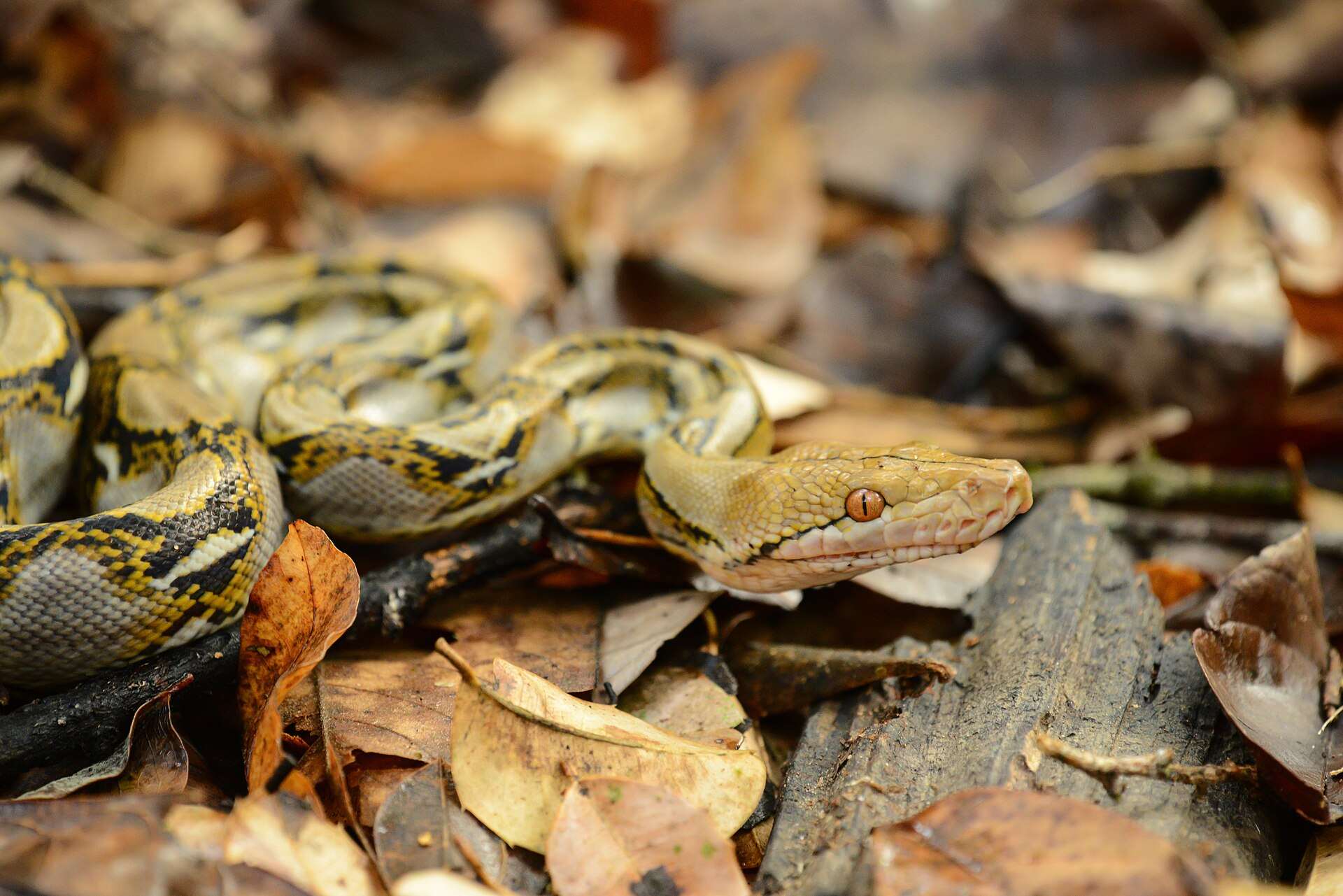
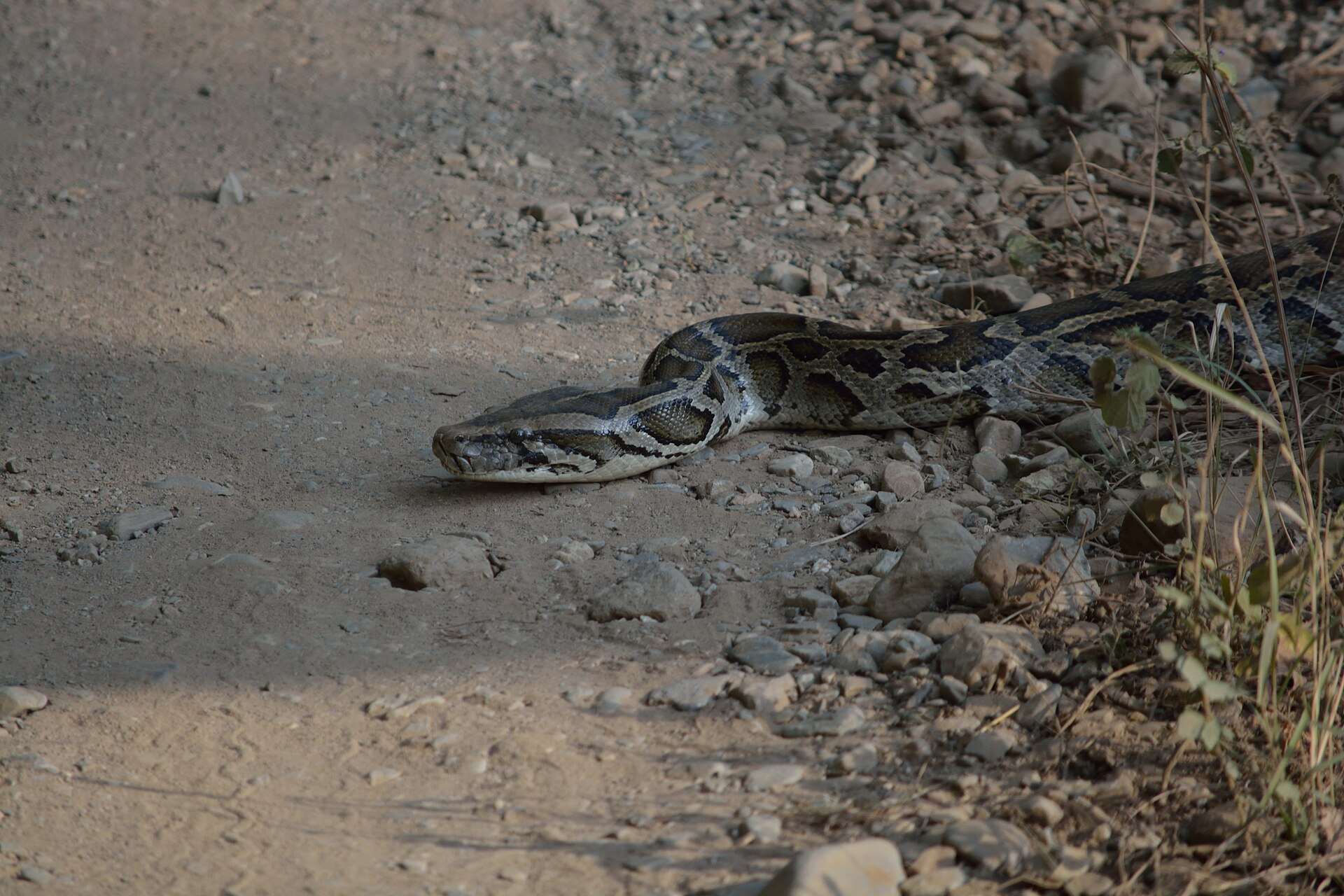
The Indian rock python (Python molurus) lives further west and overlaps with it in Nepal, north-eastern India and Bangladesh1,10. The two were long treated as one species and are told apart mainly by small scales below the eye1. The reticulated python (Malayopython reticulatus) is more slender, has a net-like pattern and lacks the dark patch below the eye1,9. These differences are not a safe basis for handling any snake. Keep your distance from every snake you cannot identify.
In captivity
The Burmese python has been widely kept as a pet, and more than 300,000 were imported into the United States over 30 years2. Captive Burmese pythons have lived for 28–34 years3. Released and escaped pets are the likely source of the invasive Florida population2, and since 2012 the United States has listed it as injurious wildlife, barring imports without a permit7.
Look-alikes
Don’t confuse it with…
These snakes are often mistaken for each other. Use the differences to learn, never as a reason to handle a snake.
References
- 1
Uetz, P. et al. (eds.) (2026). Python bivittatus Kuhl, 1820. The Reptile Database. reptile-database.reptarium.cz
- 2
U.S. Geological Survey (2026). Python bivittatus Kuhl, 1820. Nonindigenous Aquatic Species Database fact sheet (Campbell, G.M. & Freedman, J.A.; revised 27 June 2022). Gainesville, Florida. nas.er.usgs.gov
- 3
Guzy, J.C., Falk, B.G., Smith, B.J., Willson, J.D., Reed, R.N., Aumen, N.G., Avery, M.L., Bartoszek, I.A., Campbell, E., Cherkiss, M.S., Claunch, N.M., Currylow, A.F., Dean, T., Dixon, J. et al. (2023). Burmese pythons in Florida: a synthesis of biology, impacts, and management tools. NeoBiota 80: 1–119. doi.org
- 4
Conservancy of Southwest Florida (2023). Conservancy measures longest Burmese python ever captured (12 July 2023). conservancy.org
- 5
Guinness World Records. Longest Burmese python (Baby, 5.74 m, Serpent Safari, Gurnee, Illinois). guinnessworldrecords.com
- 6
Stuart, B., Nguyen, T.Q., Thy, N., Grismer, L., Chan-Ard, T., Iskandar, D., Golynsky, E. & Lau, M.W.N. (2012). Python bivittatus. The IUCN Red List of Threatened Species 2012: e.T193451A151341916. iucnredlist.org
- 7
U.S. Fish and Wildlife Service (2012). Injurious wildlife species; listing three python species and one anaconda species as injurious reptiles. Federal Register 77: 3330 (23 January 2012). federalregister.gov
- 8
World Health Organization, Regional Office for South-East Asia (2016). Guidelines for the management of snakebites, 2nd edition (Warrell, D.A., ed.). WHO SEARO, New Delhi. iris.who.int
- 9
Uetz, P. et al. (eds.) (2026). Malayopython reticulatus (Schneider, 1801). The Reptile Database. reptile-database.reptarium.cz
- 10
Uetz, P. et al. (eds.) (2026). Python molurus (Linnaeus, 1758). The Reptile Database. reptile-database.reptarium.cz
Play
Play as the burmese python.
Its real pattern is a skin in Snake. Every run ends with a fact.