
Central African rock python
Python sebae (Gmelin, 1789)
Also called African rock python, Northern African python, Northern African rock python
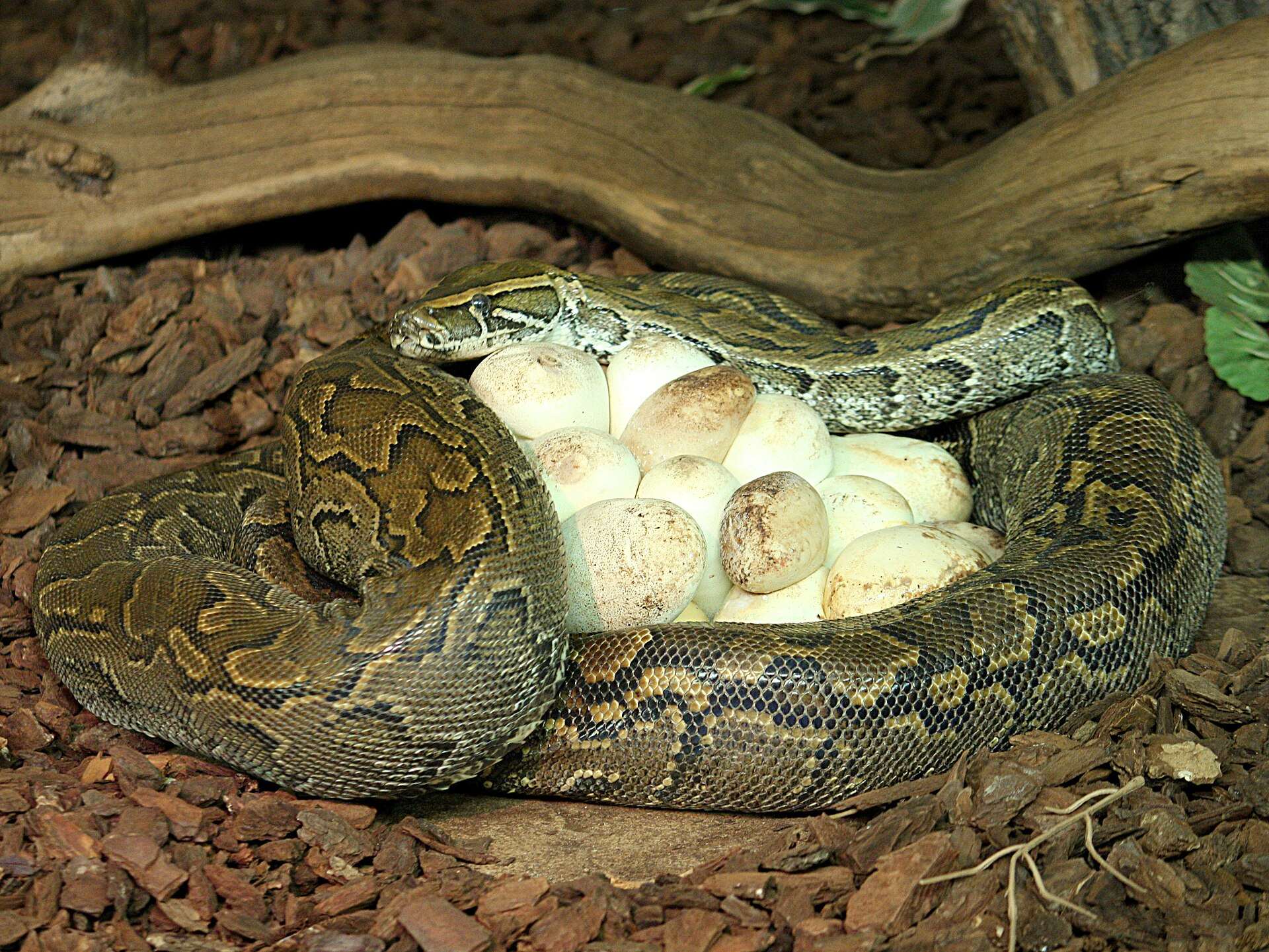
Africa's largest snake, a heavy python with dark, pale-edged blotches and a dark spearhead mark on its head. It lives from West Africa to Ethiopia and Tanzania; the southern rock python is now a separate species.

Is it dangerous?
No. It has no venom, but large rock pythons have big, sharp teeth and can give a serious bite if they are bothered. Leave it alone.
Harmless to people, but it may bite if handled. Treat any snake you can’t identify as venomous.
Snakebite first aidAt a glance
- Length
- 4.0–7.6 m
- Active
- At night
- Found in
- West, Central and East Africa
- Venom
- None
- Young
- Lays eggs
- Habitat
- Savanna, Forest, Rivers and lakes
- Diet
- Rodents, Antelope and other mammals, Birds
Length shows a typical adult, then the largest recorded.
IUCN Red List status: Near Threatened
Country guideSnakes of KenyaSnakes of Nigeria
True size
Gaboon viperMedically significant
1.75 m at most
About as long as a 1.7 m adult is tall.
Usual range 1.0–1.75 m, the bar on the ruler.
Ball pythonNon-venomous
1.83 m at most
About as long as a 1.7 m adult is tall.
Usual range 1.2–1.83 m, the bar on the ruler.
Black-necked spitting cobraMedically significant
2.2 m at most
About 1.5 times the height of a 1.7 m adult.
Usual range 1.25–2.2 m, the bar on the ruler.
BoomslangMedically significant
2.3 m at most
About 1.5 times the height of a 1.7 m adult.
Usual range 1.3–2.3 m, the bar on the ruler.
Indian rock pythonNon-venomous
4.3 m at most
About 2.5 times the height of a 1.7 m adult.
Usual range 3.0–4.3 m, the bar on the ruler.
Black mambaMedically significant
4.5 m at most
About 2.5 times the height of a 1.7 m adult.
Usual range 2.5–4.5 m, the bar on the ruler.
Burmese pythonNon-venomous
5.79 m at most
About 3.5 times the height of a 1.7 m adult.
Usual range 2.6–5.79 m, the bar on the ruler.
Central African rock pythonNon-venomous
7.6 m at most
About 4.5 times the height of a 1.7 m adult.
Usual range 4.0–7.6 m, the bar on the ruler.
Each snake is drawn at the longest length in its profile, on the same scale as the adult. Length is to scale; thickness is not.
Identification
The Central African rock python is a very large, stout snake with smooth scales and vertical, cat-like pupils3. It is tan-brown or brownish-grey, with irregular dark blotches down the back that are edged in black and white, smaller dark marks on the sides, and a pale belly with dark mottling3. The top of the head is dark, with a pale stripe on each side running through the eye to the nose, forming a dark spearhead shape, and a second pale stripe from the corner of the mouth to the eye3. Deep heat-sensing pits line the upper lip3.
Most adults are 3–5 m long3. It is Africa’s largest snake, and the Reptile Database gives a maximum length of 7.6 m1; a 7.5 m snake has been recorded from Côte d’Ivoire4.
Distribution
The southern African rock python, once a subspecies of this snake, was raised to a full species, Python natalensis, by Broadley in 19991. As now defined, P. sebae lives from Senegal, the Gambia and Mauritania east through West and Central Africa to Sudan, Ethiopia, Eritrea and Somalia, and south to Gabon, the Congo, Angola, Rwanda, Burundi and Tanzania1. Python natalensis replaces it from southern Angola, Zambia, Malawi and central Kenya south to South Africa2, and the two meet in parts of Kenya and northern Tanzania4.
This python has been introduced to Florida, where a small breeding population has probably lived in western Miami-Dade County since the early 2000s1,3.
Habitat
African rock pythons favour forest and moist, open savanna, often near rocky outcrops or in mammal burrows4. They are closely tied to water and are often found near rivers and lakes4. They have been recorded up to 2,300 m above sea level, although most live much lower4. In Florida, they have been found in sawgrass prairie, farmland, canals, lakes and housing developments3.
Behaviour
Adult rock pythons are mainly active at night, but they may bask by day; juveniles are most active at dawn and dusk4. They live mostly on the ground but can climb, and they swim well and can stay under water for a long time4.
Rock pythons usually stay hidden in dense vegetation3. If cornered they strike quickly, and if grabbed they bite, hold on and constrict3. They are not aggressive and strike only in defence, although they are more ready to bite than Burmese pythons3.
Diet
Young rock pythons eat small mammals, especially rats4. Adults take larger prey, including monkeys, antelope, large lizards and even crocodiles, and sometimes fish; a large adult can kill an antelope of up to 59 kg4. The python strikes, coils around its prey and squeezes until it suffocates or its heart fails4.
Near people, rock pythons sometimes eat dogs, goats, poultry and other livestock4, and WHO advises protecting goats, sheep, domestic fowl and pets from pythons6. A captive rock python reportedly went without food for more than two and a half years4.
Reproduction
The Central African rock python lays eggs1. In Florida, females have laid 11–47 eggs, and up to 100 have been recorded in the native range3. The female coils around her eggs and does not eat until they hatch3. The young are 45–61 cm long when they hatch3.
Venom and medical significance
The Central African rock python has no venom3. It bites to defend itself; small individuals are not generally dangerous, but large ones have big, sharp teeth that can cause severe cuts3. Virtually all bites happen when people deliberately disturb the snake3. Attacks on people are rare, although African rock pythons have occasionally constricted and killed people4. Large rock pythons can also eat dogs and cats3.
Conservation
The Central African rock python is listed as Near Threatened on the IUCN Red List (assessed in 2021)5. It is hunted for its meat and skin, and larger individuals have become rare in many areas4. In West Africa, large snakes such as pythons are often eaten as a delicacy and used in rituals6. The species is listed in Appendix II of CITES, which regulates international trade4.
Similar species
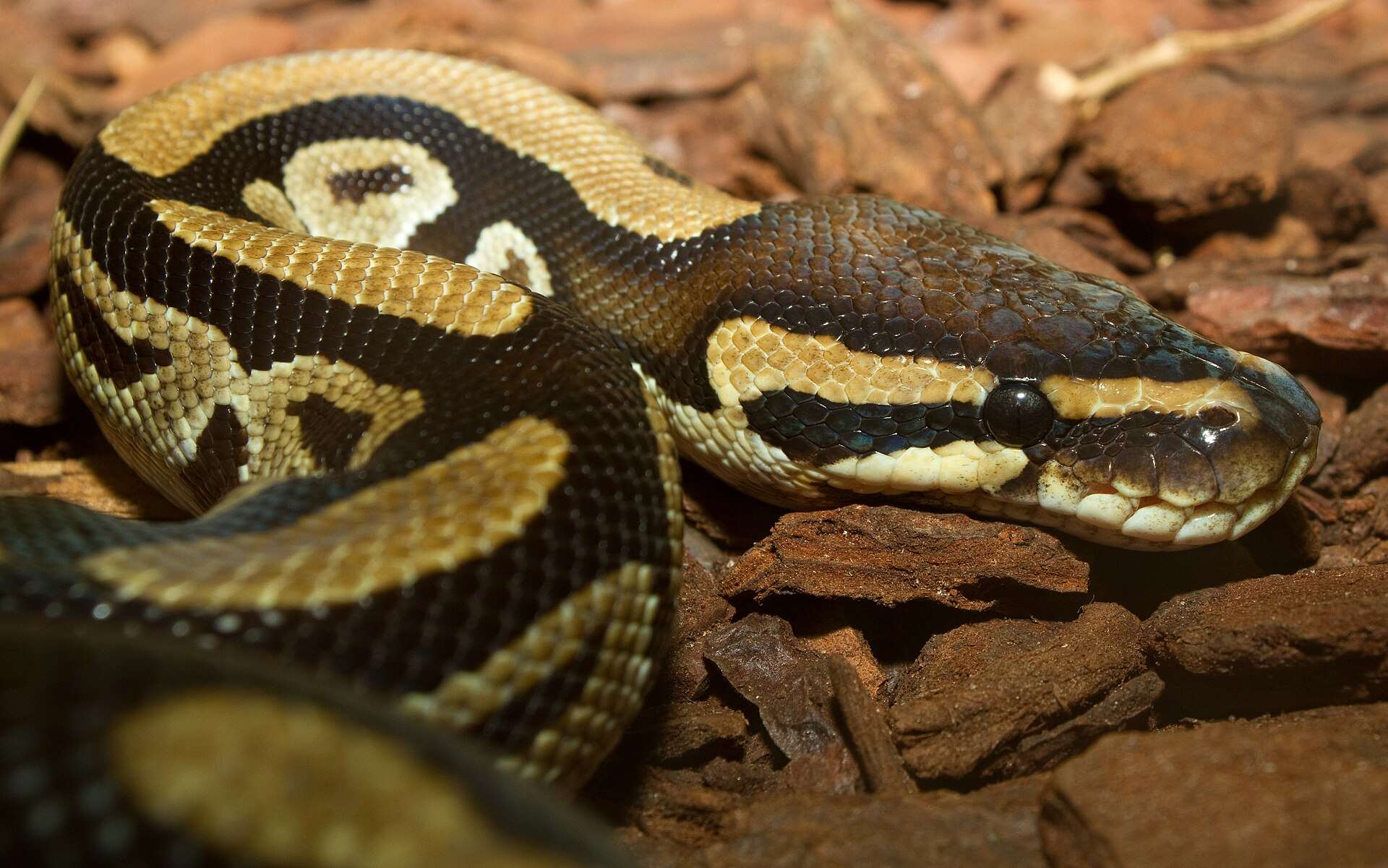
Young rock pythons can be mistaken for the smaller ball python (Python regius), which shares much of its range in West and Central Africa. The ball python rarely grows longer than about 1.5 m and has large brown blotches with lighter patches and often a yellowish stripe through the eye7. The rock python has a dark spearhead mark on its head and irregular blotches edged in black and white3.
Where its range meets that of the southern African rock python (P. natalensis), the two can be told apart by the side of the head: P. sebae shows a pale yellowish stripe at eye level, while P. natalensis has a narrower, paler dark patch around the eye, is drabber overall and has smaller head scales2. These differences are not a safe basis for handling any snake. Keep your distance from every snake you cannot identify.
In captivity
The Central African rock python grows very large and strong, and it is generally a poor choice as a pet: wild-caught snakes rarely settle in captivity4. It can live up to 30 years in captivity4. In the United States it was listed as an injurious species in 2012, which bans imports except for zoos, education, medicine or science with a permit3.
Look-alikes
Don’t confuse it with…
These snakes are often mistaken for each other. Use the differences to learn, never as a reason to handle a snake.
References
- 1
Uetz, P. et al. (eds.) (2026). Python sebae (Gmelin, 1789). The Reptile Database. reptile-database.reptarium.cz
- 2
Uetz, P. et al. (eds.) (2026). Python natalensis Smith, 1840. The Reptile Database. reptile-database.reptarium.cz
- 3
Florida Museum of Natural History, University of Florida. Florida Snake ID Guide: African Rock Python, Python sebae. floridamuseum.ufl.edu
- 4
Sherman, P. (2006). Python sebae. Animal Diversity Web, University of Michigan Museum of Zoology. (Written when the southern rock python was treated as a subspecies, P. sebae natalensis.) animaldiversity.org
- 5
Alexander, G.J., Tolley, K.A., Penner, J., Luiselli, L., Jallow, M., Segniagbeto, G., Niagate, B., Howell, K., Beraduccii, J., Msuya, C.A. & Ngalason, W. (2021). Python sebae. The IUCN Red List of Threatened Species 2021: e.T13300572A13300582. iucnredlist.org
- 6
World Health Organization, Regional Office for Africa (2010). Guidelines for the prevention and clinical management of snakebite in Africa. WHO/AFR/EDM/EDP/10.01, Brazzaville. (Chapter 1.) iris.who.int
- 7
Graf, A. (2011). Python regius. Animal Diversity Web, University of Michigan Museum of Zoology. animaldiversity.org
Play
Play as the central african rock python.
Its real pattern is a skin in Snake. Every run ends with a fact.