
Malayan pit viper
Calloselasma rhodostoma (Kuhl, 1824)
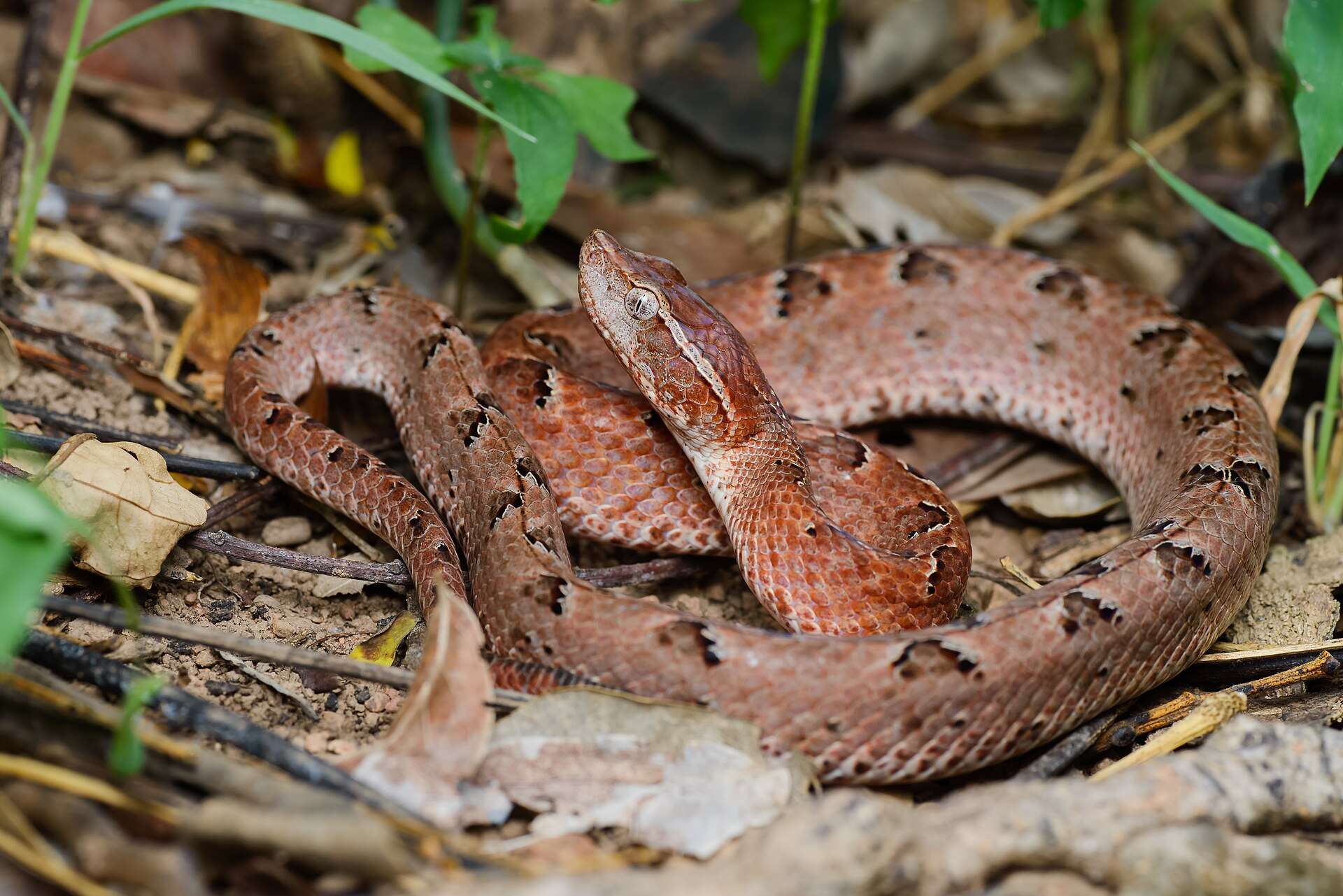
A stout, pinkish to greyish-brown pit viper with a pointed snout and dark triangular markings along its back. It lives in forest and plantations and is a leading cause of snakebite in Thailand.

Is it dangerous?
Yes. Its venom causes painful swelling, blistering and bleeding, and can destroy tissue around the bite. Anyone bitten should go to hospital immediately.
Do not approach. If someone is bitten, go to a hospital now.
At a glance
- Length
- 0.7–0.87 m
- Active
- At night
- Found in
- South-East Asia
- Venom
- Haemotoxic and cytotoxic
- Young
- Lays eggs
- Habitat
- Forest, Plantations, Farmland
- Diet
- Small mammals, Lizards, Frogs and toads
Length shows a typical adult, then the largest recorded.
IUCN Red List status: Least Concern
Country guideSnakes of Indonesia
True size
Malayan pit viperMedically significant
0.87 m at most
About half the height of a 1.7 m adult.
Usual range 0.7–0.87 m, the bar on the ruler.
White-lipped pit viperMedically significant
0.9 m at most
About half the height of a 1.7 m adult.
Usual range 0.5–0.9 m, the bar on the ruler.
Banded kraitMedically significant
2.25 m at most
About 1.5 times the height of a 1.7 m adult.
Usual range 1.35–2.25 m, the bar on the ruler.
Monocled cobraMedically significant
2.3 m at most
About 1.5 times the height of a 1.7 m adult.
Usual range 1.5–2.3 m, the bar on the ruler.
Indian rat snakeNon-venomous
3 m at most
About 2 times the height of a 1.7 m adult.
Usual range 1.8–3.0 m, the bar on the ruler.
King cobraMedically significant
5.5 m at most
About 3 times the height of a 1.7 m adult.
Usual range 3.0–5.5 m, the bar on the ruler.
Burmese pythonNon-venomous
5.79 m at most
About 3.5 times the height of a 1.7 m adult.
Usual range 2.6–5.79 m, the bar on the ruler.
Reticulated pythonNon-venomous
7.67 m at most
About 4.5 times the height of a 1.7 m adult.
Usual range 2.5–7.67 m, the bar on the ruler.
Each snake is drawn at the longest length in its profile, on the same scale as the adult. Length is to scale; thickness is not.
Identification
The Malayan pit viper is a stout snake with a large, triangular head, a pointed snout and a heat-sensing pit between the eye and the nostril1,3. Its body scales are smooth2.
It is reddish, pinkish or greyish-brown above, with large, dark, roughly triangular blotches edged in black, usually alternating on either side of a dark line down the back2. A broad dark stripe runs from the eye to the corner of the mouth, with a pale stripe above it that is clearest in young snakes, and the belly is dirty white speckled with brown2.
It rarely grows longer than about 70 cm1. The largest snake in Smith’s classic account was a female of 87 cm2.
Distribution
The Malayan pit viper lives in Thailand, Laos, Cambodia, southern Vietnam, Peninsular Malaysia and Indonesia, where it is found on Java and possibly Borneo1. It occurs in most of Thailand4. WHO also lists it for the southern peninsula of Myanmar and for the Indonesian island of Madura3.
Habitat
It lives in wooded country at low altitudes and is common in many parts of its range, especially near the sea2. It has been studied in deciduous dipterocarp forest in north-east Thailand, and it is also found in farmland4,6. People most often meet it in rubber and coffee plantations3.
Behaviour
Like other Asian pit vipers, it is slow-moving and hunts in the evening and at night2. It bites readily if disturbed2. In southern Thailand, most bites happen between 6 and 9 pm and between April and June, and more than half are on the foot6.
Diet
Asian pit vipers feed mainly on small mammals, but they also take lizards, frogs and toads, and less often birds, eggs and other snakes2. Smith’s captive Malayan pit vipers lived chiefly on mice2. A radio-tracked female in north-east Thailand fed only once while she stayed with her eggs4.
Its diet differs from place to place, and so does its venom: a study across its range found that the variation in venom closely matches local diet, suggesting that each population’s venom is adapted to its prey5.
Reproduction
The female lays eggs and then stays coiled around them until they hatch, a kind of parental care that few snakes give2,4. The eggshells are very thin1. Two captive females laid 13 and 30 eggs, which hatched after 42 and 47 days, and the young measured 15–16 cm2.
In north-east Thailand, a wild female tracked by radio laid three eggs in a rock crevice in August and stayed coiled around them for the whole 49–62 days until they hatched4.
Venom and medical significance
The Malayan pit viper causes 38% of snakebites by identified snakes in Thailand, and the World Health Organization places it in its highest category of medical importance in Thailand and Indonesia3,6. About half of its bites inject too little venom to cause symptoms3.
When venom is injected, it causes local swelling, blistering, bruising and persistent bleeding from the fang marks, and it can stop the blood from clotting and cause bleeding from the gums and elsewhere; severe tissue death may need surgery and can leave permanent disability3. In a study of 838 patients in southern Thailand, 1.3% had bleeding away from the bite and 2.5% developed acute kidney injury6.
The Thai Red Cross makes a specific Malayan pit viper antivenom, which corrects the clotting problems but appears to do little against local tissue damage, and Biofarma in Indonesia makes an antivenom that includes this species3. Anyone bitten should go to hospital immediately.
Conservation
The Malayan pit viper is listed as Least Concern on the IUCN Red List (2022 assessment)7. It is common in many parts of its range2.
Similar species
The eastern Russell’s viper (Daboia siamensis), which also lives in Thailand and on Java, is a true viper with no heat-sensing pit between the eye and the nostril, and it has rows of large, dark-rimmed spots instead of triangular blotches3. These differences are not a safe basis for handling any snake. Keep your distance from every snake you cannot identify.
In captivity
The Malayan pit viper is a dangerous venomous snake and is not suitable as a pet. Its bite can cause severe bleeding and permanent tissue damage3. It should never be caught or kept by private individuals.
References
- 1
Uetz, P. et al. (eds.) (2026). Calloselasma rhodostoma (Kuhl, 1824). The Reptile Database. reptile-database.reptarium.cz
- 2
Smith, M.A. (1943). The Fauna of British India, Ceylon and Burma. Reptilia and Amphibia. Vol. III, Serpentes. Taylor and Francis, London. (Asiatic pit vipers, p. 494; Ancistrodon rhodostoma, pp. 497–499.) archive.org
- 3
World Health Organization, Regional Office for South-East Asia (2016). Guidelines for the management of snakebites, 2nd edition. WHO SEARO, New Delhi. who.int
- 4
Hill, J.G. III, Chanhome, L., Artchawakom, T., Thirakhupt, K. & Voris, H.K. (2006). Nest attendance by a female Malayan pit viper (Calloselasma rhodostoma) in northeast Thailand. The Natural History Journal of Chulalongkorn University 6(2): 57–66. doi.org
- 5
Daltry, J.C., Wüster, W. & Thorpe, R.S. (1996). Diet and snake venom evolution. Nature 379: 537–540. doi.org
- 6
Chesor, M., Chaisakul, J., Promsorn, P. & Chantkran, W. (2024). Clinical laboratory investigations and antivenom administration after Malayan pit viper (Calloselasma rhodostoma) envenoming: a retrospective study from southernmost Thailand. American Journal of Tropical Medicine and Hygiene 110(3): 609–617. doi.org
- 7
Grismer, L. & Chan-ard, T. (2022). Calloselasma rhodostoma. The IUCN Red List of Threatened Species 2022: e.T192168A217769040. iucnredlist.org
Play
Play as the malayan pit viper.
Its real pattern is a skin in Snake. Every run ends with a fact.