
Reticulated python
Malayopython reticulatus (Schneider, 1801)
Also called Ular sanca batik
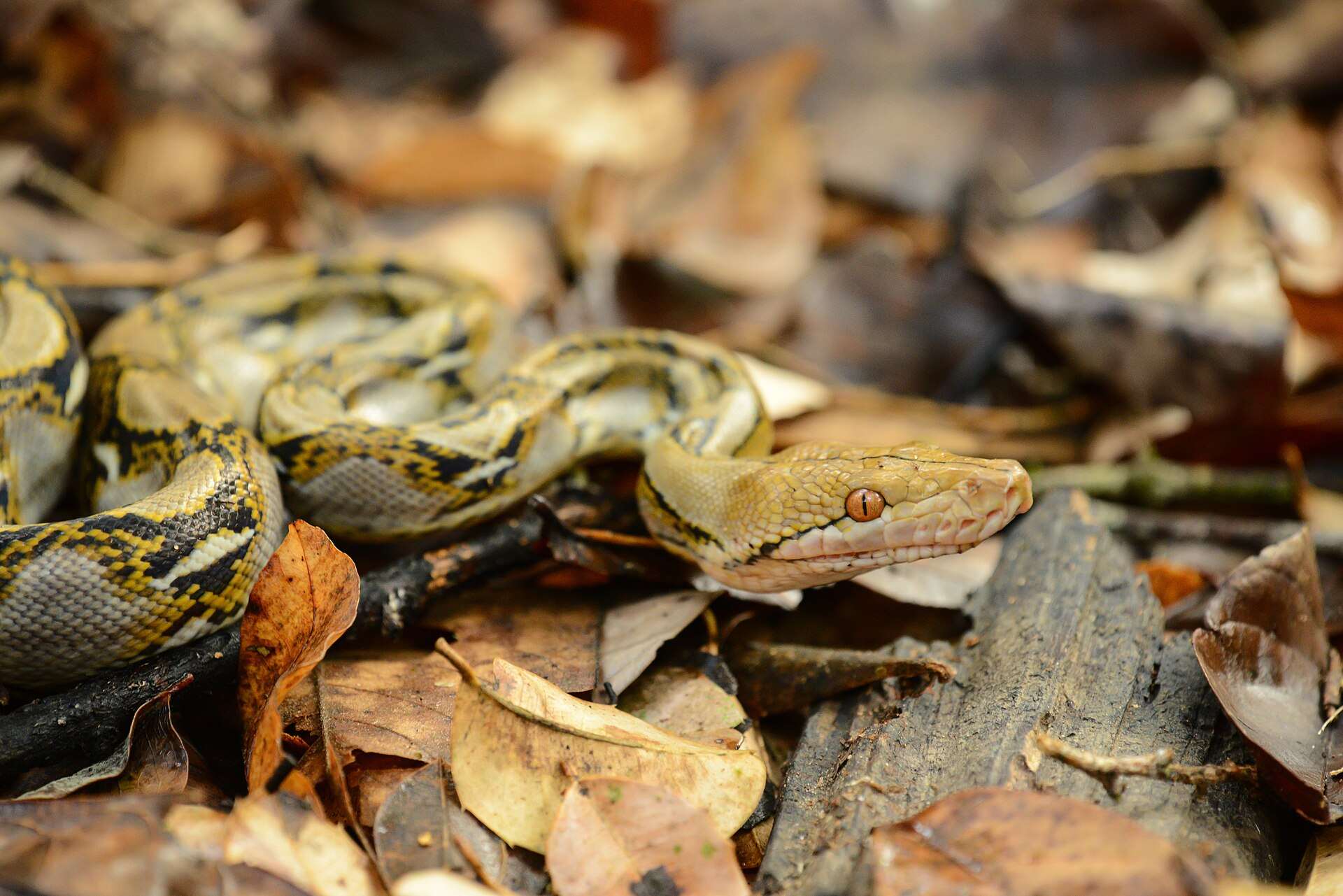
The world's longest snake, a python of South-East Asia with a net-like pattern of black lines and pale patches on a tan or yellowish body. It is not venomous and kills its prey by squeezing.

Is it dangerous?
No. It has no venom, but very large ones are strong enough to kill a person, and rare fatal attacks are recorded. Never approach or handle a large python.
Harmless to people, but it may bite if handled. Treat any snake you can’t identify as venomous.
Snakebite first aidAt a glance
- Length
- 2.5–7.67 m
- Weight
- Up to about 96.5 kg
- Active
- At night
- Found in
- South-East Asia
- Venom
- None
- Young
- Lays eggs
- Habitat
- Forest, Rivers and swamps, Oil palm plantations
- Diet
- Rodents, Monkeys, Wild pigs
Length shows a typical adult, then the largest recorded.
IUCN Red List status: Least Concern
Country guideSnakes of BangladeshSnakes of IndonesiaSnakes of IndiaSnakes of the Philippines
True size
Malayan pit viperMedically significant
0.87 m at most
About half the height of a 1.7 m adult.
Usual range 0.7–0.87 m, the bar on the ruler.
White-lipped pit viperMedically significant
0.9 m at most
About half the height of a 1.7 m adult.
Usual range 0.5–0.9 m, the bar on the ruler.
Banded kraitMedically significant
2.25 m at most
About 1.5 times the height of a 1.7 m adult.
Usual range 1.35–2.25 m, the bar on the ruler.
Monocled cobraMedically significant
2.3 m at most
About 1.5 times the height of a 1.7 m adult.
Usual range 1.5–2.3 m, the bar on the ruler.
Indian rat snakeNon-venomous
3 m at most
About 2 times the height of a 1.7 m adult.
Usual range 1.8–3.0 m, the bar on the ruler.
King cobraMedically significant
5.5 m at most
About 3 times the height of a 1.7 m adult.
Usual range 3.0–5.5 m, the bar on the ruler.
Burmese pythonNon-venomous
5.79 m at most
About 3.5 times the height of a 1.7 m adult.
Usual range 2.6–5.79 m, the bar on the ruler.
Reticulated pythonNon-venomous
7.67 m at most
About 4.5 times the height of a 1.7 m adult.
Usual range 2.5–7.67 m, the bar on the ruler.
Each snake is drawn at the longest length in its profile, on the same scale as the adult. Length is to scale; thickness is not.
Identification
The reticulated python is tan or yellowish-tan, with a net of black lines along the back and down the sides that widen to enclose pale or white patches2. Its skin shines with a rainbow sheen in sunlight2. The name reticulatus is Latin for “made like a net”, after this pattern1. Like other pythons it has heat-sensing pits in its lip scales; in this genus the pits on the lower lip are better developed than those on the upper lip1.
It is the world’s longest snake, but most are far smaller than the famous records4,6. Pythons harvested in Sumatra averaged 2.5–3.1 m from snout to vent4, and only 50 of more than 7,000 harvested in Indonesia and Malaysia exceeded 4.5 m from snout to vent5. Females grow longer and heavier than males5. The longest wild snake ever reliably measured was a female from Sulawesi, 7.22 m long and 96.5 kg, in 2026; a captive snake has been measured at 7.67 m3. An often-repeated 10 m snake killed on Sulawesi in 1912 was never verified3.
Distribution
The reticulated python is found in Bangladesh, north-eastern India and the Nicobar Islands, Myanmar, Thailand, Laos, Cambodia, Vietnam, Malaysia, Singapore, Brunei, Indonesia, Timor-Leste and the Philippines1. In Indonesia it occurs from Sumatra, Java and Borneo east to Sulawesi, the Lesser Sunda Islands and the Moluccas1. Three subspecies are recognised, two of them found only in south-western Sulawesi and on small islands nearby1. It was long placed in the genus Python and moved to Malayopython in 20141.
Habitat
This python lives in a wide range of habitats, from forest to plantations, farmland and villages2,7. In northern Luzon it is common in low- to mid-elevation country, including residential areas, plantations and disturbed forest7. About 80% of the pythons caught for the skin trade in Malaysia come from oil palm plantations or regrowing logged forest5, and it appears to have become more common in oil palm plantations4. It is closely tied to water, and field surveys in Sabah searched for it along riverbanks6.
Behaviour
Reticulated pythons are very secretive and can stay hidden for long periods, which makes them hard to study4,6. They are active mainly at night: in the Philippines they have been seen hunting on the ground and in low vegetation after dark, and surveyors in Sabah found more pythons on dark, moonless nights6,7. Although it lives mostly on the ground, it is a good climber2.
Diet
The reticulated python eats mammals, from mouse-sized prey up to deer and pigs2. It often eats long-tailed macaques and leaf monkeys, and its natural diet includes wild pigs weighing up to 60 kg8. One 6.4 m python killed in Luzon in 1982 contained a 14.5 kg pig8. Like other large constrictors, it kills its prey by squeezing it in its coils8.
Reproduction
The reticulated python lays eggs1. In Indonesia and Malaysia, about half of females are mature by 2.55–2.65 m from snout to vent, while males mature at smaller sizes5. Larger females lay more eggs than smaller ones, but they breed less often5.
Venom and medical significance
The reticulated python has no venom; WHO groups large pythons with the non-venomous snakes10. It can still give a painful bite, and most people attacked by pythons in one Philippine community had bite wounds, often leaving lasting scars8.
Very large reticulated pythons have occasionally attacked and even swallowed people, mainly in Indonesia10. A 2025 review found 17 such incidents in Indonesia between 1927 and 2025, 13 of them fatal, involving snakes reported to be 5–8 m long; most were on Sulawesi9. Among the Agta people of eastern Luzon, interviews in 1976 found that 26% of adult men had survived a python attack, and six people had been killed between 1934 and 19738. Anyone bitten should seek medical care.
Conservation
The reticulated python is listed as Least Concern on the IUCN Red List (assessed in 2018)11. More than 300,000 wild reticulated pythons are taken each year in Indonesia and Malaysia for their skins, and the international trade is regulated under CITES4. Surveys of harvested snakes in Sumatra 20 years apart found no drop in their numbers, body sizes or breeding output4,5.
Similar species
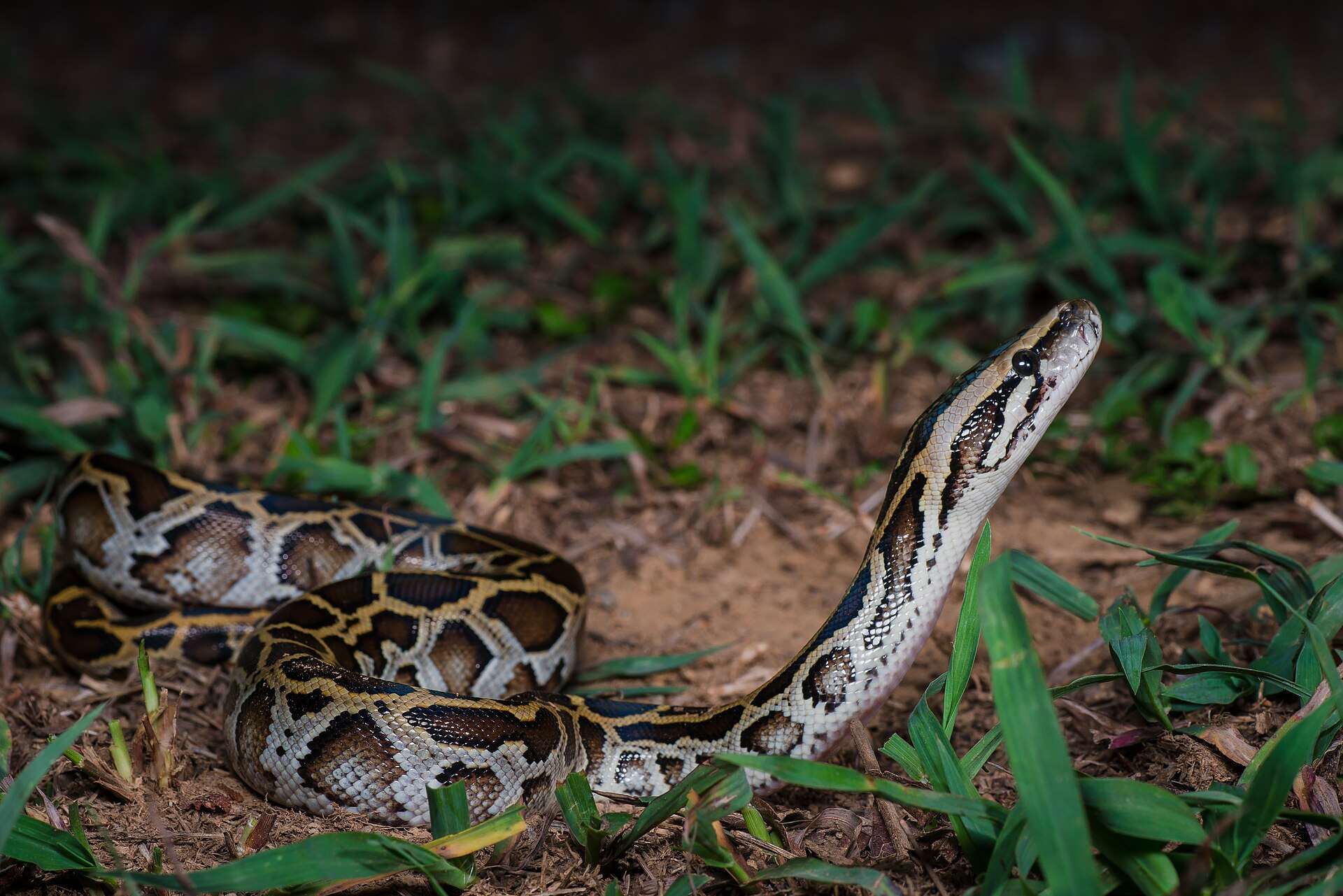
The Burmese python (Python bivittatus) shares much of the reticulated python’s mainland range and also lives on Java, Bali and Sulawesi1,13. It is heavier-bodied and carries a clear arrow-shaped mark on top of its head13. Pythons of the genus Python also have a dark patch below the eye, which the reticulated python lacks1. These differences are not a safe basis for handling any snake. Keep your distance from every snake you cannot identify.
In captivity
Reticulated pythons are kept in captivity, where the longest snake on record measured 7.67 m3. Large individuals are strong enough to kill a person8,9. In 2015 the United States listed it as injurious wildlife, which bars importing live reticulated pythons without a permit12.
Look-alikes
Don’t confuse it with…
These snakes are often mistaken for each other. Use the differences to learn, never as a reason to handle a snake.
References
- 1
Uetz, P. et al. (eds.) (2026). Malayopython reticulatus (Schneider, 1801). The Reptile Database. reptile-database.reptarium.cz
- 2
National Parks Board, Singapore. Flora & Fauna Web: Malayopython reticulatus (reticulated python). nparks.gov.sg
- 3
Guinness World Records. Longest wild snake specimen (Ibu Baron, 7.22 m, Maros, Sulawesi, 18 January 2026; also notes the captive record of 7.67 m and the unverified 10 m claim of 1912). guinnessworldrecords.com
- 4
Natusch, D.J.D., Lyons, J.A., Mumpuni, Riyanto, A. & Shine, R. (2016). Jungle giants: assessing sustainable harvesting in a difficult-to-survey species (Python reticulatus). PLOS ONE 11(7): e0158397. doi.org
- 5
Natusch, D.J.D., Lyons, J.A., Mumpuni, Riyanto, A., Khadiejah, S., Mustapha, N., Badiah & Ratnaningsih, S. (2016). Sustainable management of the trade in reticulated python skins in Indonesia and Malaysia. Occasional Paper of the IUCN Species Survival Commission No. 61. IUCN, Gland. doi.org
- 6
Burger, R., Natusch, D.J.D., Shine, R., Vaughan, I.P., Sipangkui, S. & Goossens, B. (2026). Efficacy of field-based surveys for detecting and assessing demographics of giant snakes (Malayopython reticulatus) in Malaysia. Scientific Reports 16: 26081. doi.org
- 7
Brown, R.M., Siler, C.D., Oliveros, C.H., Welton, L.J., Rock, A., Swab, J., Van Weerd, M., van Beijnen, J., Jose, E., Rodriguez, D., Jose, E. & Diesmos, A.C. (2013). The amphibians and reptiles of Luzon Island, Philippines, VIII: the herpetofauna of Cagayan and Isabela Provinces, northern Sierra Madre Mountain Range. ZooKeys 266: 1–120. doi.org
- 8
Headland, T.N. & Greene, H.W. (2011). Hunter–gatherers and other primates as prey, predators, and competitors of snakes. Proceedings of the National Academy of Sciences 108(52): E1470–E1474. pmc.ncbi.nlm.nih.gov
- 9
Iqbal, M., Sari, D.K., Arifah, N., Widayanti, G.A. & Aprillia, I. (2025). Notes on humans as prey of reticulated pythons Malayopython reticulatus (Serpentes: Pythonidae) in Indonesia. Bio Palembanica 2(1): 43–49. doi.org
- 10
World Health Organization, Regional Office for South-East Asia (2016). Guidelines for the management of snakebites, 2nd edition (Warrell, D.A., ed.). WHO SEARO, New Delhi. iris.who.int
- 11
Stuart, B.L., Thy, N., Chan-Ard, T., Nguyen, T.Q., Grismer, L., Auliya, M., Das, I. & Wogan, G. (2018). Malayopython reticulatus. The IUCN Red List of Threatened Species 2018: e.T183151A1730027. iucnredlist.org
- 12
U.S. Fish and Wildlife Service (2015). Injurious wildlife species; listing three anaconda species and one python species as injurious reptiles. Federal Register 80: 12702 (10 March 2015). federalregister.gov
- 13
Uetz, P. et al. (eds.) (2026). Python bivittatus Kuhl, 1820. The Reptile Database. reptile-database.reptarium.cz
Play
Play as the reticulated python.
Its real pattern is a skin in Snake. Every run ends with a fact.