
Corn snake
Pantherophis guttatus (Linnaeus, 1766)
Also called Red cornsnake, Eastern corn snake, Red rat snake, Chicken snake
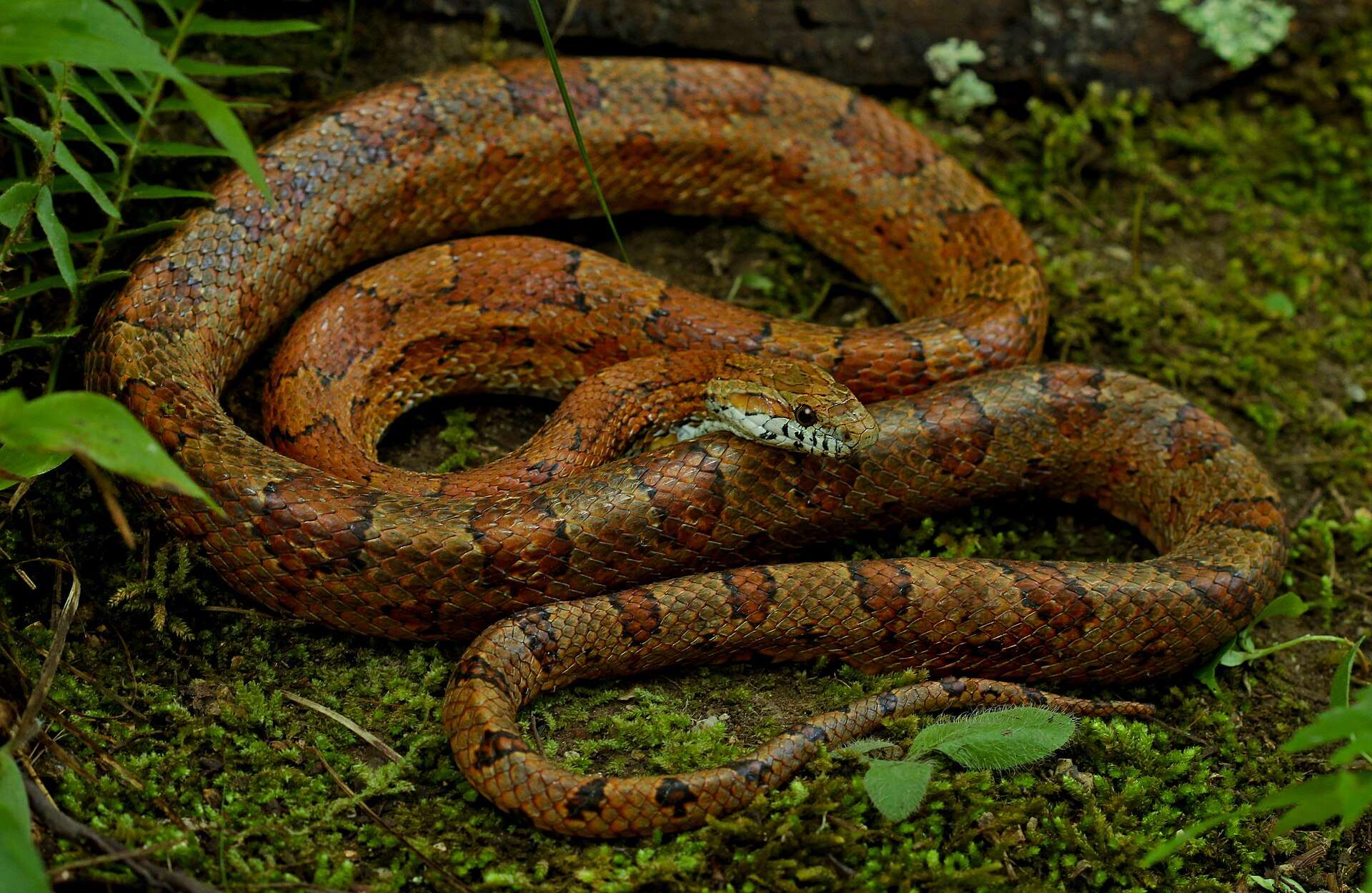
A slender orange, red or brown snake of the south-eastern United States, with black-edged reddish blotches and a black-and-white checkered belly. It is harmless and one of the most popular pet snakes.

Is it dangerous?
No. It is non-venomous and harmless to people, though it may bite if handled. It is often mistaken for the venomous copperhead.
Harmless to people, but it may bite if handled. Treat any snake you can’t identify as venomous.
Snakebite first aidAt a glance
- Length
- 1.2–1.88 m
- Active
- Dawn and dusk
- Found in
- South-eastern United States
- Venom
- None
- Young
- Lays eggs
- Habitat
- Pine woodland, Hardwood hammocks, Old fields
- Diet
- Rodents, Birds and eggs, Lizards
- Lifespan
- Up to 23 years in captivity
Length shows a typical adult, then the largest recorded.
IUCN Red List status: Least Concern
Country guideSnakes of the United States
True size
Scarlet kingsnakeNon-venomous
0.74 m at most
About half the height of a 1.7 m adult.
Usual range 0.45–0.74 m, the bar on the ruler.
Western hognose snakeMildly venomous
1 m at most
About two thirds of the height of a 1.7 m adult.
Usual range 0.5–1.0 m, the bar on the ruler.
Eastern milksnakeNon-venomous
1.32 m at most
About three quarters of the height of a 1.7 m adult.
Usual range 0.75–1.32 m, the bar on the ruler.
CopperheadMedically significant
1.35 m at most
About three quarters of the height of a 1.7 m adult.
Usual range 0.75–1.35 m, the bar on the ruler.
Common garter snakeNon-venomous
1.37 m at most
About three quarters of the height of a 1.7 m adult.
Usual range 0.56–1.37 m, the bar on the ruler.
Corn snakeNon-venomous
1.88 m at most
About as long as a 1.7 m adult is tall.
Usual range 1.2–1.88 m, the bar on the ruler.
California kingsnakeNon-venomous
2 m at most
About 1 times the height of a 1.7 m adult.
Usual range 0.9–2.0 m, the bar on the ruler.
Eastern rat snakeNon-venomous
2.56 m at most
About 1.5 times the height of a 1.7 m adult.
Usual range 1.5–2.56 m, the bar on the ruler.
Each snake is drawn at the longest length in its profile, on the same scale as the adult. Length is to scale; thickness is not.
Identification
The corn snake is a slender, medium-sized constrictor with an orange to reddish-brown back crossed by 27–40 reddish, black-edged blotches2. Its belly has a bold black-and-white checkerboard pattern, which may explain the name, as it looks like the kernels of Indian corn6,7. A spear-shaped mark runs forward from the neck to a point between the eyes, and a black-edged reddish stripe runs from the eye past the jaw onto the neck2,4. The underside of the tail has two black stripes, the scales are glossy and weakly keeled, and the pupil is round3,6.
Snakes from the coastal plain are usually bright orange, those from the Piedmont and uplands are darker and duller, and young snakes are browner or greyer2. Adults usually measure about 0.9–1.2 m2, and the record length is 1.88 m3.
Distribution
The corn snake lives in the south-eastern United States, from southern New Jersey south through the Carolinas to the Florida Keys, and west to eastern Louisiana2. It is found in every county of mainland Florida and throughout the Keys3. In Tennessee it lives mainly in the southern two-thirds of East Tennessee and the state’s south-western corner5.
A 2002 genetic study split the old, wider species into three: the name Pantherophis guttatus now covers populations east of the Mississippi River, while the western forms are Slowinski’s corn snake (P. slowinskii) and the Great Plains rat snake (P. emoryi)4,8. The Reptile Database follows this arrangement1. Introduced populations live on several Caribbean islands, including the Bahamas, Grand Cayman and St Thomas7, and one has been reported from Bahia in Brazil1.
Habitat
Corn snakes use many habitats, including open pine woodland such as longleaf pine sandhills, abandoned fields, hardwood hammocks and the edges of farmland2. In Florida they also live in swamps and are often found in suburban neighbourhoods3. They are drawn to barns, sheds and old buildings, where rodents are plentiful2,5. By day they hide under logs, loose bark and debris, or in burrows2.
Behaviour
Corn snakes are mainly active at dawn and dusk, and become more active at night in hot weather2. They climb well but spend more time on the ground than their close relatives the rat snakes, and they often travel through rodent burrows2,5. They are often seen crossing roads on humid nights2.
When approached, a corn snake usually flees or keeps still3. If cornered, it draws its front body into an S-shape, strikes and rapidly vibrates its tail tip, which can make a buzzing sound in dry leaves3.
Diet
Corn snakes kill larger prey by constriction but often swallow small prey alive3. Young snakes eat mostly cold-blooded prey such as frogs and lizards, while adults switch to rodents and birds2. They also eat bird eggs and are efficient predators of quail and songbird nests2. Tennessee’s wildlife agency lists small rodents as the main food, with treefrogs, lizards, birds and bats also taken5.
Reproduction
Corn snakes mate in spring and lay their eggs in early summer2,6. A clutch usually holds 10–20 eggs, although clutches of 3 to about 40 have been recorded2,3,6. The eggs are laid in rotting logs, burrows, sawdust piles or other damp, sheltered spots, and the parents give no care2,6. They hatch after about 60 days, and the young are 20–30 cm long2. Young corn snakes mature in two to three years2.
Venom and medical significance
The corn snake has no venom and is not dangerous to people or pets3,6. Like other harmless snakes, it will bite to defend itself, and almost all bites happen when someone deliberately handles or harasses it3. Its main medical relevance is that it is often mistaken for the venomous copperhead2,4.
Conservation
The corn snake is listed as Least Concern on the IUCN Red List (assessed in 2015 and published in 2016)9. It adapts well to farmland and suburbs, but habitat loss, fragmentation, road deaths and collection for the pet trade can harm local populations2. Many are killed by people who mistake them for copperheads2,7. It is protected in Georgia and South Carolina2.
Similar species
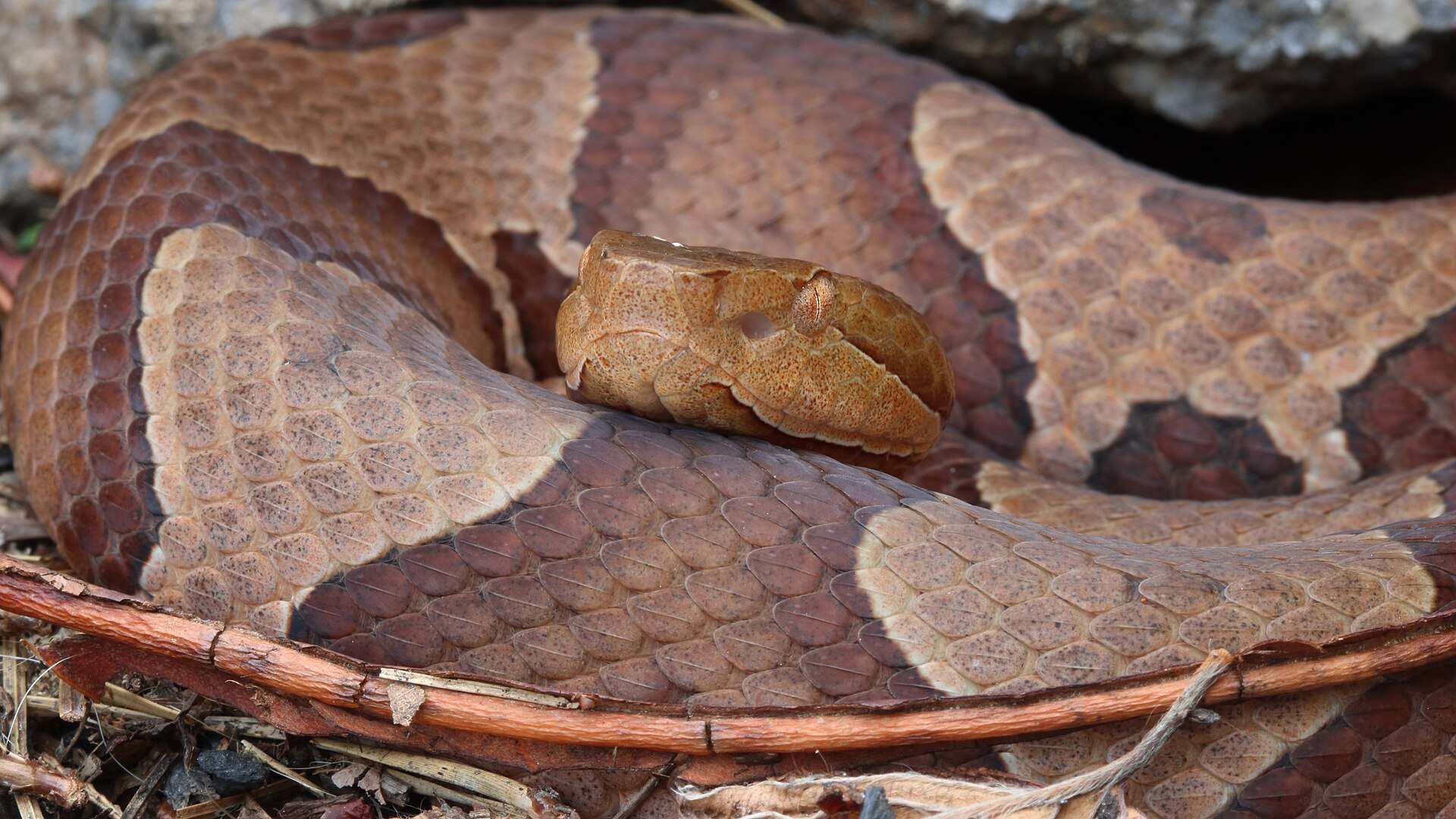
Corn snakes are often mistaken for the venomous copperhead (Agkistrodon contortrix), which has hourglass-shaped crossbands that are wide on the sides and narrow across the back, and lacks the corn snake’s bold checkerboard belly4,7,10.
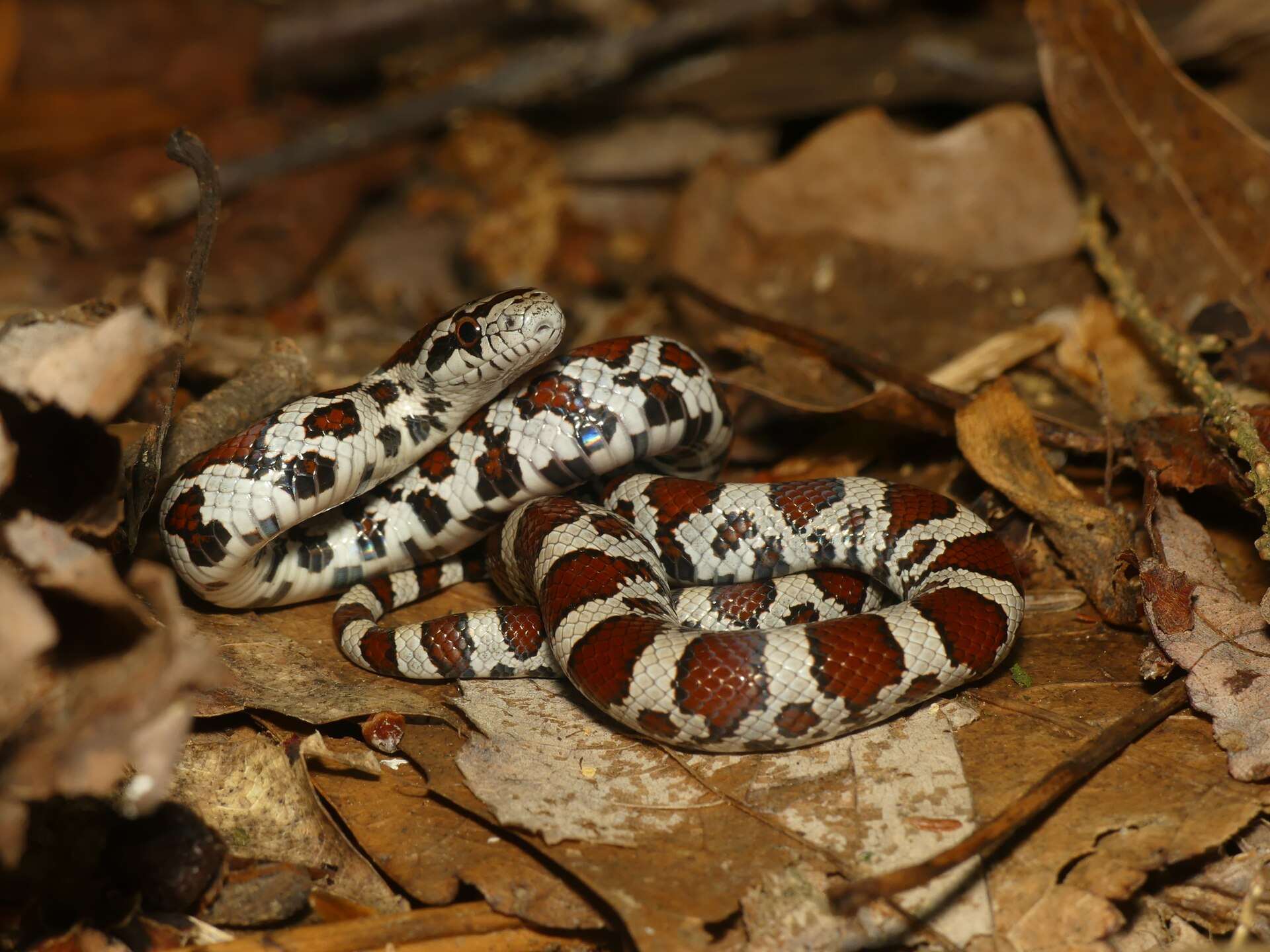
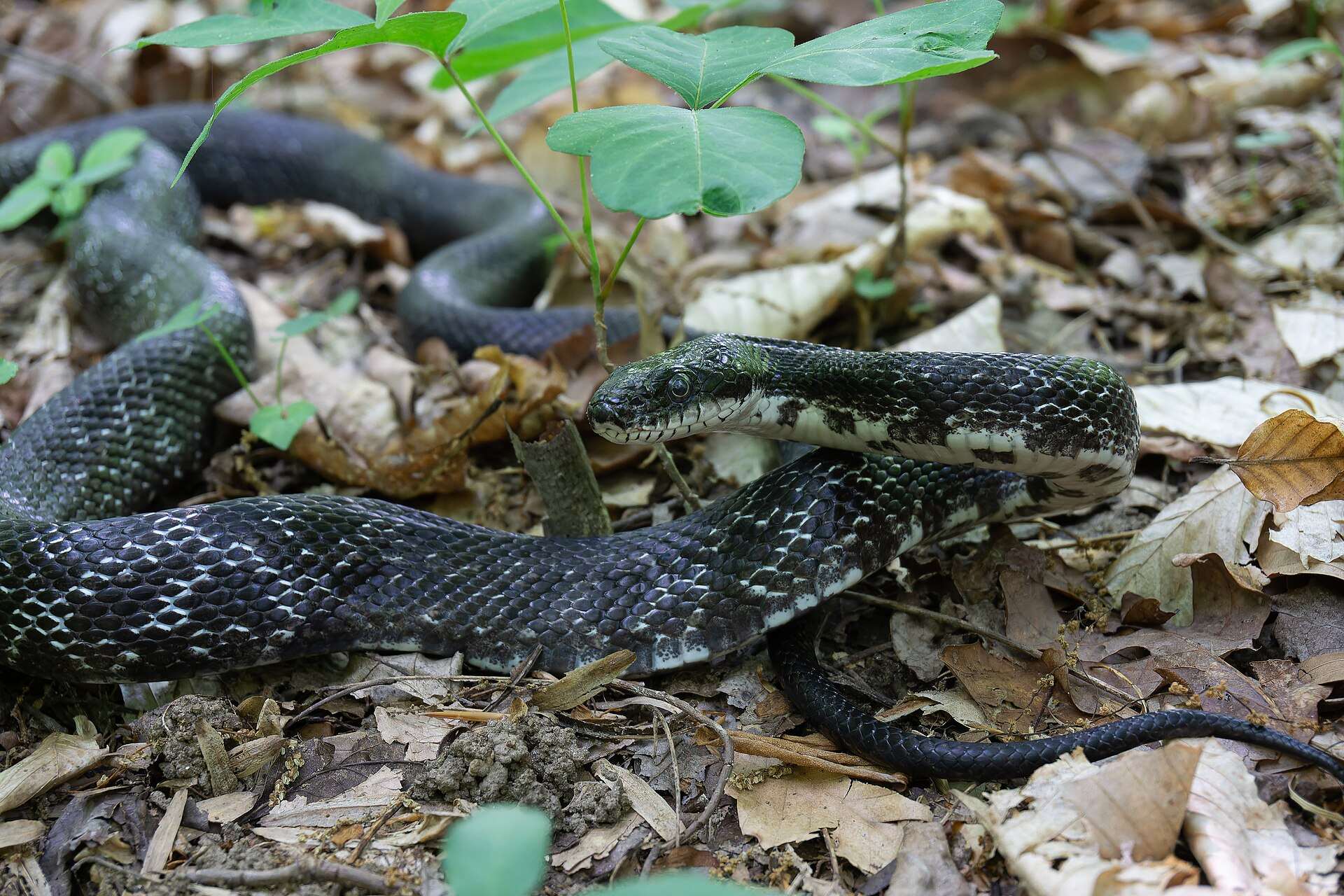
The corn snake is itself a kind of rat snake, sometimes called the red rat snake, but young grey and eastern rat snakes lack its spear-shaped mark between the eyes3,5,6,8. Adult rat snakes are larger, usually 1.07–1.83 m long, and are mostly black above across most of their range, or striped in peninsular Florida3,11. Milk snakes and mole kingsnakes have a short eye-jaw stripe that stops at the mouth, and no stripes under the tail4,5.
These differences are not a safe basis for handling any snake. Keep your distance from every snake you cannot identify.
In captivity
The corn snake is a very popular pet and is the snake species most commonly bred in the pet trade7. Pet corn snakes usually live 10–15 years12, and some have lived up to 23 years in human care7. The RSPCA advises a secure vivarium that prevents escape and lets the snake stretch out fully, with a warm basking area at one end and a cooler area at the other so the snake can control its body temperature12.
Look-alikes
Don’t confuse it with…
These snakes are often mistaken for each other. Use the differences to learn, never as a reason to handle a snake.
References
- 1
Uetz, P. et al. (eds.) (2026). Pantherophis guttatus (Linnaeus, 1766). The Reptile Database. reptile-database.reptarium.cz
- 2
Savannah River Ecology Laboratory, University of Georgia. Corn Snake (Elaphe [Pantherophis] guttata). Herpetology at SREL. srelherp.uga.edu
- 3
Florida Museum of Natural History. Red Cornsnake (Pantherophis guttatus). Florida Snake ID Guide. floridamuseum.ufl.edu
- 4
Virginia Herpetological Society. Red Cornsnake, Pantherophis guttatus (species account after Mitchell, J.C., The Reptiles of Virginia). virginiaherpetologicalsociety.com
- 5
Tennessee Wildlife Resources Agency. Red Cornsnake, Pantherophis guttatus. tn.gov
- 6
North Carolina Wildlife Resources Commission. Corn Snake. ncwildlife.gov
- 7
Smithsonian's National Zoo and Conservation Biology Institute. Eastern corn snake. nationalzoo.si.edu
- 8
Nicholson, K.E. (ed.) (2025). Scientific and Standard English Names of Amphibians and Reptiles of North America North of Mexico, with Comments Regarding Confidence in Our Understanding. 9th edition. SSAR Herpetological Circular. webapps.fhsu.edu
- 9
Echternacht, S. & Hammerson, G.A. (2016). Pantherophis guttatus. The IUCN Red List of Threatened Species 2016: e.T63863A71740603. iucnredlist.org
- 10
New Jersey Division of Fish and Wildlife, Endangered and Nongame Species Program. Snake Identification: Avoid Being Confused! nj.gov
- 11
Virginia Herpetological Society. Central Ratsnake, Pantherophis alleghaniensis (species account after Mitchell, J.C., The Reptiles of Virginia). virginiaherpetologicalsociety.com
- 12
RSPCA. How to care for a corn snake. rspca.org.uk
Play
Play as the corn snake.
Its real pattern is a skin in Snake. Every run ends with a fact.