
Scarlet kingsnake
Lampropeltis elapsoides (Holbrook, 1838)
Also called Scarlet milksnake
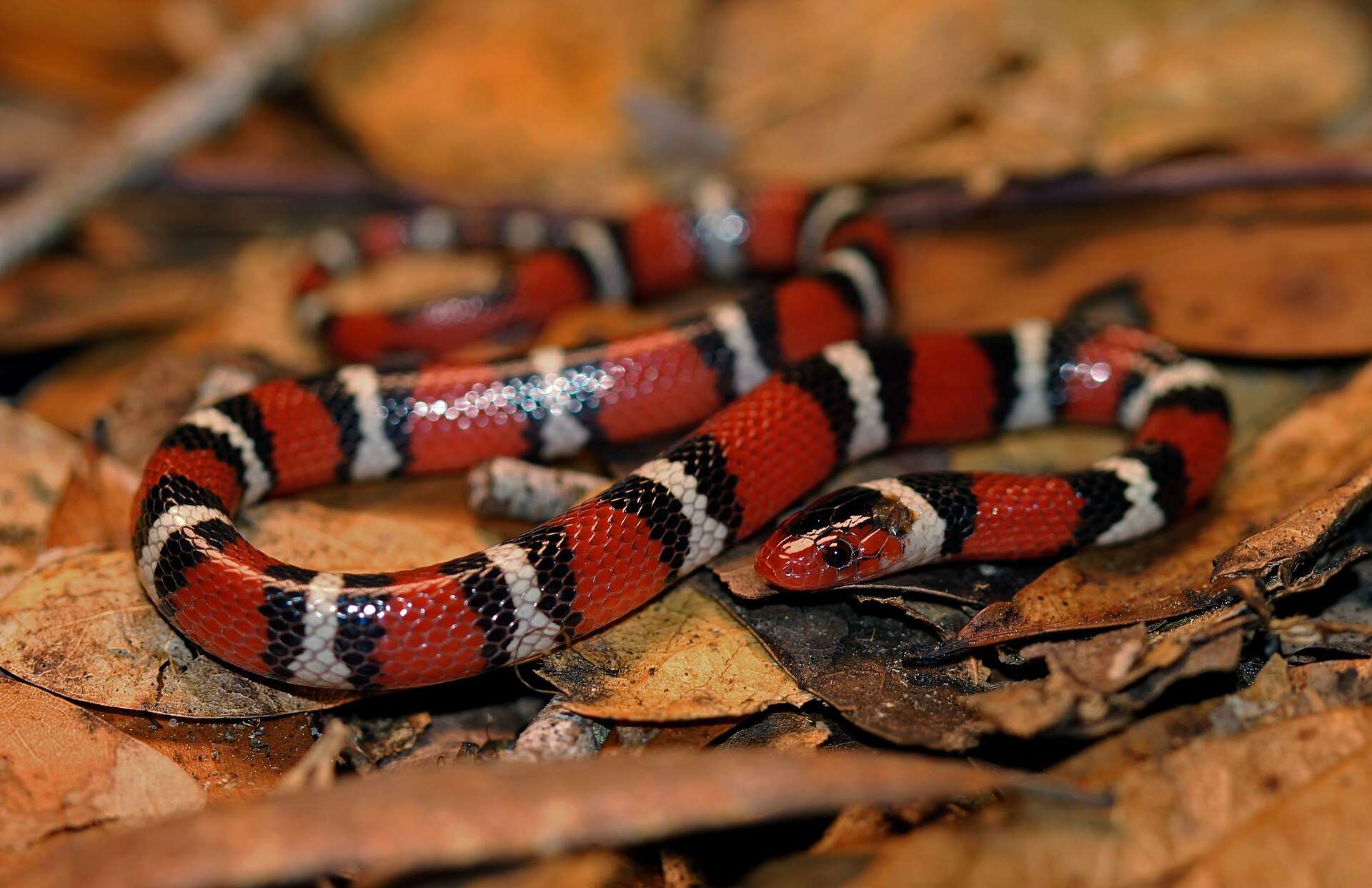
A small, harmless snake of the south-eastern United States with red, black and yellow or white rings, where the red rings touch only black. It has a red snout and mimics the venomous coral snake.

Is it dangerous?
No. It is non-venomous and harmless, though it may bite if grabbed. It looks like the venomous coral snake, so leave any red, black and yellow snake alone.
Harmless to people, but it may bite if handled. Treat any snake you can’t identify as venomous.
Snakebite first aidAt a glance
- Length
- 0.45–0.74 m
- Active
- At night
- Found in
- South-eastern United States
- Venom
- None
- Young
- Lays eggs
- Habitat
- Pine woodland, Moist hammocks, Rotting stumps and logs
- Diet
- Skinks and other lizards, Small snakes, Lizard eggs
Length shows a typical adult, then the largest recorded.
IUCN Red List status: Least Concern
Country guideSnakes of the United States
GuidesCoral snake vs kingsnake
True size
Scarlet kingsnakeNon-venomous
0.74 m at most
About half the height of a 1.7 m adult.
Usual range 0.45–0.74 m, the bar on the ruler.
Western hognose snakeMildly venomous
1 m at most
About two thirds of the height of a 1.7 m adult.
Usual range 0.5–1.0 m, the bar on the ruler.
Eastern coral snakeMedically significant
1.21 m at most
About three quarters of the height of a 1.7 m adult.
Usual range 0.65–1.21 m, the bar on the ruler.
Eastern milksnakeNon-venomous
1.32 m at most
About three quarters of the height of a 1.7 m adult.
Usual range 0.75–1.32 m, the bar on the ruler.
Common garter snakeNon-venomous
1.37 m at most
About three quarters of the height of a 1.7 m adult.
Usual range 0.56–1.37 m, the bar on the ruler.
Corn snakeNon-venomous
1.88 m at most
About as long as a 1.7 m adult is tall.
Usual range 1.2–1.88 m, the bar on the ruler.
California kingsnakeNon-venomous
2 m at most
About 1 times the height of a 1.7 m adult.
Usual range 0.9–2.0 m, the bar on the ruler.
Eastern rat snakeNon-venomous
2.56 m at most
About 1.5 times the height of a 1.7 m adult.
Usual range 1.5–2.56 m, the bar on the ruler.
Each snake is drawn at the longest length in its profile, on the same scale as the adult. Length is to scale; thickness is not.
Identification
The scarlet kingsnake is a small, slender snake with smooth, shiny scales1. Its body is ringed with red, black and yellow, and the red and yellow rings are always separated by black rings, so red never touches yellow; in young snakes the yellow rings may be white1. The small head is barely wider than the neck and has a red snout, and the pupils are round1. In Florida the rings run right round the body, but in Virginia many individuals have rings that do not meet on the belly1,3.
Most adults are about 36–51 cm long, and the longest recorded was about 74 cm1. Hatchlings are 13–18 cm long and look like small, brightly coloured adults2.
Distribution
The scarlet kingsnake lives only in the south-eastern United States4. It ranges from Virginia south through Florida and west to Louisiana, and inland to Tennessee and southern Kentucky2,4. It has been recorded in every county in Florida, with single records from Key Largo and Key West1. In Georgia and South Carolina it is most often found on the Coastal Plain2.
It was long treated as a subspecies of the milksnake, Lampropeltis triangulum elapsoides, but genetic studies showed it is a separate species2,4. A 2022 genome-scale study supported recognising it, the eastern milksnake and the Central Plains milksnake as three species5.
Habitat
In Florida it usually lives in wet pine woods and moist hammocks, but it also uses drier habitats1. Across the coastal plains it is most often found in sandy pine or mixed pine and hardwood forest2. It hides under logs, bark, rocks and debris and often climbs into rotting pine stumps, shrubs and under loose bark on trees1,2. It is sometimes found in barns, on buildings and in suburban neighbourhoods1,2.
Behaviour
This snake is secretive and mainly active at night, often coming out on warm, humid nights in spring and early summer or after heavy rain2. It is an excellent climber1. When captured it may strike, vibrate its tail, bite and release a foul-smelling musk, although some individuals do not bite1.
Its bright rings mimic the venomous coral snake, which helps protect it from predators2. Where coral snakes are rare, at the edge of their range, scarlet kingsnakes resemble them more closely, and in experiments with snake replicas, predators there avoided only the close mimics6. After coral snakes disappeared from the North Carolina Sandhills around 1960, the local kingsnakes evolved even more precise mimicry over the next 50 years7.
Diet
The scarlet kingsnake feeds mainly on lizards, especially skinks, and on small snakes, which it kills by constriction1. Larger individuals may also eat small mammals, and newborns eat small frogs and invertebrates1. It also eats lizard eggs3. Its small, pointed head is well suited to probing under bark and into crevices for hidden prey2.
Reproduction
The scarlet kingsnake lays eggs4. Mating takes place in spring, and females lay clutches of about 2–9 long, leathery eggs in early summer1,2. The eggs are laid in rotting logs, underground or in piles of debris1. In Florida they hatch between July and November1.
Venom and medical significance
The scarlet kingsnake is non-venomous and is not dangerous to people or pets1. If grabbed or pinned it may bite, but it has no venom1.
Its main medical importance is that it looks like the venomous eastern coral snake8. In a study of 39 people bitten by eastern coral snakes, the most common situation was that the person had mistaken the coral snake for a harmless scarlet kingsnake8. Anyone bitten by a red, black and yellow snake that has not been identified for certain should get medical care immediately, as for a coral snake bite10.
Conservation
The scarlet kingsnake is listed as Least Concern on the IUCN Red List, in an assessment published in 20199. It is widespread and locally common, though rarely seen because it is so secretive2. Urban development and fire suppression have reduced its pine and scrub habitat in places, and some are killed on roads or by people who mistake them for coral snakes2. It is protected by law in Georgia and South Carolina2.
Similar species
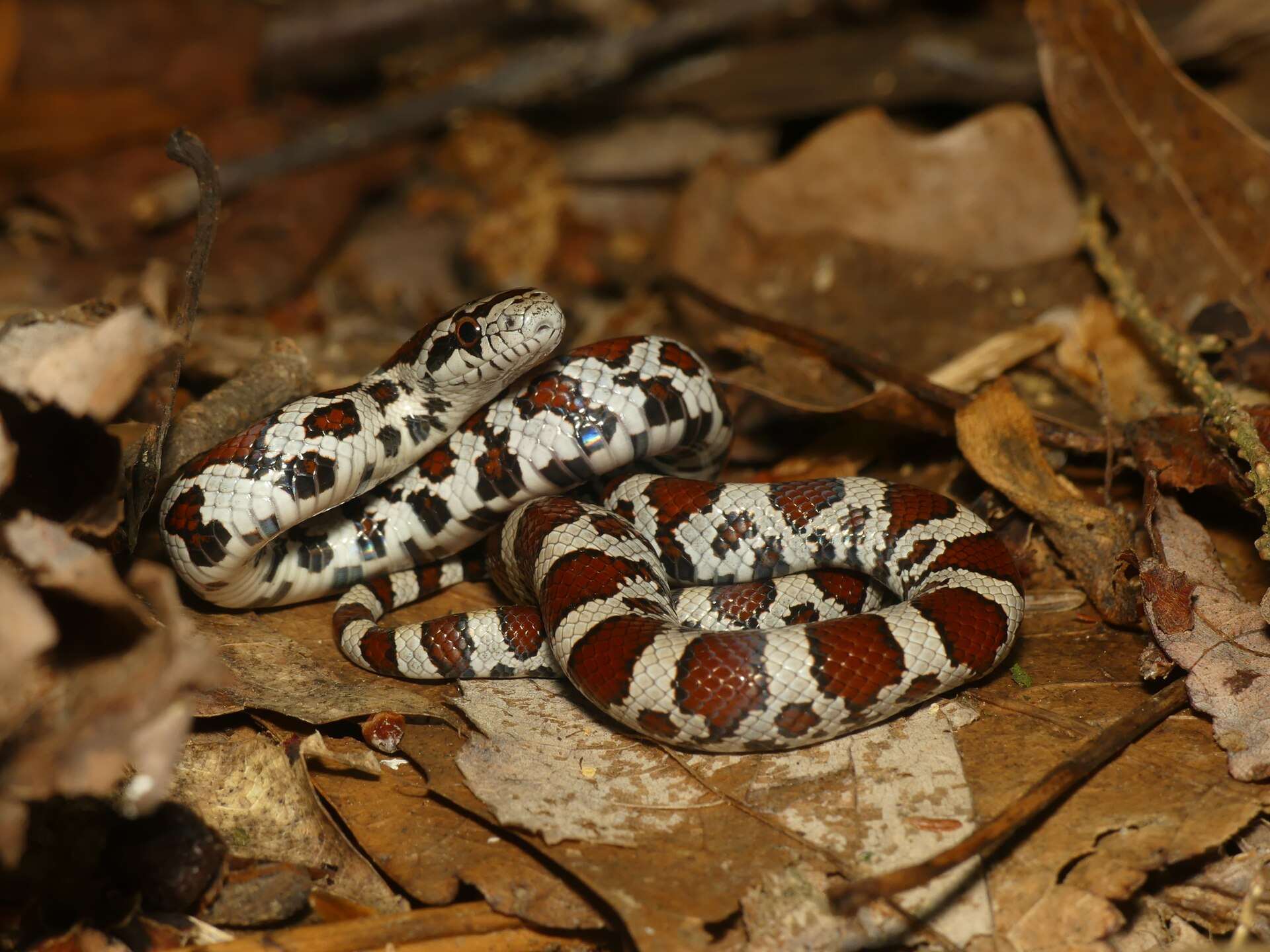
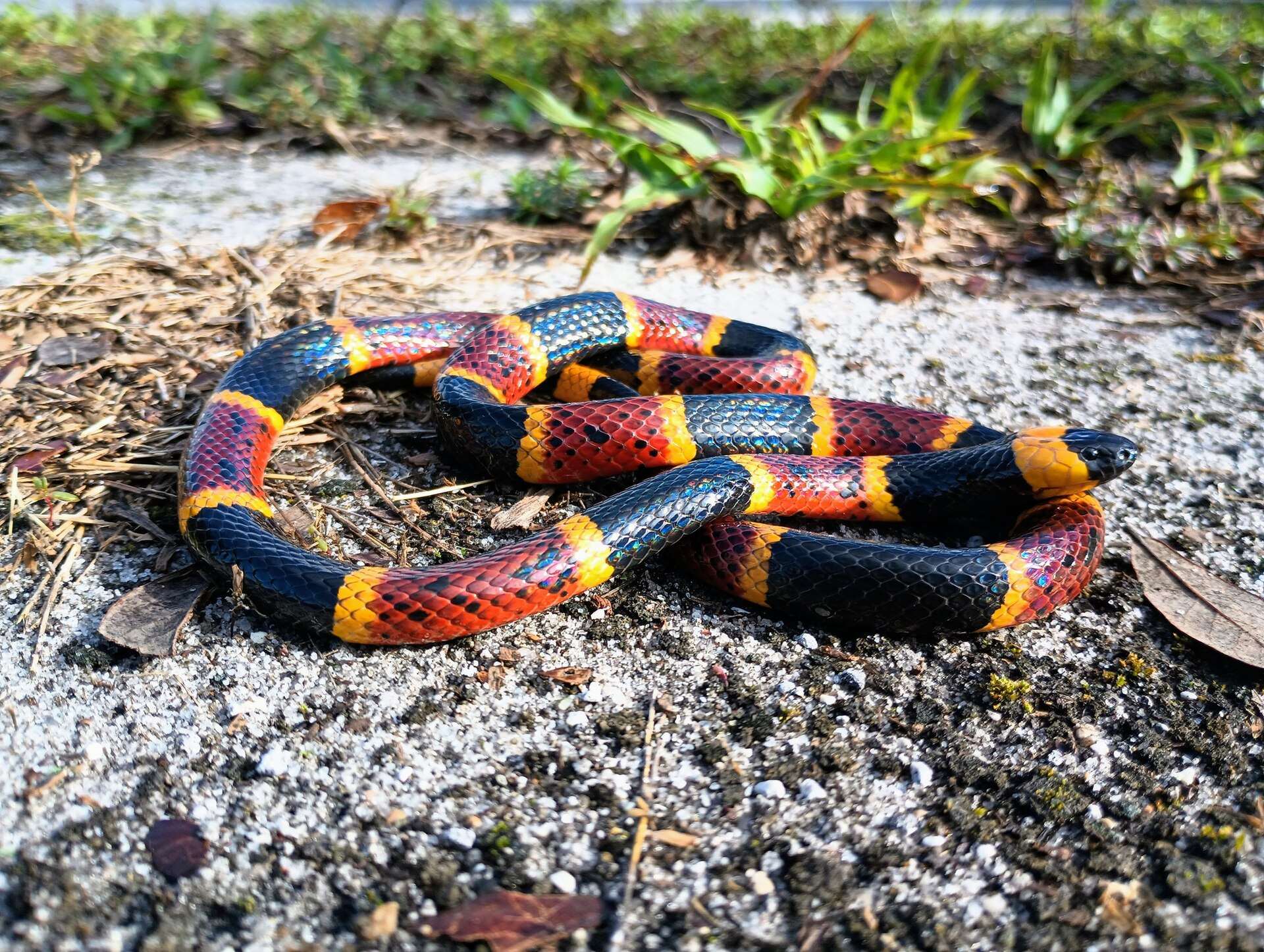
The venomous eastern coral snake (Micrurus fulvius) shares its range and colours, but its red rings touch yellow rings and its snout is black with a yellow band behind it10, whereas in the scarlet kingsnake the red rings touch only black rings and the snout is red1,11. The harmless scarlet snake (Cemophora coccinea) has a more pointed red snout and rings that stop at the sides, leaving a plain whitish belly, while milksnakes also have red markings bordered by black1,2,12.
The rhyme “red touches yellow, kills a fellow; red touches black, venom lack” fits these snakes in Florida most of the time, but unusual colour variants occasionally break it1,10. It only works for coral snakes in the United States: some coral snakes in Mexico, Central America and South America have red rings touching white or even black rings, so the rhyme must not be relied on there12. These differences are not a safe basis for handling any snake. Keep your distance from every snake you cannot identify.
In captivity
The scarlet kingsnake is harmless, but it is a wild animal protected by law in Georgia and South Carolina2. Its longevity record is 22 years and 4 months3. Because it looks so much like a coral snake, it is safest to watch it from a distance and let it go on its way1.
Look-alikes
Don’t confuse it with…
These snakes are often mistaken for each other. Use the differences to learn, never as a reason to handle a snake.
References
- 1
Florida Museum of Natural History. Scarlet Kingsnake (Lampropeltis elapsoides). Florida Snake ID Guide. University of Florida. floridamuseum.ufl.edu
- 2
Savannah River Ecology Laboratory, University of Georgia. Scarlet Kingsnake (Lampropeltis elapsoides). Herpetology at SREL. srelherp.uga.edu
- 3
Virginia Herpetological Society. Scarlet Kingsnake (Lampropeltis elapsoides). virginiaherpetologicalsociety.com
- 4
Uetz, P. et al. (eds.) (2026). Lampropeltis elapsoides (Holbrook, 1838). The Reptile Database. reptile-database.reptarium.cz
- 5
Burbrink, F.T., Bernstein, J.M., Kuhn, A., Gehara, M. & Ruane, S. (2022). Ecological divergence and the history of gene flow in the Nearctic milksnakes (Lampropeltis triangulum complex). Systematic Biology 71(4): 839–858. doi.org
- 6
Harper, G.R. & Pfennig, D.W. (2007). Mimicry on the edge: why do mimics vary in resemblance to their model in different parts of their geographical range? Proceedings of the Royal Society B 274: 1955–1961. doi.org
- 7
Akcali, C.K. & Pfennig, D.W. (2014). Rapid evolution of mimicry following local model extinction. Biology Letters 10(6): 20140304. doi.org
- 8
Kitchens, C.S. & Van Mierop, L.H. (1987). Envenomation by the Eastern coral snake (Micrurus fulvius fulvius). A study of 39 victims. JAMA 258(12): 1615–1618. doi.org
- 9
Hammerson, G.A. (2019). Lampropeltis elapsoides. The IUCN Red List of Threatened Species 2019: e.T67662850A67662876. iucnredlist.org
- 10
Florida Museum of Natural History. Harlequin Coralsnake (Micrurus fulvius). Florida Snake ID Guide. University of Florida. floridamuseum.ufl.edu
- 11
Johnson, S.A. & Main, M.B. Recognizing Florida's Venomous Snakes. UF/IFAS Extension publication WEC 202/UW229. University of Florida. ask.ifas.ufl.edu
- 12
Frank, M. (2019). Identifying Venomous and Nonvenomous Snakes in Texas. Texas A&M AgriLife Extension, publication WFSC-023. texnat.tamu.edu
Play
Play as the scarlet kingsnake.
Its real pattern is a skin in Snake. Every run ends with a fact.