
Eastern rat snake
Pantherophis alleghaniensis (Holbrook, 1836)
Also called Central ratsnake, Black rat snake, Gray rat snake, Midland rat snake, Pilot snake
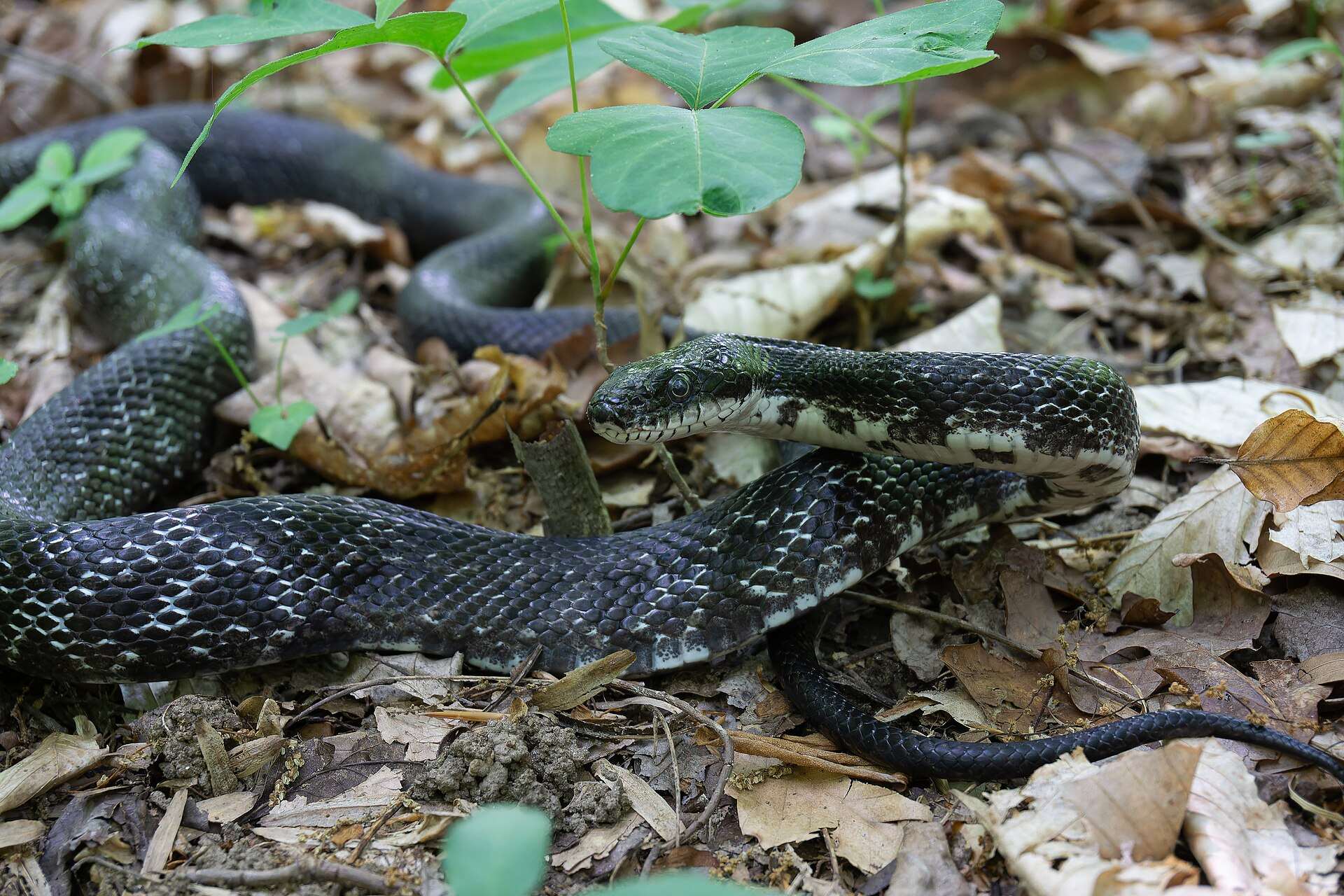
A large, glossy black snake of eastern North America with a white chin and a checkered belly; the young are grey with dark blotches. It climbs well and is often found around woods, farms and barns.

Is it dangerous?
No. It is non-venomous and harmless to people. If handled it may bite, release a foul musk or vibrate its tail, so leave it alone.
Harmless to people, but it may bite if handled. Treat any snake you can’t identify as venomous.
Snakebite first aidAt a glance
- Length
- 1.5–2.56 m
- Active
- Day and night
- Found in
- Eastern United States and southern Ontario
- Venom
- None
- Young
- Lays eggs
- Habitat
- Deciduous forest, Forest edges and fields, Rocky ledges
- Diet
- Rodents, Squirrels and chipmunks, Birds
Length shows a typical adult, then the largest recorded.
IUCN Red List status: Least Concern
Country guideSnakes of the United States
GuidesCorn snake vs rat snake
True size
Scarlet kingsnakeNon-venomous
0.74 m at most
About half the height of a 1.7 m adult.
Usual range 0.45–0.74 m, the bar on the ruler.
Western hognose snakeMildly venomous
1 m at most
About two thirds of the height of a 1.7 m adult.
Usual range 0.5–1.0 m, the bar on the ruler.
Eastern milksnakeNon-venomous
1.32 m at most
About three quarters of the height of a 1.7 m adult.
Usual range 0.75–1.32 m, the bar on the ruler.
CopperheadMedically significant
1.35 m at most
About three quarters of the height of a 1.7 m adult.
Usual range 0.75–1.35 m, the bar on the ruler.
Common garter snakeNon-venomous
1.37 m at most
About three quarters of the height of a 1.7 m adult.
Usual range 0.56–1.37 m, the bar on the ruler.
Corn snakeNon-venomous
1.88 m at most
About as long as a 1.7 m adult is tall.
Usual range 1.2–1.88 m, the bar on the ruler.
California kingsnakeNon-venomous
2 m at most
About 1 times the height of a 1.7 m adult.
Usual range 0.9–2.0 m, the bar on the ruler.
Eastern rat snakeNon-venomous
2.56 m at most
About 1.5 times the height of a 1.7 m adult.
Usual range 1.5–2.56 m, the bar on the ruler.
Each snake is drawn at the longest length in its profile, on the same scale as the adult. Length is to scale; thickness is not.
Identification
Adults are large, stout snakes that are glossy black above, with a white chin and throat and an irregular black-and-white checkerboard belly that fades towards the tail4,5. Some keep faint stripes or traces of the young snake’s blotches4. The scales along the middle of the back are weakly keeled, and the body is flat-bottomed, shaped like a loaf of bread in cross-section4,6.
Young rat snakes are grey with 28–40 dark blotches and a dark stripe from the eye to the corner of the mouth; this pattern usually fades to black by about 60 cm long, although the snake may take four to five years to become fully black4,7. Adults usually measure 1.07–1.83 m, and the largest known specimen measured 2.56 m4. It is Ontario’s largest snake, reaching about 2 m there5.
Distribution
This species lives in the eastern United States, from the Mississippi River east to the Atlantic Seaboard Fall Line in Virginia, and north to Wisconsin, Michigan, New York, Vermont and Massachusetts3. It also reaches southern Ontario in Canada1, where there are two widely separated populations, one in the south-west and one in the south-east of the province5.
These snakes were long treated as one species, the black rat snake, before genetic studies split them into western, central and eastern species3. In 2021 the original specimen of P. alleghaniensis, from the Blue Ridge in Virginia, was shown to belong to the central group, so the name now covers the central snakes once called the grey rat snake (P. spiloides); the coastal-plain and Florida snakes are the yellow rat snake (P. quadrivittatus), and those west of the Mississippi are P. obsoletus1,2,3. The 2025 standard list of North American names calls this species the central ratsnake, but many guides and agencies still call it the eastern or black rat snake2,3,6.
Habitat
Rat snakes do best where woodland is mixed with open ground, such as fields, thickets, wetland edges and rocky outcrops3. In Connecticut they live in rough, forested terrain with ledges and rock outcrops, and in small meadows next to woodland6. They are often found in farmland, hardwood forest and around barns and old buildings, where rodents are common4. They shelter in hollow trees, logs, rock crevices and under rocks3.
In the north they need good winter dens, often in rocky talus or ledges facing south, and they return to the same den year after year3,6. Dens are often shared with other snakes, including racers, copperheads and timber rattlesnakes3,6.
Behaviour
Rat snakes are active by day and at night, and are often out just after sunset4,6. They are excellent climbers that often go high into trees, attics and haylofts, and they also swim well3,5,6.
When it meets a person, a rat snake often keeps still, and if alarmed it may vibrate its tail in dry leaves, which can sound like a rattlesnake6. A cornered snake may raise its front body in an S-shaped coil, hiss and strike4. If grabbed, it may bite repeatedly, wrap around the arm and release a foul-smelling musk6.
Diet
Rodents, birds and birds’ eggs are the main prey4. Recorded mammal prey includes chipmunks, grey squirrels, cottontail rabbits, voles and mice, and many of the birds taken are nestlings4. Rat snakes also eat lizards, frogs and insects4,6. Prey is killed by constriction, while eggs are swallowed whole and broken in the throat4.
Reproduction
Rat snakes lay eggs. Mating takes place in late spring, soon after the snakes leave their winter dens, and males may fight over females3,5. A clutch holds 5–44 eggs, about 14 on average, laid in rotting logs, leaf litter, compost or sawdust piles3. The eggs hatch after 60–75 days, usually by late summer3. Several females may use the same nest site, and young from these shared nests tend to be fitter than those from solitary nests3.
Growth is slow in the north: rat snakes in Maryland mature at about 4 years old, but those in Ontario take 10–12 years3.
Venom and medical significance
The eastern rat snake has no venom and is harmless to people5,6. Like most snakes, it will bite if grabbed or cornered, and a handled snake may also smear a foul-smelling musk4,6.
The belief that rat snakes and copperheads interbreed to produce venomous young is a myth, because the two are only distantly related4.
Conservation
The IUCN Red List assessed North American rat snakes in 2019 under the older names. Its assessment of Pantherophis spiloides covers the snakes now called P. alleghaniensis, and it and the assessment published under the name P. alleghaniensis both list them as Least Concern3,9,10.
The species is still common in much of its range, but northern populations are declining3. It is listed as Endangered in Massachusetts and Threatened in Vermont3. In Canada, the Carolinian population is listed as Endangered and the Great Lakes/St. Lawrence population as Threatened3,5. The main threats are habitat loss, especially of winter dens, road deaths and persecution by people3,5.
Similar species
The northern black racer (Coluber constrictor) is the snake most often confused with an adult rat snake4. Racers have smooth scales, a rounded body and dark eyes, and only the chin is white; rat snakes have weakly keeled scales, a checkered belly and a clearly visible iris4,6.
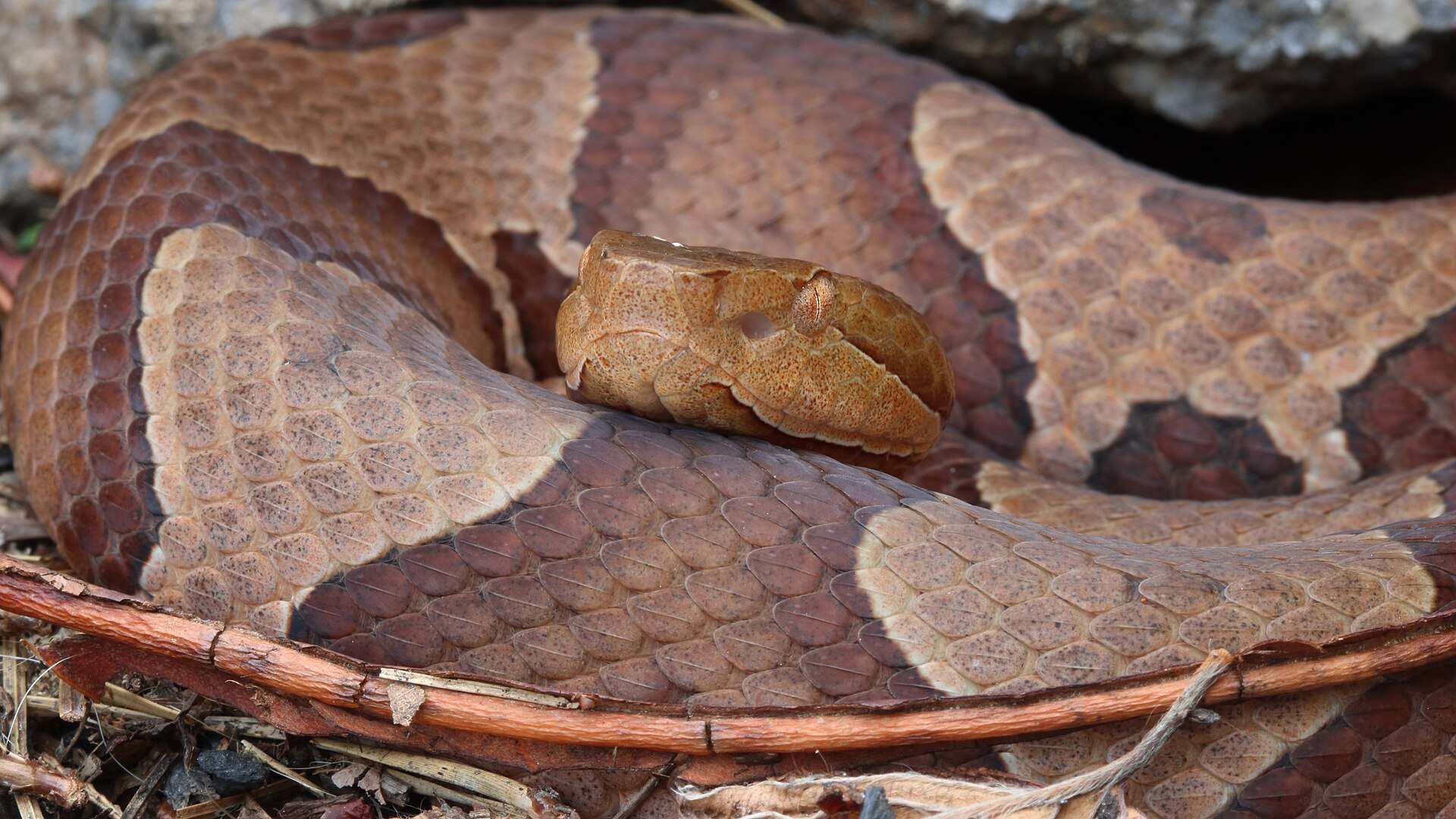
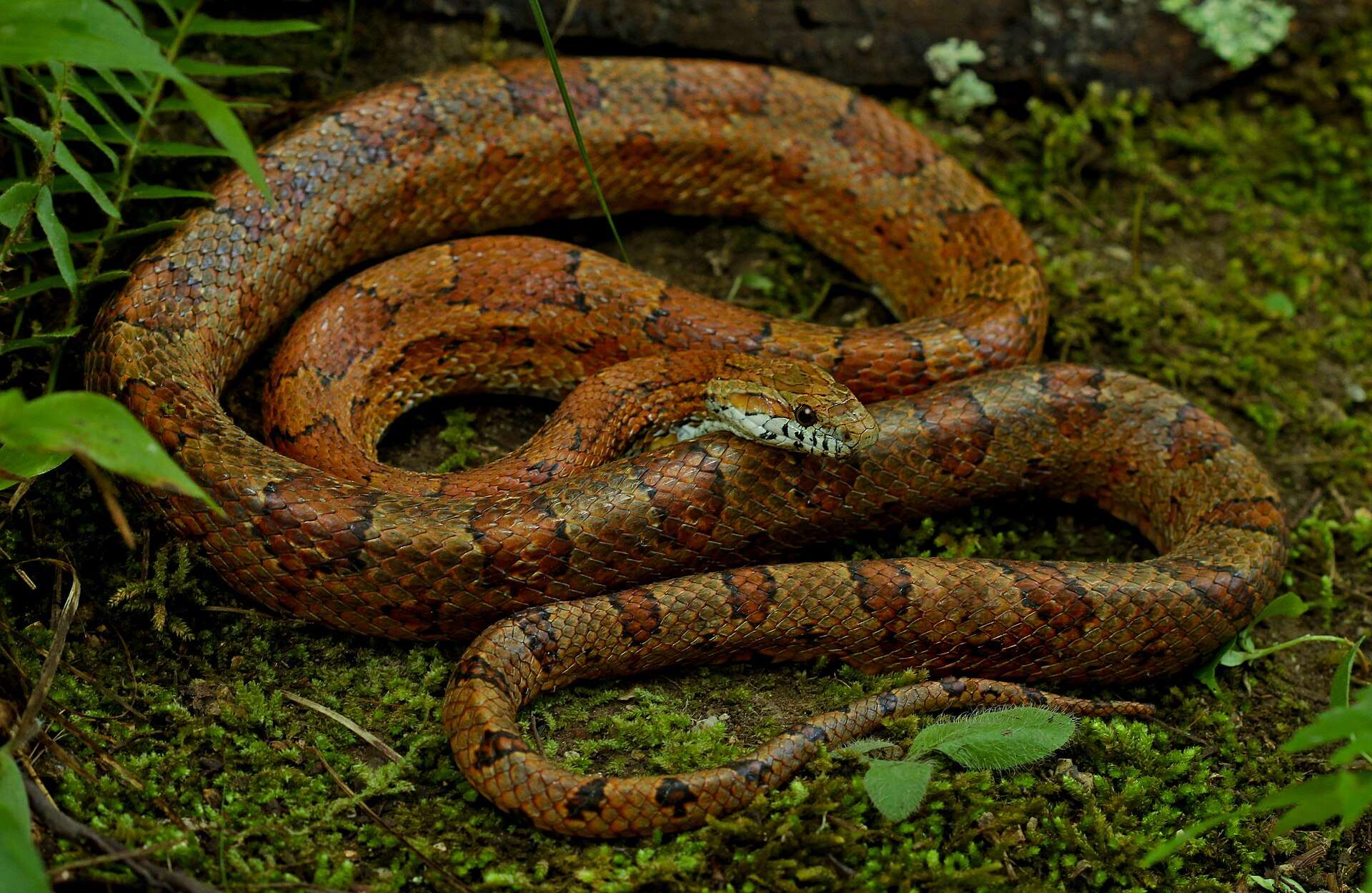
Young rat snakes are sometimes mistaken for young copperheads (Agkistrodon contortrix), which are venomous and have brown hourglass-shaped crossbands and a yellowish tail tip4. They can also look like young corn snakes (Pantherophis guttatus), but corn snakes have a spear-shaped mark between the eyes that young grey rat snakes lack8.
These differences are not a safe basis for handling any snake. Keep your distance from every snake you cannot identify.
In captivity
Rat snakes are popular in the pet trade, and collecting them from the wild has harmed some populations6. Connecticut’s wildlife agency advises never taking a wild snake as a pet, because wild-caught snakes often suffer from infection, parasites and stress in captivity6. Snakes of this complex, then all called Elaphe obsoleta, have lived up to 33.9 years in captivity11. A pet snake should never be released, because it may carry diseases into wild populations6.
Look-alikes
Don’t confuse it with…
These snakes are often mistaken for each other. Use the differences to learn, never as a reason to handle a snake.
References
- 1
Uetz, P. et al. (eds.) (2026). Pantherophis alleghaniensis (Holbrook, 1836). The Reptile Database. reptile-database.reptarium.cz
- 2
Nicholson, K.E. (ed.) (2025). Scientific and Standard English Names of Amphibians and Reptiles of North America North of Mexico, with Comments Regarding Confidence in Our Understanding. 9th edition. SSAR Herpetological Circular. (Pantherophis, pp. 48–49.) webapps.fhsu.edu
- 3
New York State Department of Environmental Conservation (2025). Species Status Assessment: Central ratsnake, Pantherophis alleghaniensis. Updated by C. Macklem & L. Pipino, April 2025. extapps.dec.ny.gov
- 4
Virginia Herpetological Society. Central Ratsnake, Pantherophis alleghaniensis (species account after Mitchell, J.C., The Reptiles of Virginia). virginiaherpetologicalsociety.com
- 5
Government of Ontario, Ministry of the Environment, Conservation and Parks. Gray ratsnake. ontario.ca
- 6
Connecticut Department of Energy and Environmental Protection, Wildlife Division. Eastern Ratsnake (fact sheet). portal.ct.gov
- 7
New Jersey Division of Fish and Wildlife, Endangered and Nongame Species Program. Snake Identification: Avoid Being Confused! nj.gov
- 8
Tennessee Wildlife Resources Agency. Red Cornsnake, Pantherophis guttatus. tn.gov
- 9
Hammerson, G.A. (2019). Pantherophis spiloides. The IUCN Red List of Threatened Species 2019: e.T90069659A90069671. iucnredlist.org
- 10
Hammerson, G.A. (2019). Pantherophis alleghaniensis. The IUCN Red List of Threatened Species 2019: e.T90069536A90069545. iucnredlist.org
- 11
de Magalhães, J.P. & Costa, J. AnAge entry for Elaphe obsoleta. AnAge: The Animal Ageing and Longevity Database, Human Ageing Genomic Resources. genomics.senescence.info
Play
Play as the eastern rat snake.
Its real pattern is a skin in Snake. Every run ends with a fact.