
Western hognose snake
Heterodon nasicus Baird & Girard, 1852
Also called Plains hog-nosed snake, Western hog-nosed snake, Dusty hog-nosed snake
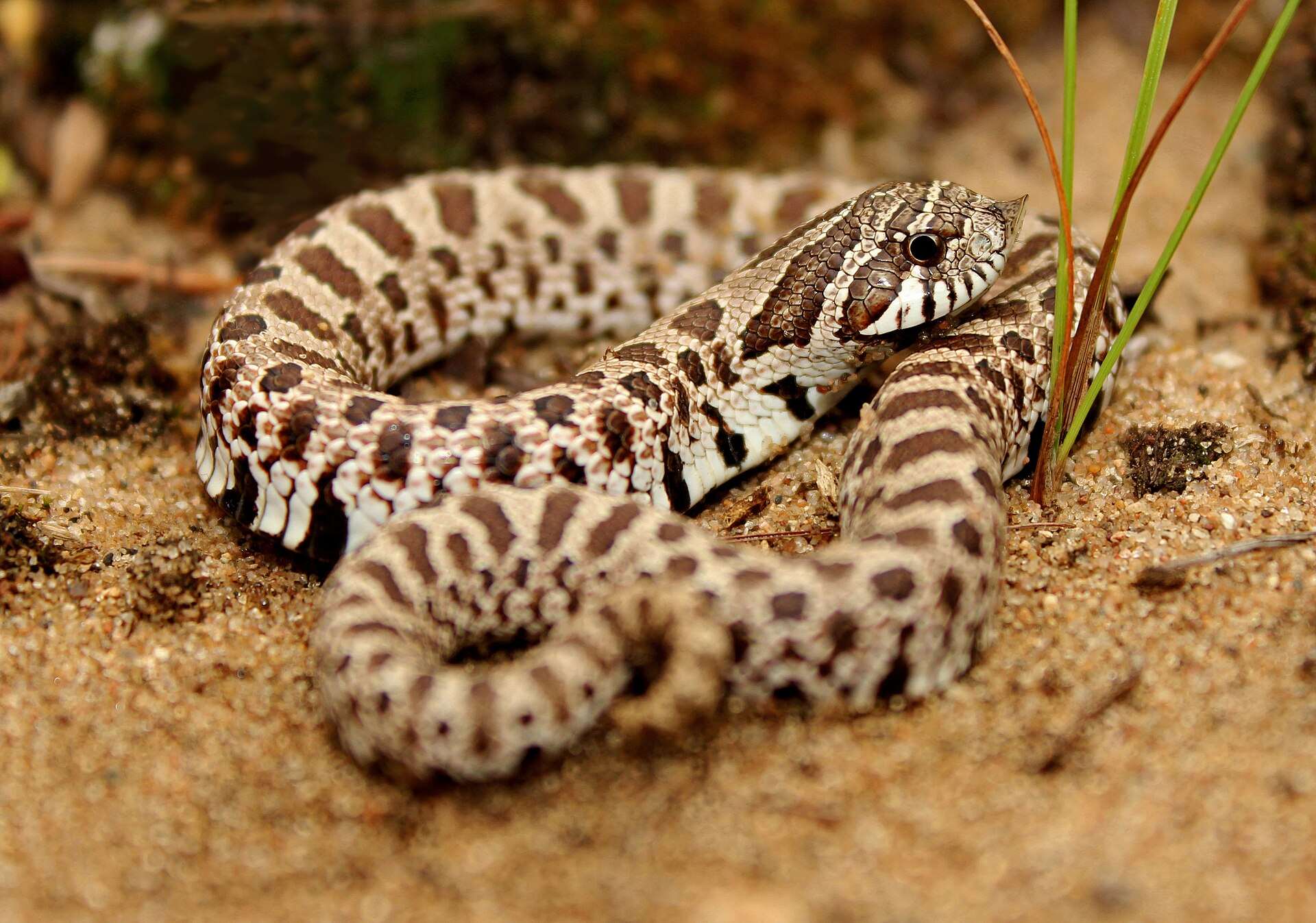
A small, stout snake of the Great Plains with a sharply upturned snout, dark blotches on a tan or grey body and a mostly black belly. When threatened it hisses, flattens its neck and may play dead.

Is it dangerous?
Mildly. It rarely bites, but a long bite, usually from a pet snake at feeding time, can cause painful local swelling. Do not handle it, and seek medical care if bitten.
Do not approach. If someone is bitten, go to a hospital now.
At a glance
- Length
- 0.5–1.0 m
- Active
- By day
- Found in
- Great Plains of North America
- Venom
- Mild (rear-fanged)
- Young
- Lays eggs
- Habitat
- Sand prairie, Plains grassland, Sandhills
- Diet
- Toads, Reptile eggs, Lizards
- Lifespan
- Nearly 20 years in captivity
Length shows a typical adult, then the largest recorded.
IUCN Red List status: Least Concern
Country guideSnakes of the United States
True size
Scarlet kingsnakeNon-venomous
0.74 m at most
About half the height of a 1.7 m adult.
Usual range 0.45–0.74 m, the bar on the ruler.
Western hognose snakeMildly venomous
1 m at most
About two thirds of the height of a 1.7 m adult.
Usual range 0.5–1.0 m, the bar on the ruler.
Eastern milksnakeNon-venomous
1.32 m at most
About three quarters of the height of a 1.7 m adult.
Usual range 0.75–1.32 m, the bar on the ruler.
Common garter snakeNon-venomous
1.37 m at most
About three quarters of the height of a 1.7 m adult.
Usual range 0.56–1.37 m, the bar on the ruler.
Corn snakeNon-venomous
1.88 m at most
About as long as a 1.7 m adult is tall.
Usual range 1.2–1.88 m, the bar on the ruler.
California kingsnakeNon-venomous
2 m at most
About 1 times the height of a 1.7 m adult.
Usual range 0.9–2.0 m, the bar on the ruler.
Western diamondback rattlesnakeMedically significant
2.29 m at most
About 1.5 times the height of a 1.7 m adult.
Usual range 1.2–2.29 m, the bar on the ruler.
Eastern rat snakeNon-venomous
2.56 m at most
About 1.5 times the height of a 1.7 m adult.
Usual range 1.5–2.56 m, the bar on the ruler.
Each snake is drawn at the longest length in its profile, on the same scale as the adult. Length is to scale; thickness is not.
Identification
The western hognose snake is small and stout, with a sharply upturned, keeled snout that it uses like a spade for digging4,5. Its body is grey, tan, yellowish or light brown, with 23–50 dark brown blotches down the back and rows of smaller spots along the sides4. The belly and the underside of the tail are largely jet black, sometimes edged with yellow or orange4,5. The scales are keeled4.
Adults usually measure 38–63.5 cm, and the largest recorded reached 1.0 m (100.3 cm)4. In Colorado few grow longer than about 50 cm8.
Distribution
This snake lives on the Great Plains, from southern Alberta, Saskatchewan and Manitoba south through Montana, the Dakotas, Nebraska, Kansas and eastern Colorado to Oklahoma, Texas and New Mexico, and east to Minnesota, Iowa and Illinois1,5.
The Mexican hognose snake (Heterodon kennerlyi) of southern Arizona, southern New Mexico, southern Texas and Mexico was long treated as a subspecies of this snake, but The Reptile Database now lists it as a separate species, so H. nasicus does not occur in Mexico1,2. The dusty hognose snake of Texas and Oklahoma, sometimes called H. gloydi, is kept as a subspecies, H. n. gloydi, by both The Reptile Database and the 2025 list of North American names1,3. In Illinois, one population in Kankakee County was introduced by people6.
Habitat
The western hognose snake prefers plains and savanna with loose, well-drained sandy or gravelly soil that it can burrow into5. In Colorado it lives in sandhills, plains grassland and sandy floodplains, often near streams, irrigation ditches and ponds8. In Illinois it is a snake of sand prairies and savannas6. It can also live in lightly farmed areas where the soil suits it, but intensive cropping reduces its habitat5.
Behaviour
This snake is active by day, mostly in the morning and late afternoon, and spends the night and other quiet periods buried in loose soil4,5. It does not gather in shared winter dens; each snake digs its own burrow below the frost line5.
When disturbed it usually crawls away or hides its head under its coils4. If pressed, it flattens its neck into a hood-like shape, hisses loudly and makes short strikes with its mouth closed4. If that fails, it may writhe, bring up its last meal, roll onto its back and play dead for up to five minutes4. If turned the right way up, it rolls straight back over5.
Diet
The western hognose snake finds much of its food by smell and digs it out with its snout4,5. It eats toads, the eggs of reptiles such as turtles, lizards and snakes, and also takes frogs, rodents and birds4,5. Enlarged teeth at the back of its upper jaw help it hold and deflate toads that puff themselves up5.
Reproduction
The western hognose snake lays eggs. It usually mates in May, although some mating happens in autumn4,5. Clutches of 4–23 eggs, about 9 on average, are laid in July a few centimetres below the soil surface, and females often breed only every other year4. The eggs hatch after 50–60 days, and the hatchlings are 14–20 cm long4,5. Males mature at 2–3 years old and females at 3–4 years5.
Venom and medical significance
The western hognose snake is rear-fanged, with enlarged teeth at the back of its upper jaw, and its saliva is toxic to its prey5,6. Wild snakes almost never bite, and nearly all recorded bites have happened while people were feeding pet snakes4,5. When a snake holds on, the bite can cause painful swelling, bruising, blisters and swollen lymph nodes, which took about five months to clear in one case9. In another case, a woman also had a temporary drop in blood platelets10. Experts label it differently: Colorado’s wildlife agency calls it venomous but not dangerous to people8, while a 2009 review concluded that hognose snakes can occasionally cause medically significant bites but should not be considered dangerous or venomous9. Anyone bitten should seek medical care10.
Conservation
The western hognose snake is listed as Least Concern on the IUCN Red List (assessed in 2007)11. It has declined in some areas and is listed as Threatened in Illinois and as a Species of Concern in Montana5,6. Likely threats include the conversion of prairie to farmland, road deaths while snakes bask on roads, people killing them in the mistaken belief that they are rattlesnakes, and collection for the pet trade5.
Similar species
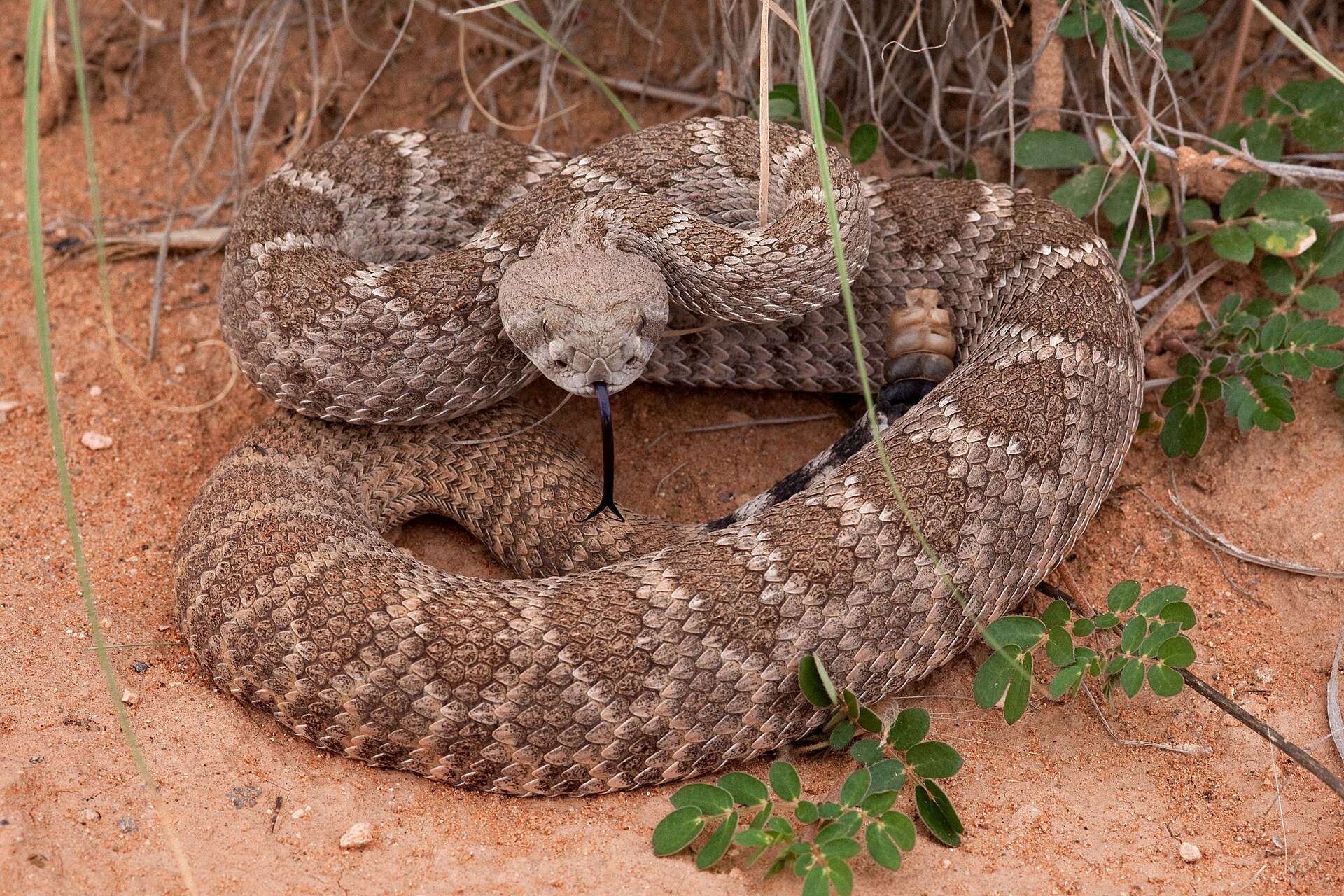
Because of its blotched pattern and loud hissing, the western hognose snake is often mistaken for a rattlesnake and killed4,5. Rattlesnakes such as the prairie rattlesnake have a similar blotched pattern, but the hognose has a sharply upturned snout and no rattle5.
The eastern hognose snake (Heterodon platirhinos) is similar, but the underside of its tail is always lighter than its belly, while the western hognose has a mostly black belly and tail6,7. The Mexican hognose snake replaces this species further south-west and was split from it on the basis of scale differences1,2.
These differences are not a safe basis for handling any snake. Keep your distance from every snake you cannot identify.
In captivity
The western hognose snake is fairly docile and is popular in the pet trade, where it has been bred into dozens of colour forms8. Captive snakes have lived for nearly 20 years4,5. Because most bites happen at feeding time, captive hognose snakes should be handled with care, especially when food is offered4,9.
Look-alikes
Don’t confuse it with…
These snakes are often mistaken for each other. Use the differences to learn, never as a reason to handle a snake.
References
- 1
Uetz, P. et al. (eds.) (2026). Heterodon nasicus Baird & Girard, 1852. The Reptile Database. reptile-database.reptarium.cz
- 2
Uetz, P. et al. (eds.) (2026). Heterodon kennerlyi Kennicott, 1860. The Reptile Database. reptile-database.reptarium.cz
- 3
Nicholson, K.E. (ed.) (2025). Scientific and Standard English Names of Amphibians and Reptiles of North America North of Mexico, with Comments Regarding Confidence in Our Understanding. 9th edition. SSAR Herpetological Circular. (Heterodon, pp. 42–43.) webapps.fhsu.edu
- 4
Center for North American Herpetology. Plains Hog-nosed Snake, Heterodon nasicus. Kansas Herpetofaunal Atlas. cnah.org
- 5
Montana Natural Heritage Program and Montana Fish, Wildlife & Parks. Western Hog-nosed Snake, Heterodon nasicus. Montana Field Guide. fieldguide.mt.gov
- 6
Illinois Natural History Survey, Prairie Research Institute. Plains Hog-nosed Snake (Heterodon nasicus). INHS Herpetology Collection. herpetology.inhs.illinois.edu
- 7
Illinois Natural History Survey, Prairie Research Institute. Eastern Hog-nosed Snake (Heterodon platirhinos). INHS Herpetology Collection. herpetology.inhs.illinois.edu
- 8
Colorado Parks and Wildlife. Western Hognose Snake. cpw.state.co.us
- 9
Weinstein, S.A. & Keyler, D.E. (2009). Local envenoming by the Western hognose snake (Heterodon nasicus): a case report and review of medically significant Heterodon bites. Toxicon 54(3): 354–360. pubmed.ncbi.nlm.nih.gov
- 10
Brandehoff, N., Smith, C.F., Buchanan, J.A., Mackessy, S.P. & Bonney, C.F. (2019). First reported case of thrombocytopenia from a Heterodon nasicus envenomation. Toxicon 157: 12–17. pubmed.ncbi.nlm.nih.gov
- 11
Hammerson, G.A. (2007). Heterodon nasicus. The IUCN Red List of Threatened Species 2007: e.T63819A12718545. iucnredlist.org
Play
Play as the western hognose snake.
Its real pattern is a skin in Snake. Every run ends with a fact.