
Common garter snake
Thamnophis sirtalis (Linnaeus, 1758)
Also called Common gartersnake, Eastern garter snake, Red-sided garter snake
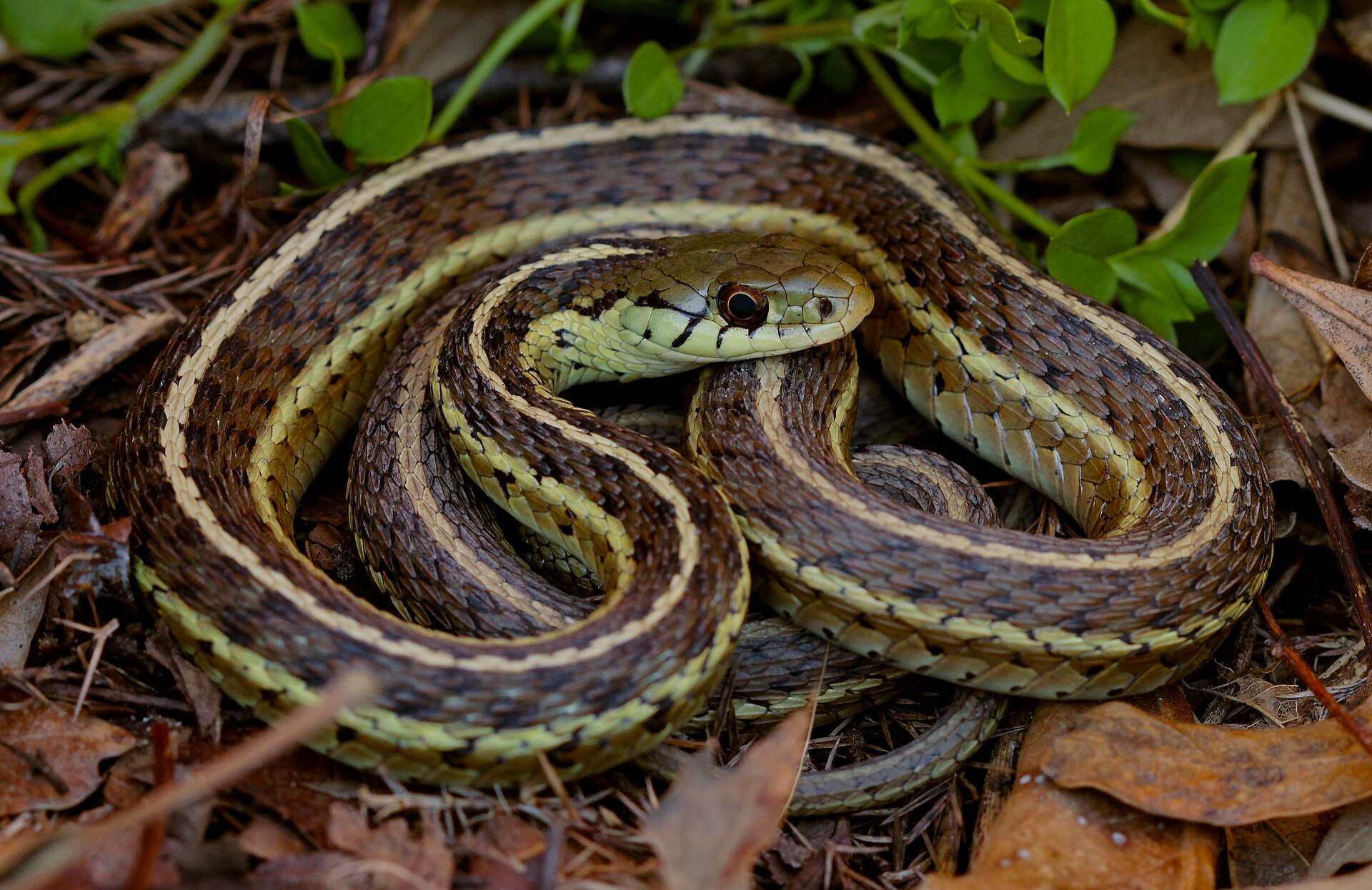
A small striped snake found across most of North America, usually dark with three yellow, greenish or bluish stripes. It is often seen in gardens, parks and near water, and is harmless to people.

Is it dangerous?
No. It is harmless to people. It may bite and smear musk if handled, and a long, chewing bite has very rarely caused mild local swelling.
Harmless to people, but it may bite if handled. Treat any snake you can’t identify as venomous.
Snakebite first aidAt a glance
- Length
- 0.56–1.37 m
- Active
- By day
- Found in
- Most of North America
- Venom
- None
- Young
- Live young
- Habitat
- Meadows and grassland, Marshes and pond edges, Woodland
- Diet
- Earthworms, Frogs and toads, Salamanders
- Lifespan
- 6–10 years in captivity
Length shows a typical adult, then the largest recorded.
IUCN Red List status: Least Concern
Country guideSnakes of MexicoSnakes of the United States
True size
Scarlet kingsnakeNon-venomous
0.74 m at most
About half the height of a 1.7 m adult.
Usual range 0.45–0.74 m, the bar on the ruler.
Western hognose snakeMildly venomous
1 m at most
About two thirds of the height of a 1.7 m adult.
Usual range 0.5–1.0 m, the bar on the ruler.
Texas coral snakeMedically significant
1.22 m at most
About three quarters of the height of a 1.7 m adult.
Usual range 0.6–1.22 m, the bar on the ruler.
Eastern milksnakeNon-venomous
1.32 m at most
About three quarters of the height of a 1.7 m adult.
Usual range 0.75–1.32 m, the bar on the ruler.
Common garter snakeNon-venomous
1.37 m at most
About three quarters of the height of a 1.7 m adult.
Usual range 0.56–1.37 m, the bar on the ruler.
Corn snakeNon-venomous
1.88 m at most
About as long as a 1.7 m adult is tall.
Usual range 1.2–1.88 m, the bar on the ruler.
California kingsnakeNon-venomous
2 m at most
About 1 times the height of a 1.7 m adult.
Usual range 0.9–2.0 m, the bar on the ruler.
Eastern rat snakeNon-venomous
2.56 m at most
About 1.5 times the height of a 1.7 m adult.
Usual range 1.5–2.56 m, the bar on the ruler.
Each snake is drawn at the longest length in its profile, on the same scale as the adult. Length is to scale; thickness is not.
Identification
The common garter snake usually has three light stripes running the length of a black, brown, grey or olive body3. The stripes may be yellow, white, blue, greenish or brown, and rows of dark spots between them can give a checkered look3. The side stripes sit on the second and third rows of scales up from the belly, and the lip scales have black bars4,5. The scales are keeled, the head is a little wider than the neck, and the tongue is red with a black tip3,5.
Colour varies widely across its range, and some populations include many all-black snakes3. Most adults are 46–66 cm long4, and the largest reach about 1.37 m3.
Distribution
This is one of North America’s most widespread snakes. It ranges from Florida to coastal Quebec and west to British Columbia and California, and reaches north into the Northwest Territories in Canada1,3. It is largely absent from the dry south-west, but isolated populations live in the mountains of New Mexico and northern Mexico3.
Twelve subspecies are recognised, including the eastern, red-sided and San Francisco garter snakes1,2. A 2023 genetic study did not support these traditional subspecies and instead found four broad geographic lineages2.
Habitat
Common garter snakes live in meadows, marshes, woodland and hillsides, and they favour moist, grassy places3,4. They are often found near water, such as the edges of ponds, lakes, ditches and streams, but can also live far from it4. They are among the snakes most often seen in suburbs and towns where there is cover such as boards, logs or rocks3,4. In Illinois they even live on vacant city lots5.
Behaviour
Garter snakes are active mainly by day and can stay active at lower temperatures than most snakes3. They hibernate from about late October to March or April in burrows, rock piles and other cavities, and may come out to bask on mild winter days3,5. Many gather to hibernate together3. At the Narcisse snake dens in Manitoba, tens of thousands of red-sided garter snakes overwinter in limestone caverns below the frost line6.
When threatened, a garter snake usually flees, often into water3. If cornered it coils, strikes and may bite, and if grabbed it writhes and releases a foul-smelling secretion3.
Diet
Common garter snakes eat earthworms, frogs, toads, salamanders, tadpoles and small fish3,4. They also take leeches, slugs, snails, insects, crayfish and occasionally small mammals or young birds3,5. They seem unaffected by the toxic skin of toads3. Some populations eat rough-skinned newts, which carry a powerful toxin, and these snakes have evolved resistance to it1.
Reproduction
The common garter snake gives birth to live young3. Mating starts in spring as soon as the snakes leave hibernation, and in Manitoba a single female may be surrounded by up to 100 males in a “mating ball”3,6. Females can store sperm until it is needed3. Litters of 10–40 young are typical, but up to about 80 have been recorded, born from late July to October3,5. The newborn snakes are 12.5–23 cm long and get no care from their mother3.
Venom and medical significance
The common garter snake is not dangerous to people, and its reputation as a harmless snake is well deserved3,6. Its saliva may be mildly toxic to small prey, which helps it handle them3. In one published case, a 13-year-old’s hand became swollen and bruised after a long, chewing bite; tests were normal, recovery was quick and later bites caused no symptoms7. Such reactions are very rare3.
Conservation
The common garter snake is listed as Least Concern on the IUCN Red List (assessed in 2007 and published in 2015)8. It is one of the most abundant snakes in the eastern United States, partly because it does well in towns and suburbs3. Even so, pesticides, habitat loss, water pollution and over-collection for the pet trade have reduced some populations3. The San Francisco garter snake, a subspecies, has been listed as endangered in the United States since 19673.
Similar species
The common garter snake is most easily confused with other harmless garter and ribbon snakes, and with the lined snake5. Ribbon snakes are more slender, and their side stripes sit on the third and fourth scale rows rather than the second and third4. Ribbon snakes also lack the black bars on the lip scales that common garter snakes have4.
These differences are not a safe basis for handling any snake. Keep your distance from every snake you cannot identify.
In captivity
Common garter snakes tame easily and are sometimes kept as pets3. In captivity they usually live 6–10 years, and one lived to 20 years3. Collecting them for the pet trade has contributed to local declines, so wild garter snakes are best left where they are found3.
References
- 1
Uetz, P. et al. (eds.) (2026). Thamnophis sirtalis (Linnaeus, 1758). The Reptile Database. reptile-database.reptarium.cz
- 2
Nicholson, K.E. (ed.) (2025). Scientific and Standard English Names of Amphibians and Reptiles of North America North of Mexico, with Comments Regarding Confidence in Our Understanding. 9th edition. SSAR Herpetological Circular. (Thamnophis sirtalis, pp. 53–54.) webapps.fhsu.edu
- 3
Zimmerman, R. (2013). Thamnophis sirtalis (common garter snake). Animal Diversity Web, University of Michigan Museum of Zoology. animaldiversity.org
- 4
Gleaton, A. (ed. J.D. Willson). Eastern Garter Snake (Thamnophis sirtalis). Herpetology at SREL, Savannah River Ecology Laboratory, University of Georgia. srelherp.uga.edu
- 5
Illinois Natural History Survey, Prairie Research Institute. Common Gartersnake (Thamnophis sirtalis). INHS Herpetology Collection. herpetology.inhs.illinois.edu
- 6
Government of Manitoba, Natural Resources and Indigenous Futures. Snakes of Narcisse. gov.mb.ca
- 7
Hayes, W.K. & Hayes, F.E. (1985). Human envenomation from the bite of the eastern garter snake, Thamnophis s. sirtalis (Serpentes: Colubridae). Toxicon 23(4): 719–721. pubmed.ncbi.nlm.nih.gov
- 8
Frost, D.R., Hammerson, G.A. & Santos-Barrera, G. (2015). Thamnophis sirtalis. The IUCN Red List of Threatened Species 2015: e.T62240A68308267. iucnredlist.org
Play
Play as the common garter snake.
Its real pattern is a skin in Snake. Every run ends with a fact.