
Eastern milksnake
Lampropeltis triangulum (Lacépède, 1789)
Also called Eastern milk snake, Milk snake, Checkered adder
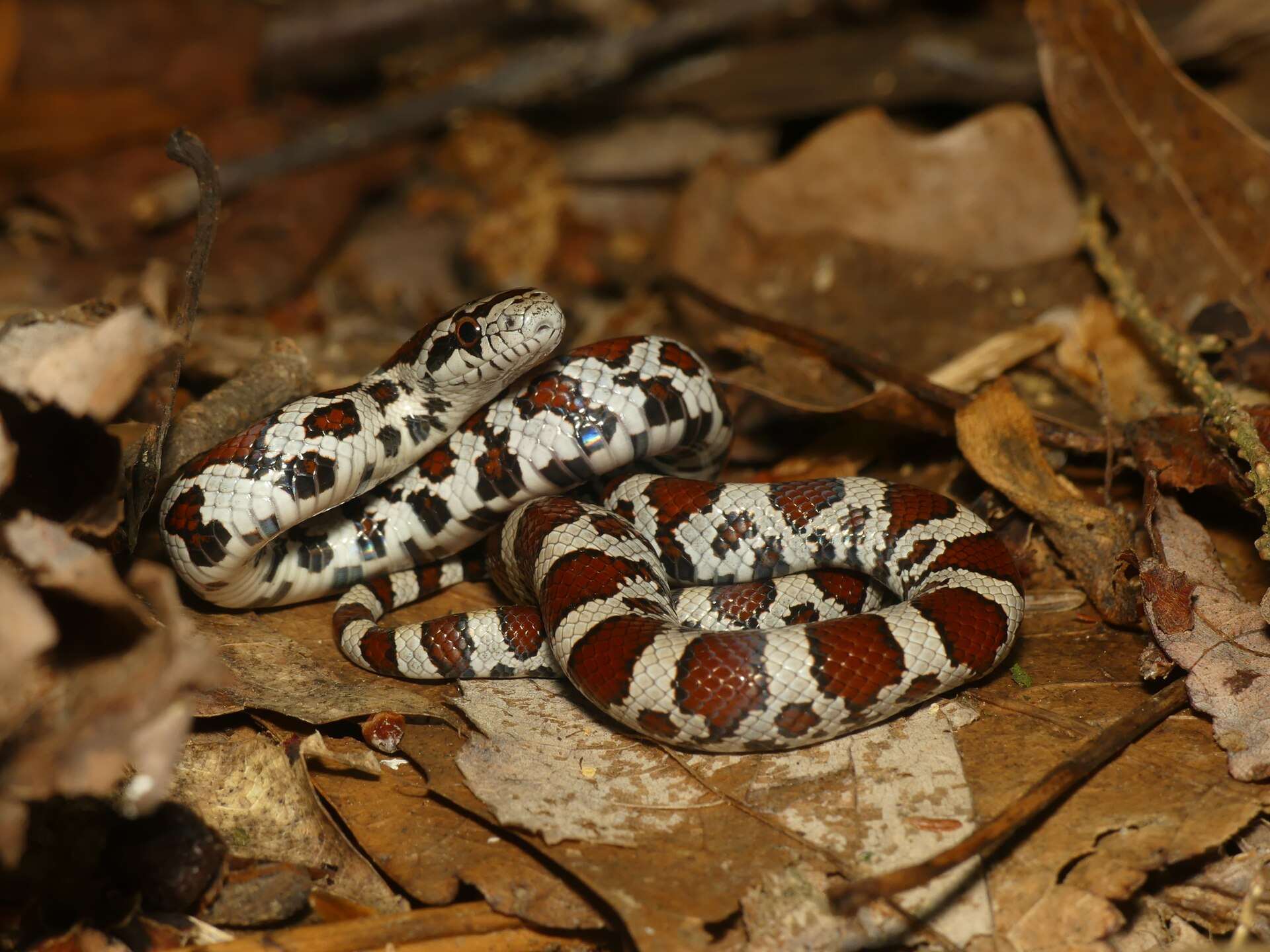
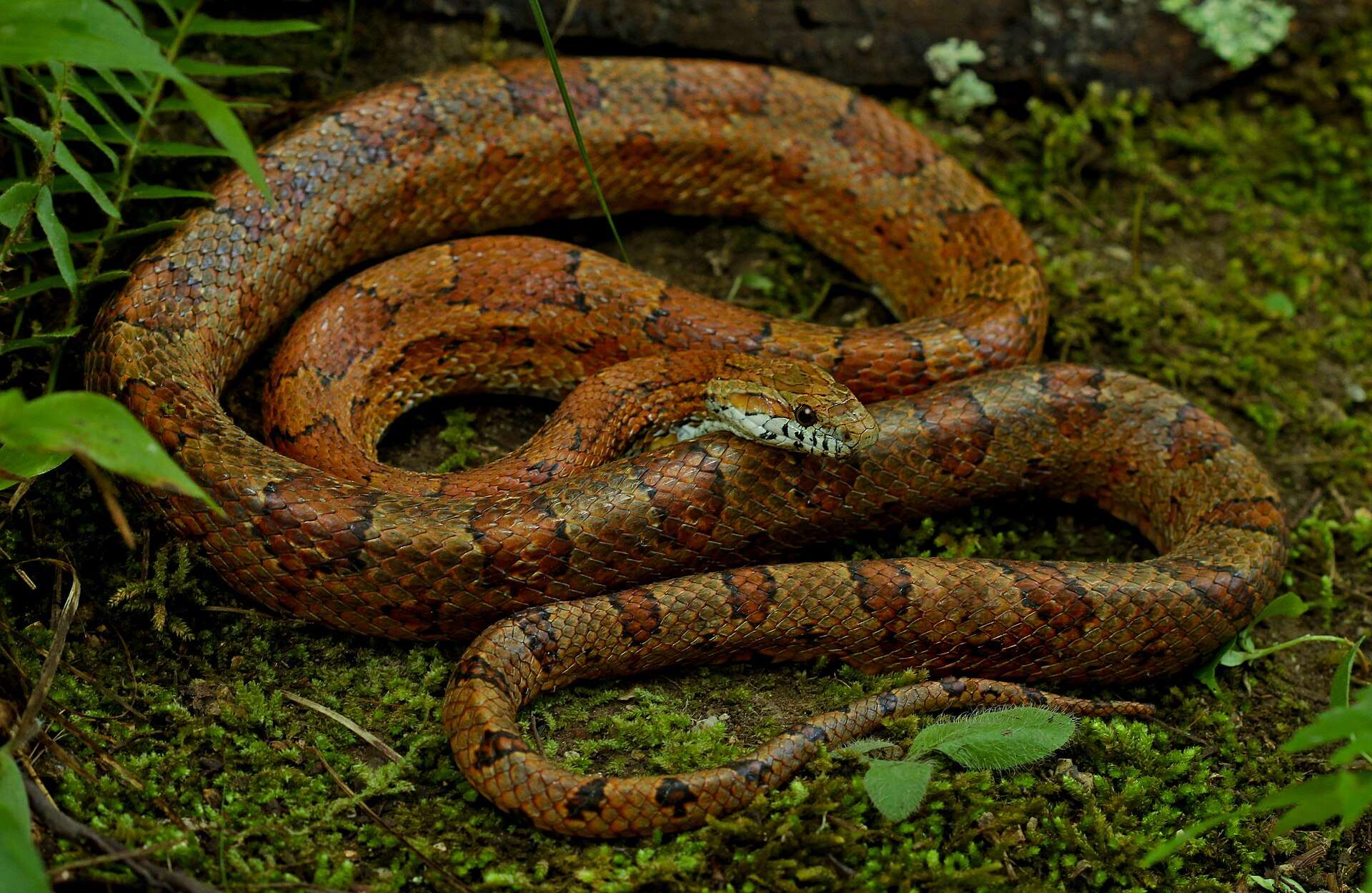
A slender, harmless snake of eastern North America, grey or tan with black-edged, reddish-brown blotches and a black-and-white checkerboard belly. It often lives around barns and houses, where it hunts mice.

Is it dangerous?
No. It is non-venomous and harmless, though it may strike if cornered. It is often mistaken for the venomous copperhead, so leave alone any snake you cannot identify.
Harmless to people, but it may bite if handled. Treat any snake you can’t identify as venomous.
Snakebite first aidAt a glance
- Length
- 0.75–1.32 m
- Active
- At night
- Found in
- Eastern North America
- Venom
- None
- Young
- Lays eggs
- Habitat
- Farmland and old fields, Meadows, Rocky hillsides
- Diet
- Mice and voles, Shrews, Snakes
- Lifespan
- Up to 22.6 years in captivity
Length shows a typical adult, then the largest recorded.
IUCN Red List status: Least Concern
Country guideSnakes of the United States
True size
Scarlet kingsnakeNon-venomous
0.74 m at most
About half the height of a 1.7 m adult.
Usual range 0.45–0.74 m, the bar on the ruler.
Western hognose snakeMildly venomous
1 m at most
About two thirds of the height of a 1.7 m adult.
Usual range 0.5–1.0 m, the bar on the ruler.
Eastern coral snakeMedically significant
1.21 m at most
About three quarters of the height of a 1.7 m adult.
Usual range 0.65–1.21 m, the bar on the ruler.
Eastern milksnakeNon-venomous
1.32 m at most
About three quarters of the height of a 1.7 m adult.
Usual range 0.75–1.32 m, the bar on the ruler.
CopperheadMedically significant
1.35 m at most
About three quarters of the height of a 1.7 m adult.
Usual range 0.75–1.35 m, the bar on the ruler.
Common garter snakeNon-venomous
1.37 m at most
About three quarters of the height of a 1.7 m adult.
Usual range 0.56–1.37 m, the bar on the ruler.
Corn snakeNon-venomous
1.88 m at most
About as long as a 1.7 m adult is tall.
Usual range 1.2–1.88 m, the bar on the ruler.
California kingsnakeNon-venomous
2 m at most
About 1 times the height of a 1.7 m adult.
Usual range 0.9–2.0 m, the bar on the ruler.
Each snake is drawn at the longest length in its profile, on the same scale as the adult. Length is to scale; thickness is not.
Identification
The eastern milksnake is a slender snake with smooth scales and a narrow head only slightly wider than its neck1. Adults are grey to tan with three to five rows of black-edged brown or reddish-brown blotches, and there is usually a light V- or Y-shaped mark on the back of the head1,2. The belly has a black-and-white checkerboard pattern1. Young milksnakes have bright red blotches, and their colours dull with age1.
Most adults are 61–90 cm long, and the record length is 132.1 cm2. Hatchlings are about 20–25 cm long3.
Distribution
The eastern milksnake lives in south-eastern Canada, in southern Ontario and south-western Quebec, and across much of the eastern and central United States5,7. The Reptile Database lists it from southern Maine west to Minnesota, Iowa and parts of the Great Plains, and south to the northern parts of Alabama, Georgia and Louisiana5.
In 2014 a genetic study split the wide-ranging milksnake of the Americas into several species, and the name Lampropeltis triangulum now applies only to the eastern milksnake5,6,7. It is the most northerly of these species and the only one found in Canada7. Whether the Central Plains milksnake (L. gentilis) should be kept separate from it is still debated5.
Habitat
The eastern milksnake uses a wide range of habitats, including farmland, meadows, old fields, river bottoms, bogs, rocky hillsides, and both coniferous and deciduous forest1,3. These places need plenty of cover and a healthy population of rodents1. It is often found around houses, barns and other buildings1,4. In winter it shelters underground, in places such as old wells, stone walls, rock crevices and sometimes the basements of homes1,4.
Behaviour
The eastern milksnake is secretive and spends most of its time hidden under logs, boards, rocks and other debris, seldom basking in the open1. It is mainly active at night1. When disturbed it usually stays still or crawls away, but if harassed it may vibrate the tip of its tail and strike repeatedly1. Because of this tail-vibrating, it is often mistaken for a rattlesnake4. It is eaten by birds of prey and mammals, and many are killed on roads3.
Diet
It is a constrictor that feeds mainly on mice and other small mammals, such as voles and shrews1,4. It also eats other snakes, birds and their eggs, reptile eggs, frogs and even slugs1,3. Its habit of hunting rodents in barns led to the old, false belief that it sucks milk from cows by night, which is how it got its name1,4.
Reproduction
The eastern milksnake lays eggs5. Adults mate in spring or early summer, and females lay 6–24 eggs, 13 on average, in loose soil or rotting logs from mid-June to July1,3. Eggs have also been found in sawdust, manure and sand4. They hatch after about 42–56 days, between late August and October1.
Venom and medical significance
The eastern milksnake is non-venomous and harmless to people1,2. If it is startled or cornered it may strike in self-defence, but its teeth can barely puncture the skin1. Its main importance is that people often mistake it for the venomous copperhead and kill it1.
Conservation
The eastern milksnake is listed as Least Concern on the IUCN Red List, in an assessment published in 20198. In Canada, COSEWIC lists it as Special Concern, a status first given in 2002 and confirmed in 20147. The main threats there are the loss of habitat to towns and farmland, road deaths, deliberate killing and collection for the pet trade7.
Similar species
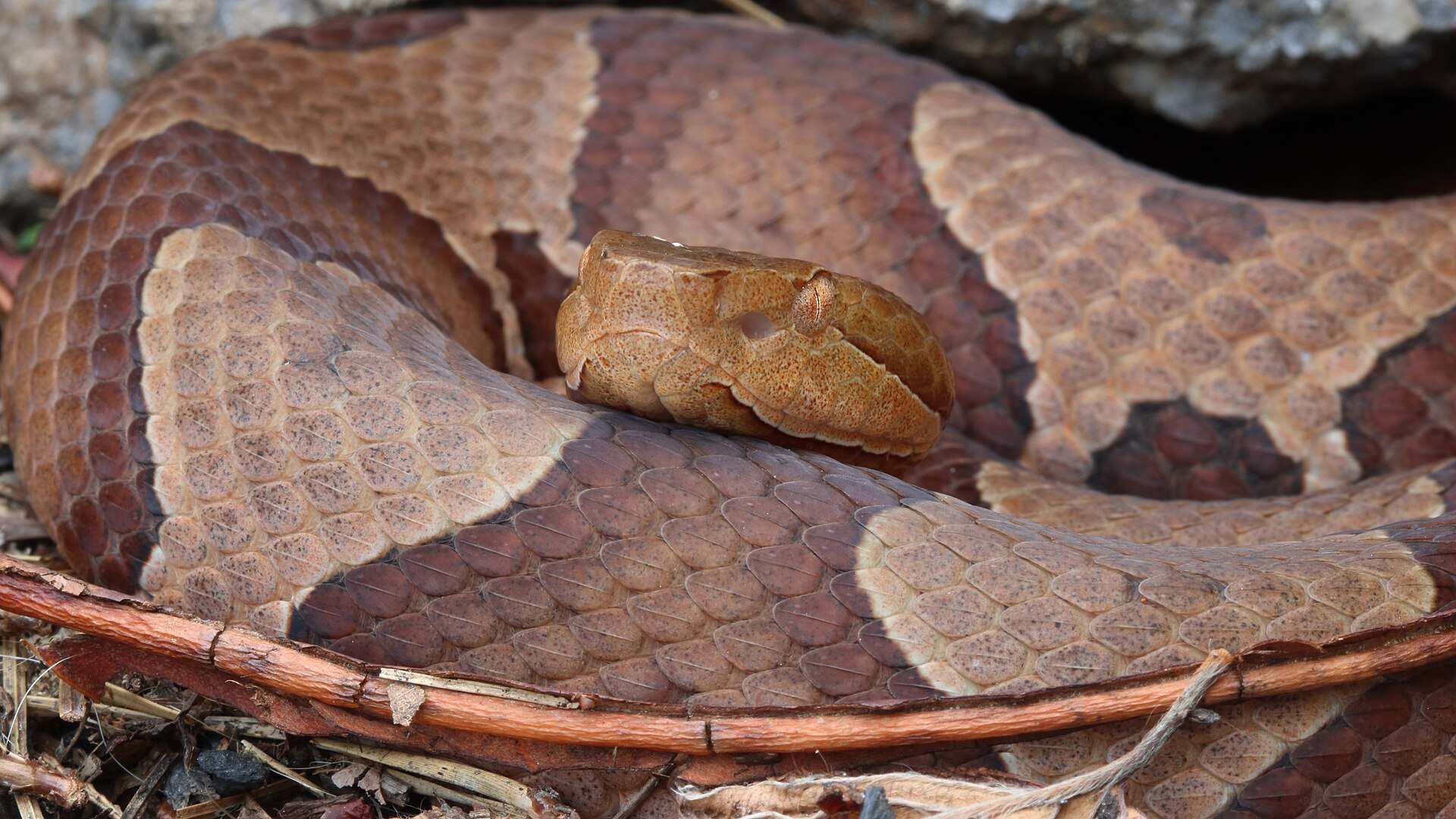
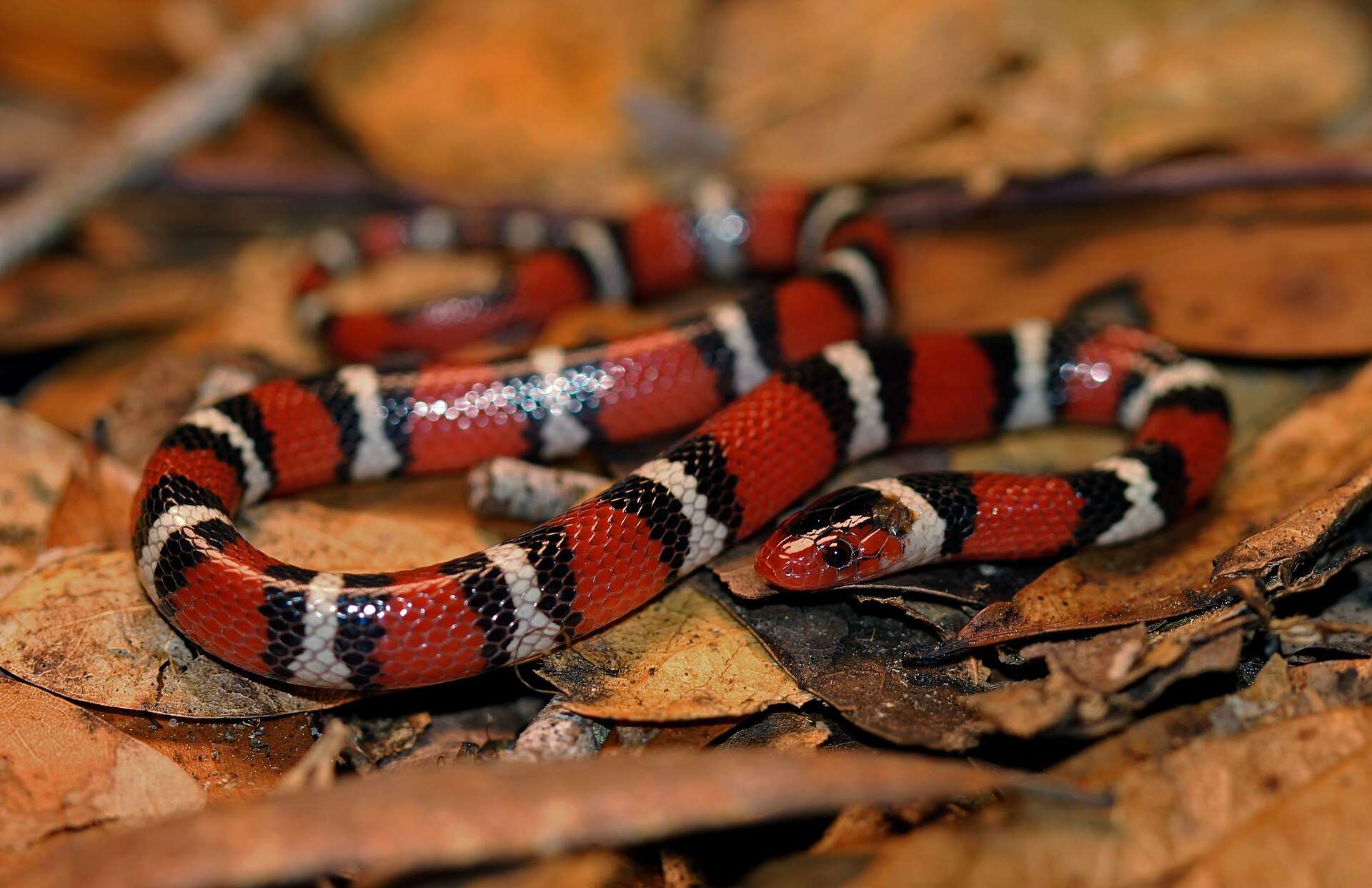
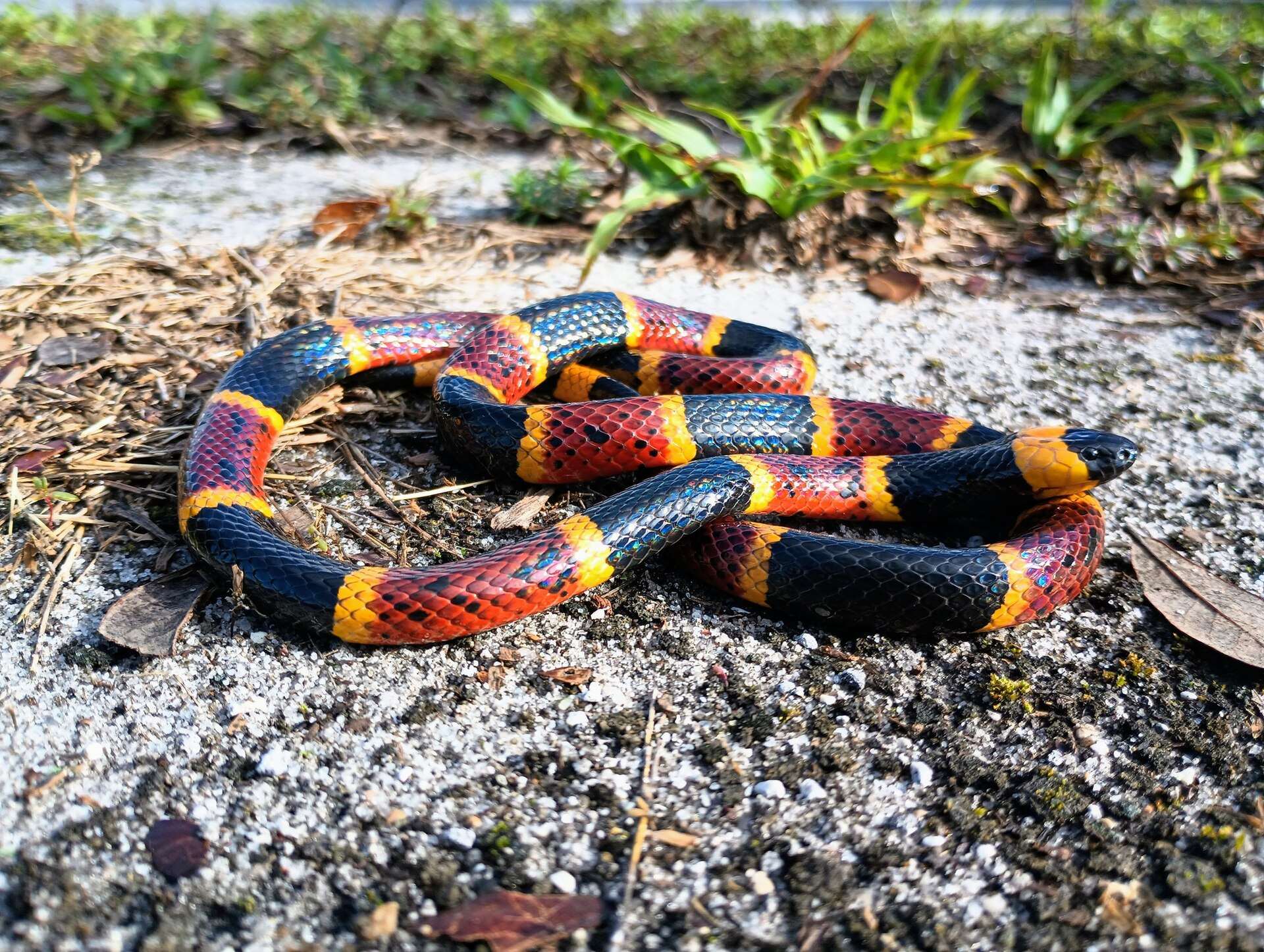
The eastern milksnake is most often confused with the venomous copperhead (Agkistrodon contortrix), and many reported “copperheads” in basements turn out to be milksnakes1. A copperhead has a plain copper-coloured head, a broad triangular head on a narrow neck, a single row of crossbands and keeled scales, while the milksnake has a narrow head with a light V or Y mark, three to five rows of blotches and smooth scales1. Red-marked milksnakes are also confused with coral snakes, but in milksnakes the red markings touch black, while in the eastern coral snake the red rings touch yellow and the snout is black9,10.
The rhyme “red touches yellow, kills a fellow; red touches black, venom lack” only works for coral snakes in the United States; some coral snakes in Mexico, Central America and South America have red rings touching white or even black, so the rhyme must not be relied on there9. These differences are not a safe basis for handling any snake. Keep your distance from every snake you cannot identify.
In captivity
Milksnakes are kept as pets, and wild eastern milksnakes are collected for the pet trade in some places3,7. Milksnakes recorded as Lampropeltis triangulum have lived for up to 22.6 years in captivity11. The RSPCA advises keeping Lampropeltis snakes singly, because they eat other snakes and may attack or even eat each other12. Wild snakes should never be collected as pets1.
Look-alikes
Don’t confuse it with…
These snakes are often mistaken for each other. Use the differences to learn, never as a reason to handle a snake.
References
- 1
Connecticut Department of Energy and Environmental Protection, Wildlife Division. Eastern Milksnake (Lampropeltis triangulum) fact sheet. portal.ct.gov
- 2
Virginia Herpetological Society. Eastern Milksnake (Lampropeltis triangulum). virginiaherpetologicalsociety.com
- 3
Illinois Natural History Survey, Prairie Research Institute. Eastern Milksnake. Field Guide to Amphibians and Reptiles of Illinois. herpetology.inhs.illinois.edu
- 4
Maine Department of Inland Fisheries and Wildlife. Eastern Milksnake. Species information: reptiles and amphibians. www1.maine.gov
- 5
Uetz, P. et al. (eds.) (2026). Lampropeltis triangulum (Lacépède, 1789). The Reptile Database. reptile-database.reptarium.cz
- 6
Ruane, S., Bryson, R.W., Pyron, R.A. & Burbrink, F.T. (2014). Coalescent species delimitation in milksnakes (genus Lampropeltis) and impacts on phylogenetic comparative analyses. Systematic Biology 63(2): 231–250. doi.org
- 7
COSEWIC (2014). COSEWIC assessment and status report on the Eastern Milksnake (Lampropeltis triangulum) in Canada. Committee on the Status of Endangered Wildlife in Canada, Ottawa. canada.ca
- 8
Hammerson, G.A. (2019). Lampropeltis triangulum. The IUCN Red List of Threatened Species 2019: e.T197493A2490171. iucnredlist.org
- 9
Frank, M. (2019). Identifying Venomous and Nonvenomous Snakes in Texas. Texas A&M AgriLife Extension, publication WFSC-023. texnat.tamu.edu
- 10
Florida Museum of Natural History. Harlequin Coralsnake (Micrurus fulvius). Florida Snake ID Guide. University of Florida. floridamuseum.ufl.edu
- 11
AnAge: The Animal Ageing and Longevity Database (Build 15). Lampropeltis triangulum (milk snake). Human Ageing Genomic Resources. genomics.senescence.info
- 12
RSPCA. Kingsnake (Lampropeltis species): care and welfare advice. rspca.org.uk
Play
Play as the eastern milksnake.
Its real pattern is a skin in Snake. Every run ends with a fact.