
Copperhead
Agkistrodon contortrix (Linnaeus, 1766)
Also called Eastern copperhead, Northern copperhead, Southern copperhead, Highland moccasin
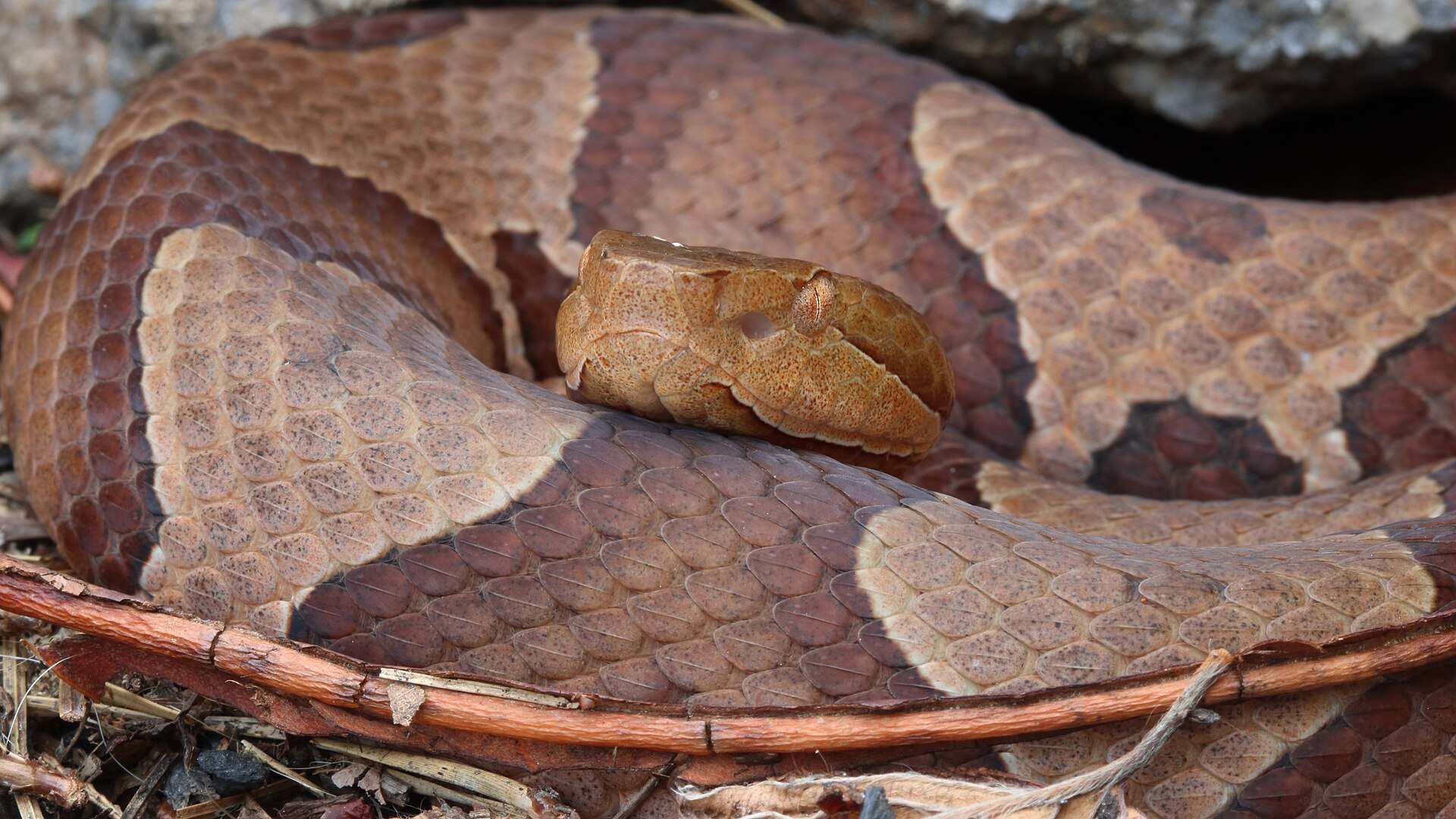
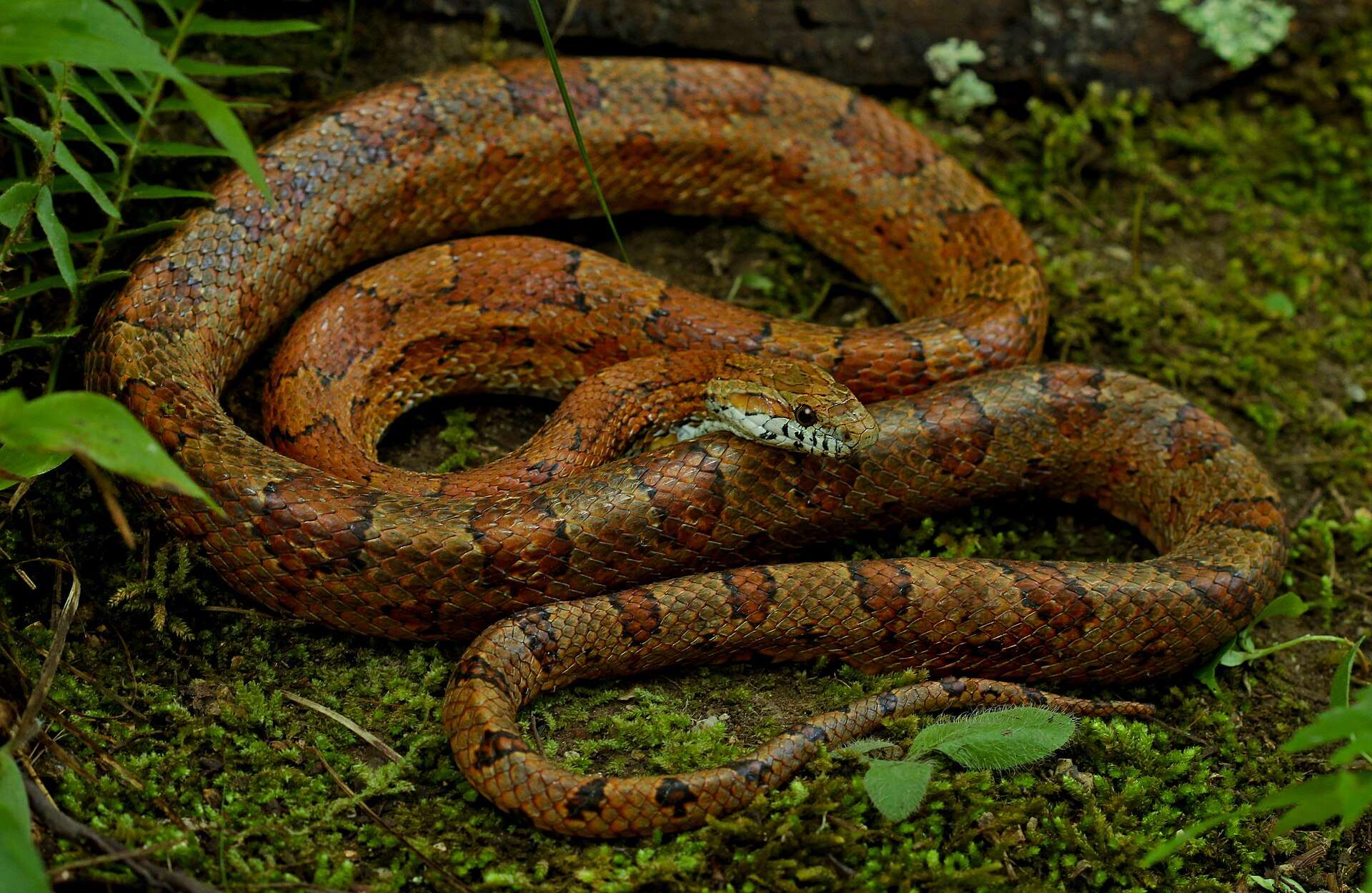
A stout pit viper with tan to pinkish-brown bands and darker hourglass-shaped crossbands, and a plain coppery head. It is common in woods and on rocky hillsides of the eastern United States.

Is it dangerous?
Yes. Its bite is very painful and causes swelling and tissue damage, though deaths are rare. Get hospital care immediately if bitten.
Do not approach. If someone is bitten, go to a hospital now.
At a glance
- Length
- 0.75–1.35 m
- Active
- Dawn and dusk
- Found in
- Eastern United States
- Venom
- Haemotoxic and cytotoxic
- Young
- Live young
- Habitat
- Deciduous forest, Pine-hardwood forest, Rocky hillsides
- Diet
- Small mammals, Birds, Frogs
Length shows a typical adult, then the largest recorded.
IUCN Red List status: Least Concern
Country guideSnakes of the United States
True size
Eastern milksnakeNon-venomous
1.32 m at most
About three quarters of the height of a 1.7 m adult.
Usual range 0.75–1.32 m, the bar on the ruler.
CopperheadMedically significant
1.35 m at most
About three quarters of the height of a 1.7 m adult.
Usual range 0.75–1.35 m, the bar on the ruler.
CottonmouthMedically significant
1.88 m at most
About as long as a 1.7 m adult is tall.
Usual range 0.9–1.88 m, the bar on the ruler.
Corn snakeNon-venomous
1.88 m at most
About as long as a 1.7 m adult is tall.
Usual range 1.2–1.88 m, the bar on the ruler.
Mexican west coast rattlesnakeMedically significant
2.05 m at most
About 1 times the height of a 1.7 m adult.
Usual range 1.5–2.05 m, the bar on the ruler.
Western diamondback rattlesnakeMedically significant
2.29 m at most
About 1.5 times the height of a 1.7 m adult.
Usual range 1.2–2.29 m, the bar on the ruler.
TerciopeloMedically significant
2.5 m at most
About 1.5 times the height of a 1.7 m adult.
Usual range 1.5–2.5 m, the bar on the ruler.
Eastern rat snakeNon-venomous
2.56 m at most
About 1.5 times the height of a 1.7 m adult.
Usual range 1.5–2.56 m, the bar on the ruler.
Each snake is drawn at the longest length in its profile, on the same scale as the adult. Length is to scale; thickness is not.
Identification
The copperhead, also called the eastern copperhead, is a medium-sized, fairly heavy-bodied pit viper with a broad, triangular head that is distinct from the neck4,5. Its body is light brown to tan, sometimes with a pinkish tint, crossed by 10–18 darker, hourglass-shaped bands that are narrow along the spine and wide on the sides4,5. The head is a plain copper to reddish colour without dark markings on top5. The scales are keeled, the pupil is vertical, and there is a deep heat-sensing pit between each nostril and eye4.
Average adults are about 56–91 cm long, and the record length is 135 cm4. Newborns are 20–25 cm long and have a bright sulphur-yellow tail tip that fades with age4,5.
Distribution
The copperhead lives in the eastern United States, from Massachusetts, Connecticut and southern New York south to northern Florida, and west to Illinois, Missouri, eastern Kansas, eastern Oklahoma and eastern Texas1,3. In Florida it is found only in the Panhandle4.
Until 2015 all copperheads were treated as one species. That year a genetic study split them into two2, and The Reptile Database follows this split1,3. The broad-banded copperhead (Agkistrodon laticinctus) of central and western Texas, central Oklahoma and parts of Kansas, including the Trans-Pecos copperheads of west Texas and northern Mexico, is now a separate species3. The two interbreed along a broad zone from south-eastern Texas to eastern Kansas3.
Habitat
Copperheads use many kinds of habitat, including hardwood forest, mixed pine and hardwood stands, old fields and rocky hillsides5. In Florida they favour upland pine and hardwood forest with deep leaf litter, often next to swamps, streams, river bottoms and damp ravines4. Large logs, rock piles and debris are common shelters4.
They tolerate moderate disturbance by people and can be common in urban parks and suburban lots5. In winter they retreat underground5.
Behaviour
Copperheads are mainly active at dawn and dusk. They are often active by day in spring and autumn but become mostly nocturnal in hot summer weather, and they spend the day hidden under logs, leaf litter or rocks5. They rely heavily on camouflage to avoid being seen4.
When frightened, a copperhead usually freezes and may flatten its body against the ground4,6. If pressed further, it may release a foul-smelling musk and vibrate its tail, and it strikes only as a last resort4. Because it stays still, many bites happen when people accidentally step on one5.
Diet
The copperhead is an ambush hunter. It often strikes and releases its prey, then follows the scent trail to find it5. It eats a broad range of animals, including small mammals, birds, frogs, lizards and insects, especially cicadas5.
Young copperheads take more frogs, lizards, salamanders and insects, while adults feed mainly on rodents and other small mammals4,5. Newborns raise and wiggle their bright sulphur-yellow tail tip like a caterpillar to lure prey within reach; this habit usually stops after about a year, when the yellow fades4,5.
Reproduction
The copperhead gives birth to live young1,5. Litters of 4–15 young have been recorded, often born in sheltered spots near rotting logs or rock crevices5. In Florida, births take place between July and October4. Females may stay near the birth site until the young disperse5.
During the breeding season, rival males perform “combat dances” as they trail females4. Wild female copperheads have also been shown to produce young without mating, a process called facultative parthenogenesis10.
Venom and medical significance
The copperhead is venomous, and the World Health Organization lists it in Category 1, the highest medical importance, in the United States7. Its venom mainly damages blood and tissue; it is milder than that of most other North American vipers, but bites can still cause severe pain, swelling, bruising and local tissue death5. Bites are rarely life-threatening for healthy adults, but they can be more dangerous for children and for older people in poor health4.
In a review of 88 copperhead bites treated at one Texas hospital, 85% were graded as mild, none needed antivenom or surgery, and none was fatal8. A clinical trial found that the US antivenom CroFab improved recovery of limb function two weeks after a bite9. Anyone bitten should go to hospital immediately.
Conservation
The copperhead is listed as Least Concern on the IUCN Red List, based on an assessment published in 2007, before the 2015 split11. It is widespread and locally common, but it can decline locally because of road deaths, habitat loss and killing by people5.
Similar species
Harmless corn snakes (Pantherophis guttatus) are sometimes mistaken for copperheads. A corn snake has a spear-point mark on top of its head and a boldly chequered belly, while the copperhead has a plain head and a lightly mottled belly5.
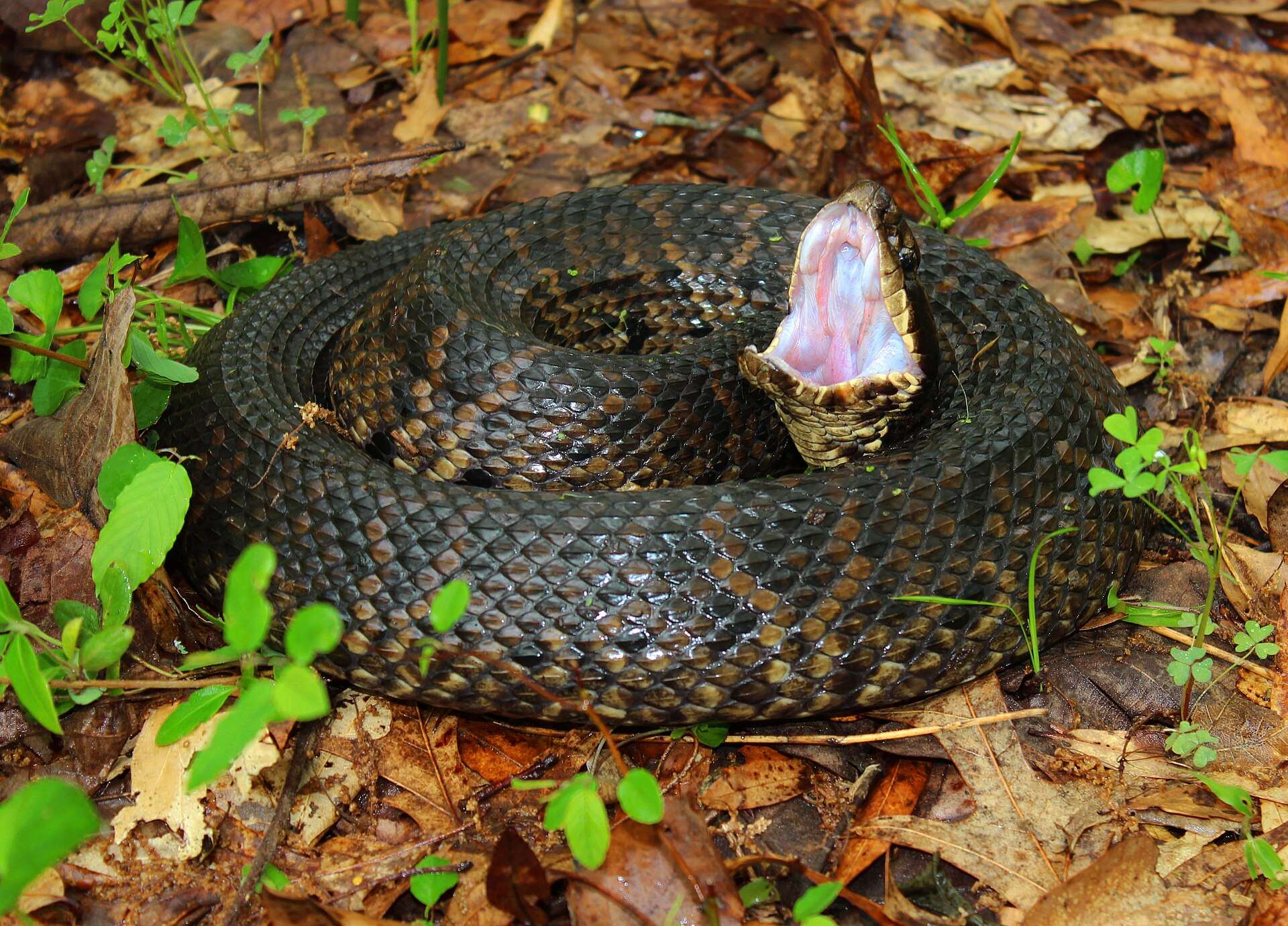
Harmless watersnakes (genus Nerodia) have darker, narrower and more numerous bands, round pupils and dark vertical lines on the lips, which copperheads lack4. Young cottonmouths have crossbands full of dark spots and a broad dark stripe through the eye, while the copperhead’s bands have at most one dark spot and its eye is not hidden by a dark band4.
These differences are not a safe basis for handling any snake. Keep your distance from every snake you cannot identify.
In captivity
The copperhead is a venomous snake and is not suitable as a pet. Most bites happen when people deliberately disturb the snake or accidentally step on it4. If you meet one, step back and let it move away on its own.
Look-alikes
Don’t confuse it with…
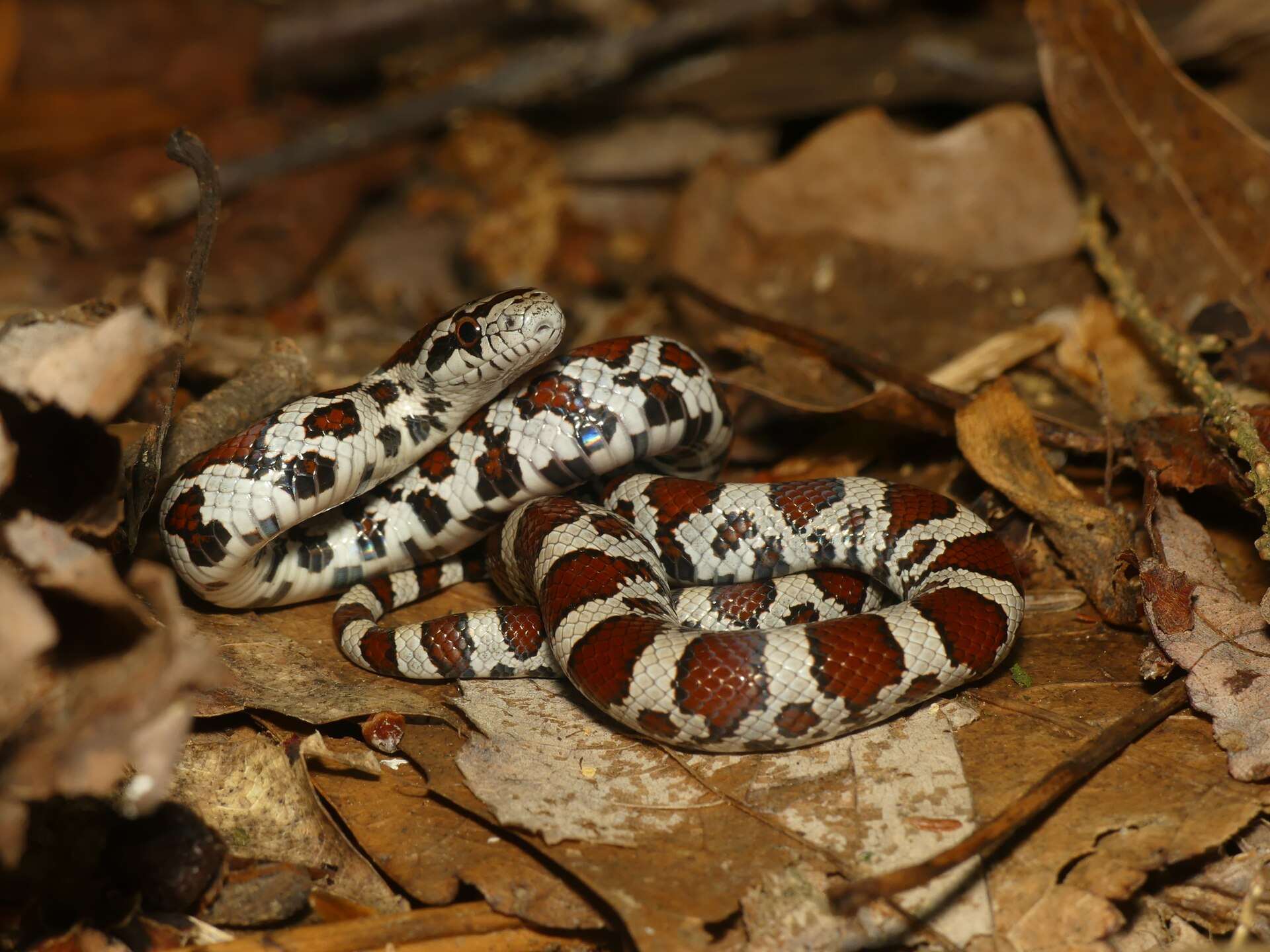
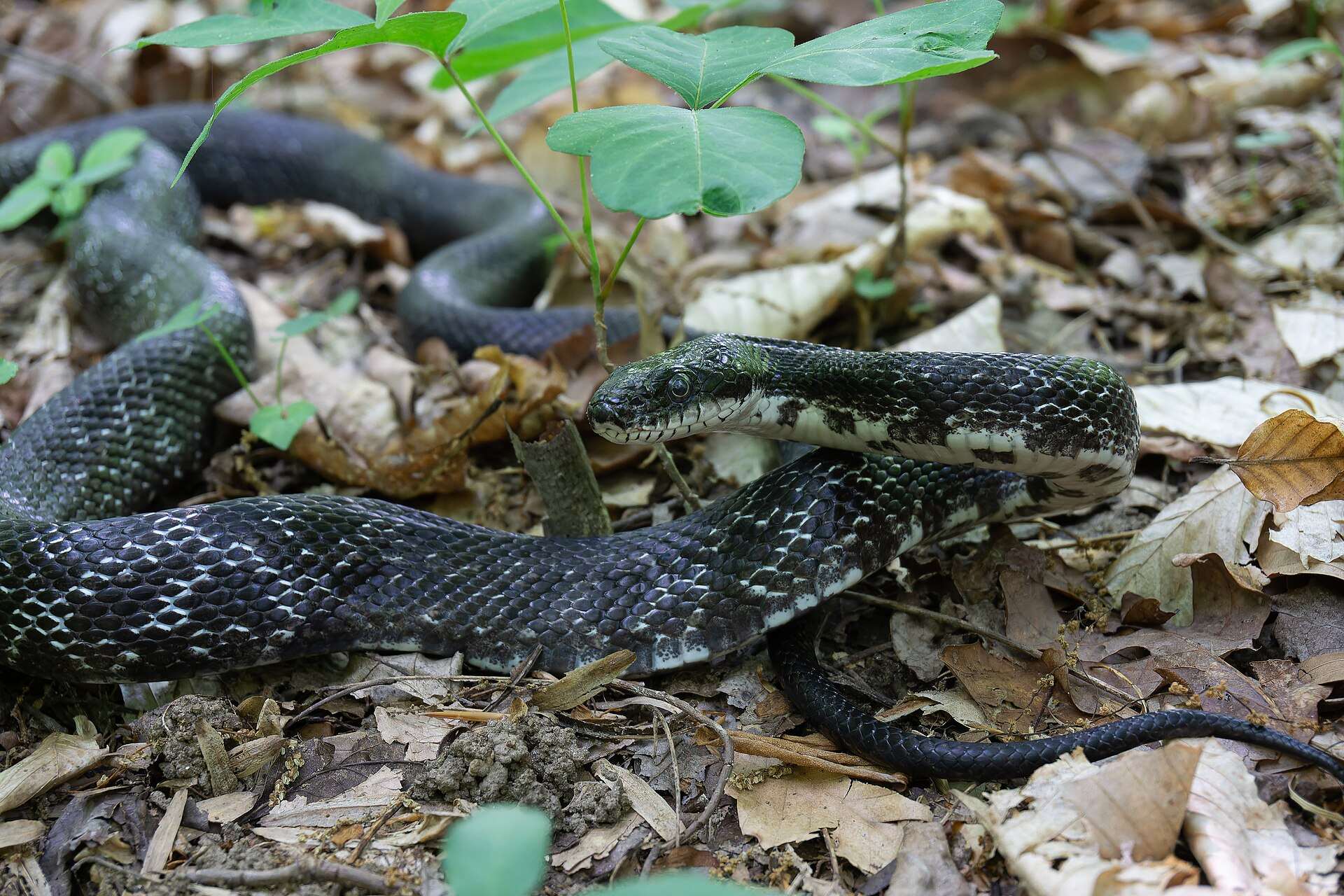
These snakes are often mistaken for each other. Use the differences to learn, never as a reason to handle a snake.
References
- 1
Uetz, P. et al. (eds.) (2026). Agkistrodon contortrix (Linnaeus, 1766). The Reptile Database. reptile-database.reptarium.cz
- 2
Burbrink, F.T. & Guiher, T.J. (2015). Considering gene flow when using coalescent methods to delimit lineages of North American pitvipers of the genus Agkistrodon. Zoological Journal of the Linnean Society 173(3): 505–526. doi.org
- 3
Uetz, P. et al. (eds.) (2026). Agkistrodon laticinctus Gloyd & Conant, 1934. The Reptile Database. reptile-database.reptarium.cz
- 4
Florida Museum of Natural History. Eastern Copperhead, Agkistrodon contortrix. Florida Snake ID Guide. University of Florida. floridamuseum.ufl.edu
- 5
Savannah River Ecology Laboratory, University of Georgia. Eastern Copperhead (Agkistrodon contortrix). Herpetology at SREL: Snakes of South Carolina and Georgia. srelherp.uga.edu
- 6
Centers for Disease Control and Prevention, National Institute for Occupational Safety and Health (NIOSH). Venomous snakes (Outdoor workers). cdc.gov
- 7
World Health Organization (2017). Guidelines for the production, control and regulation of snake antivenom immunoglobulins. WHO Technical Report Series No. 1004, Annex 5, Appendix 1: Worldwide distribution of medically important venomous snakes. cdn.who.int
- 8
Walker, J.P. & Morrison, R.L. (2011). Current management of copperhead snakebite. Journal of the American College of Surgeons 212(4): 470–474. doi.org
- 9
Gerardo, C.J., Quackenbush, E., Lewis, B. et al. (2017). The efficacy of Crotalidae polyvalent immune Fab (ovine) antivenom versus placebo plus optional rescue therapy on recovery from copperhead snake envenomation: a randomized, double-blind, placebo-controlled, clinical trial. Annals of Emergency Medicine 70(2): 233–244. doi.org
- 10
Booth, W., Smith, C.F., Eskridge, P.H., Hoss, S.K., Mendelson, J.R. & Schuett, G.W. (2012). Facultative parthenogenesis discovered in wild vertebrates. Biology Letters 8(6): 983–985. pmc.ncbi.nlm.nih.gov
- 11
Frost, D.R., Hammerson, G.A. & Santos-Barrera, G. (2007). Agkistrodon contortrix. The IUCN Red List of Threatened Species 2007: e.T64297A12756101. iucnredlist.org
Play
Play as the copperhead.
Its real pattern is a skin in Snake. Every run ends with a fact.