
Compare
Corn snake vs rat snake
The corn snake is itself a rat snake, and the young of both species are grey with dark blotches. Colour, the mark between the eyes and the underside of the tail separate them. Neither is venomous.
Every fact is sourced · draft, pending review by a herpetologist
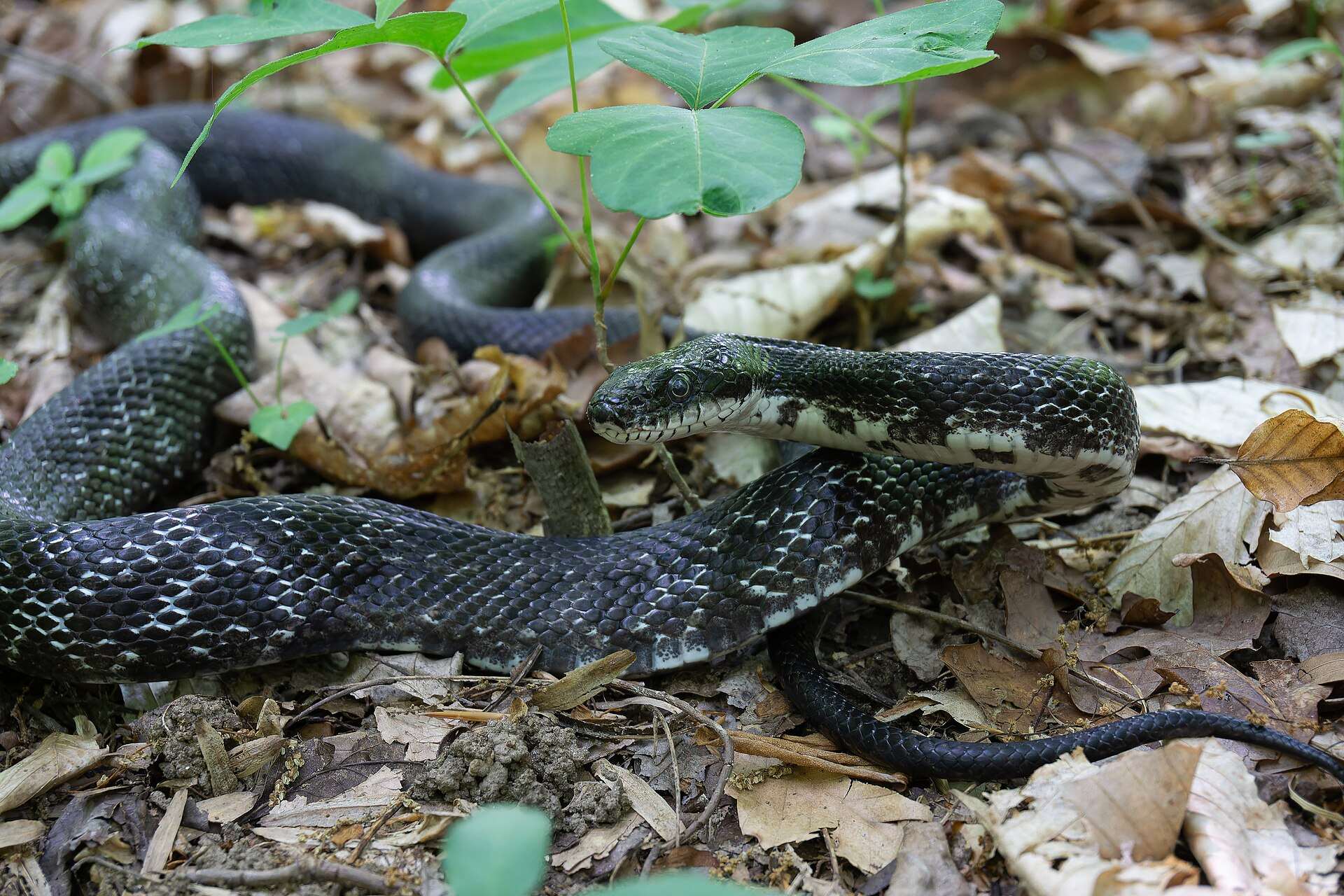
Eastern rat snake
Pantherophis alleghaniensis
Eastern United States and southern Ontario
Non-venomous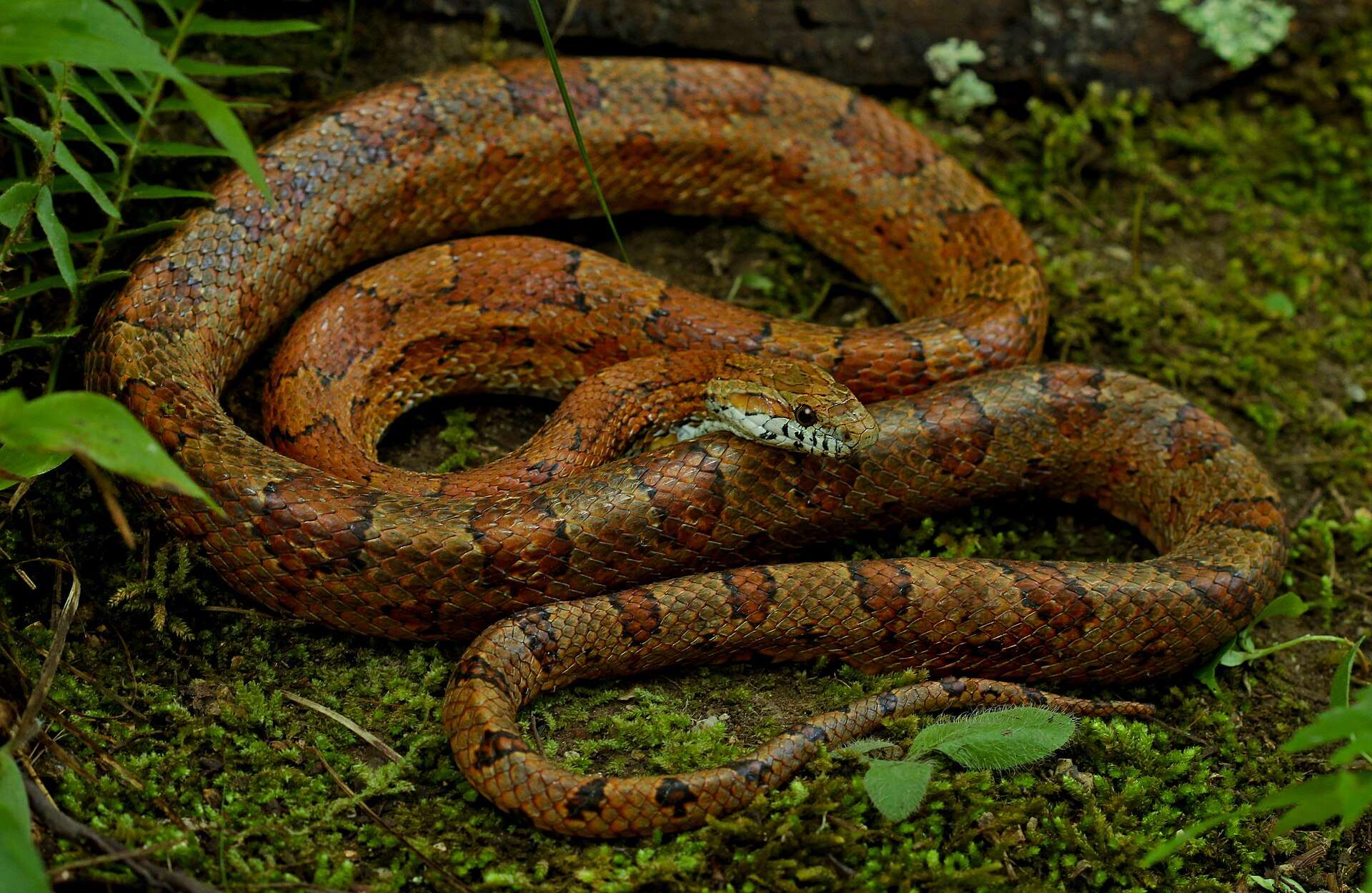
Corn snake
Pantherophis guttatus
South-eastern United States
Non-venomousSide by side
| Eastern rat snakePantherophis alleghaniensis | Corn snakePantherophis guttatus | |
|---|---|---|
| Danger | Non-venomous | Non-venomous |
| Length | 1.5–2.56 m (typical, largest) | 1.2–1.88 m (typical, largest) |
| Colours | Black, Grey | Orange, Red, Brown |
| Pattern | Plain or nearly plain | Blotches |
| Spreads a hood | No | No |
| Active | Day and night | Dawn and dusk |
| Found in | Eastern United States and southern Ontario | South-eastern United States |
| Habitat | Deciduous forest, Forest edges and fields, Rocky ledges | Pine woodland, Hardwood hammocks, Old fields |
| Venom | None | None |
Look closely
Spot the difference
Two rat snakes, one name
Both snakes belong to the genus Pantherophis, the North American rat snakes8,9. The corn snake is sometimes called the red rat snake, and its belly checks are said to have reminded people of the kernels of Indian corn1,10. “Rat snake” on its own usually means the big black or grey snake of the eastern United States, which the 2025 standard list of North American names calls the central ratsnake, although many guides and state agencies still call it the eastern or black rat snake7,9. The two look most alike as hatchlings, when both are grey with dark blotches, and least alike as adults3,5.
Colour and pattern
An adult corn snake is orange to reddish-brown with 27–40 reddish blotches edged in black along the back5. Snakes from the coastal plain are the brightest orange; those from the Piedmont and uplands are darker and duller, and young snakes are browner or greyer5. An adult rat snake across most of its range is glossy black above with a white chin and throat, sometimes with faint traces of its juvenile blotches3,6. In peninsular Florida the rat snake is instead yellowish with four dark stripes running the length of the body1.
Young rat snakes are the problem. They hatch grey with 28–40 dark blotches and a dark stripe from the eye to the corner of the mouth, and they do not turn black until they are about 60 cm long, which can take four or five years3,12. At that stage they are easily taken for young corn snakes, and the reverse.
The head and the belly
The surest mark is on the head. A corn snake has a spear-shaped mark that runs forward from the neck and meets in a point between the eyes, and a black-edged reddish stripe runs from the eye past the jaw onto the neck1,2,5. Young grey rat snakes have no spear point between the eyes2. Turn to the underside and the corn snake has a bold black-and-white checkerboard belly that continues as two black stripes under the tail1,2. The black rat snake also has a black-and-white checkerboard belly, but it is irregular, greyer and fades towards the tail, and it has no tail stripes; Florida’s striped rat snakes have no checkerboard at all1,3. Milksnakes and mole kingsnakes, which can also be confused with corn snakes, likewise lack the stripes under the tail2,4.
Both species have weakly keeled scales and round pupils, and the rat snake’s body is flat-bottomed, like a loaf of bread in cross-section1,3,6.
Size
The rat snake is the larger animal. Adult eastern rat snakes usually measure 1.07–1.83 m and the largest known was 2.56 m; it is Ontario’s largest snake, reaching about 2 m there3,11. Adult corn snakes are usually about 0.9–1.2 m, with a record of 1.88 m1,5. A big, glossy black snake is a rat snake, not a corn snake.
Where they overlap
The corn snake lives in the south-eastern United States, from southern New Jersey south through the Carolinas to the Florida Keys and west to eastern Louisiana, and it is found in every county of mainland Florida1,5. The eastern rat snake covers a much larger area, from the Mississippi River east to the Atlantic and north to Wisconsin, Michigan, New York, Vermont and Massachusetts, and into southern Ontario7,9,11. Across the south-east, where the two share pine woods, old fields, farms and barns, either may turn up in a shed or chicken house, because both hunt rodents and birds and both climb well1,5,6.
Neither is venomous
Both are harmless to people. The corn snake is a constrictor that kills its prey by squeezing5, and the eastern rat snake is non-venomous too; if handled it may bite, release a foul musk or vibrate its tail, which is why it is best left alone6. The snake people most often mistake for a corn snake is the venomous copperhead, which has hourglass-shaped crossbands that are wide on the sides and narrow across the back, and lacks the corn snake’s checkerboard belly4,10. Rat snakes do not interbreed with copperheads, whatever the old stories say; the two are only distantly related6.
These differences are not a safe basis for handling any snake. Keep your distance from every snake you cannot identify. Pet corn snakes are bred in huge numbers, and wildlife agencies advise never taking a wild snake as a pet or releasing a pet into the wild6,10.
Questions people ask
- Is a corn snake a rat snake?
- Yes. The corn snake is also called the red rat snake, and it belongs to the same genus, Pantherophis, as the eastern rat snake. 'Rat snake' on its own usually means the black or grey rat snake.
- Are corn snakes or rat snakes venomous?
- No. Both are non-venomous constrictors that kill rodents by squeezing. A cornered one may bite, release a foul-smelling musk or vibrate its tail, but neither can hurt you with venom.
- How do you tell a young rat snake from a corn snake?
- Look at the head. A corn snake has a spear-shaped mark that runs forward from the neck to a point between the eyes; young grey rat snakes have no such mark. Corn snakes also have two black stripes under the tail.
- Which is bigger, a corn snake or a rat snake?
- The rat snake. Adult eastern rat snakes are usually 1.07–1.83 m and the record is 2.56 m, while adult corn snakes are usually 0.9–1.2 m with a record of 1.88 m.
- Where do corn snakes and rat snakes live together?
- In the south-eastern United States. The corn snake ranges from southern New Jersey to the Florida Keys and west to Louisiana; the eastern rat snake covers the eastern United States from the Mississippi to the Atlantic and north into southern Ontario.
References
- 1
Florida Museum of Natural History. Red Cornsnake (Pantherophis guttatus). Florida Snake ID Guide. University of Florida. floridamuseum.ufl.edu
- 2
Tennessee Wildlife Resources Agency. Red Cornsnake, Pantherophis guttatus. tn.gov
- 3
Virginia Herpetological Society. Central Ratsnake, Pantherophis alleghaniensis (species account after Mitchell, J.C., The Reptiles of Virginia). virginiaherpetologicalsociety.com
- 4
Virginia Herpetological Society. Red Cornsnake, Pantherophis guttatus (species account after Mitchell, J.C., The Reptiles of Virginia). virginiaherpetologicalsociety.com
- 5
Savannah River Ecology Laboratory, University of Georgia. Corn Snake (Elaphe [Pantherophis] guttata). Herpetology at SREL. srelherp.uga.edu
- 6
Connecticut Department of Energy and Environmental Protection, Wildlife Division. Eastern Ratsnake (fact sheet). portal.ct.gov
- 7
New York State Department of Environmental Conservation (2025). Species Status Assessment: Central ratsnake, Pantherophis alleghaniensis. extapps.dec.ny.gov
- 8
Uetz, P. et al. (eds.) (2026). Pantherophis guttatus (Linnaeus, 1766). The Reptile Database. reptile-database.reptarium.cz
- 9
Uetz, P. et al. (eds.) (2026). Pantherophis alleghaniensis (Holbrook, 1836). The Reptile Database. reptile-database.reptarium.cz
- 10
Smithsonian's National Zoo and Conservation Biology Institute. Eastern corn snake. nationalzoo.si.edu
- 11
Government of Ontario, Ministry of the Environment, Conservation and Parks. Gray ratsnake. ontario.ca
- 12
New Jersey Division of Fish and Wildlife, Endangered and Nongame Species Program. Snake Identification: Avoid Being Confused! nj.gov