
Care guide
Corn snake care
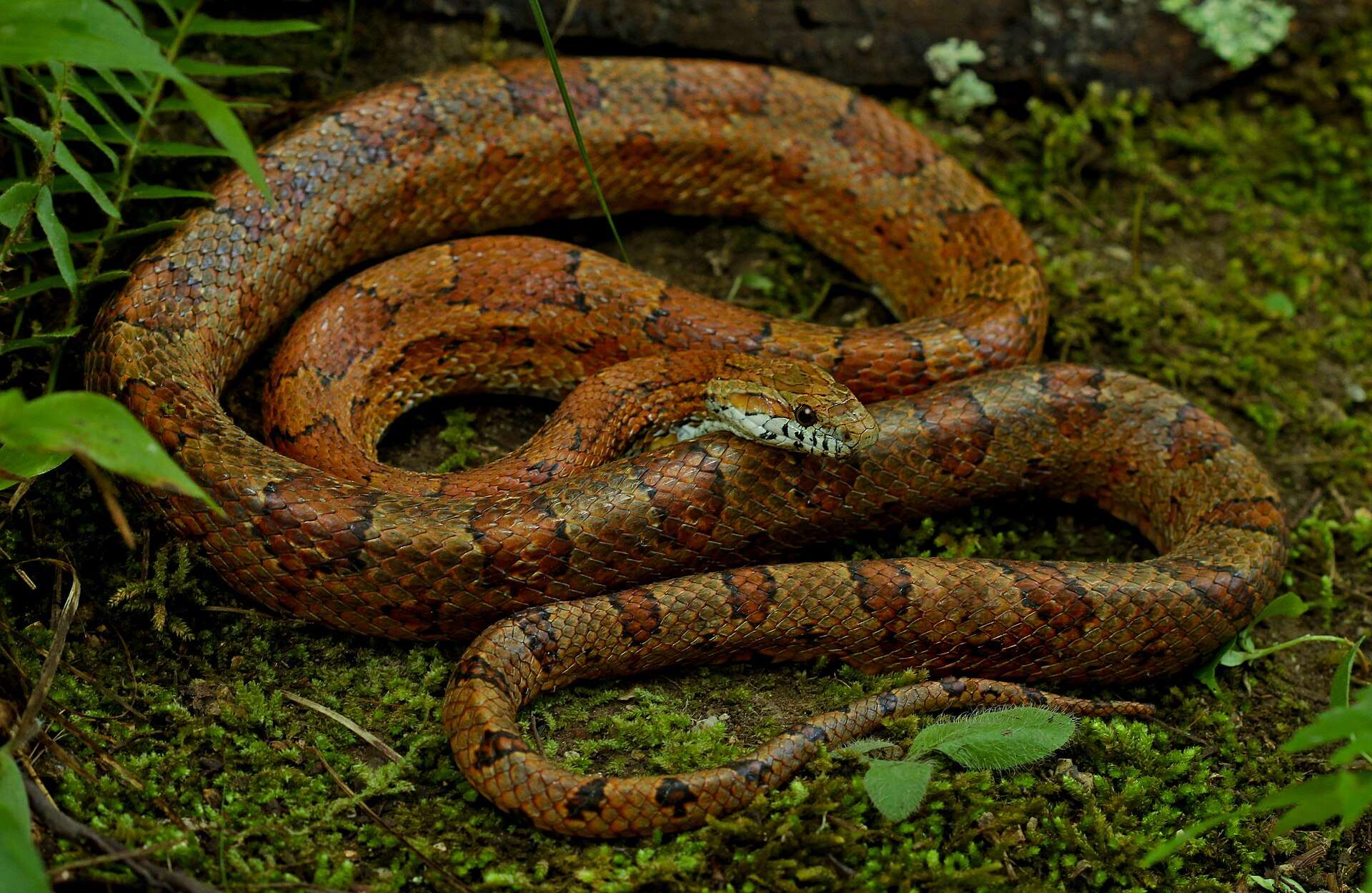
Corn snakes are placid, climbing snakes from the United States that can live for up to 20 years. They do best with space to stretch out and climb, a warm-to-cool gradient and thawed mice.
Every fact is sourced · draft, pending review by a reptile vet
At a glance
- Adult size
- Can grow to around 1.5 m; males are usually smaller1
- Enclosure for an adult
- At least as long as the snake, and a third of its length wide and high1
- Warm side
- Basking zone 28–30 °C1
- Cool side
- 20–24 °C1
- Humidity
- 40–50%1
- Feeding an adult
- One thawed adult mouse every 7–14 days1
- Lifespan in captivity
- Up to 20 years2
Before you get one
Corn snakes come from the south-eastern United States; they are placid, mainly ground-dwelling but good climbers, most active at dawn and dusk, and not venomous12,1. Lifespan estimates differ: the RSPCA and a veterinary manual give 10–15 years, the Royal Veterinary College up to 20 years, and some have lived 23 years in human care1,5,2,7. Corn snakes sold in the UK are captive-bred, and captive-bred reptiles are less likely than wild-caught ones to bite or carry parasites1,5. Check the law where you live: Queensland, for example, lists the corn snake as a prohibited invasive animal that must not be kept, sold or released11. Corn snakes have been introduced outside their native range, for example to Brazil, so never release one12,11.
Enclosure
Sources differ on size: the RSPCA asks for a vivarium that lets the snake stretch out fully, at least as long as the snake and a third of its length wide and high, such as 150 × 50 × 50 cm for a 1.5 m snake1. The Royal Veterinary College recommends at least 122 × 61 × 61 cm, while one veterinary hospital says adults can be kept in a 20–30-gallon (about 75–115-litre) tank2,6. In a study of 12 corn snakes, snakes in enclosures longer than their bodies were more active, spent time stretched out and preferred that enclosure when active, while an enclosure two-thirds of their length, the minimum that English pet-shop rules still allow, gave no room to stretch out8,13. The study’s authors recommend enclosures longer than the snake, and in an owner survey snakes kept in enclosures longer than themselves were reported to have fewer signs of ill health8,9. Corn snakes climb, so add branches, at least two hides (one at each end) and a soil-based substrate to burrow in1. Hatchlings can be stressed in a large, open space, so start them in a smaller vivarium or give plenty of small hiding places1.
Heat and light
The RSPCA recommends a basking zone of 28–30 °C at one end and 20–24 °C at the cool end, with the heat off at night so the vivarium can fall to 16–20 °C1. Other veterinary sources differ, especially at night: the Royal Veterinary College gives a basking spot of about 30 °C and nights no cooler than about 24 °C, one hospital a background of 27–29 °C with a 29–31 °C basking spot, and the MSD Veterinary Manual a preferred air range of 25–30 °C2,6,4. Control every heater with a thermostat, guard heat lamps, check both ends with a thermometer every day and keep under-tank heaters to no more than 30% of the floor1,14. The RSPCA recommends a low-output UVB lamp giving about UVI 1.0 in the basking zone and none in the shade, or no more than 0.7 for albino morphs, on 12 hours a day1. The Royal Veterinary College also says corn snakes appear to benefit from low-level UVB2.
Humidity and water
Advice on humidity varies: the RSPCA gives 40–50%, one veterinary hospital 35–60% (higher during a shed), the Royal Veterinary College 50–60% and the MSD Veterinary Manual 30–70%1,6,2,4. In an owner survey, corn snakes were the species most likely to be kept at a humidity outside recommended ranges, so measure it with a hygrometer rather than guessing9,1. Blisters on the skin can be a sign that a snake has been kept too damp, and humidity that is too high needs more ventilation1. A hide with damp moss gives the snake a humid retreat for shedding1. Put a water dish big enough to bathe in at the cool end, and change it at least daily1.
Feeding
Feed dead mice: hatchlings start on one pinky mouse every 5–6 days and move up in size to one adult mouse every 7–14 days, with prey slightly wider than the widest part of the snake’s body1. The Royal Veterinary College gives every 1–2 weeks for adults and one veterinary hospital every 10–14 days2,6. Thaw frozen prey and warm it to about 37 °C, offer it with tongs, and avoid feeding on loose substrate the snake could swallow2,1. The occasional rat or quail adds variety, and snakes fed good-quality whole prey should not need supplements1. Live prey is not advised because it can injure the snake, and regular weighing shows whether a snake is becoming underweight or obese15,1.
Handling
Corn snakes can become used to regular handling, but grabbing them causes stress that can lead them to struggle or bite1. Scoop the snake up with one hand near the head and the other nearer the tail, supporting its whole body, and leave it alone if it pulls its neck into an S shape1. Keep sessions to about 10–15 minutes, wait 48 hours after a meal and avoid handling around a shed1. Wash your hands before handling if you have touched prey, because the snake may smell food and bite, and afterwards too, because reptiles can carry Salmonella1. A startled corn snake may vibrate its tail quickly, which is a defensive display6.
Health and when to see a vet
Have a reptile vet examine a new snake soon after you get it, including a test of its droppings for parasites, then once a year, and keep new snakes apart from others for 3–6 months6,17,3. See a reptile vet if you notice:
- abnormal droppings, which can be a sign of internal parasites1;
- regurgitating meals, which in snakes is linked to cryptosporidiosis, a parasitic stomach infection that has been seen in corn snakes16;
- mites, seen as small black specks or as a snake sitting in its water for long periods1,16;
- signs of mouth rot, or blisters on the skin1;
- old skin left over the eyes after a shed, which should never be forced off1,15;
- wheezing, open-mouth breathing, or swelling around the face10.
Questions people ask
- How long do corn snakes live?
- Usually 10–15 years, and up to about 20 years with good care. Some have lived 23 years in human care.
- What size tank does a corn snake need?
- Sources differ, but welfare research supports an enclosure longer than the snake. The RSPCA suggests 150 × 50 × 50 cm for a 1.5 m adult, with branches for climbing.
- How often should I feed my corn snake?
- Adults need one suitably sized thawed mouse every 7–14 days. Hatchlings start on one pinky mouse every 5–6 days.
- Do corn snakes bite?
- Corn snakes are not venomous and are usually placid, but they may bite if grabbed, or if your hands smell of prey.
- What temperature does a corn snake need?
- The RSPCA recommends a basking zone of 28–30 °C at one end and 20–24 °C at the cool end, controlled by a thermostat. Some veterinary sources give slightly warmer ranges.
References
- 1
RSPCA. Corn snake care (care sheet). Royal Society for the Prevention of Cruelty to Animals, accessed 2026. rspca.org.uk
- 2
RVC Exotics Service, Beaumont Sainsbury Animal Hospital (2024). Corn snake care (factsheet, reviewed December 2024). Royal Veterinary College. rvc.ac.uk
- 3
Divers, S.J. & Comolli, J.R. (2025). Management and husbandry of reptiles. MSD Veterinary Manual, professional version. msdvetmanual.com
- 4
Divers, S.J. & Comolli, J.R. (2025). Table: Important husbandry requirements for selected reptiles. MSD Veterinary Manual. msdvetmanual.com
- 5
Divers, S.J. (2020, updated 2026). Selecting a reptile. MSD Veterinary Manual, pet owner version. msdvetmanual.com
- 6
Chicago Exotics Animal Hospital. Cornsnake care (veterinary care sheet), accessed 2026. exoticpetvet.com
- 7
Smithsonian's National Zoo and Conservation Biology Institute. Eastern corn snake (animal fact page), accessed 2026. nationalzoo.si.edu
- 8
Hoehfurtner, T., Wilkinson, A., Walker, M. & Burman, O. (2021). Does enclosure size influence the behaviour & welfare of captive snakes (Pantherophis guttatus)? Applied Animal Behaviour Science 243: 105435. doi.org
- 9
Cargill, B.M., Benato, L. & Rooney, N.J. (2022). A survey exploring the impact of housing and husbandry on pet snake welfare. Animal Welfare 31(2): 193–208. doi.org
- 10
Animal Welfare Committee (2023). Opinion on the space requirements for snakes in vivaria within pet selling establishments. Defra, UK Government. assets.publishing.service.gov.uk
- 11
Business Queensland (2026). American corn snake (prohibited invasive animal). Queensland Government. business.qld.gov.au
- 12
Uetz, P. et al. (eds.) (2026). Pantherophis guttatus (Linnaeus, 1766). The Reptile Database. reptile-database.reptarium.cz
- 13
Defra (2018, updated 2026). Selling animals as pets licensing: statutory guidance for local authorities. UK Government. gov.uk
- 14
Divers, S.J. (2020, updated 2026). Providing a home for a reptile. MSD Veterinary Manual, pet owner version. msdvetmanual.com
- 15
Divers, S.J. & Comolli, J.R. (2025). Environmental diseases and traumatic injuries of reptiles. MSD Veterinary Manual, professional version. msdvetmanual.com
- 16
Divers, S.J. & Comolli, J.R. (2025). Parasitic diseases of reptiles. MSD Veterinary Manual, professional version. msdvetmanual.com
- 17
Divers, S.J. (2020, updated 2024). Routine health care of reptiles. MSD Veterinary Manual, pet owner version. msdvetmanual.com