
California kingsnake
Lampropeltis californiae (Blainville, 1835)
Also called Banded kingsnake
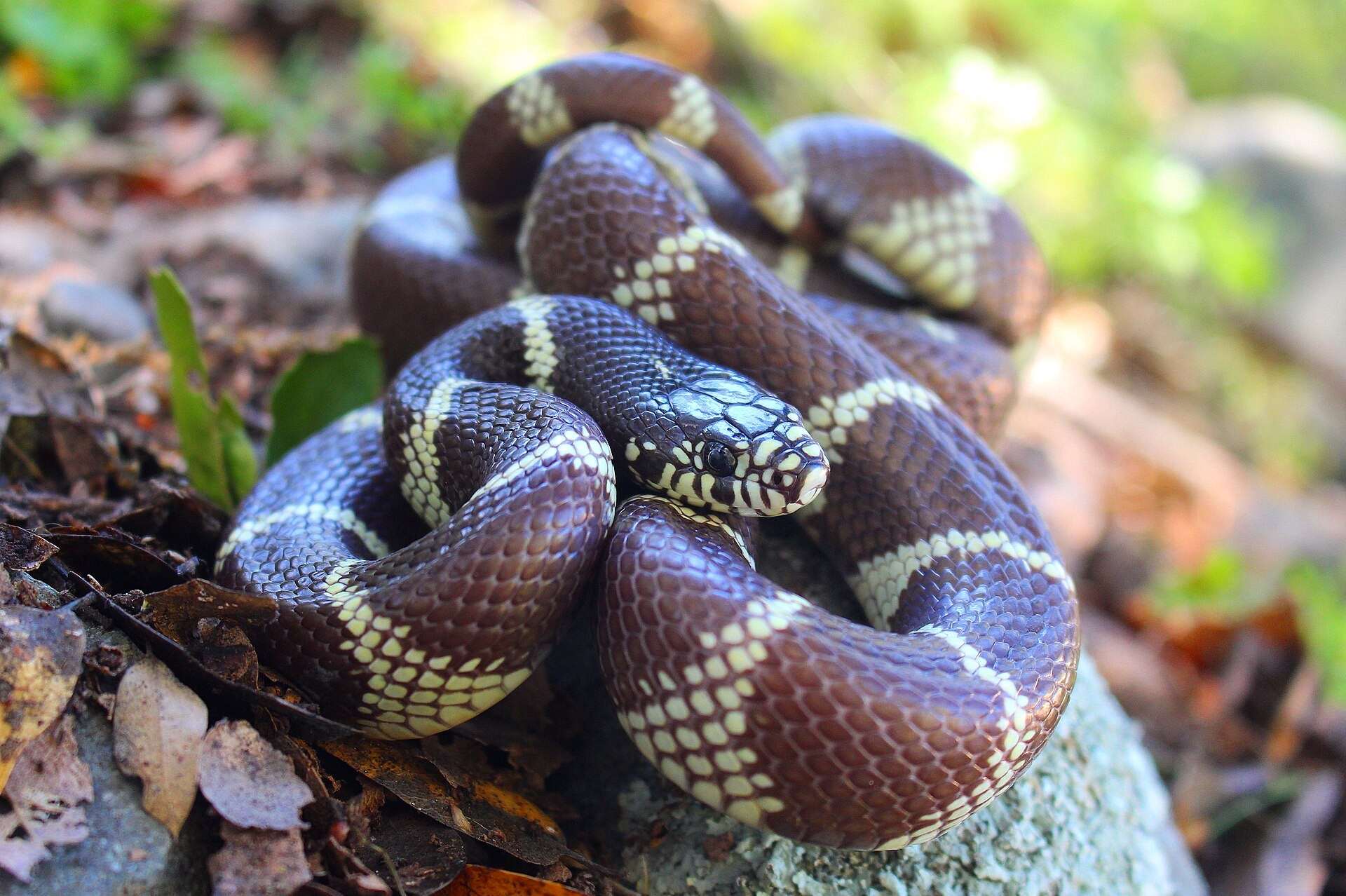
A glossy, harmless kingsnake of the western United States and north-western Mexico, usually black or dark brown with bold white or cream bands. Some coastal snakes have a single pale stripe instead.

Is it dangerous?
No. It is non-venomous and harmless to people, though it may hiss, bite or release musk if handled. It even eats rattlesnakes.
Harmless to people, but it may bite if handled. Treat any snake you can’t identify as venomous.
Snakebite first aidAt a glance
- Length
- 0.9–2.0 m
- Active
- Day and night
- Found in
- SW USA and NW Mexico
- Venom
- None
- Young
- Lays eggs
- Habitat
- Woodland and chaparral, Grassland, Desert scrub
- Diet
- Snakes including rattlesnakes, Lizards, Rodents
- Lifespan
- Over 20 years in captivity
Length shows a typical adult, then the largest recorded.
IUCN Red List status: Least Concern
Country guideSnakes of MexicoSnakes of the United States
True size
Scarlet kingsnakeNon-venomous
0.74 m at most
About half the height of a 1.7 m adult.
Usual range 0.45–0.74 m, the bar on the ruler.
Western hognose snakeMildly venomous
1 m at most
About two thirds of the height of a 1.7 m adult.
Usual range 0.5–1.0 m, the bar on the ruler.
Texas coral snakeMedically significant
1.22 m at most
About three quarters of the height of a 1.7 m adult.
Usual range 0.6–1.22 m, the bar on the ruler.
Eastern milksnakeNon-venomous
1.32 m at most
About three quarters of the height of a 1.7 m adult.
Usual range 0.75–1.32 m, the bar on the ruler.
Common garter snakeNon-venomous
1.37 m at most
About three quarters of the height of a 1.7 m adult.
Usual range 0.56–1.37 m, the bar on the ruler.
Corn snakeNon-venomous
1.88 m at most
About as long as a 1.7 m adult is tall.
Usual range 1.2–1.88 m, the bar on the ruler.
California kingsnakeNon-venomous
2 m at most
About 1 times the height of a 1.7 m adult.
Usual range 0.9–2.0 m, the bar on the ruler.
Eastern rat snakeNon-venomous
2.56 m at most
About 1.5 times the height of a 1.7 m adult.
Usual range 1.5–2.56 m, the bar on the ruler.
Each snake is drawn at the longest length in its profile, on the same scale as the adult. Length is to scale; thickness is not.
Identification
The California kingsnake is a medium to large constrictor with smooth, shiny scales and round pupils1,3. Over most of its range it is black or dark brown with 21–44 broad white or pale yellow bands that widen on the lower sides, and the light bands continue across the belly1,2. Along the coast of southern California, some individuals instead have a single thin pale stripe running down the back1,2. In parts of Sonora, Mexico, adults may darken to almost plain black1.
Most adults are about 76–122 cm long, and few exceed 1.2 m1,2. The largest reported size is about 2 m1.
Distribution
The California kingsnake lives in the western United States and north-western Mexico1. Its range covers most of California, south-western Oregon, Nevada, southern Utah, extreme south-western Colorado and much of Arizona, and in Mexico all of Baja California and much of Sonora1,2. In California it is absent only from the damp redwood belt of the far north-west coast, the north-eastern Great Basin desert and high mountains2.
It was once treated as a subspecies of the common kingsnake, Lampropeltis getula, but in 2009 it was recognised as a separate species1,2. An introduced population lives on Gran Canaria in the Canary Islands, where it was first detected in 19985.
Habitat
This kingsnake lives in a very wide range of habitats, including forest, woodland, chaparral, grassland, marshes, farmland, deserts and brushy suburban areas2. It is found from sea level to about 2,160 m in the Sierra Nevada2.
Behaviour
The California kingsnake is active by day in cooler weather, and at dawn, dusk and night when it is hot2. It lives mainly on the ground and often shelters in rodent burrows and under logs10. When disturbed it is usually not aggressive, but it may vibrate its tail, hiss, or roll into a ball with its head hidden, sometimes everting its vent2,3.
Diet
It eats a wide variety of animals, including rodents, lizards and their eggs, snakes, turtle eggs and hatchlings, frogs, salamanders, birds and their eggs2. It is well known for eating other snakes, including rattlesnakes, and it is resistant to rattlesnake venom2,3. Kingsnakes, including this species, squeeze their prey harder than rat snakes of a similar size, which helps them overpower other snakes, even ones larger than themselves4.
Reproduction
The California kingsnake lays eggs1. Mating usually takes place within a few weeks of the snakes leaving their winter shelters, and about six weeks later females lay 3–24 eggs, usually about 8–102. The eggs hatch after six weeks to two months, sooner in warmer conditions2.
Venom and medical significance
The California kingsnake has no venom and is not dangerous to people2. If it is handled roughly it may bite or release a foul-smelling musk, which are normal defensive behaviours10. Like other reptiles, kingsnakes can carry Salmonella bacteria, so hands should be washed after touching one or its equipment10.
Conservation
The California kingsnake is listed as Least Concern on the IUCN Red List, in an assessment published in 20197. It is not on California’s Special Animals List, which suggests no significant conservation concern in the state2.
On Gran Canaria, where it is an invasive species, it has caused severe declines in the island’s native reptiles6. In invaded areas the Gran Canaria giant lizard was more than 90% less abundant, the Gran Canaria skink more than 80% and Boettger’s wall gecko more than 50%6. The Canary Islands and Gran Canaria governments have run control programmes every year since the snake was found5.
Similar species
In California, related banded snakes include the California mountain kingsnake (Lampropeltis zonata), the western long-nosed snake and the Mojave shovel-nosed snake2. The California kingsnake usually has no red, only black or brown with white or pale yellow bands1. Red-ringed harmless snakes such as milksnakes are often confused with coral snakes: in US coral snakes the red rings touch yellow, while in these harmless snakes the red touches black8. That rule, and the rhyme “red touches yellow, kills a fellow; red touches black, venom lack”, only works for coral snakes in the United States, because some coral snakes in Mexico, Central America and South America have red rings touching white or even black8. These differences are not a safe basis for handling any snake. Keep your distance from every snake you cannot identify.
In captivity
The California kingsnake is harmless and has become popular as a pet9. Kingsnakes can live for more than 20 years in captivity, and the RSPCA advises keeping them singly, because they eat other snakes and may attack or even eat each other10. Escaped or released pets are the presumed source of the invasive population on Gran Canaria, so a pet kingsnake must never be let go9.
References
- 1
Uetz, P. et al. (eds.) (2026). Lampropeltis californiae (Blainville, 1835). The Reptile Database. (Diagnosis quoted from Pyron & Burbrink 2009.) reptile-database.reptarium.cz
- 2
Nafis, G. California Kingsnake – Lampropeltis californiae. CaliforniaHerps.com: A Guide to the Amphibians and Reptiles of California. californiaherps.com
- 3
Brennan, T.C. Common Kingsnake, Lampropeltis getula (account including the California kingsnake). Online Field Guide to the Reptiles and Amphibians of Arizona. Arizona Game and Fish Department. reptilesofaz.org
- 4
Penning, D.A. & Moon, B.R. (2017). The king of snakes: performance and morphology of intraguild predators (Lampropeltis) and their prey (Pantherophis). Journal of Experimental Biology 220(6): 1154–1161. doi.org
- 5
Maestresalas, B., Piquet, J.C. & López-Darias, M. (2023). Spatial ecology to strengthen invasive snake management on islands. Scientific Reports 13: 6731. doi.org
- 6
Piquet, J.C. & López-Darias, M. (2021). Invasive snake causes massive reduction of all endemic herpetofauna on Gran Canaria. Proceedings of the Royal Society B 288: 20211939. doi.org
- 7
Hammerson, G.A. (2019). Lampropeltis californiae. The IUCN Red List of Threatened Species 2019: e.T67662524A67662576. iucnredlist.org
- 8
Frank, M. (2019). Identifying Venomous and Nonvenomous Snakes in Texas. Texas A&M AgriLife Extension, publication WFSC-023. texnat.tamu.edu
- 9
Santana-Hernández, K.M., Orós, J., Priestnall, S.L., Monzón-Argüello, C. & Rodríguez-Ponce, E. (2021). Parasitological findings in the invasive California kingsnake (Lampropeltis californiae) in Gran Canaria, Spain. Parasitology 148(11): 1345–1352. doi.org
- 10
RSPCA. Kingsnake (Lampropeltis species): care and welfare advice. rspca.org.uk
Play
Play as the california kingsnake.
Its real pattern is a skin in Snake. Every run ends with a fact.