
White-lipped pit viper
Trimeresurus albolabris Gray, 1842
Also called White-lipped green pit viper, Bamboo snake, White-lipped tree viper
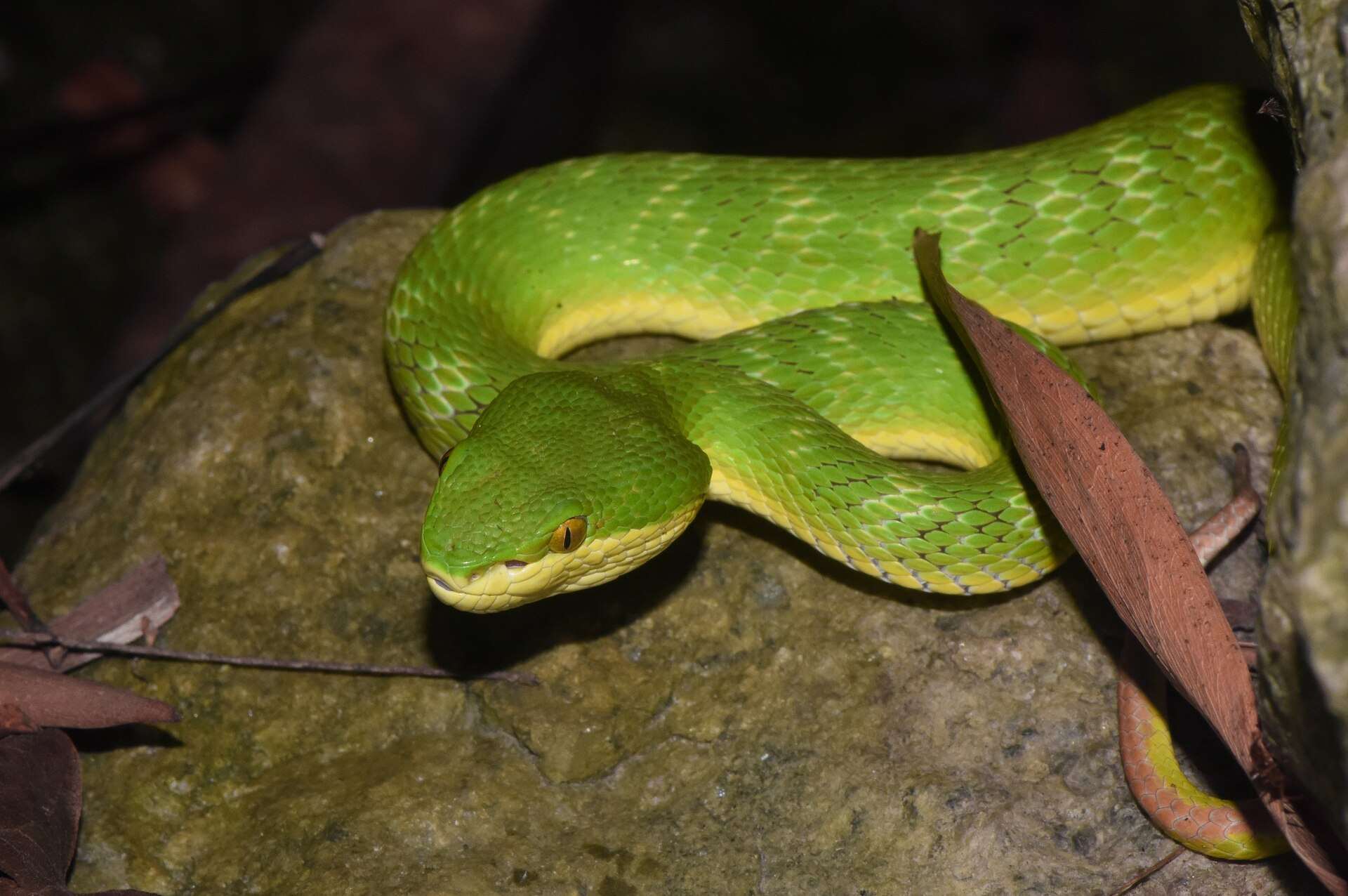
A bright green pit viper of southern China and South-East Asia, with yellow or white lips and a rusty-brown tail tip. It is common around farmland and villages and is a frequent cause of snakebite.

Is it dangerous?
Yes. Its bite is painful, causes swelling and can stop blood from clotting, though deaths are rare. Anyone bitten should go to hospital immediately.
Do not approach. If someone is bitten, go to a hospital now.
At a glance
- Length
- 0.5–0.9 m
- Active
- At night
- Found in
- Southern China and South-East Asia
- Venom
- Haemotoxic
- Young
- Live young
- Habitat
- Shrubland, Grassland, Field edges
- Diet
- Small mammals, Frogs, Lizards
Length shows a typical adult, then the largest recorded.
IUCN Red List status: Least Concern
Country guideSnakes of Indonesia
True size
Malayan pit viperMedically significant
0.87 m at most
About half the height of a 1.7 m adult.
Usual range 0.7–0.87 m, the bar on the ruler.
White-lipped pit viperMedically significant
0.9 m at most
About half the height of a 1.7 m adult.
Usual range 0.5–0.9 m, the bar on the ruler.
Banded kraitMedically significant
2.25 m at most
About 1.5 times the height of a 1.7 m adult.
Usual range 1.35–2.25 m, the bar on the ruler.
Monocled cobraMedically significant
2.3 m at most
About 1.5 times the height of a 1.7 m adult.
Usual range 1.5–2.3 m, the bar on the ruler.
Indian rat snakeNon-venomous
3 m at most
About 2 times the height of a 1.7 m adult.
Usual range 1.8–3.0 m, the bar on the ruler.
King cobraMedically significant
5.5 m at most
About 3 times the height of a 1.7 m adult.
Usual range 3.0–5.5 m, the bar on the ruler.
Burmese pythonNon-venomous
5.79 m at most
About 3.5 times the height of a 1.7 m adult.
Usual range 2.6–5.79 m, the bar on the ruler.
Reticulated pythonNon-venomous
7.67 m at most
About 4.5 times the height of a 1.7 m adult.
Usual range 2.5–7.67 m, the bar on the ruler.
Each snake is drawn at the longest length in its profile, on the same scale as the adult. Length is to scale; thickness is not.
Identification
The white-lipped pit viper is bright green on the back and sides, with yellow lips and a yellow side of the neck3. The belly is yellowish1,3, and the top of the tail is reddish brown3,5. Males have a thin pale line along the lower edge of each side1,3. The head is broad and strongly triangular, covered in small granular scales, and has a heat-sensing pit between the eye and the nostril3. The eyes are orange-yellow with vertical, slit-like pupils, and the body scales are moderately keeled3.
In Hong Kong, adults average about 0.5 m long and can reach about 0.9 m3. Females grow larger than males1.
Distribution
The white-lipped pit viper lives in southern China (including Hainan, Hong Kong and Macau), Myanmar, Thailand, Laos, Cambodia, Vietnam and western Indonesia, including Sumatra and western and central Java1,2. Records from Borneo and Sulawesi are uncertain, and it is no longer considered to occur in India1.
The species was once treated much more broadly. The white-lipped island pit viper of the Lesser Sunda Islands (T. insularis) and the northern white-lipped pit viper of the Himalayan foothills (T. septentrionalis) are now separate species1,2,5. A 2025 revision recognised three subspecies: T. a. albolabris in China and far north-eastern Vietnam, T. a. fario in the lowlands of southern Thailand, Cambodia, southern Vietnam and western Java, and T. a. guoi in Yunnan, northern Vietnam, northern Thailand and Myanmar1,2.
Habitat
This pit viper lives in many kinds of open and disturbed country2,3. In Hong Kong it is found at all altitudes and is especially common on low hills with shrubland and grassland and at the edges of farmed fields, but it is rare in dense forest and absent from towns, fish ponds and mangroves3. Elsewhere it has been found in swamp forest and grassland in Cambodia, and in secondary forest, plantations and farmland in Java and southern Thailand2. It seems to adapt well to living near people2.
Behaviour
It is mainly active at night3. The heat-sensing pits let it find and strike warm-blooded prey accurately even in total darkness3. It climbs into bushes and small trees, but is often found on low plants or on the ground2,3. Like most snakes, it does not attack people unless it is disturbed6.
Diet
The white-lipped pit viper eats mammals, frogs and lizards, and occasionally small birds3. Its heat-sensing pits help it to find warm-blooded prey such as mammals and birds in the dark3.
Reproduction
This pit viper gives birth to live young1,3. In Hong Kong, pairing takes place in May and the young are born about two months later3. An average litter has about 12 young, each 15–20 cm long at birth3.
Venom and medical significance
The white-lipped pit viper is a common cause of snakebite. It accounts for about 95% of venomous snakebites treated in Hong Kong4, and in 2017 it caused 92% of 267 snakebites treated in hospitals in Can Tho, in Vietnam’s Mekong Delta2. WHO lists it among the snakes of highest medical importance in Indonesia and Myanmar5.
A bite is painful and causes marked swelling3. The venom can also stop the blood from clotting properly, sometimes with bleeding, and this can be life-threatening4. Deaths are rare: in Hong Kong the last reported death was in 19864, and none of the 267 patients in the Can Tho study died2. Specific green pit viper antivenoms are made in Thailand and Vietnam and can correct the clotting problem2,4,5. Anyone bitten should go to hospital immediately.
Conservation
The white-lipped pit viper is listed as Least Concern on the IUCN Red List (assessed in 2012)7. It is Hong Kong’s most common venomous snake3.
Similar species
The harmless greater green snake (Cyclophiops major) of southern China looks similar, but it is slender, with mostly smooth, glossy scales and a less triangular head, and it is active by day8. The spot-tailed green pit viper (Trimeresurus erythrurus) has a brown-spotted tail and keeled scales on the sides of the head, while the white-lipped pit viper has a plain brown-topped tail and smooth scales there5. In East Java and the Lesser Sundas, the white-lipped island pit viper (T. insularis) takes its place2. These differences are not a safe basis for handling any snake. Keep your distance from every snake you cannot identify.
In captivity
The white-lipped pit viper is a venomous snake and is not suitable as a pet. In Hong Kong, the authorities advise people never to try to catch a snake, and to call 999 if one enters a house6. It should never be caught or kept by private individuals.
References
- 1
Uetz, P. et al. (eds.) (2026). Trimeresurus albolabris Gray, 1842. The Reptile Database. reptile-database.reptarium.cz
- 2
Malhotra, A., Walter, M., Limia Russel, G. & Thorpe, R.S. (2025). Integrative analysis of geographic variation and species boundaries in the white-lipped pitviper complex (Squamata: Viperidae: Crotalinae: Trimeresurus albolabris). Vertebrate Zoology 75: 191–225. doi.org
- 3
School of Biological Sciences, The University of Hong Kong. Reptiles of Hong Kong: Trimeresurus albolabris (Gray, 1842), Bamboo Snake. biosch.hku.hk
- 4
Lam, S.K., Yip, S.F., Crow, P., Fung, H.T., Cheng, J.M.H., Tan, K.S., Wong, O.F., Yeung, D.Y.T., Wong, Y.K., Poon, K.M. & Ades, G. (2017). Comparison of green pit viper and Agkistrodon halys antivenom in inhibition of coagulopathy due to Trimeresurus albolabris venom: an in-vitro study using human plasma. Hong Kong Medical Journal 23(1): 13–18. doi.org
- 5
World Health Organization, Regional Office for South-East Asia (2016). Guidelines for the management of snakebites, 2nd edition (Warrell, D.A., ed.). WHO SEARO, New Delhi. iris.who.int
- 6
Agriculture, Fisheries and Conservation Department, Hong Kong SAR Government. Venomous land snakes in Hong Kong. afcd.gov.hk
- 7
Stuart, B., Thy, N., Nguyen, T.Q. & Auliya, M. (2012). Trimeresurus albolabris. The IUCN Red List of Threatened Species 2012: e.T178433A1534017. iucnredlist.org
- 8
School of Biological Sciences, The University of Hong Kong. Reptiles of Hong Kong: Cyclophiops major (Günther, 1858), Greater Green Snake. biosch.hku.hk
Play
Play as the white-lipped pit viper.
Its real pattern is a skin in Snake. Every run ends with a fact.