
Eastern coral snake
Micrurus fulvius (Linnaeus, 1766)
Also called Harlequin coral snake, North American coral snake
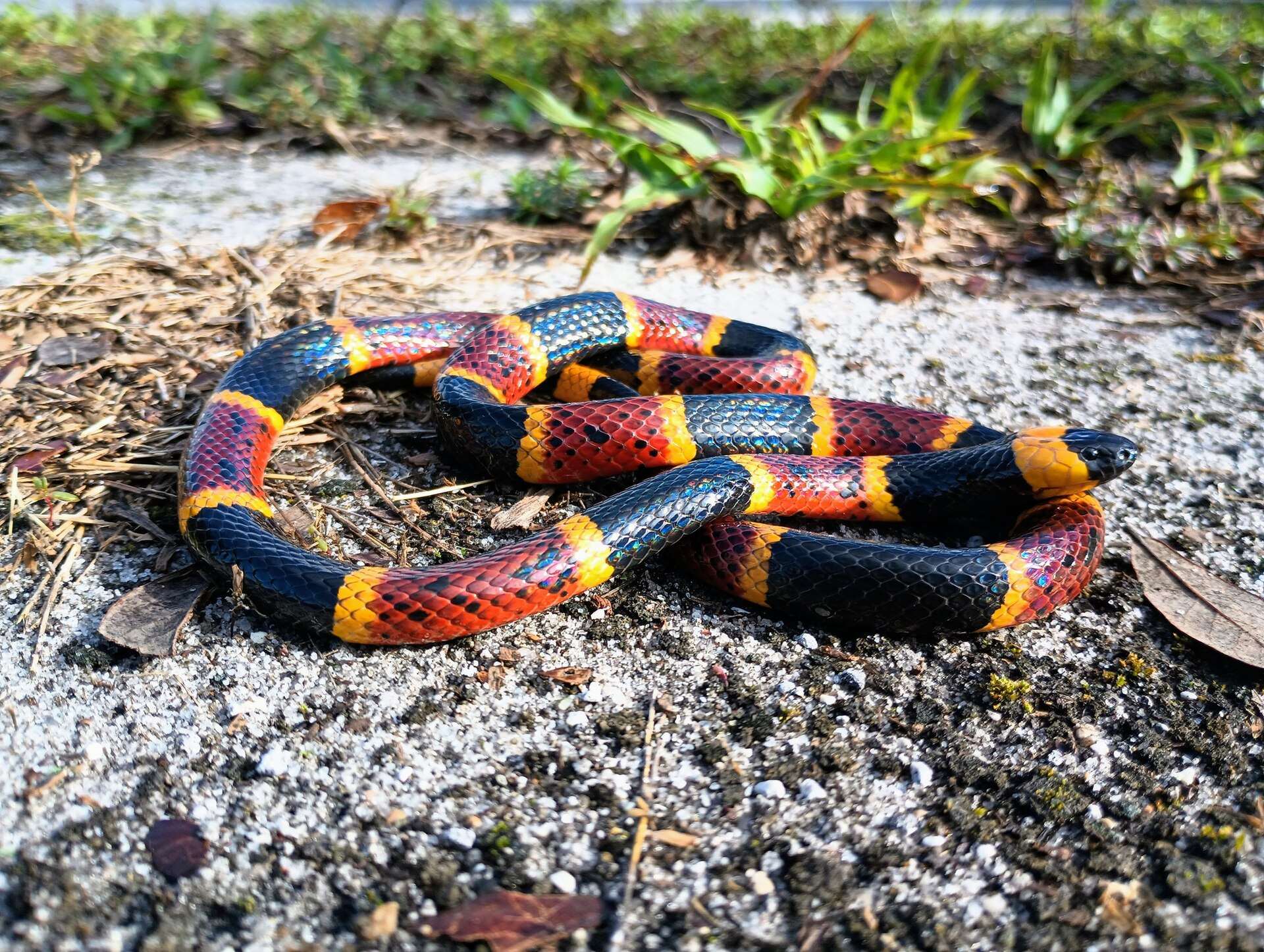
A slender, shiny snake of the south-eastern United States with wide red and black rings separated by narrow yellow rings, so red touches yellow. Its blunt snout is black, with a yellow band behind the eyes.

Is it dangerous?
Yes. Its venom attacks the nerves and can stop breathing, and symptoms may not start for hours. Anyone bitten should go to hospital immediately.
Do not approach. If someone is bitten, go to a hospital now.
At a glance
- Length
- 0.65–1.21 m
- Active
- By day
- Found in
- South-eastern United States
- Venom
- Neurotoxic
- Young
- Lays eggs
- Habitat
- Pine flatwoods, Sandhills and scrub, Hardwood hammocks
- Diet
- Small snakes, Lizards, Frogs
Length shows a typical adult, then the largest recorded.
IUCN Red List status: Least Concern
Country guideSnakes of the United States
True size
Scarlet kingsnakeNon-venomous
0.74 m at most
About half the height of a 1.7 m adult.
Usual range 0.45–0.74 m, the bar on the ruler.
Painted coral snakeMedically significant
0.74 m at most
About half the height of a 1.7 m adult.
Usual range 0.52–0.74 m, the bar on the ruler.
Eastern coral snakeMedically significant
1.21 m at most
About three quarters of the height of a 1.7 m adult.
Usual range 0.65–1.21 m, the bar on the ruler.
Texas coral snakeMedically significant
1.22 m at most
About three quarters of the height of a 1.7 m adult.
Usual range 0.6–1.22 m, the bar on the ruler.
Eastern milksnakeNon-venomous
1.32 m at most
About three quarters of the height of a 1.7 m adult.
Usual range 0.75–1.32 m, the bar on the ruler.
Black-necked spitting cobraMedically significant
2.2 m at most
About 1.5 times the height of a 1.7 m adult.
Usual range 1.25–2.2 m, the bar on the ruler.
Banded kraitMedically significant
2.25 m at most
About 1.5 times the height of a 1.7 m adult.
Usual range 1.35–2.25 m, the bar on the ruler.
Black mambaMedically significant
4.5 m at most
About 2.5 times the height of a 1.7 m adult.
Usual range 2.5–4.5 m, the bar on the ruler.
Each snake is drawn at the longest length in its profile, on the same scale as the adult. Length is to scale; thickness is not.
Identification
The eastern coral snake is a slender snake with smooth, shiny scales and broad red and black rings separated by narrow yellow rings, so the red rings touch yellow ones1. The red rings usually carry black flecks, the rings run right round the body, and the tail has only black and yellow bands1,2. The small head is not distinct from the neck: the blunt snout is black, followed by a broad yellow band behind the tiny, round-pupilled eyes1.
Most adults are about 51–76 cm long, and the longest recorded was 120.7 cm1. Females are longer than males, and the young look like small adults1,2. Its scientific name, fulvius, means orange-yellow; it was apparently chosen after preserved specimens whose red rings had faded to yellowish orange3.
Distribution
This coral snake is found only in the United States3. It ranges from south-eastern North Carolina south through Florida and west into south-eastern Louisiana2. In Florida it has been recorded in every county and on Key Largo1.
Coral snakes west of the Mississippi River are now treated as a separate species, the Texas coral snake (Micrurus tener)3,4. The eastern coral snake is extremely rare along the northern edge of its range in the Carolinas4.
Habitat
It lives in many habitats, from dry, well-drained pine flatwoods and scrub to low, wet hammocks and the edges of swamps1. It favours sandy soils, including pine and scrub sandhills and dry oak woodland, where it can burrow2,4. It spends much of its life underground or under logs, leaf litter and debris2. It is sometimes found in suburban areas next to natural habitat1,2.
Behaviour
This snake is secretive and seldom seen above ground, except in spring and autumn and after heavy rain floods the soil2. It is mainly active by day but may switch to dawn, dusk or night activity in hot weather2.
When approached it usually flees1. It may also flatten the back of its body, hide its head under its coils and raise and wave its tail, which draws an attack away from the head1. It is not aggressive, but it will readily bite if grabbed or pinned, and almost all bites happen when people handle or harass it1.
Diet
The eastern coral snake feeds almost entirely on lizards and small snakes, which it kills with its venom1. Its snake prey includes burrowing species such as worm snakes and crowned snakes, and it occasionally eats frogs2. It hunts by crawling slowly and probing its head into leaf litter and burrows1,2. It usually holds on to its prey after biting and chews to deliver venom2.
Reproduction
This species lays eggs3. In Florida, females usually lay about 4–13 white, elongated, leathery eggs underground or in leaf litter, and they hatch in August and September1. Incubation takes about 60–80 days, and hatchlings are 18–23 cm long2.
Venom and medical significance
The eastern coral snake is highly venomous: the WHO lists it in Category 2 in the United States, for snakes that can cause death or disability but are less often involved in bites5. It has small, fixed front fangs, and although it may chew when it bites, it does not need to chew to inject venom1. Its venom attacks the nerves and can cause tingling, double vision, drooping eyelids, difficulty swallowing, muscle weakness and paralysis of the breathing muscles, sometimes only after a delay of up to about 12–13 hours6,7.
Bites are rare: US poison centres recorded 1,374 coral snake bites from 2006 to 2022, mostly in Florida and Texas, with no deaths9, and a 2009 report described the first documented US coral snake death in over 40 years, in a man who did not seek medical care8. North American Coral Snake Antivenin is the only coral snake antivenom approved in the United States; production stopped in 2003, causing a shortage, but has since resumed6. Anyone bitten should go to hospital immediately.
Conservation
The eastern coral snake is listed as Least Concern on the IUCN Red List, in an assessment made in 200710. It is still of local conservation concern: it is listed as Endangered in North Carolina, Imperiled in South Carolina and of Highest Conservation Concern in Alabama4. Threats include the loss of pine and scrub habitat to development, road traffic and killing by people2. A 2018 study predicted that a warming climate will make more habitat to the north suitable, though fragmented habitat may limit its spread4.
Similar species
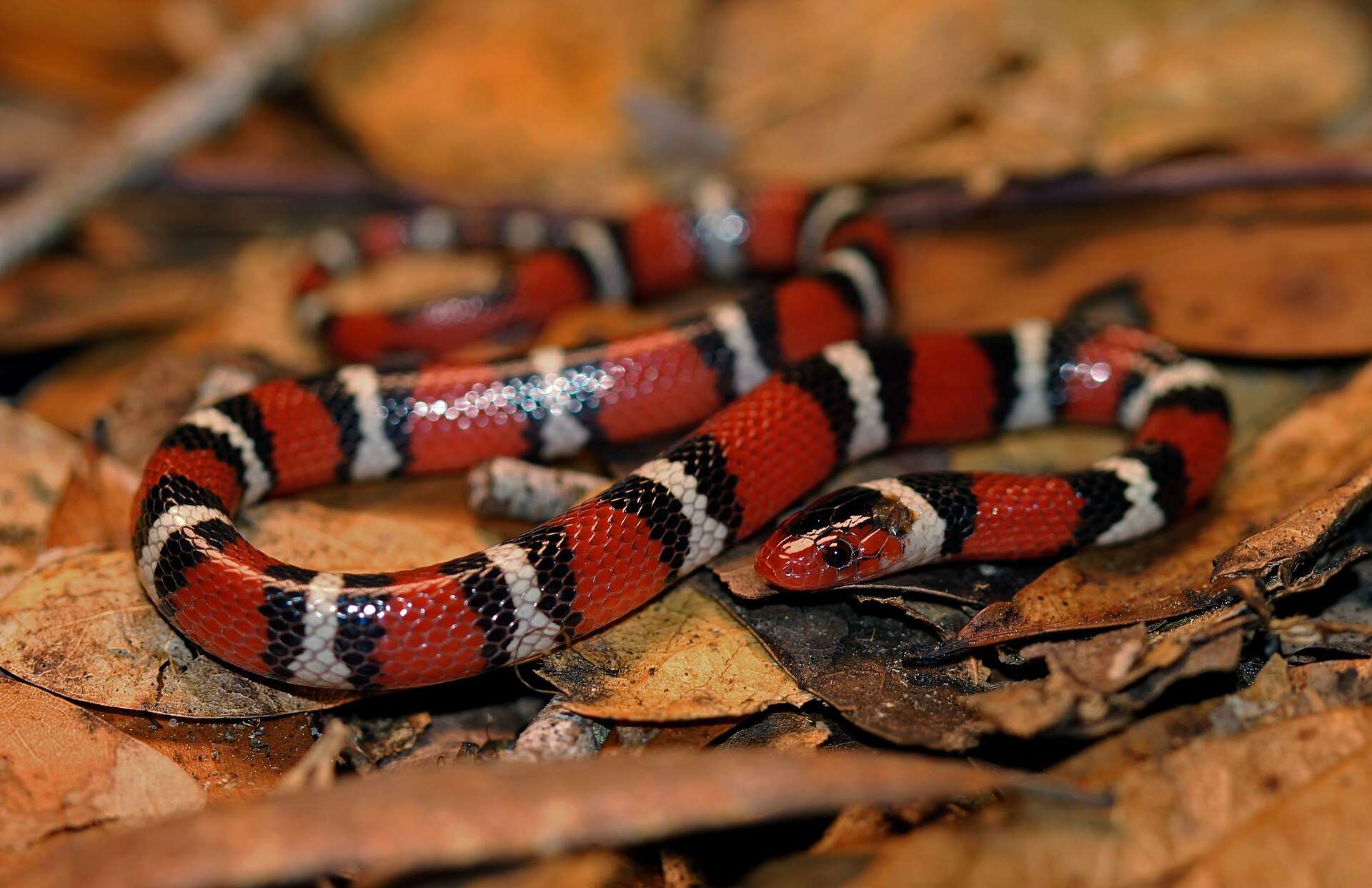
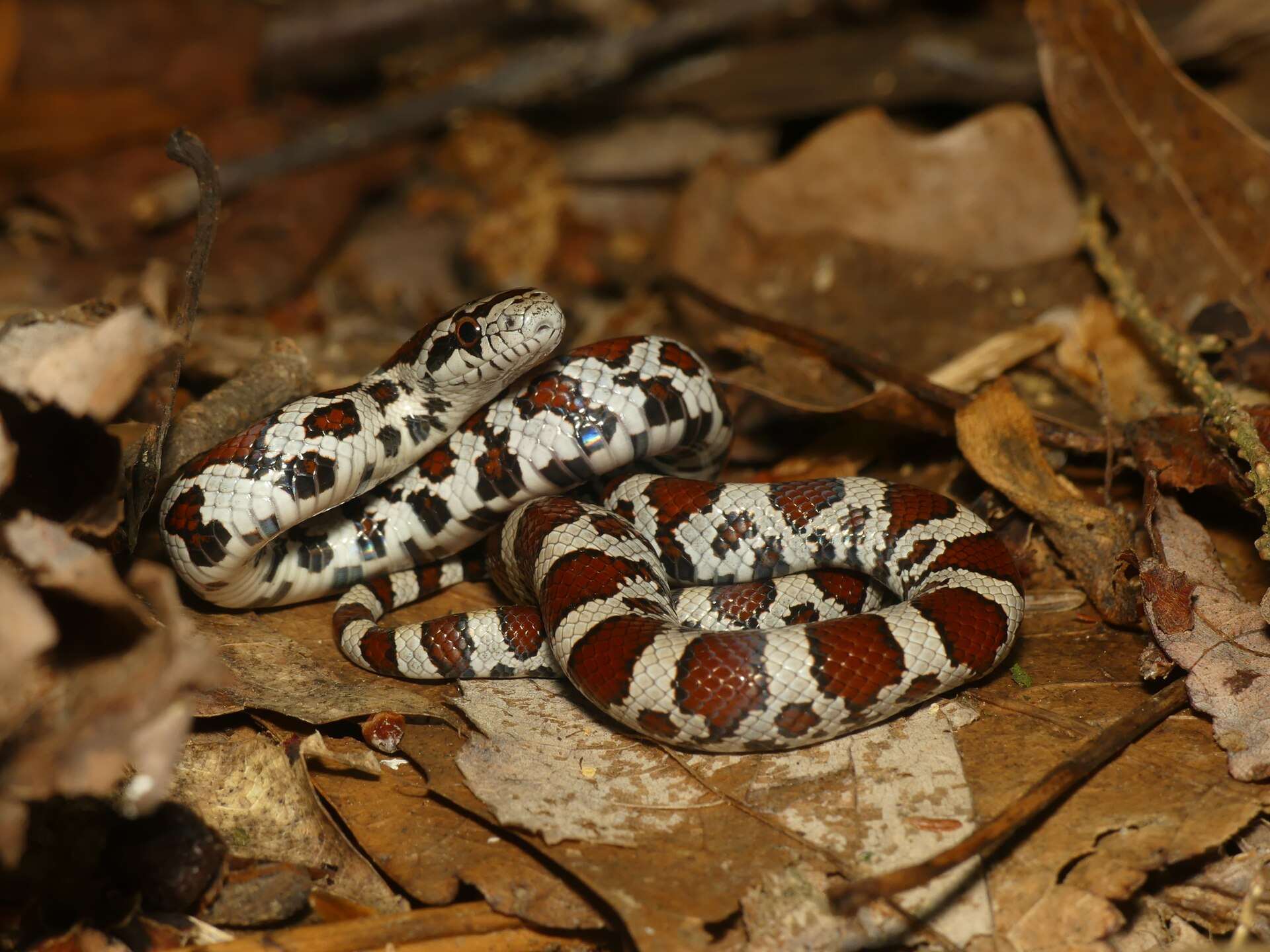
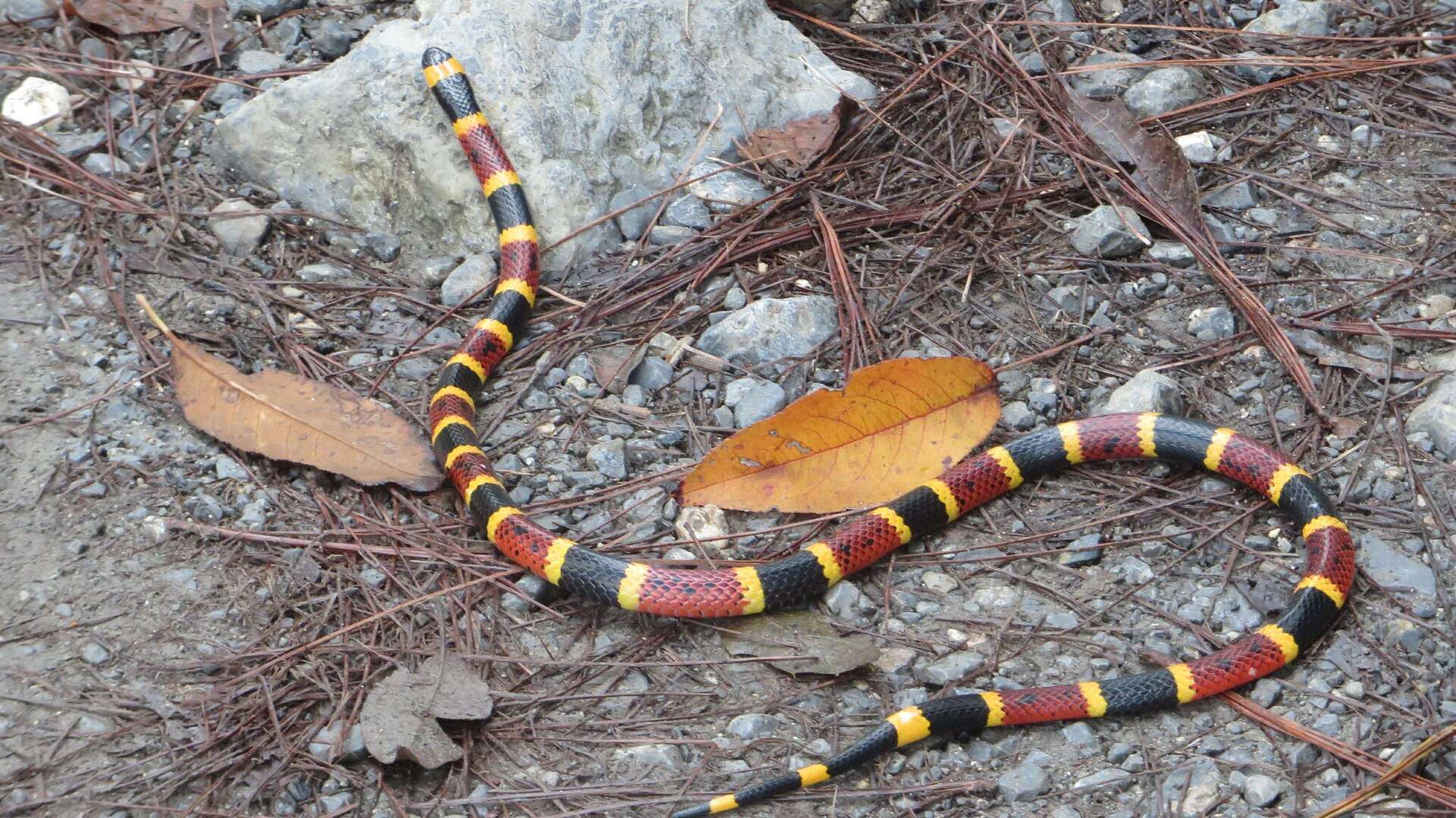
Two harmless snakes in its range, the scarlet kingsnake (Lampropeltis elapsoides) and the scarlet snake (Cemophora coccinea), also have red, black and yellow or white rings, and in a study of 39 bitten people the most common cause of a bite was mistaking a coral snake for a scarlet kingsnake1,7. In the eastern coral snake the red rings touch yellow rings and the snout is blunt and black; in both look-alikes the red rings touch only black and the snout is red and more pointed, and milksnakes also have red markings bordered by black1,11,12.
The rhyme “red touches yellow, kills a fellow; red touches black, venom lack” sums up this difference, but it only works for coral snakes in the United States, and even in Florida unusual colour variants occasionally break it1,11. Some coral snakes in Mexico, Central America and South America have red rings touching white or even black rings, so the rhyme must not be relied on there11. These differences are not a safe basis for handling any snake. Keep your distance from every snake you cannot identify.
In captivity
The eastern coral snake is a dangerous venomous snake and is not suitable as a pet. Almost all bites happen when people deliberately handle or harass these snakes1. It is listed as Endangered in North Carolina4, and South Carolina protects all of its native reptiles2. If you see one, the Florida Museum advises simply leaving it alone1.
Look-alikes
Don’t confuse it with…
These snakes are often mistaken for each other. Use the differences to learn, never as a reason to handle a snake.
References
- 1
Florida Museum of Natural History. Harlequin Coralsnake (Micrurus fulvius). Florida Snake ID Guide. University of Florida. floridamuseum.ufl.edu
- 2
Savannah River Ecology Laboratory, University of Georgia. Eastern Coral Snake (Micrurus fulvius). Herpetology at SREL. srelherp.uga.edu
- 3
Uetz, P. et al. (eds.) (2026). Micrurus fulvius (Linnaeus, 1766). The Reptile Database. reptile-database.reptarium.cz
- 4
Archis, J.N., Akcali, C., Stuart, B.L., Kikuchi, D. & Chunco, A.J. (2018). Is the future already here? The impact of climate change on the distribution of the eastern coral snake (Micrurus fulvius). PeerJ 6: e4647. doi.org
- 5
World Health Organization (2017). Guidelines for the production, control and regulation of snake antivenom immunoglobulins. WHO Technical Report Series No. 1004, Annex 5, Appendix 1: Worldwide distribution of medically important venomous snakes. cdn.who.int
- 6
Simmons, R., Ubani, C., Garvan, G. et al. (2025). Retrospective comparison of empiric antivenom vs. expectant treatment for eastern coral snakebites. Western Journal of Emergency Medicine 27(1): 167–176. doi.org
- 7
Kitchens, C.S. & Van Mierop, L.H. (1987). Envenomation by the Eastern coral snake (Micrurus fulvius fulvius). A study of 39 victims. JAMA 258(12): 1615–1618. doi.org
- 8
Norris, R.L., Pfalzgraf, R.R. & Laing, G. (2009). Death following coral snake bite in the United States: first documented case (with ELISA confirmation of envenomation) in over 40 years. Toxicon 53(6): 693–697. doi.org
- 9
Velagapudi, M.E., Navarro, J.J., Hill, A.E., Darracq, M.A. & Thornton, S.L. (2024). Epidemiology and characteristics of coral snake bites reported to the National Poison Data System (2006–2022). Journal of the American College of Emergency Physicians Open 5(5): e13296. doi.org
- 10
Hammerson, G.A. (2007). Micrurus fulvius. The IUCN Red List of Threatened Species 2007: e.T64025A12737582. iucnredlist.org
- 11
Frank, M. (2019). Identifying Venomous and Nonvenomous Snakes in Texas. Texas A&M AgriLife Extension, publication WFSC-023. texnat.tamu.edu
- 12
Johnson, S.A. & Main, M.B. Recognizing Florida's Venomous Snakes. UF/IFAS Extension publication WEC 202/UW229. University of Florida. ask.ifas.ufl.edu
Play
Play as the eastern coral snake.
Its real pattern is a skin in Snake. Every run ends with a fact.