
Painted coral snake
Micrurus corallinus (Merrem, 1820)
Also called Atlantic coral snake, Cobra-coral, Coral-verdadeira
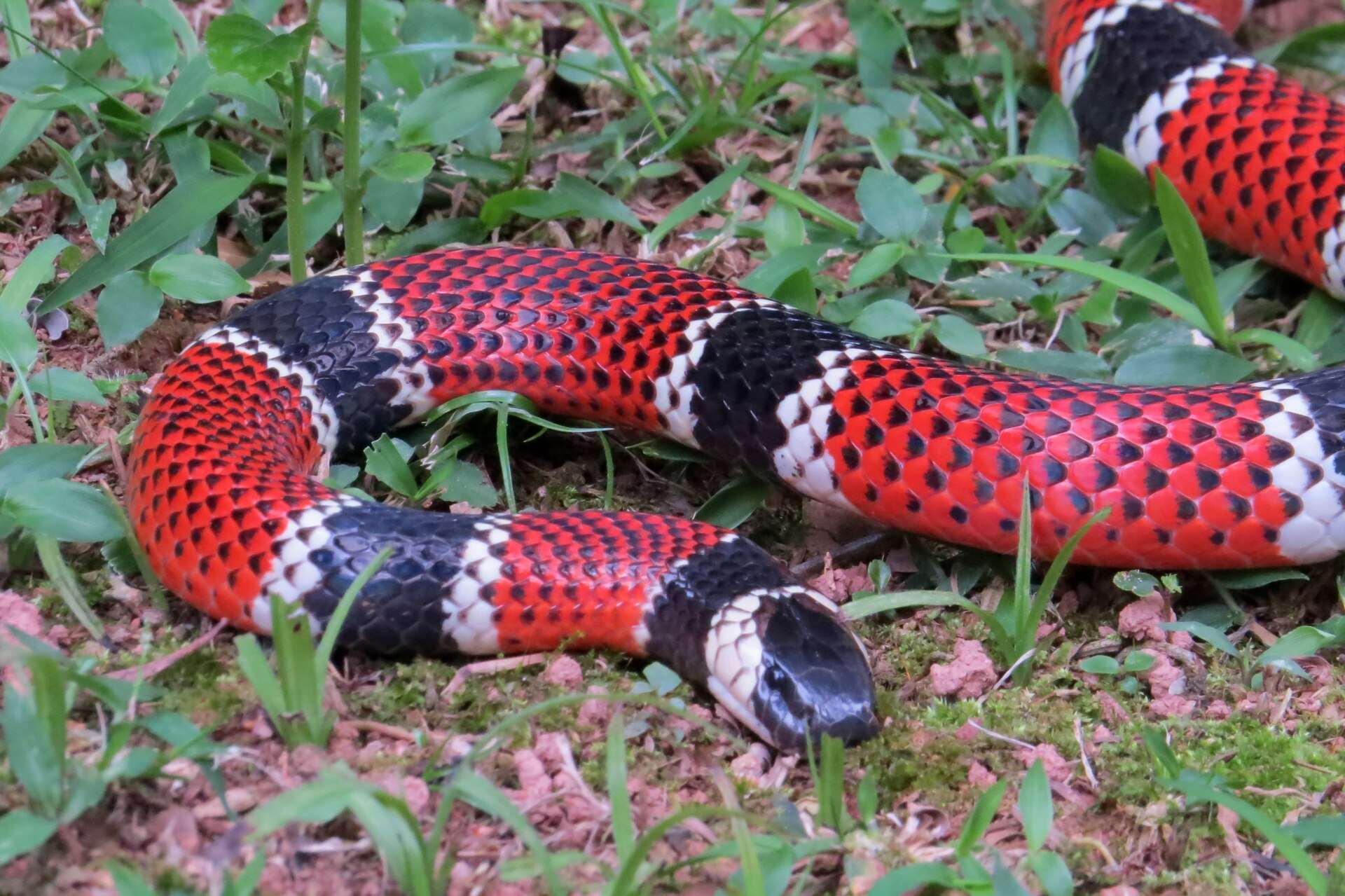
A brightly ringed coral snake of the Atlantic Forest in Brazil, Paraguay and Argentina, red with single black rings. It lives hidden in leaf litter and rarely bites, but its venom is dangerous.

Is it dangerous?
Yes. Its bite may cause little pain, but the venom can paralyse muscles, including those used for breathing. Anyone bitten should go to hospital immediately.
Do not approach. If someone is bitten, go to a hospital now.
At a glance
- Length
- 0.52–0.74 m
- Active
- Day and night
- Found in
- Atlantic Forest of South America
- Venom
- Neurotoxic
- Young
- Lays eggs
- Habitat
- Atlantic Forest, Leaf litter, Semi-deciduous forest
- Diet
- Amphisbaenians, Legless lizards, Caecilians
Length shows a typical adult, then the largest recorded.
IUCN Red List status: Least Concern
Country guideSnakes of Brazil
True size
Painted coral snakeMedically significant
0.74 m at most
About half the height of a 1.7 m adult.
Usual range 0.52–0.74 m, the bar on the ruler.
Eastern coral snakeMedically significant
1.21 m at most
About three quarters of the height of a 1.7 m adult.
Usual range 0.65–1.21 m, the bar on the ruler.
Texas coral snakeMedically significant
1.22 m at most
About three quarters of the height of a 1.7 m adult.
Usual range 0.6–1.22 m, the bar on the ruler.
South American rattlesnakeMedically significant
1.47 m at most
About three quarters of the height of a 1.7 m adult.
Usual range 1.1–1.47 m, the bar on the ruler.
JararacaMedically significant
1.6 m at most
About as long as a 1.7 m adult is tall.
Usual range 1.06–1.6 m, the bar on the ruler.
Banded kraitMedically significant
2.25 m at most
About 1.5 times the height of a 1.7 m adult.
Usual range 1.35–2.25 m, the bar on the ruler.
Boa constrictorNon-venomous
4.45 m at most
About 2.5 times the height of a 1.7 m adult.
Usual range 2.5–4.45 m, the bar on the ruler.
Green anacondaNon-venomous
5.21 m at most
About 3 times the height of a 1.7 m adult.
Usual range 3.1–5.21 m, the bar on the ruler.
Each snake is drawn at the longest length in its profile, on the same scale as the adult. Length is to scale; thickness is not.
Identification
Coral snakes are small to medium-sized snakes with short, fixed fangs at the front of the mouth and bright red bodies crossed by complete black, yellow or white rings5. In the painted coral snake, the black rings are single rather than in groups of three4. In the most populated parts of Brazil it is the only single-ringed coral snake, while most other coral snakes there have black rings in threes4. Its Portuguese names include “black-headed coral snake” and “white-collared coral snake”1.
Adult males from São Paulo state averaged 52 cm from snout to vent, and the largest measured 74 cm2.
Distribution
The painted coral snake lives in Brazil, from Rio Grande do Sul north along the Atlantic coast to Rio Grande do Norte and inland to Mato Grosso do Sul, and in Paraguay and Misiones province in north-eastern Argentina1. It has been reported from Uruguay in the past, but there are no reliable records from that country1. In Brazil it is mainly found in the Atlantic Forest along the coast5.
Habitat
This is a common snake of the Atlantic Forest in south-eastern Brazil, living in dense rainforest and semi-deciduous seasonal forest2. It hides in the forest floor and is closely tied to the leaf litter, which gives it shelter and is where it carries out its daily activities3.
Behaviour
The painted coral snake is semi-fossorial, spending much of its time hidden under leaf litter and soil, which makes it hard to see3. Coral snakes cause few bites in Brazil because of this burrowing habit9. They are not aggressive: when they meet people they usually try to escape and bite only as a last resort5. Both sexes are most active on the surface in spring, when they search for mates, and groups of one male with two females, or two males with one female, have been seen mating2.
Diet
The painted coral snake feeds mainly on long, slender animals: amphisbaenians (worm lizards), lizards, especially legless ones, caecilians and small burrowing snakes3. Because these prey are hard to keep, feeding it in captivity is difficult, and it refuses fish, which some other coral snakes accept3.
Reproduction
The painted coral snake lays eggs1. Its breeding is strongly seasonal: females develop their eggs and mate early in the rainy season, lay their eggs in the middle of it, and the young hatch at the end of the rainy season or early in the dry season2. Males produce sperm in autumn and store it until the spring mating season2.
Venom and medical significance
The painted coral snake is highly venomous; the WHO lists it in Category 2 in Brazil, Argentina and Paraguay6, and in Brazil it and Micrurus frontalis cause most coral snake bites3. A bite usually causes little change at the bite site, but it can lead to drooping eyelids, blurred or double vision and a sleepy look, and deaths are caused by paralysis of the breathing muscles, often after a delay in getting help7. Coral snake bites are rare in Brazil, with 380 reported in 2023 (about 1% of snakebites) and no deaths9. Every coral snake bite is treated as potentially severe, using anti-elapid antivenom made from the venoms of this species and M. frontalis3,8. In one case, a man bitten while handling a painted coral snake that people thought was harmless developed drooping eyelids, double vision and difficulty swallowing, and recovered after antivenom5. Anyone bitten should go to hospital immediately.
Conservation
The painted coral snake is listed as Least Concern on the IUCN Red List (published 2019)12. It is still a common snake in the Atlantic Forest of south-eastern Brazil2.
Similar species
Several harmless or mildly venomous snakes, often called false coral snakes, copy the red, black and white colours of true coral snakes5,10. Telling them apart is difficult even for experts: the painted coral snake in the case above was picked up by a biologist who believed it was a false coral5. Some true coral snakes also lack the familiar red, white and black pattern11. Researchers advise that any snake that looks like a coral snake should be treated as a true coral snake5. These differences are not a safe basis for handling any snake. Keep your distance from every snake you cannot identify.
In captivity
The painted coral snake is a dangerously venomous snake and is not suitable as a pet. In Brazil, keeping venomous snakes is allowed only in research centres or for the pharmaceutical industry11. The Instituto Butantan keeps these snakes to make antivenom, but they are difficult to keep alive in captivity3. A painted coral snake yields only about 3 mg of dried venom, compared with about 83 mg from a jararaca, so many snakes are needed to make coral snake antivenom3.
References
- 1
Uetz, P. et al. (eds.) (2026). Micrurus corallinus (Merrem, 1820). The Reptile Database. reptile-database.reptarium.cz
- 2
Almeida-Santos, S.M., Pizzatto, L. & Marques, O.A.V. (2006). Intra-sex synchrony and inter-sex coordination in the reproductive timing of the Atlantic coral snake Micrurus corallinus (Elapidae) in Brazil. Herpetological Journal 16: 371–376. thebhs.org
- 3
Mendes, G.F., Stuginski, D.R., Loibel, S.M.C., de Morais-Zani, K., da Rocha, M.M.T., Fernandes, W., Sant'Anna, S.S. & Grego, K.F. (2019). Factors that can influence the survival rates of coral snakes (Micrurus corallinus) for antivenom production. Journal of Animal Science 97(2): 972–980. doi.org
- 4
Serafim, H., Peccinini-Seale, D.M. & Batistic, R.F. (2007). Estudo cariotípico de duas espécies brasileiras do gênero Micrurus (Ophidia: Elapidae). Biota Neotropica 7(1): 75–80. doi.org
- 5
Strauch, M.A., Souza, G.J., Pereira, J.N., Ramos, T.D.S., Cesar, M.O., Tomaz, M.A., Monteiro-Machado, M., Patrão-Neto, F.C. & Melo, P.A. (2018). True or false coral snake: is it worth the risk? A Micrurus corallinus case report. Journal of Venomous Animals and Toxins including Tropical Diseases 24: 10. doi.org
- 6
World Health Organization (2017). Guidelines for the production, control and regulation of snake antivenom immunoglobulins. WHO Technical Report Series No. 1004, Annex 5, Appendix 1: Worldwide distribution of medically important venomous snakes. cdn.who.int
- 7
Ministério da Saúde (Brazil). Acidentes ofídicos: sintomas. gov.br
- 8
Ministério da Saúde (Brazil). Acidentes ofídicos: tratamento (bivalent anti-elapid antivenom, SAEla; all coral snake bites treated as potentially severe). gov.br
- 9
Ministério da Saúde, Secretaria de Vigilância em Saúde e Ambiente (2024). Epidemiologia dos acidentes ofídicos no Brasil em 2023. Boletim Epidemiológico 55(15). gov.br
- 10
Ministério da Saúde (Brazil). Acidentes ofídicos (overview of the four types of venomous snakebite in Brazil, including false coral snakes). gov.br
- 11
Ministério da Saúde (Brazil). Acidentes ofídicos: perguntas frequentes. gov.br
- 12
Cacciali, P., Carreira, S., Fitzgerald, L., Giraudo, A., Kacoliris, F., Montero, R. & Scott, N. (2019). Micrurus corallinus. The IUCN Red List of Threatened Species 2019: e.T56040806A56040867. iucnredlist.org
Play
Play as the painted coral snake.
Its real pattern is a skin in Snake. Every run ends with a fact.