
Black mamba
Dendroaspis polylepis Günther, 1864
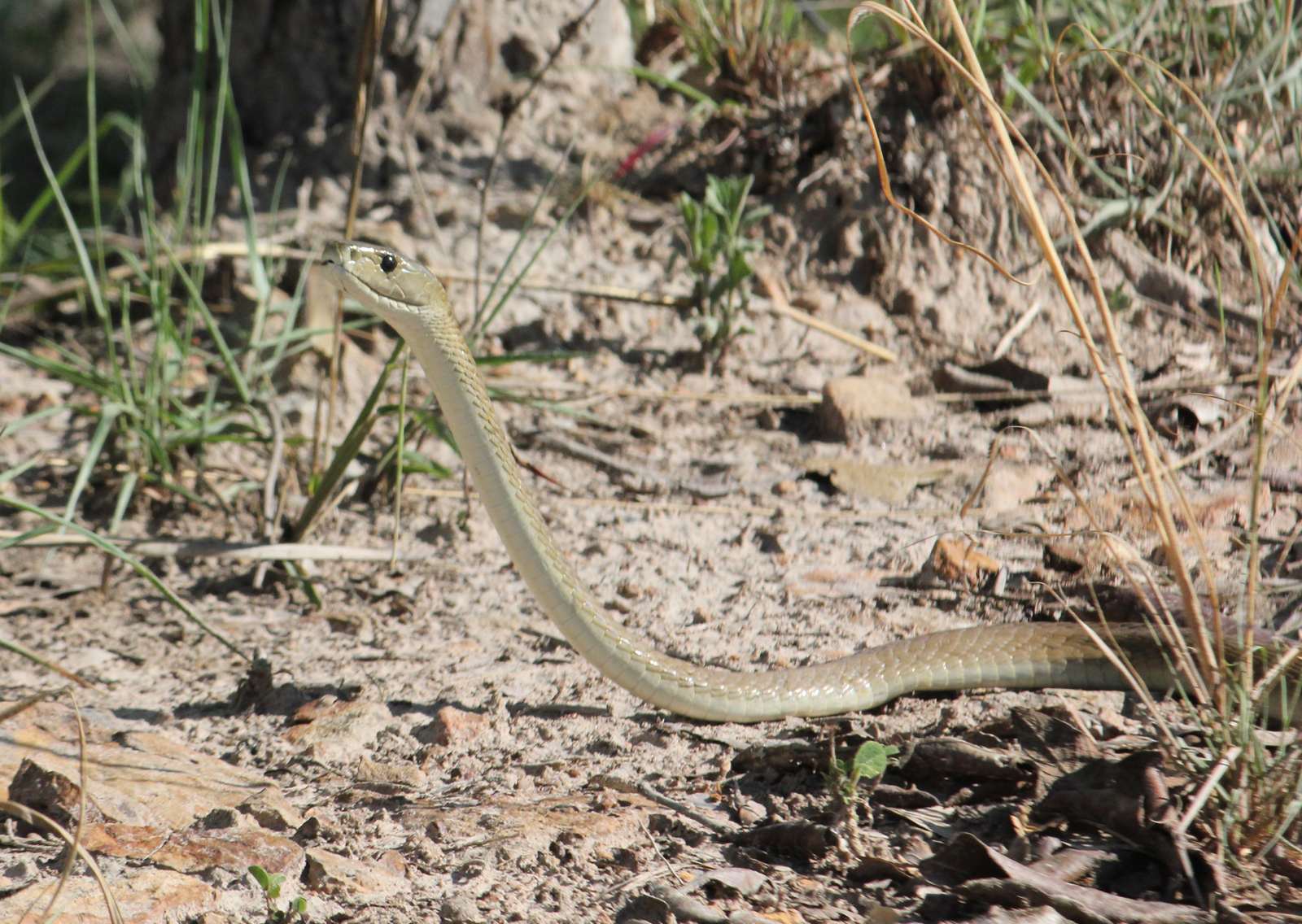
Africa's longest venomous snake, usually olive to grey rather than black. A shy, fast-moving daytime snake of savanna and rocky hills, it shows an inky-black mouth when threatened.

Is it dangerous?
Yes. Its fast-acting venom affects the nerves and can stop breathing. Bites are rare, but anyone bitten needs hospital care immediately.
Do not approach. If someone is bitten, go to a hospital now.
At a glance
- Length
- 2.5–4.5 m
- Active
- By day
- Found in
- Sub-Saharan Africa
- Venom
- Neurotoxic
- Young
- Lays eggs
- Habitat
- Savanna, Open woodland, Rocky hills
- Diet
- Rodents, Hyraxes, Squirrels
Length shows a typical adult, then the largest recorded.
IUCN Red List status: Least Concern
Country guideSnakes of KenyaSnakes of South Africa
True size
Brown house snakeNon-venomous
1.5 m at most
About three quarters of the height of a 1.7 m adult.
Usual range 0.6–1.5 m, the bar on the ruler.
Gaboon viperMedically significant
1.75 m at most
About as long as a 1.7 m adult is tall.
Usual range 1.0–1.75 m, the bar on the ruler.
Mozambique spitting cobraMedically significant
1.8 m at most
About as long as a 1.7 m adult is tall.
Usual range 1.2–1.8 m, the bar on the ruler.
Puff adderMedically significant
1.9 m at most
About as long as a 1.7 m adult is tall.
Usual range 0.8–1.9 m, the bar on the ruler.
Black-necked spitting cobraMedically significant
2.2 m at most
About 1.5 times the height of a 1.7 m adult.
Usual range 1.25–2.2 m, the bar on the ruler.
BoomslangMedically significant
2.3 m at most
About 1.5 times the height of a 1.7 m adult.
Usual range 1.3–2.3 m, the bar on the ruler.
Black mambaMedically significant
4.5 m at most
About 2.5 times the height of a 1.7 m adult.
Usual range 2.5–4.5 m, the bar on the ruler.
Central African rock pythonNon-venomous
7.6 m at most
About 4.5 times the height of a 1.7 m adult.
Usual range 4.0–7.6 m, the bar on the ruler.
Each snake is drawn at the longest length in its profile, on the same scale as the adult. Length is to scale; thickness is not.
Identification
Despite its name, the black mamba is not black. Adults are olive, brownish, grey or sometimes khaki, with a cream belly, and young snakes are lighter grey or olive1. It is a long, slender snake with smooth scales, a long coffin-shaped head and dark eyes1,2. When threatened it gapes to show the inky-black lining of its mouth and may spread a narrow hood1,3.
Adults are usually 2–3 m long, averaging about 2.2–2.7 m1. It is the longest venomous snake in Africa, reaching up to about 4.5 m, although snakes over 3.8 m are rare3.
Distribution
Black mambas live across much of sub-Saharan Africa. The Reptile Database lists them from Senegal and Guinea in the west, through Cameroon and the Central African Republic, to Eritrea, Ethiopia and Somalia in the east, and south to Angola, Namibia, Botswana, Mozambique and South Africa4. They are most common in eastern and southern Africa, while records from West Africa are scattered1.
The species has been recorded from lowlands up to about 1,800 m above sea level1.
Habitat
The black mamba prefers wooded savanna, rocky hills and riverside forest where rocks or fallen trees give cover1. It often shelters in hollow trees, termite mounds, holes in anthills and rock crevices, and if left undisturbed it may return to the same lair for a long time1,3.
Although it mostly travels on the ground, it is partly arboreal and climbs trees quickly and easily1,4.
Behaviour
The black mamba is active by day, usually from a few hours after sunrise until about an hour before dusk1. It spends a lot of time basking, often near a hole or crevice it can slip into if disturbed1,3. It is shy and quick to escape, and contrary to popular stories it does not chase people3,5.
If cornered, it raises its head high, opens its black mouth, spreads a narrow hood and hisses, and it may then strike several times in quick succession1,5. If the person moves slowly away, the snake will usually retreat1.
Diet
Black mambas eat mainly small mammals, such as rodents, squirrels and hyraxes (dassies), and occasionally birds1. They usually strike their prey once or twice and wait for it to be overcome by the venom before swallowing it1.
Because they eat many rodents, black mambas help to keep pest numbers down1.
Reproduction
The black mamba lays eggs4. Mating takes place in early spring, and rival males may wrestle by twisting their bodies together and raising their heads off the ground1.
Females lay about 6 to 17 eggs in a burrow or other sheltered place and then leave them. The eggs hatch after roughly 80 to 90 days1. Hatchlings look after themselves from the start and already have working venom glands1.
Venom and medical significance
The black mamba is dangerous to people. The World Health Organization lists it among the snakes of highest medical importance (Category 1) in many African countries6. Its venom is mainly neurotoxic: toxins such as α-neurotoxins and dendrotoxins act on nerves and muscles and can cause paralysis, including of the muscles used for breathing7. Symptoms have been reported within 10 to 15 minutes of a bite, and breathing difficulty can develop within half an hour3,7.
Bites are quite rare. Most happen when someone gets very close to a basking mamba or corners one in a confined space5. Quick hospital treatment, which may include antivenom and breathing support, is what saves lives7. Anyone bitten must seek medical care immediately.
Conservation
The IUCN Red List classifies the black mamba as Least Concern, based on an assessment published in 20218. It has a very wide range and is still common in many parts of south and east Africa1.
Local threats include the spread of human settlement and people killing snakes out of fear1.
Similar species
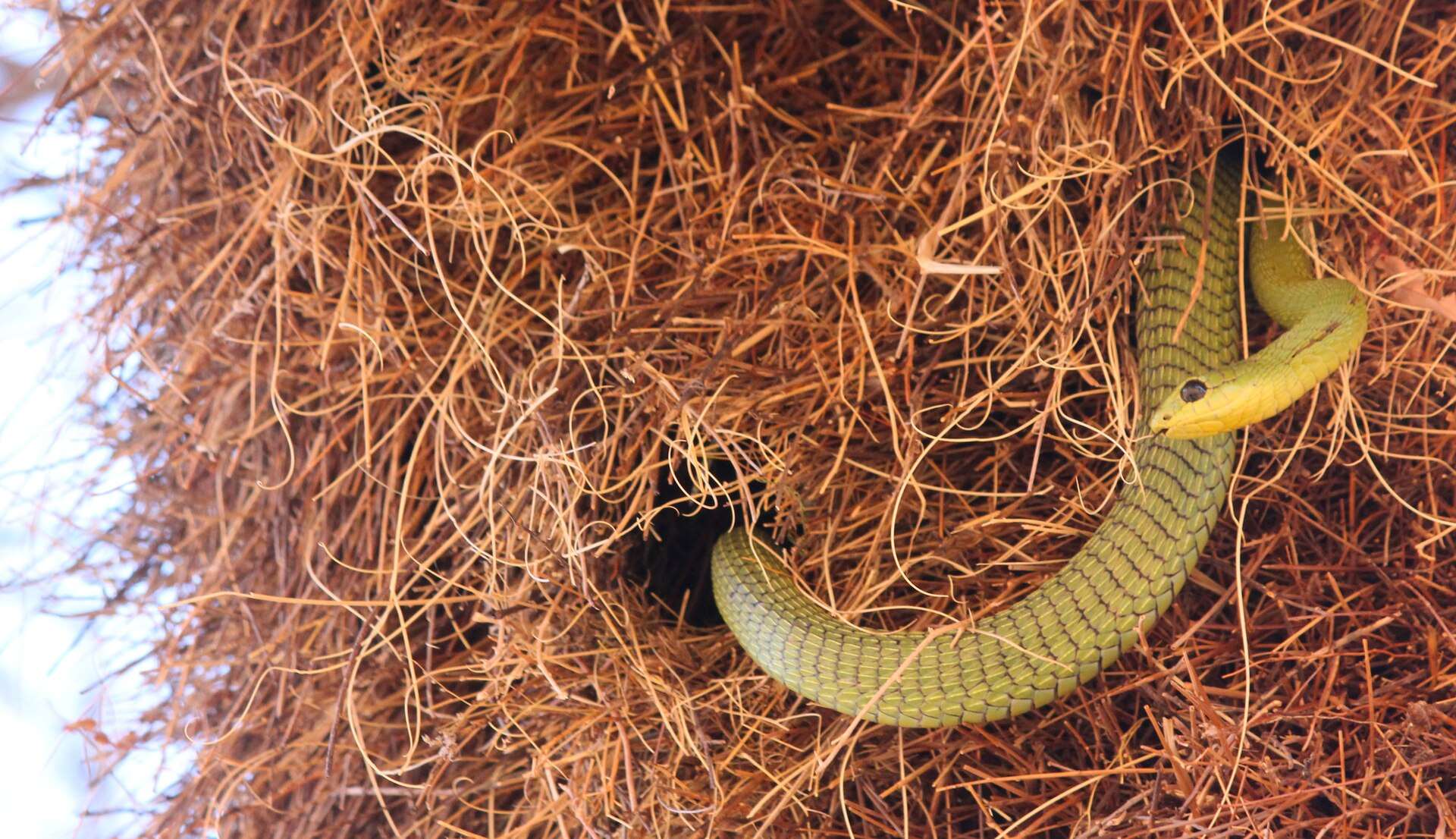
None of the other snakes on this site share its range. In southern Africa, a black mamba can be confused with a female boomslang, which is also long, slender and usually brown2. Boomslangs have keeled scales that give the body a rough look, a noticeably pointed head and very large eyes. Black mambas have smooth scales, a long coffin-shaped head, dark eyes and a black mouth lining1,2. Young black mambas are grey or olive, but not light enough to be mistaken for green mambas1. These differences are not a safe basis for handling any snake. Keep your distance from all snakes.
In captivity
The black mamba is not a suitable pet. Keeping one is generally a bad idea, and fatal or near-fatal bites to experienced keepers have been reported1. Recent medical reports of black mamba bites from Europe have mostly involved breeders or keepers of exotic snakes7.
Snake-safety experts advise never approaching a black mamba closely and never trying to catch or kill one5.
Look-alikes
Don’t confuse it with…
These snakes are often mistaken for each other. Use the differences to learn, never as a reason to handle a snake.
References
- 1
Schott, R. (2005). Dendroaspis polylepis (black mamba). Animal Diversity Web, University of Michigan Museum of Zoology. animaldiversity.org
- 2
African Snakebite Institute (2019). Snake comparison: Black Mamba vs Boomslang. africansnakebiteinstitute.com
- 3
African Snakebite Institute. Black Mamba (Dendroaspis polylepis) species account. africansnakebiteinstitute.com
- 4
Uetz, P. et al. (eds.) (2026). Dendroaspis polylepis Günther, 1864. The Reptile Database. reptile-database.reptarium.cz
- 5
African Snakebite Institute (2024). Snakebite profile: Black Mamba, Dendroaspis polylepis. africansnakebiteinstitute.com
- 6
World Health Organization (2017). Guidelines for the production, control and regulation of snake antivenom immunoglobulins. WHO Technical Report Series No. 1004, Annex 5, Appendix 1: Worldwide distribution of medically important venomous snakes. cdn.who.int
- 7
Erulu, V.E., Okumu, M.O., Ochola, F.O. & Gikunju, J.K. (2018). Revered but poorly understood: a case report of Dendroaspis polylepis (black mamba) envenomation in Watamu, Malindi, Kenya, and a review of the literature. Tropical Medicine and Infectious Disease 3(3): 104. doi.org
- 8
Branch, W.R., Trape, J.-F., Luiselli, L., Spawls, S., Penner, J., Howell, K., Msuya, C.A. & Ngalason, W. (2021). Dendroaspis polylepis. The IUCN Red List of Threatened Species 2021: e.T177584A15627370. iucnredlist.org
Play
Play as the black mamba.
Its real pattern is a skin in Snake. Every run ends with a fact.