
Compare
Coral snake vs kingsnake
The scarlet kingsnake is the eastern coral snake's closest mimic, a harmless copy that fools predators and people. The order of the rings and the colour of the snout tell them apart; decades of research explain why they look so alike.
Every fact is sourced · draft, pending review by a herpetologist
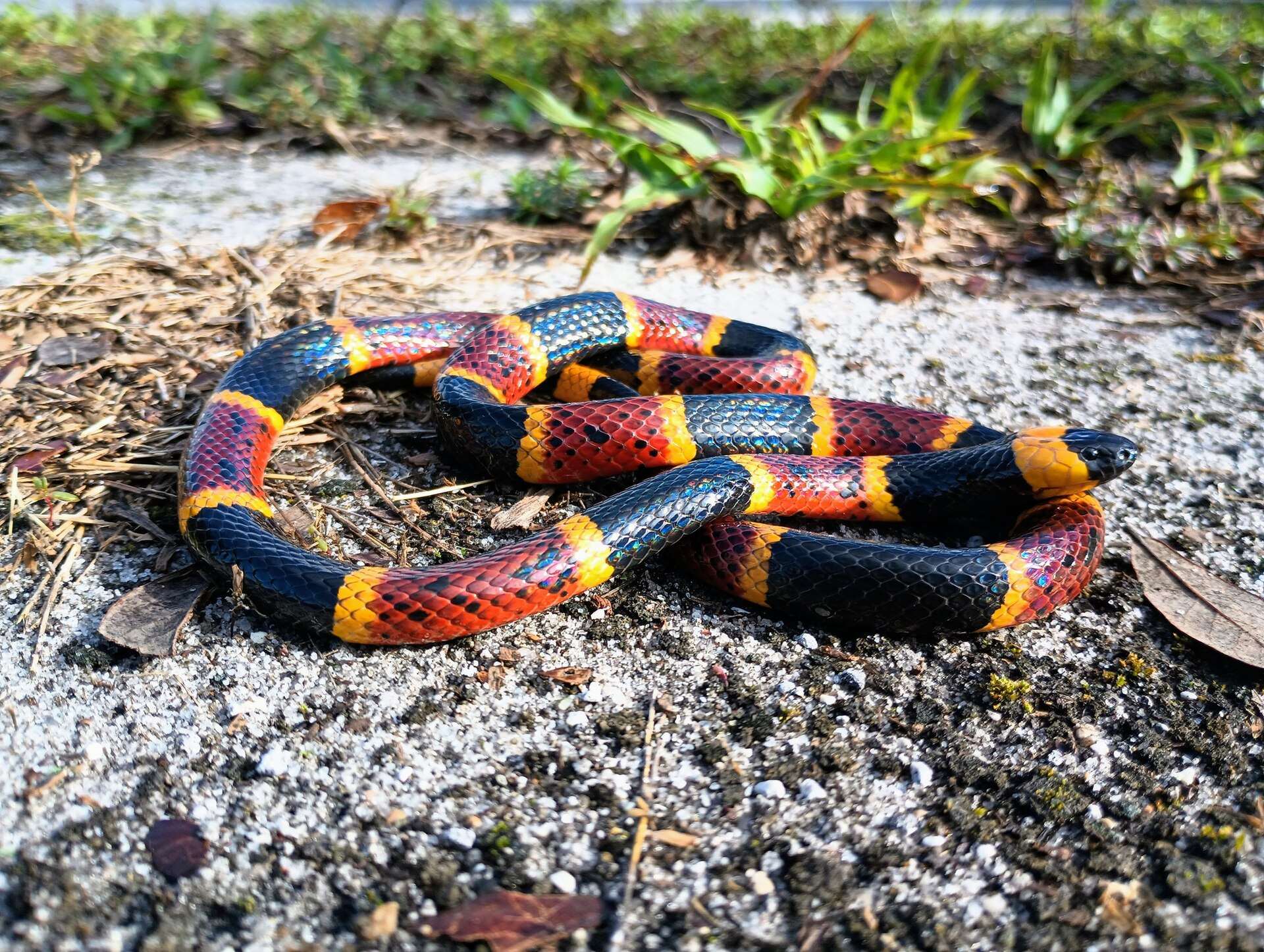
Eastern coral snake
Micrurus fulvius
South-eastern United States
Medically significant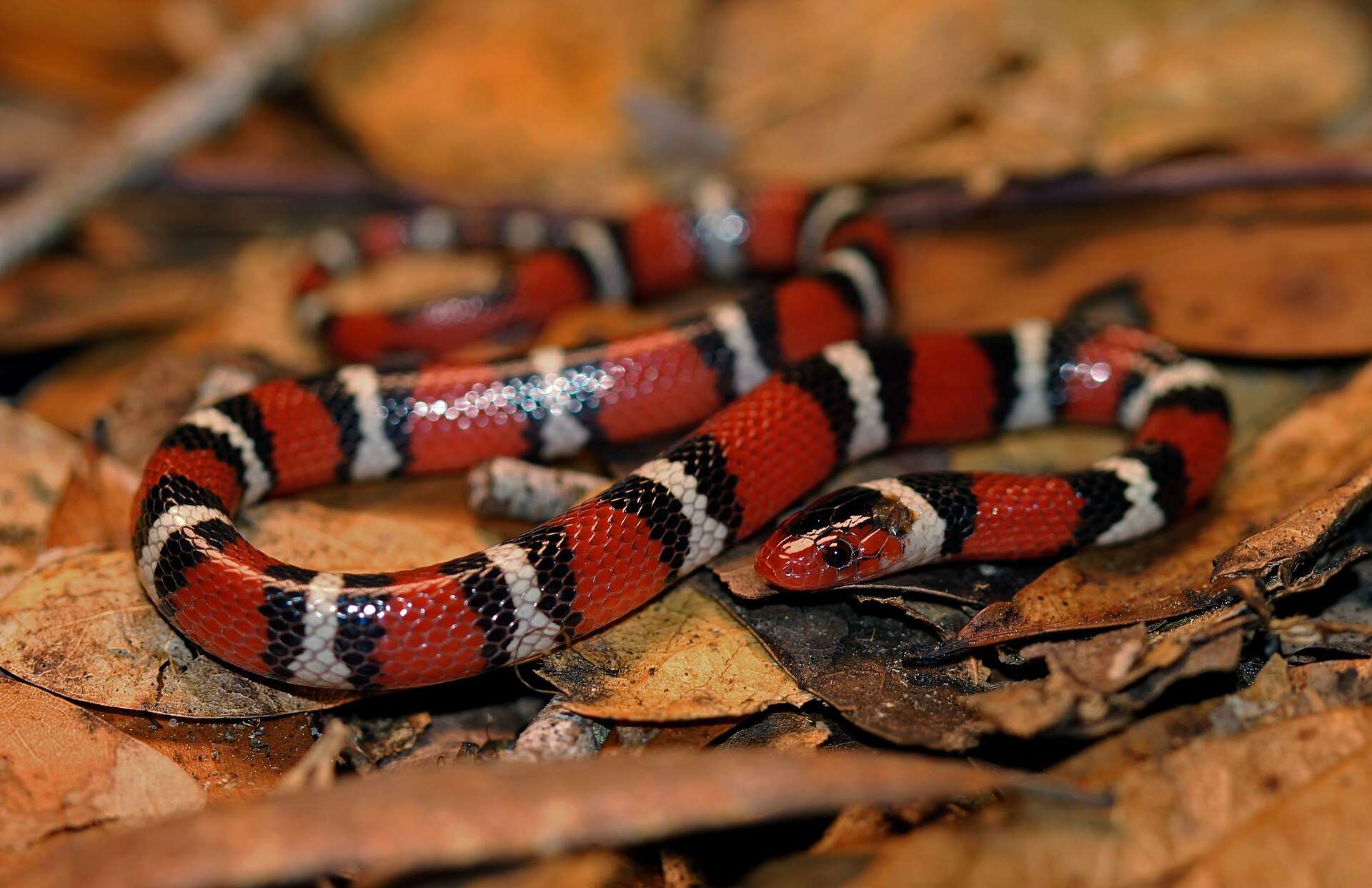
Scarlet kingsnake
Lampropeltis elapsoides
South-eastern United States
Non-venomousSide by side
| Eastern coral snakeMicrurus fulvius | Scarlet kingsnakeLampropeltis elapsoides | |
|---|---|---|
| Danger | Medically significant | Non-venomous |
| Length | 0.65–1.21 m (typical, largest) | 0.45–0.74 m (typical, largest) |
| Colours | Red, Black, Yellow | Red, Black, Yellow, White |
| Pattern | Bands or rings | Bands or rings |
| Spreads a hood | No | No |
| Active | By day | At night |
| Found in | South-eastern United States | South-eastern United States |
| Habitat | Pine flatwoods, Sandhills and scrub, Hardwood hammocks | Pine woodland, Moist hammocks, Rotting stumps and logs |
| Venom | Neurotoxic | None |
Look closely
Spot the difference
Same colours, different order
Both snakes are ringed in red, black and yellow, and both live in the pine woods and hammocks of the south-eastern United States1,2. The eastern coral snake has broad red and black rings separated by narrow yellow rings, so the red rings touch yellow, and the red rings usually carry black flecks1. On the scarlet kingsnake the red and yellow rings are always separated by black, so red never touches yellow; in young kingsnakes the yellow rings may be white2. That is what the rhyme “red touches yellow, kills a fellow; red touches black, venom lack” records1,5.
The rhyme fits these two snakes in Florida most of the time, but unusual colour variants occasionally break it1,2. It also works only in the United States: coral snakes in Mexico, Central America and South America may have red rings touching white or even black, so outside the US it must not be relied on at all5.
The snout
The second tell is the head. The coral snake has a rounded, blunt black snout followed by a broad yellow band behind the eyes1. The scarlet kingsnake, like the other harmless look-alikes, has a red snout1,2. Both have small heads barely wider than the neck and round pupils, so head shape and eye shape do not help1,2.
Rings around the belly
On the coral snake the rings run right round the body, including the belly, and the tail is banded only in black and yellow1. In Florida the scarlet kingsnake’s rings also encircle the body completely, but in Virginia many scarlet kingsnakes have rings that do not meet on the belly2,4. The third ringed snake of the region, the harmless scarlet snake, has a more pointed red snout and rings that stop at the sides, leaving a plain cream belly1,2.
Size and habits
The coral snake is the larger of the two: most adults are 51–76 cm long and the longest recorded was 120.7 cm1. Most scarlet kingsnakes are 36–51 cm, with a record of about 74 cm, and hatchlings are only 13–18 cm2,3. The kingsnake is a secretive, mostly nocturnal snake that hides under loose bark and in rotting logs and stumps, hunting skinks and small snakes2,3. The coral snake is active by day, also spends most of its time under cover, and when disturbed it typically flees; if grabbed it bites readily and may chew, although chewing is not needed for it to inject venom1. In a study of 39 people bitten by eastern coral snakes, most were bitten while handling the snake, and the commonest cause was mistaking it for a scarlet kingsnake6.
Why they look alike: Batesian mimicry
The scarlet kingsnake is a textbook Batesian mimic: a harmless species that copies a dangerous one so that predators which have learned to avoid the model avoid it too. Pfennig, Harcombe and Pfennig tested this in 2001 by setting out 1,200 life-size plasticine replicas of coral snakes and scarlet kingsnakes, inside the coral snake’s range in the Carolinas and beyond it in central North Carolina, where coral snakes do not live7. The replicas kept the marks of bites and scratches, and predators attacked the ringed models far more often where there were no coral snakes to teach them caution, which is just what Bates’s theory predicts7.
Later work showed that the resemblance is tuned by how common the model is. At the edge of the coral snake’s range, where coral snakes are rare, scarlet kingsnakes match them most precisely, because predators there can afford to attack any imperfect copy; deep inside the range, where coral snakes are common, even rough imitations are left alone8. In the Sandhills of North Carolina, where coral snakes disappeared around 1960, the kingsnakes went on evolving to look even more like them over the next 50 years, as the predators that still remembered coral snakes kept picking off the poorer mimics9.
If you are bitten or not sure
If a ringed snake bites someone and you cannot be certain it was a kingsnake, treat the bite as a coral snake bite1,10. Coral snake bites may be painless with little swelling, and the effects can be delayed for hours before they progress: tingling, slurred speech, drooping eyelids, weakness and, at worst, paralysis of the breathing muscles10. Keep the person calm and still, remove rings and tight clothing near the bite, and get to hospital at once; every suspected bite is observed for at least 24 hours10. Do not use a tourniquet, ice, cutting or suction10,12, and do not try to catch or kill the snake10. In the United States, Poison Help on 1-800-222-1222 gives free expert advice around the clock10, and the United States first-aid page has the full steps11. These differences are not a safe basis for handling any snake; almost all coral snake bites happen when people deliberately handle them1. Keep your distance from every snake you cannot identify.
Questions people ask
- How do you tell a coral snake from a kingsnake?
- On an eastern coral snake the red rings touch yellow rings and the snout is black, with a yellow band behind the eyes. On a scarlet kingsnake the red rings touch only black and the snout is red. The rhyme 'red touches yellow, kills a fellow' sums it up, but only in the United States.
- Is the scarlet kingsnake venomous?
- No. It is a small, harmless constrictor of the south-eastern United States that eats skinks and small snakes. It may bite if grabbed, but it has no venom.
- Why does the kingsnake look like a coral snake?
- It is a Batesian mimic. Predators that have learned to avoid the venomous coral snake also avoid snakes that look like it. Experiments with 1,200 plasticine snake models showed that ringed replicas were attacked far more often outside the coral snake's range than inside it.
- Does the coral snake rhyme work everywhere?
- No. It only works for coral snakes in the United States. In Mexico, Central America and South America some coral snakes have red rings touching white or even black, and even in Florida unusual colour variants occasionally break the rule.
- What should you do if bitten by a snake that might be a coral snake?
- Keep still, remove rings and tight items, do not cut, suck, ice or tie off the bite, and go to hospital at once. Coral snake symptoms can be delayed for hours, so suspected bites are observed for at least 24 hours.
References
- 1
Florida Museum of Natural History. Harlequin Coralsnake (Micrurus fulvius). Florida Snake ID Guide. University of Florida. floridamuseum.ufl.edu
- 2
Florida Museum of Natural History. Scarlet Kingsnake (Lampropeltis elapsoides). Florida Snake ID Guide. University of Florida. floridamuseum.ufl.edu
- 3
Savannah River Ecology Laboratory, University of Georgia. Scarlet Kingsnake (Lampropeltis elapsoides). Herpetology at SREL. srelherp.uga.edu
- 4
Virginia Herpetological Society. Scarlet Kingsnake (Lampropeltis elapsoides). virginiaherpetologicalsociety.com
- 5
Frank, M. (2019). Identifying Venomous and Nonvenomous Snakes in Texas. Texas A&M AgriLife Extension, publication WFSC-023. texnat.tamu.edu
- 6
Kitchens, C.S. & Van Mierop, L.H. (1987). Envenomation by the Eastern coral snake (Micrurus fulvius fulvius). A study of 39 victims. JAMA 258(12): 1615–1618. doi.org
- 7
Pfennig, D.W., Harcombe, W.R. & Pfennig, K.S. (2001). Frequency-dependent Batesian mimicry. Nature 410: 323. doi.org
- 8
Harper, G.R. & Pfennig, D.W. (2007). Mimicry on the edge: why do mimics vary in resemblance to their model in different parts of their geographical range? Proceedings of the Royal Society B 274: 1955–1961. doi.org
- 9
Akcali, C.K. & Pfennig, D.W. (2014). Rapid evolution of mimicry following local model extinction. Biology Letters 10(6): 20140304. doi.org
- 10
Poison Control, National Capital Poison Center. Are coral snakes poisonous? (Coral snake bite treatment.) poison.org
- 11
Johnson, S.A. & Main, M.B. Recognizing Florida's Venomous Snakes. UF/IFAS Extension publication WEC 202/UW229. University of Florida. ask.ifas.ufl.edu
- 12
World Health Organization. Snakebite envenoming: treatment (Box 1, first aid for snakebites). Control of Neglected Tropical Diseases. who.int