
Texas coral snake
Micrurus tener (Baird & Girard, 1853)
Also called Texas coralsnake, Coralillo texano
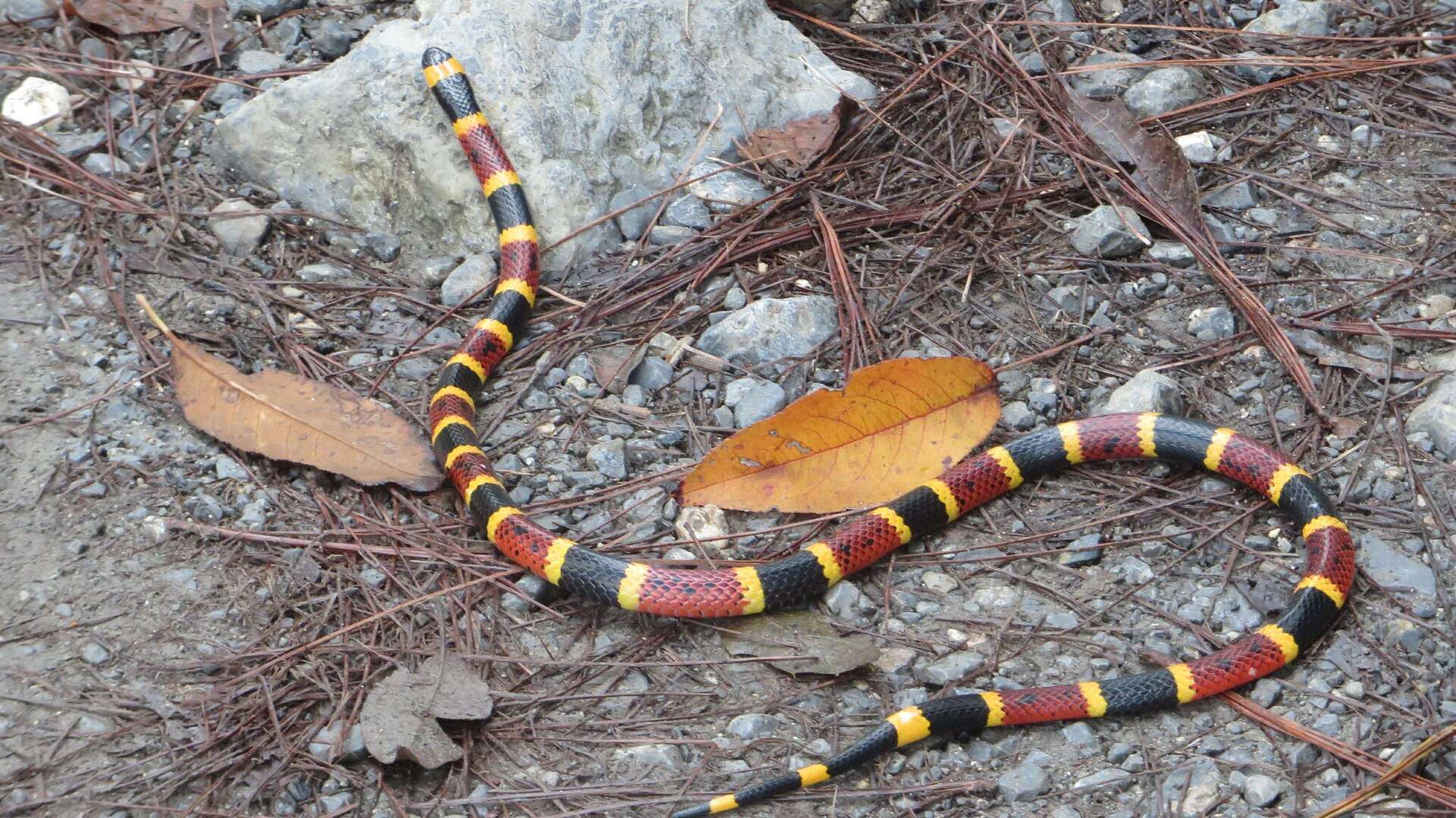
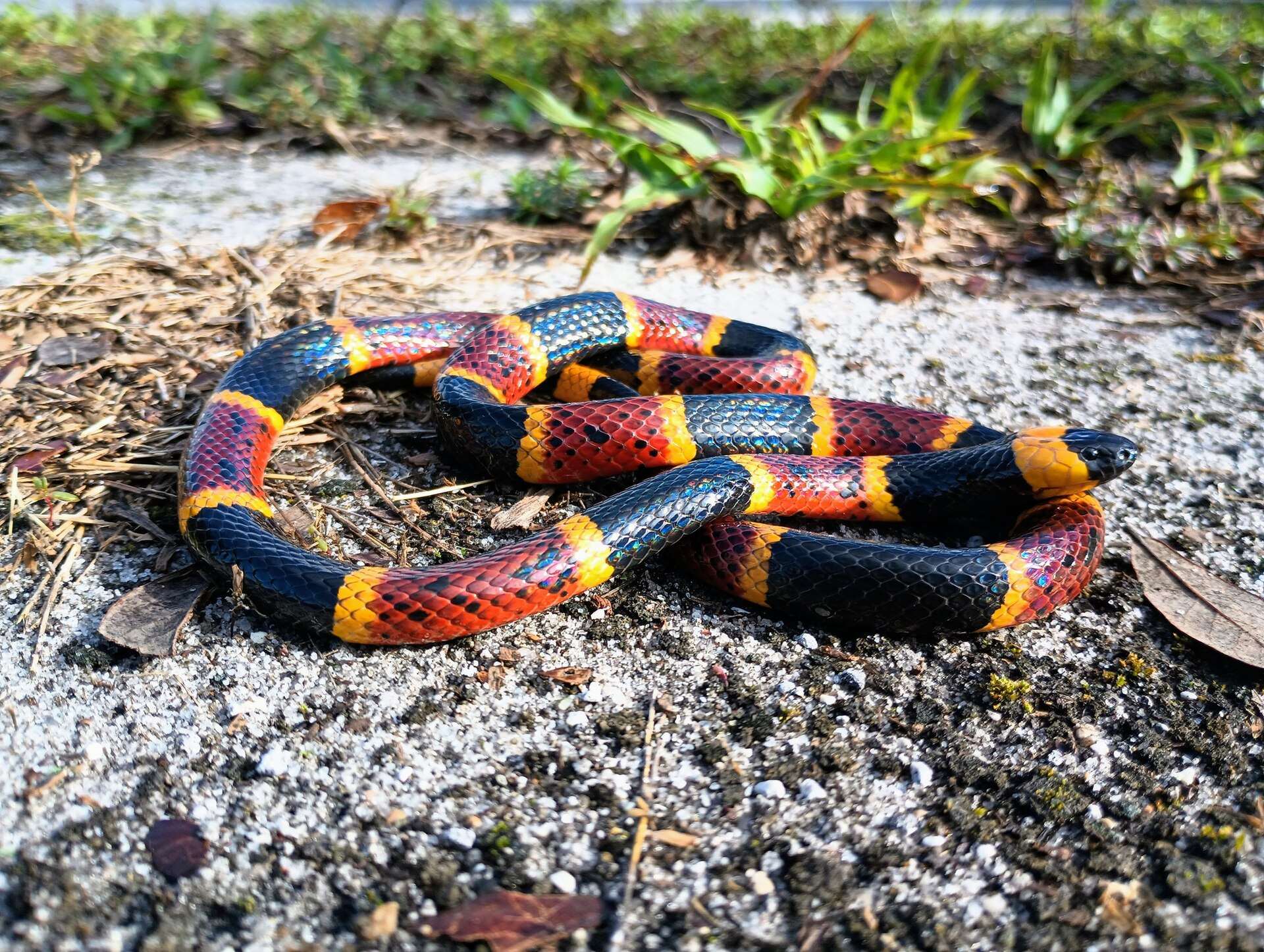
A slender, shy snake ringed in red, yellow and black, with the red rings touching the narrow yellow ones and a black snout. It lives in woods and brush from Louisiana and Texas south into Mexico.

Is it dangerous?
Yes. Its venom acts on the nerves and can, rarely, cause paralysis, though most bites cause pain and tingling. Get hospital care immediately if bitten.
Do not approach. If someone is bitten, go to a hospital now.
At a glance
- Length
- 0.6–1.22 m
- Active
- Dawn and dusk
- Found in
- South-central USA and Mexico
- Venom
- Neurotoxic
- Young
- Lays eggs
- Habitat
- Moist woodland, Leaf litter, Rocky areas
- Diet
- Small snakes, Lizards, Frogs
- Lifespan
- Up to 7 years in captivity
Length shows a typical adult, then the largest recorded.
IUCN Red List status: Least Concern
Country guideSnakes of MexicoSnakes of the United States
True size
Painted coral snakeMedically significant
0.74 m at most
About half the height of a 1.7 m adult.
Usual range 0.52–0.74 m, the bar on the ruler.
Eastern coral snakeMedically significant
1.21 m at most
About three quarters of the height of a 1.7 m adult.
Usual range 0.65–1.21 m, the bar on the ruler.
Texas coral snakeMedically significant
1.22 m at most
About three quarters of the height of a 1.7 m adult.
Usual range 0.6–1.22 m, the bar on the ruler.
Common garter snakeNon-venomous
1.37 m at most
About three quarters of the height of a 1.7 m adult.
Usual range 0.56–1.37 m, the bar on the ruler.
California kingsnakeNon-venomous
2 m at most
About 1 times the height of a 1.7 m adult.
Usual range 0.9–2.0 m, the bar on the ruler.
Banded kraitMedically significant
2.25 m at most
About 1.5 times the height of a 1.7 m adult.
Usual range 1.35–2.25 m, the bar on the ruler.
Western diamondback rattlesnakeMedically significant
2.29 m at most
About 1.5 times the height of a 1.7 m adult.
Usual range 1.2–2.29 m, the bar on the ruler.
Black mambaMedically significant
4.5 m at most
About 2.5 times the height of a 1.7 m adult.
Usual range 2.5–4.5 m, the bar on the ruler.
Each snake is drawn at the longest length in its profile, on the same scale as the adult. Length is to scale; thickness is not.
Identification
The Texas coral snake is a slender snake ringed along its whole length with black, yellow and red bands2. The red bands often carry black specks and always touch the narrow yellow bands, while the head and tail have only black and yellow bands and the snout is black2. Unlike the region’s pit vipers, it has a rounded head, round pupils and no heat-sensing pit2. Colour is not completely reliable, because albino, all-black and red-less individuals have been found in the wild2.
The average adult is about 51–76 cm long, and the largest recorded measured about 122 cm; females are usually larger than males2.
Distribution
The Texas coral snake lives west of the Mississippi River in south-western Arkansas, Louisiana and Texas, and south into Mexico1,2. In Texas it is found mainly in the eastern third of the state, from the Red River south and west through the Hill Country to the edge of the Trans-Pecos2. In Mexico it ranges from Coahuila, Nuevo León and Tamaulipas south through San Luis Potosí, Guanajuato, Querétaro and Hidalgo to Puebla and northern Veracruz1.
It was once treated as part of the same species as the eastern coral snake2. Records from Colima and Morelos in western Mexico are now thought to belong to a different species, Micrurus browni1.
Habitat
This coral snake does not seem to need a particular habitat, but it prefers moist, wooded areas and places with high humidity2. It is usually found where there is plenty of ground cover, such as leaf litter, rocks and fallen logs2. In the southern United States, coral snakes are found in wooded, sandy or marshy areas3.
Behaviour
The Texas coral snake is mainly active at night, early morning and evening, and spends the day hidden under debris or in shallow burrows2. Within its range it is fairly common, but it is shy and secretive and seldom seen2.
It is not aggressive, and most will simply crawl away if disturbed2. When provoked, it often tucks its head under its body and raises its tail as if the tail were about to strike2.
Diet
The Texas coral snake feeds mainly on other small snakes2. It also eats lizards, including skinks, and occasionally frogs when they are available2. It often bites prey several times and may hold on to it for a long time2.
Reproduction
Unlike many other venomous snakes, the Texas coral snake lays eggs rather than giving birth to live young2. Breeding can take place from summer through to the following spring, and females lay 3–9 small eggs in summer2.
The eggs hatch after about 60 days, and the hatchlings are 15–23 cm long and fully venomous2. Captive Texas coral snakes have lived up to seven years2.
Venom and medical significance
The Texas coral snake has neurotoxic venom, which can cause paralysis and breathing failure in severe cases2. The World Health Organization lists it in Category 2, of secondary medical importance, in the United States and Mexico4. Its fangs are small, fixed and at the front of the mouth, and symptoms can be delayed for many hours2.
Most bites are mild: of 501 confirmed bites reported to Texas poison centres from 2000 to 2023, 94% caused only pain and tingling or numbness, and 3.6% caused whole-body signs such as weakness, trouble swallowing or drooping eyelids5. In an earlier Texas series of 82 patients, no one died or needed a breathing machine6, and antivenom is now given to a minority of patients5,7. Anyone bitten should go to hospital immediately.
Conservation
The Texas coral snake is listed as Least Concern on the IUCN Red List, based on an assessment published in 20078. It is fairly common within its range2. Many are killed by people and by traffic2.
Similar species
In the United States, coral snakes are sometimes confused with harmless kingsnakes, which have similar coloured bands3. Among the similarly coloured snakes of Texas, only the coral snake has red bands touching yellow bands, but this rule is not foolproof because colour varies2. In Mexico, several harmless snakes, including milk snakes, mimic its colours1.
The eastern coral snake (Micrurus fulvius) looks almost the same, but it lives in the south-eastern United States, from the Carolinas to Florida2.
These differences are not a safe basis for handling any snake. Keep your distance from every snake you cannot identify.
In captivity
The Texas coral snake is a venomous snake and is not suitable as a pet. Bites usually happen only when people handle the snake or try to kill it2. It can bite any exposed skin, so it should never be picked up2.
Look-alikes
Don’t confuse it with…
These snakes are often mistaken for each other. Use the differences to learn, never as a reason to handle a snake.
References
- 1
Uetz, P. et al. (eds.) (2026). Micrurus tener (Baird & Girard, 1853). The Reptile Database. reptile-database.reptarium.cz
- 2
Lambert, B.C. (2017). Wildlife profile: Texas coral snake (Micrurus tener). Post Oak Savannah Wildlifer 9(1): 2–3. Texas Parks and Wildlife Department. tpwd.texas.gov
- 3
Centers for Disease Control and Prevention, National Institute for Occupational Safety and Health (NIOSH). Venomous snakes (Outdoor workers). cdc.gov
- 4
World Health Organization (2017). Guidelines for the production, control and regulation of snake antivenom immunoglobulins. WHO Technical Report Series No. 1004, Annex 5, Appendix 1: Worldwide distribution of medically important venomous snakes. cdn.who.int
- 5
Greene, S., Anderson, A., Wilcken, M., Jehle, D. & Varney, S. (2025). Regional differences in systemic toxicity following Texas coral snake (Micrurus tener) envenomations. Wilderness & Environmental Medicine 36(3): 328–334. doi.org
- 6
Morgan, D.L., Borys, D.J., Stanford, R., Kjar, D. & Tobleman, W. (2007). Texas coral snake (Micrurus tener) bites. Southern Medical Journal 100(2): 152–156. doi.org
- 7
Greene, S., Ruha, A.M., Campleman, S., Brent, J. & Wax, P. (2021). Epidemiology, clinical features, and management of Texas coral snake (Micrurus tener) envenomations reported to the North American Snakebite Registry. Journal of Medical Toxicology 17(1): 51–56. pmc.ncbi.nlm.nih.gov
- 8
Hammerson, G.A., Lavin, P. & Mendoza Quijano, F. (2007). Micrurus tener. The IUCN Red List of Threatened Species 2007: e.T64033A12738512. iucnredlist.org
Play
Play as the texas coral snake.
Its real pattern is a skin in Snake. Every run ends with a fact.