
Care guide
California kingsnake care
California kingsnakes are hardy, active snakes that can live for more than 20 years. They must live alone, because they eat other snakes, and need space, a warm-to-cool gradient and thawed prey.
Every fact is sourced · draft, pending review by a reptile vet
At a glance
- Adult size
- Usually 76–122 cm; the largest reach about 2 m4
- Enclosure for an adult
- At least as long as the snake, and a third of its length wide and high1
- Warm side
- Basking zone 26–30 °C1
- Cool side
- 21–24 °C1
- Humidity
- 40–55%1
- Feeding an adult
- One thawed adult mouse every 7–14 days1
- Lifespan in captivity
- Can be more than 20 years1
Before you get one
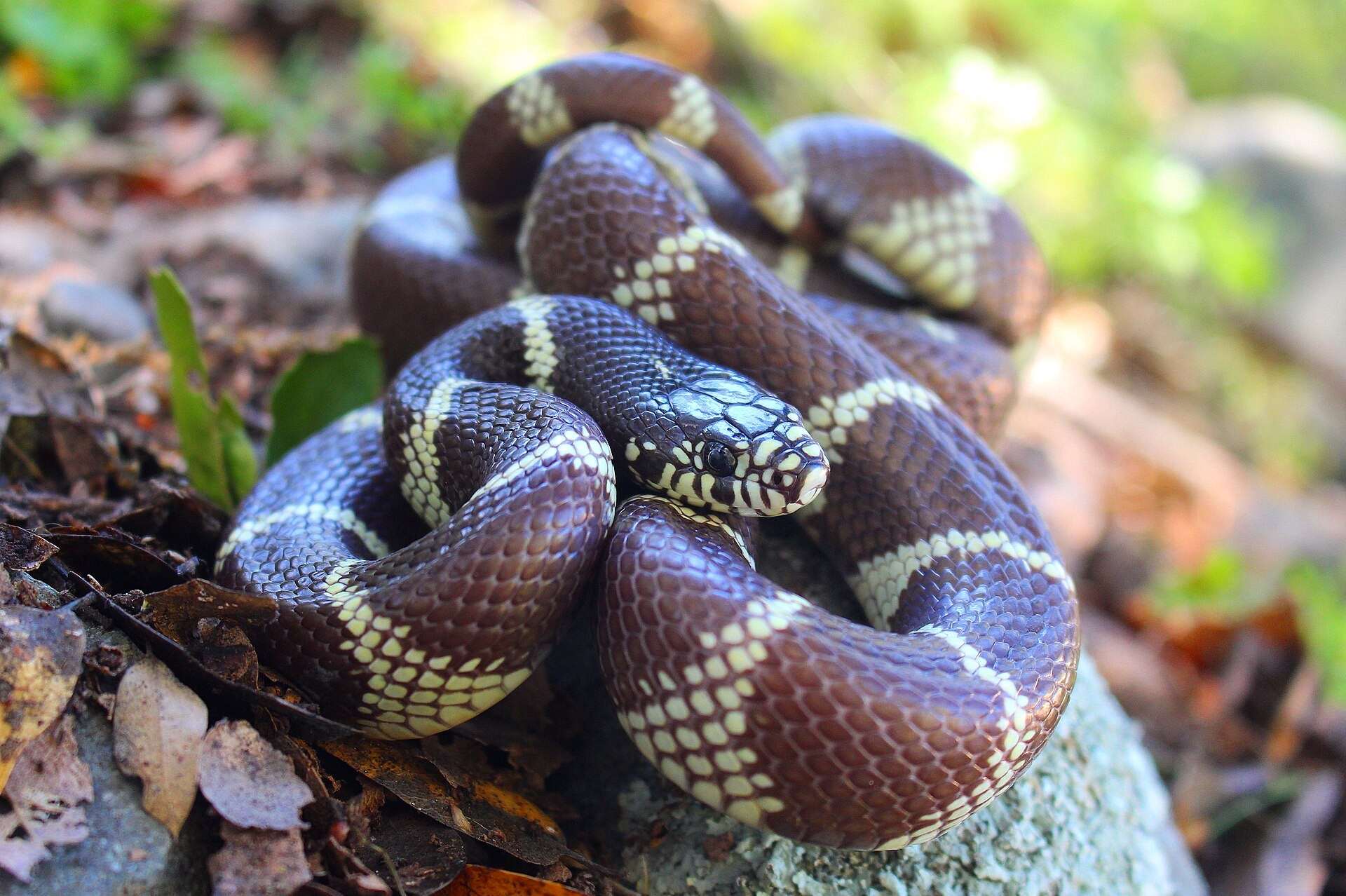
California kingsnakes are glossy, smooth-scaled constrictors from the south-western United States and north-western Mexico, usually banded or striped in black and white or brown and cream4,3. Adults are usually 76–122 cm long, and the largest reach about 2 m4. The RSPCA says they can live for more than 20 years in captivity, while a veterinary manual gives 10–15 years as the average for kingsnakes1,5. Kingsnakes sold as pets in the UK are captive-bred, and captive-bred reptiles are less likely than wild-caught ones to bite or carry parasites1,5. Never release one: California kingsnakes have established an introduced population on Gran Canaria in the Canary Islands4,2. Check local laws on snake keeping before you buy5.
Enclosure
The RSPCA asks for a vivarium the snake can fully stretch out in, at least as long as the snake and a third of its length wide and high, which means at least 100 × 33 × 33 cm for a 1 m snake1. Sources differ here: one veterinary hospital says adults can be kept in a 20–30-gallon (about 75–115-litre) tank, though larger is better, and the MSD Veterinary Manual asks for at least 0.6 m² of floor per metre of snake2,6. Welfare research points towards more room: corn snakes, a related species, were more active and stretched out in enclosures longer than their bodies, and a review concludes that snakes in general need space to extend fully7,8. Kingsnakes eat other snakes, including other kingsnakes, so always keep one per enclosure1,3. Make the vivarium escape-proof, and give hides at both ends, low branches to climb and a soil-based substrate to burrow in1,2.
Heat and light
The RSPCA recommends a basking zone of 26–30 °C and a cool end of 21–24 °C, with the heat off at night so the vivarium can fall to about 18 °C1. One veterinary hospital gives a warmer range, with a background of 27–29 °C, a basking site of 29–31 °C that should never go above 32 °C because kingsnakes suffer easily from heat stress, and nights down to about 24 °C2. Control every heater with a thermostat, guard heat lamps, check both ends with a thermometer daily, keep under-tank heaters to no more than 30% of the floor and never use hot rocks1,9. Kingsnakes are mainly active by day but may become more active at dusk or at night in hot weather1. The RSPCA recommends low-level UVB giving about UVI 0.7 in the basking zone and none in the shade, on 12 hours a day, and advises asking a vet about lighting for albino morphs1.
Humidity and water
The RSPCA recommends 40–55% humidity with a light misting each day, and one veterinary hospital gives 35–60%, using the higher end during a shed1,2. If humidity stays too high, add ventilation, because respiratory infections in kingsnakes are usually caused by high humidity and poor ventilation1. A hide with damp moss gives the snake a humid retreat1. Provide a water bowl big enough for the snake to submerge in, and change it at least daily1.
Feeding
Feed dead mice or small rats: hatchlings start on one pinky mouse every 5–6 days and move up to one adult mouse every 7–14 days, with prey slightly wider than the widest part of the snake’s body1. One veterinary hospital suggests every 10–14 days for adults2. Thaw frozen prey fully, bring it to room temperature and offer it with tongs; a chick about once a month adds variety1. Live prey can badly injure or even kill a snake, so offer only dead prey2,10. Weigh the snake regularly to catch weight loss or obesity, and expect some kingsnakes to eat less in autumn1,2.
Handling
Kingsnakes can get used to handling, but they do not like being held for long1. A stressed kingsnake may struggle, bite or release a foul-smelling musk, and may vibrate its tail like a rattlesnake1,2. Scoop it up, supporting the whole body, never grab it, and leave it alone if it pulls its neck into an S shape1. Keep sessions to about 10–15 minutes, wait 48 hours after a meal and avoid handling around a shed1. Wash the smell of prey off your hands first, because the snake may try to bite, and keep other pets away1.
Health and when to see a vet
Keep records of temperatures and feeding to show your vet, book a health check every year, and keep a new snake apart from others for 3–6 months1,11,6. See a reptile vet if you notice:
- a snake that suddenly stops feeding, which can mean a set-up problem, illness or the start of winter brumation1;
- abnormal droppings or weight loss, possible signs of internal parasites1;
- mites, seen as small black specks or as a snake sitting in its water for long periods1;
- signs of mouth rot or of a respiratory infection1;
- old skin left over the eyes after a shed, which a vet should remove1;
- burns, which usually come from unguarded bulbs or heaters10.
Questions people ask
- Can you keep two kingsnakes together?
- No. Kingsnakes eat other snakes, including other kingsnakes, and may attack or eat a cage mate, so each one needs its own enclosure.
- How big do California kingsnakes get?
- Adults are usually 76–122 cm (2.5–4 ft) long, and the largest reach about 2 m.
- How long do California kingsnakes live?
- They can live for more than 20 years in captivity with good care, although one veterinary manual gives 10–15 years as the average for kingsnakes.
- How often should I feed a kingsnake?
- Adults need one suitably sized thawed mouse every 7–14 days. Hatchlings start on one pinky mouse every 5–6 days.
References
- 1
RSPCA. Kingsnake (care sheet). Royal Society for the Prevention of Cruelty to Animals, accessed 2026. rspca.org.uk
- 2
Chicago Exotics Animal Hospital. California kingsnake care (veterinary care sheet), accessed 2026. exoticpetvet.com
- 3
Wynns, S. (2018). The king of snakes. Cabrillo National Monument, U.S. National Park Service. nps.gov
- 4
Uetz, P. et al. (eds.) (2026). Lampropeltis californiae (Blainville, 1835). The Reptile Database. reptile-database.reptarium.cz
- 5
Divers, S.J. (2020, updated 2026). Selecting a reptile. MSD Veterinary Manual, pet owner version. msdvetmanual.com
- 6
Divers, S.J. & Comolli, J.R. (2025). Management and husbandry of reptiles. MSD Veterinary Manual, professional version. msdvetmanual.com
- 7
Hoehfurtner, T., Wilkinson, A., Walker, M. & Burman, O. (2021). Does enclosure size influence the behaviour & welfare of captive snakes (Pantherophis guttatus)? Applied Animal Behaviour Science 243: 105435. doi.org
- 8
Warwick, C., Arena, P. & Steedman, C. (2019). Spatial considerations for captive snakes. Journal of Veterinary Behavior 30: 37–48. doi.org
- 9
Divers, S.J. (2020, updated 2026). Providing a home for a reptile. MSD Veterinary Manual, pet owner version. msdvetmanual.com
- 10
Divers, S.J. & Comolli, J.R. (2025). Environmental diseases and traumatic injuries of reptiles. MSD Veterinary Manual, professional version. msdvetmanual.com
- 11
Divers, S.J. (2020, updated 2024). Routine health care of reptiles. MSD Veterinary Manual, pet owner version. msdvetmanual.com