
Care guide
Western hognose snake care
Western hognose snakes are small, stout diggers from the North American plains that can live for up to about 20 years. They need floor space and deep substrate, a warm basking spot, low humidity and careful feeding.
Every fact is sourced · draft, pending review by a reptile vet
At a glance
Before you get one
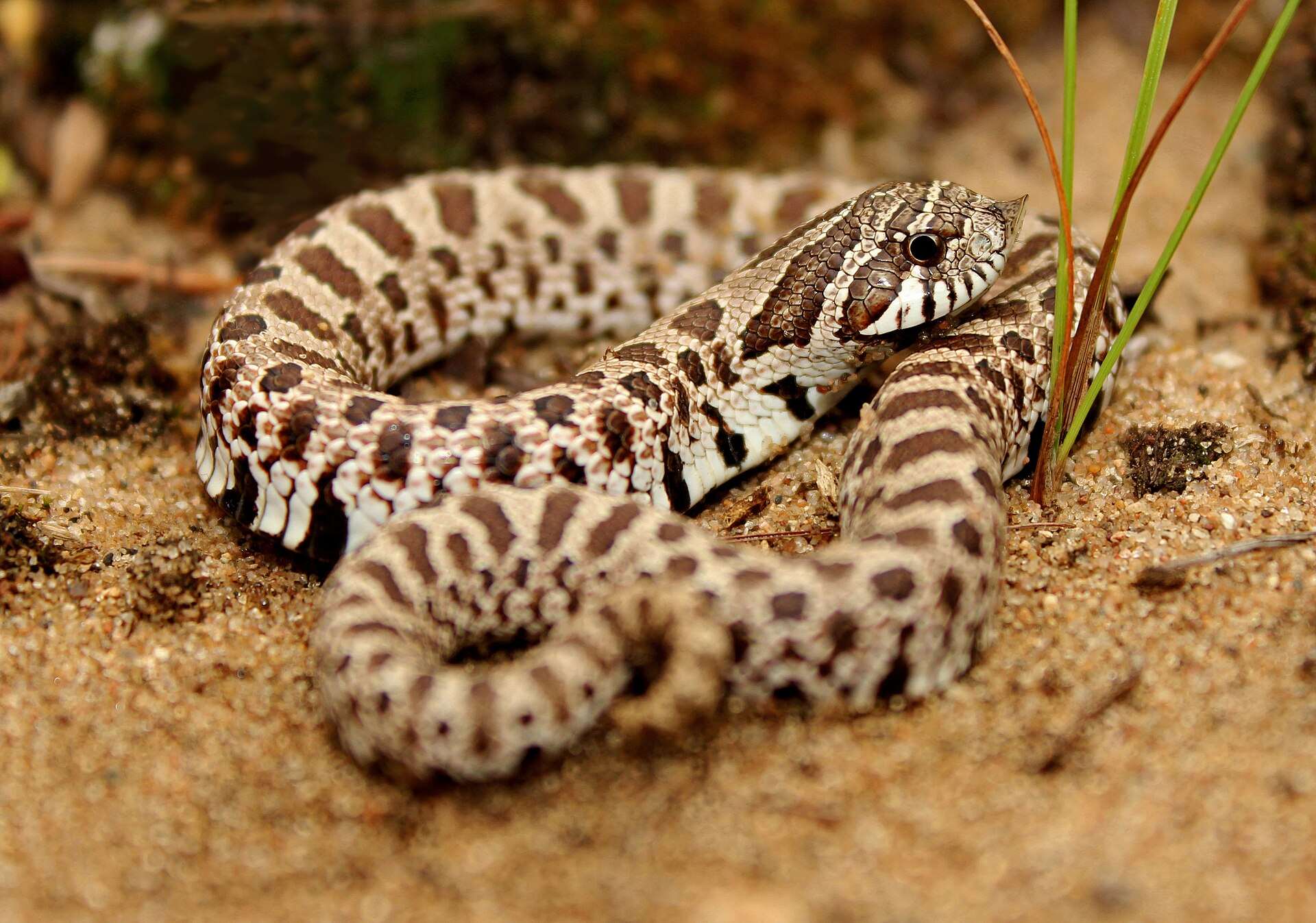
The western hognose is a small, stout snake of the North American plains, from southern Canada to Texas, with an upturned snout it uses to dig for toads13,4. Adults usually measure 38–64 cm and the largest recorded was about 1 m; females grow larger than males, and hognoses can live for up to about 20 years in captivity14,1. Young hognoses can be slow to accept rodents, so one veterinary hospital advises buying a snake that has already eaten 3–4 meals2. Buy a captive-bred snake: captive-bred reptiles carry fewer parasites, and wild hognoses are protected in some places, such as Illinois, where the species is listed as threatened8,3. Hognoses have enlarged rear teeth and saliva that is toxic to their prey, and a few bites to people have caused marked swelling3,5. Check local laws on snake keeping before you buy8.
Enclosure
Hognoses live on the ground and are poor climbers, so floor space matters more than height2. Sources differ on the minimum: the Royal Veterinary College recommends at least 91 × 46 × 46 cm so the snake can stretch, while one veterinary hospital gives a 20-gallon (about 75-litre) tank for an adult1,2. Both say the larger the better, and the UK government’s Animal Welfare Committee stresses that furnishings are not a substitute for space1,2,10. Hognoses love to dig, so give loose substrate at least 5–10 cm deep, with a hide at the warm end and another at the cool end2. Clip the lid shut, because they can push up a mesh lid with their snout2.
Heat and light
Hognoses are active by day1. The Royal Veterinary College recommends a basking spot of about 30–32 °C from a light that is on all day and off at night, with background heat so the vivarium stays above about 20–25 °C overnight1. One veterinary hospital gives a gradient of about 21–29 °C with a hotter basking area of 32–35 °C, heating about a third of the enclosure2. Control all heaters with a thermostat, guard them to prevent burns, check temperatures with a maximum–minimum thermometer and never use hot rocks1,2. Both sources recommend a low-output UVB lamp on for 12 hours a day1,2.
Humidity and water
Keep humidity low: the Royal Veterinary College gives 40–50% for western hognoses, with the water bowl at the cool end, and 50–60% for the eastern and southern species1. One veterinary hospital notes that respiratory infections in western hognoses are often linked to the wrong humidity2. When a snake’s eyes turn cloudy before a shed, raise the humidity a little, for example with a hide containing damp moss12. Provide a water bowl big enough for the snake to submerge in, and change it daily1.
Feeding
In the wild, western hognoses eat mainly toads and other amphibians, along with reptiles and their eggs, birds and small mammals3. In captivity they are fed mice, thawed and warmed to about 37 °C, starting on pinkies and moving up to large mice1. Most adults are fed about once a week, and the Royal Veterinary College suggests that one mouse a week is enough for a 500 g snake2,1. Hognoses are messy eaters that often swallow substrate with their food, so feed them in a separate tub to avoid a blockage2. Between November and February many slow down for winter; keep offering food at the usual times and weigh the snake weekly2. Live prey can injure a snake, so offer only dead prey2,11.
Handling
When threatened, a western hognose flattens its head and neck, hisses loudly and strikes, usually with its mouth closed, then may roll onto its back and play dead4,3. A pet that plays dead is stressed, so look for the cause2. Defensive bites are rare, and most bites happen when a snake mistakes a hand for food: in a survey of Polish hognose breeders, 47.7% said a snake had tried to bite them and 31.4% fed their snakes by hand4,2,6. Serious bites are uncommon, but some have caused marked swelling, bruising and blistering, one taking about five months to heal, and one patient also developed a low blood platelet count5,7. Weinstein and Keyler conclude that hognoses should not be considered dangerous but should be handled carefully at feeding time, and the authors of the platelet case advise that bites be assessed by a toxicologist familiar with these snakes5,7. Use tongs, and wash the smell of prey off your hands before handling6,2.
Health and when to see a vet
Book a health check soon after you get a hognose and then once a year, and keep a new snake apart from others for 3–6 months12,1,9. See a reptile vet if you notice:
- wheezing, open-mouth breathing, frequent yawning or bubbles at the nose2;
- a swollen face or scabs along the lips, as hognoses have fragile teeth and gums prone to infection2;
- trouble passing droppings after swallowing substrate, as a blockage can need surgery2;
- poor appetite together with other signs of illness, or weight loss over winter2;
- stuck shed or eye caps, which should never be forced off11;
- burns, which usually come from unguarded bulbs or heaters11.
Questions people ask
- Do hognose snakes bite?
- Rarely in defence: they usually hiss, spread the neck, strike with the mouth closed and play dead. Most bites happen when a snake mistakes a hand for food, and a few have caused marked swelling.
- Are hognose snakes venomous?
- They have enlarged rear teeth and saliva that is toxic to their prey. Some bites to people have caused swelling and blistering, but hognose snakes are not considered dangerous.
- How big do western hognose snakes get?
- Adults usually measure 38–64 cm (15–25 in), and the largest recorded was about 1 m. Females grow larger than males.
- Why is my hognose snake playing dead?
- Rolling over and playing dead is a defence against predators. In a pet it is a sign of stress, so look for what is frightening it.
- What do hognose snakes eat?
- In the wild they mostly eat toads and other amphibians. Pet hognoses are fed thawed mice, about once a week for an adult.
References
- 1
RVC Exotics Service, Beaumont Sainsbury Animal Hospital (2024). Hognose snake care (factsheet, reviewed December 2024). Royal Veterinary College. rvc.ac.uk
- 2
Chicago Exotics Animal Hospital. Western hognose care (veterinary care sheet), accessed 2026. exoticpetvet.com
- 3
Illinois Natural History Survey. Plains hog-nosed snake (Heterodon nasicus). INHS Herpetology Collection, Prairie Research Institute, University of Illinois. herpetology.inhs.illinois.edu
- 4
Kerns, M. (2003). Heterodon nasicus. Animal Diversity Web, University of Michigan Museum of Zoology. animaldiversity.org
- 5
Weinstein, S.A. & Keyler, D.E. (2009). Local envenoming by the Western hognose snake (Heterodon nasicus): a case report and review of medically significant Heterodon bites. Toxicon 54(3): 354–360. doi.org
- 6
Zieliński, D. (2021). Questionnaire background on the hognose snake (Heterodon nasicus) breeders' awareness of the risk of being bitten. Animals 11(12): 3537. doi.org
- 7
Brandehoff, N. et al. (2019). First reported case of thrombocytopenia from a Heterodon nasicus envenomation. Toxicon 157: 12–17. doi.org
- 8
Divers, S.J. (2020, updated 2026). Selecting a reptile. MSD Veterinary Manual, pet owner version. msdvetmanual.com
- 9
Divers, S.J. & Comolli, J.R. (2025). Management and husbandry of reptiles. MSD Veterinary Manual, professional version. msdvetmanual.com
- 10
Animal Welfare Committee (2023). Opinion on the space requirements for snakes in vivaria within pet selling establishments. Defra, UK Government. assets.publishing.service.gov.uk
- 11
Divers, S.J. & Comolli, J.R. (2025). Environmental diseases and traumatic injuries of reptiles. MSD Veterinary Manual, professional version. msdvetmanual.com
- 12
Divers, S.J. (2020, updated 2024). Routine health care of reptiles. MSD Veterinary Manual, pet owner version. msdvetmanual.com
- 13
Uetz, P. et al. (eds.) (2026). Heterodon nasicus Baird & Girard, 1852. The Reptile Database. reptile-database.reptarium.cz
- 14
Center for North American Herpetology. Plains hog-nosed snake, Heterodon nasicus. Kansas Herpetofaunal Atlas. cnah.org