
Western diamondback rattlesnake
Crotalus atrox Baird & Girard, 1853
Also called Western diamond-backed rattlesnake
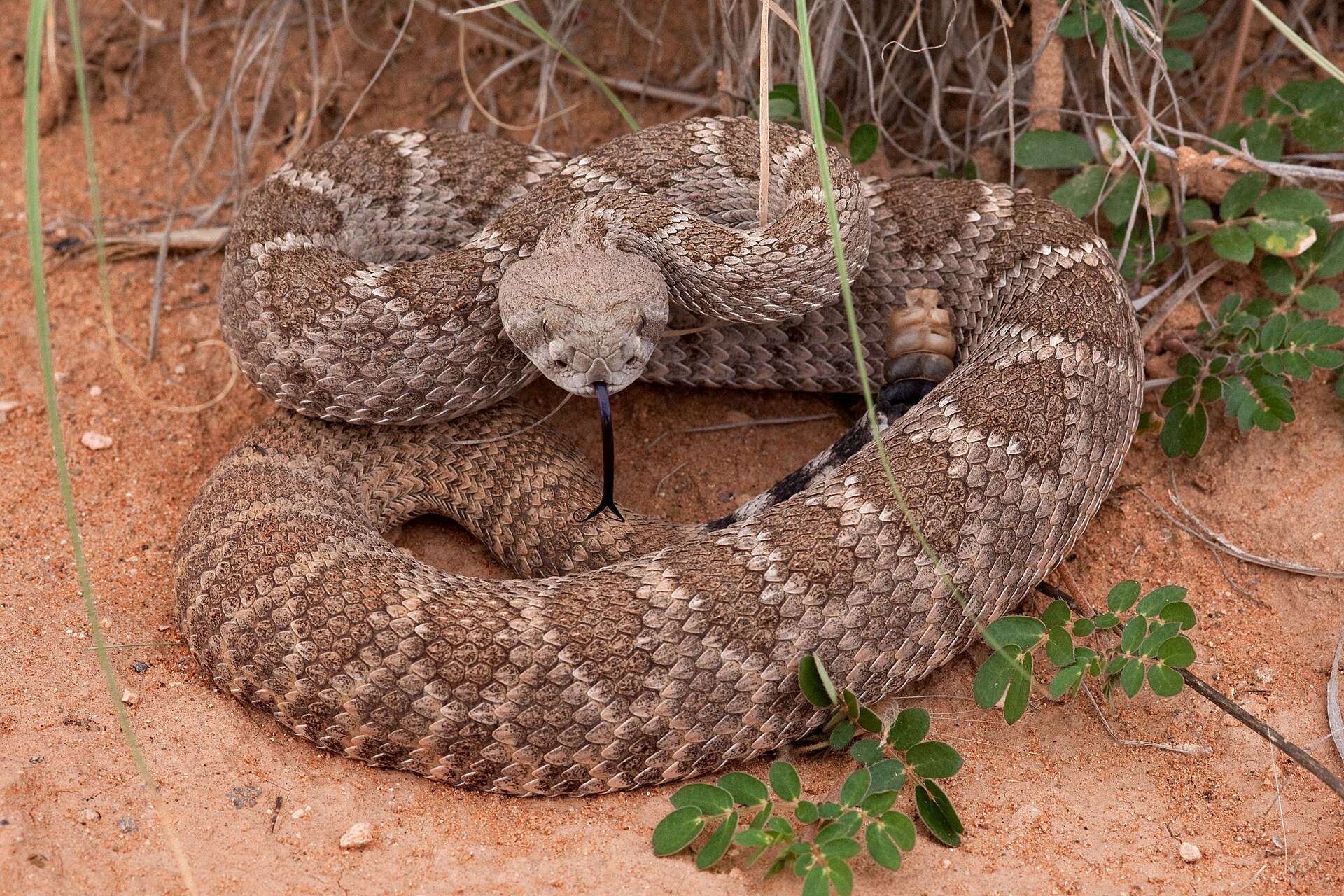
A large, heavy-bodied rattlesnake of the deserts and grasslands of the south-western United States and Mexico, with dark diamond-shaped blotches and a black-and-white banded tail ending in a rattle.

Is it dangerous?
Yes. Its bite causes severe pain and swelling and can disturb blood clotting. Keep your distance, and get hospital care immediately if bitten.
Do not approach. If someone is bitten, go to a hospital now.
At a glance
- Length
- 1.2–2.29 m
- Active
- Day and night
- Found in
- SW USA and Mexico
- Venom
- Haemotoxic and cytotoxic
- Young
- Live young
- Habitat
- Desert scrub, Grassland, Rocky hillsides
- Diet
- Rodents, Rabbits, Ground squirrels
- Lifespan
- Over 20 years in captivity
Length shows a typical adult, then the largest recorded.
IUCN Red List status: Least Concern
Country guideSnakes of MexicoSnakes of the United States
True size
Western hognose snakeMildly venomous
1 m at most
About two thirds of the height of a 1.7 m adult.
Usual range 0.5–1.0 m, the bar on the ruler.
Texas coral snakeMedically significant
1.22 m at most
About three quarters of the height of a 1.7 m adult.
Usual range 0.6–1.22 m, the bar on the ruler.
CopperheadMedically significant
1.35 m at most
About three quarters of the height of a 1.7 m adult.
Usual range 0.75–1.35 m, the bar on the ruler.
South American rattlesnakeMedically significant
1.47 m at most
About three quarters of the height of a 1.7 m adult.
Usual range 1.1–1.47 m, the bar on the ruler.
CottonmouthMedically significant
1.88 m at most
About as long as a 1.7 m adult is tall.
Usual range 0.9–1.88 m, the bar on the ruler.
Mexican west coast rattlesnakeMedically significant
2.05 m at most
About 1 times the height of a 1.7 m adult.
Usual range 1.5–2.05 m, the bar on the ruler.
Western diamondback rattlesnakeMedically significant
2.29 m at most
About 1.5 times the height of a 1.7 m adult.
Usual range 1.2–2.29 m, the bar on the ruler.
TerciopeloMedically significant
2.5 m at most
About 1.5 times the height of a 1.7 m adult.
Usual range 1.5–2.5 m, the bar on the ruler.
Each snake is drawn at the longest length in its profile, on the same scale as the adult. Length is to scale; thickness is not.
Identification
The western diamondback is a heavy-bodied pit viper with a broad, triangular head, a slender neck and keeled scales1. It is grey or tan, sometimes with a pinkish, rusty or orange tinge, and has a row of large brown diamond-shaped blotches along the back. The blotches have dark edges, are often outlined in cream and are peppered with dark specks1. The tail has bold black and white rings of roughly equal width and ends in a rattle, which gains a new segment each time the snake sheds its skin1.
Most snakes encountered are under about 1.2 m long, and adults are reported to reach 2.29 m2. In Arizona the largest recorded was 1.68 m, not counting the rattle1.
Distribution
This rattlesnake lives in the south-western United States, from south-eastern California, southern Nevada and Arizona east through New Mexico, Texas and Oklahoma to Arkansas3. In Mexico it ranges over much of the north and centre, including Sonora, Chihuahua, Coahuila, Nuevo León and Tamaulipas, with scattered records further south3.
In Arizona it is found from near sea level to about 1,600 m1. The Reptile Database lists the Tortuga Island rattlesnake of the Gulf of California under this species, although a 2019 genetic study supported treating it as a separate species3.
Habitat
The western diamondback uses many kinds of dry country, including Sonoran, Chihuahuan and Mohave desert scrub, semi-desert grassland and the lower edges of chaparral and evergreen woodland1. It seems to be most common on bajadas (gravel slopes at the foot of mountains), hillsides and other slopes rather than on the flats1.
It shelters in rock crevices and rodent burrows, and in winter it hibernates alone or in dens shared with other rattlesnakes1,4.
Behaviour
It can be active at any time of day or night when conditions suit it. In spring and autumn it is mostly active by day and at dusk, while in hot summer weather it becomes mainly nocturnal1. It often rests coiled in the partial shade of bushes or cacti1.
When disturbed it usually stays still to avoid being seen. If that fails, it may raise its head, rattle and slowly back away towards cover1. Rattlesnakes do not attack people, but they will defend themselves if disturbed or cornered2.
Diet
The western diamondback is an ambush hunter that waits coiled beside rodent trails1. Like all pit vipers, it has a heat-sensing pit on each side of its face, between the eye and the nostril, which detects infrared radiation from warm-blooded prey9. In tests with no visual cues, western diamondbacks reacted to a warm, mouse-sized target up to 1 m away10. It eats mice, rats, ground squirrels, rabbits, lizards and birds, and occasionally amphibians1. Young snakes sometimes take large insects and frogs2.
It usually strikes a rodent, lets it go and then follows its scent trail, which avoids being bitten back. Birds are often held after the strike so they cannot fly away1.
Reproduction
This species gives birth to live young; the eggs develop and hatch inside the mother3,4. Females are thought to start breeding at about three years old2,4. Litters of about 4 to 25 young have been recorded, and newborns have only a silent “button” instead of a working rattle2.
Females can store sperm for six years or longer, and in the wild this species sometimes hybridises with the timber rattlesnake3.
Venom and medical significance
The western diamondback is dangerous to people. The Reptile Database notes that it causes most snakebite casualties in North America, and the WHO lists it in Category 1, the highest medical importance, in both the United States and Mexico3,5. About 70% of its venom is made up of metalloproteinases and serine proteases, which cause bleeding and local tissue damage6.
Bites by North American pit vipers can cause pain, swelling and tissue damage, as well as clotting problems, bleeding and shock, and rarely death7. Its venom is one of those used to make the main US antivenom7. Many bites happen when people handle or harass the snake1. Anyone bitten must seek medical care immediately.
Conservation
The IUCN Red List classifies the western diamondback as Least Concern, based on an assessment published in 20078. The Animal Diversity Web describes it as a highly successful species that is not currently threatened4.
Because people fear rattlesnakes, they have long been killed through bounties, poisons, traps and the destruction of their food and shelter4.
Similar species
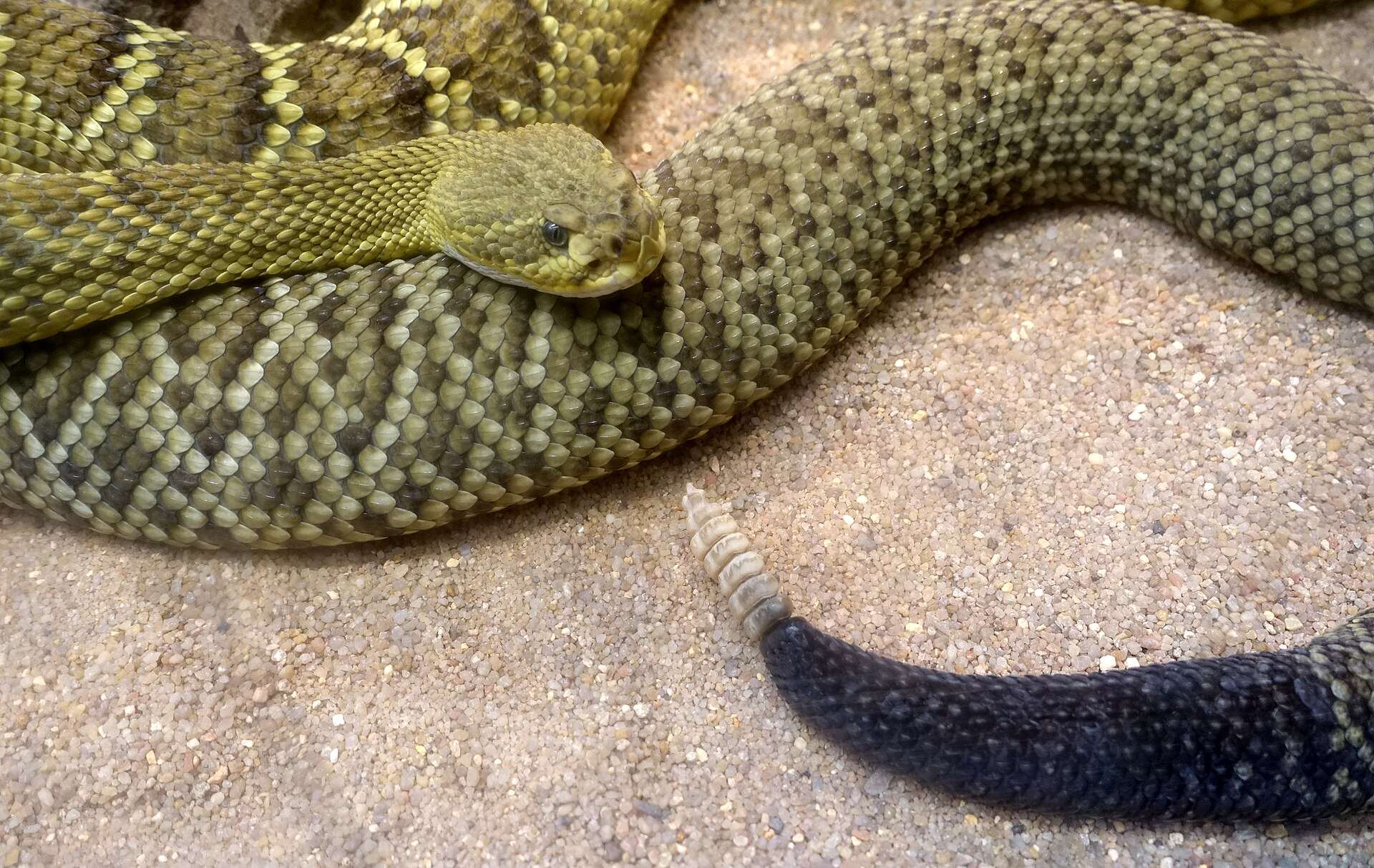
None of the other snakes on this site live in the Americas. The western diamondback can easily be confused with the Mohave rattlesnake1,2. In the western diamondback, the light stripe behind the eye slants steeply down to the upper lip, the blotches are “peppered” with dark specks, and the black tail rings are wide1. In the Mohave rattlesnake, the stripe behind the eye runs back past the corner of the jaw without reaching the lip2. The red diamond rattlesnake, where their ranges meet, is usually reddish-brown or red2.
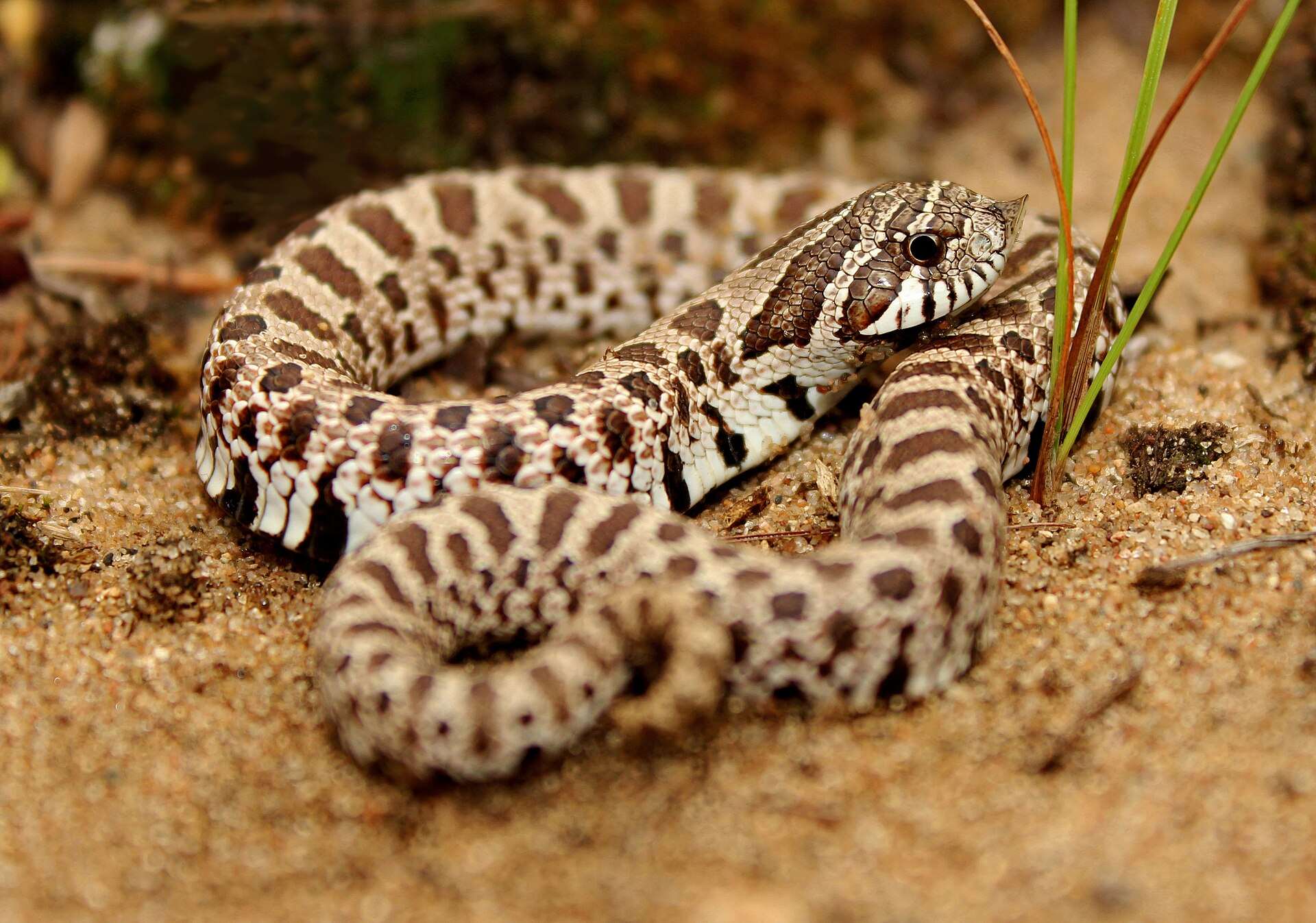
Harmless gophersnakes are also often mistaken for rattlesnakes2. These differences are not a safe basis for handling any snake.
In captivity
Western diamondbacks are kept in zoos and used as educational animals, and they have lived for more than 20 years in captivity4. It is not a suitable pet, and many serious bites happen when people handle rattlesnakes1.
If you see one, give it plenty of space and let it move away on its own2.
Look-alikes
Don’t confuse it with…
These snakes are often mistaken for each other. Use the differences to learn, never as a reason to handle a snake.
References
- 1
Brennan, T.C. Western Diamond-backed Rattlesnake, Crotalus atrox. Online Field Guide to the Reptiles and Amphibians of Arizona. reptilesofaz.org
- 2
Nafis, G. Western Diamond-backed Rattlesnake – Crotalus atrox. CaliforniaHerps.com (citing Stebbins 2003; Stebbins & McGinnis 2012, 2013; Klauber 1982). californiaherps.com
- 3
Uetz, P. et al. (eds.) (2026). Crotalus atrox Baird & Girard, 1853. The Reptile Database. reptile-database.reptarium.cz
- 4
Ingmarsson, L. (2002). Crotalus atrox (western diamondback rattlesnake). Animal Diversity Web, University of Michigan Museum of Zoology. animaldiversity.org
- 5
World Health Organization (2017). Guidelines for the production, control and regulation of snake antivenom immunoglobulins. WHO Technical Report Series No. 1004, Annex 5, Appendix 1: Worldwide distribution of medically important venomous snakes. cdn.who.int
- 6
Layfield, H.J., Williams, H.F., Ravishankar, D. et al. (2020). Repurposing cancer drugs batimastat and marimastat to inhibit the activity of a group I metalloprotease from the venom of the western diamondback rattlesnake, Crotalus atrox. Toxins 12(5): 309. doi.org
- 7
Brandehoff, N., Dalton, A., Daugherty, C., Dart, R.C. & Monte, A.A. (2023). Total CroFab and Anavip antivenom vial administration in US rattlesnake envenomations: 2019–2021. Journal of Medical Toxicology 19(3): 248–254. doi.org
- 8
Frost, D.R., Hammerson, G.A. & Santos-Barrera, G. (2007). Crotalus atrox. The IUCN Red List of Threatened Species 2007: e.T64311A12763519. iucnredlist.org
- 9
Gracheva, E.O., Ingolia, N.T., Kelly, Y.M. et al. (2010). Molecular basis of infrared detection by snakes. Nature 464: 1006–1011. pmc.ncbi.nlm.nih.gov
- 10
Ebert, J. & Westhoff, G. (2006). Behavioural examination of the infrared sensitivity of rattlesnakes (Crotalus atrox). Journal of Comparative Physiology A 192: 941–947. pubmed.ncbi.nlm.nih.gov
Play
Play as the western diamondback rattlesnake.
Its real pattern is a skin in Snake. Every run ends with a fact.