
West African carpet viper
Echis ocellatus Stemmler, 1970
Also called African saw-scaled viper, Ocellated carpet viper
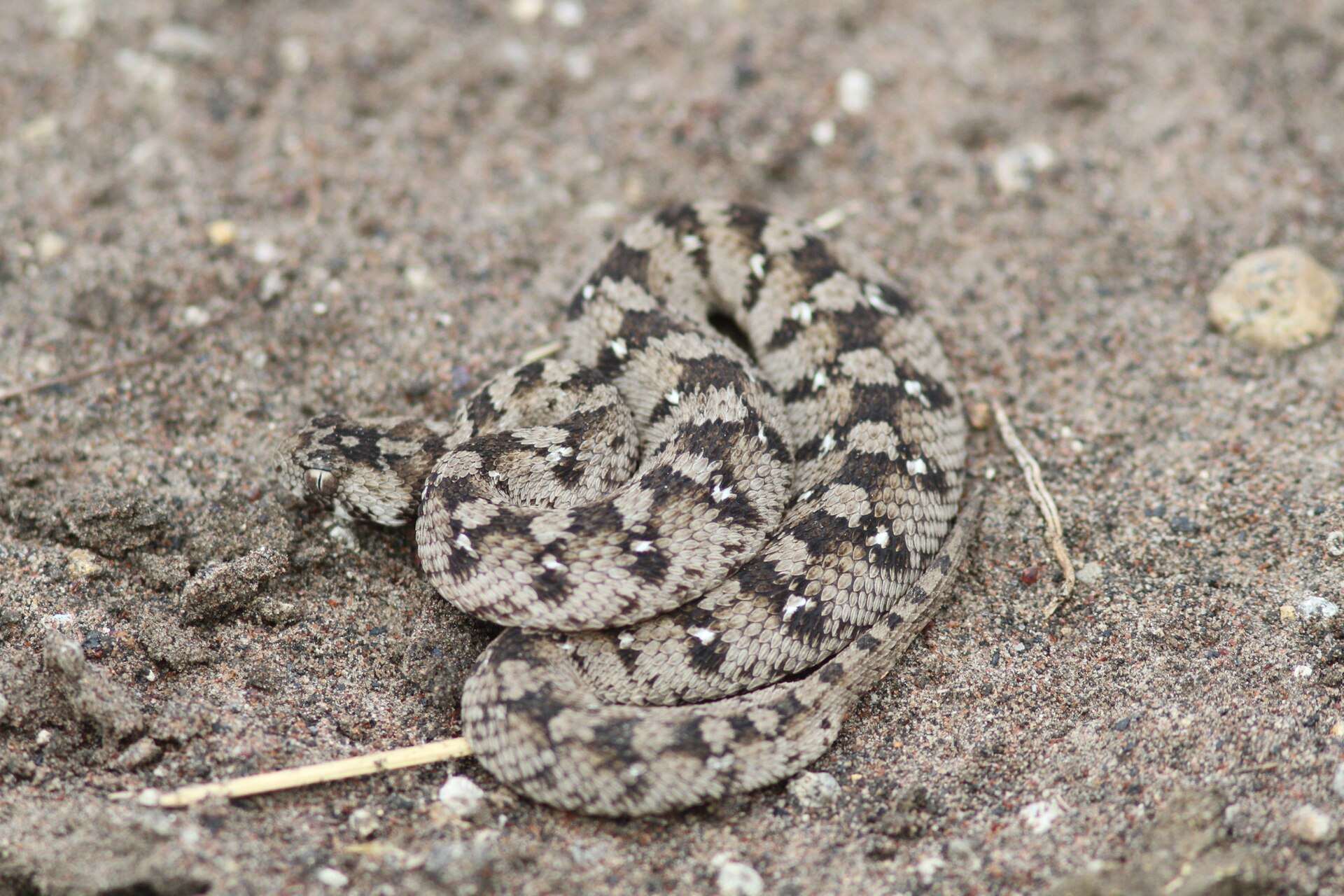
A small, rough-scaled viper of the West African savanna, brown or grey with pale blotches and white eye-spots. It rasps by rubbing its coils together and is the region's leading cause of snakebite deaths.

Is it dangerous?
Yes. It causes more snakebite deaths in West Africa than any other snake, and its venom stops blood clotting. Anyone bitten should go to hospital immediately.
Do not approach. If someone is bitten, go to a hospital now.
At a glance
- Length
- 0.4–0.7 m
- Active
- At night
- Found in
- West African savanna
- Venom
- Haemotoxic and cytotoxic
- Young
- Lays eggs
- Habitat
- Savanna, Farmland, Around houses
- Diet
- Centipedes, Rodents, Snakes
Length shows a typical adult, then the largest recorded.
IUCN Red List status: Least Concern
Country guideSnakes of Nigeria
True size
West African carpet viperMedically significant
0.7 m at most
About a third of the height of a 1.7 m adult.
Usual range 0.4–0.7 m, the bar on the ruler.
Saw-scaled viperMedically significant
0.76 m at most
About half the height of a 1.7 m adult.
Usual range 0.5–0.76 m, the bar on the ruler.
Gaboon viperMedically significant
1.75 m at most
About as long as a 1.7 m adult is tall.
Usual range 1.0–1.75 m, the bar on the ruler.
Ball pythonNon-venomous
1.83 m at most
About as long as a 1.7 m adult is tall.
Usual range 1.2–1.83 m, the bar on the ruler.
Puff adderMedically significant
1.9 m at most
About as long as a 1.7 m adult is tall.
Usual range 0.8–1.9 m, the bar on the ruler.
Black-necked spitting cobraMedically significant
2.2 m at most
About 1.5 times the height of a 1.7 m adult.
Usual range 1.25–2.2 m, the bar on the ruler.
BoomslangMedically significant
2.3 m at most
About 1.5 times the height of a 1.7 m adult.
Usual range 1.3–2.3 m, the bar on the ruler.
Central African rock pythonNon-venomous
7.6 m at most
About 4.5 times the height of a 1.7 m adult.
Usual range 4.0–7.6 m, the bar on the ruler.
Each snake is drawn at the longest length in its profile, on the same scale as the adult. Length is to scale; thickness is not.
Identification
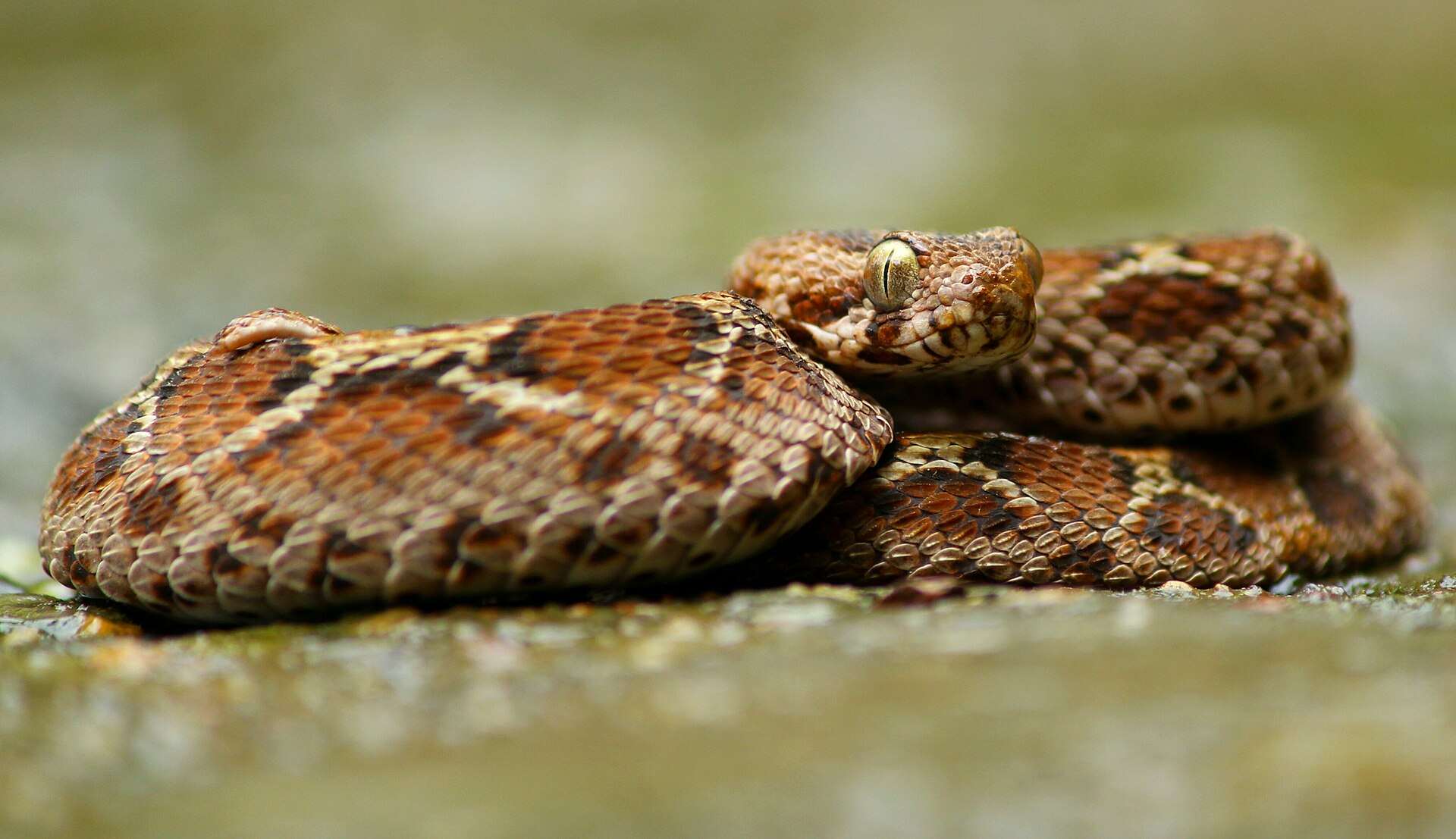
The West African carpet viper is a small, fairly slender viper with overlapping, keeled scales; the scales on its flanks have serrated keels3. It is reddish-brown or greyish, with pale oval or diamond-shaped marks along the back joined by a dark central band, and a row of white, black-edged “eye” spots along each side3. The belly is white and heavily spotted with black3. Its scientific name comes from the Latin ocellus, “little eye”, after these spots1.
Adults are usually 30–50 cm long (about 40 cm on average), and the maximum recorded length is about 70 cm3.
Distribution
This viper lives in the savanna of West Africa3. The Reptile Database lists it from Senegal, the Gambia, Guinea, Mali, Mauritania, Burkina Faso, Côte d’Ivoire, Ghana, Togo, Benin, Niger and Nigeria1.
WHO’s 2010 guidelines, written before a recent split, extended its range east to Chad, Cameroon and the Central African Republic3. In 2018 the carpet vipers of that region were described as a separate species, Echis romani, which the Reptile Database also lists from parts of Nigeria and southern Niger1,2.
Habitat
The West African carpet viper is a savanna snake3. The West African savanna has the highest snakebite incidence in Africa, and saw-scaled or carpet vipers are among the commonest causes of serious envenoming there3. In the Sudan savanna around Ouagadougou, Burkina Faso, people meet it in and around their homes, sometimes indoors4. In Nigeria, snakebite is a major public health problem among farming communities of the savanna5.
Behaviour
Around Ouagadougou, carpet viper bites happen mostly at night, including dusk and dawn, and mainly at the beginning and end of the rainy season4.
When alarmed, a carpet viper rubs its coils together so that the saw-edged keels on its side scales make a rasping sound3. This sound is easy to recognise and is the source of many local names, such as kububuwa in Hausa and fufukr in Bura3.
Diet
In a study of 47 carpet vipers collected around Ouagadougou, 39 had food remains in their gut4. The commonest prey were large Scolopendra centipedes, found in 19 snakes, followed by rodents, found in 124. Other remains included three snakes, a toad, a spider, a beetle and some ants4. The author suggested that hunting centipedes, which are common around homes, may help explain why people often meet these vipers near houses at night4.
Reproduction
The West African carpet viper lays eggs1. In this it differs from the saw-scaled viper of South Asia (Echis carinatus), which gives birth to live young; the Reptile Database notes that the other species of the genus lay eggs8.
Venom and medical significance
The West African carpet viper is the most important cause of snakebite in West Africa, and in Nigeria it has been reported to cause about 90% of snakebites and 60% of snakebite deaths3. It is also the most common cause of snakebite deaths in Senegal1, and in Nigeria more than 10–20% of envenomed patients die if untreated6.
Its venom activates clotting factors, so the blood stops clotting3. In a large Nigerian series only 4% of proven bites caused no envenoming; all envenomed patients had non-clotting blood, more than half had spontaneous bleeding, usually from the gums, and some developed blistering or tissue death that needed skin grafts or amputation3. Antivenoms made from Nigerian snake venoms, EchiTAb G and EchiTAb-Plus-ICP, proved effective in a large trial, and antivenom prevents more than 80% of deaths from carpet viper bites5,6. Anyone bitten should go to hospital immediately.
Conservation
The West African carpet viper is listed as Least Concern on the IUCN Red List (assessed in 2021)7. It remains common in the West African savanna, where it is still a leading cause of snakebite3,5.
Similar species
Other carpet vipers in West Africa look much the same. Joger’s carpet viper (Echis jogeri) of Mali and Senegal has similar colouring and differs mainly in its belly scale counts, while the white-bellied carpet viper (E. leucogaster) has a pure white belly rather than one spotted with black3. Echis romani, east of its range, differs in genetics and scale counts2.
It also looks like the saw-scaled viper (Echis carinatus), but that species lives far away, from Arabia and Central Asia to India and Sri Lanka8. These differences are not a safe basis for handling any snake. Keep your distance from every snake you cannot identify.
In captivity
The West African carpet viper is dangerously venomous and is not suitable as a pet. Captive carpet vipers are kept for medical research: the starting doses of Nigeria’s antivenoms were worked out from the largest amount of venom that could be milked from captive snakes6.
Look-alikes
Don’t confuse it with…
These snakes are often mistaken for each other. Use the differences to learn, never as a reason to handle a snake.
References
- 1
Uetz, P. et al. (eds.) (2026). Echis ocellatus Stemmler, 1970. The Reptile Database. reptile-database.reptarium.cz
- 2
Uetz, P. et al. (eds.) (2026). Echis romani Trape, 2018. The Reptile Database. reptile-database.reptarium.cz
- 3
World Health Organization, Regional Office for Africa (2010). Guidelines for the prevention and clinical management of snakebite in Africa. WHO/AFR/EDM/EDP/10.01, Brazzaville. (Sections 2.1.1, 3.1–3.2, 7.8 and Annex 1.) iris.who.int
- 4
Revault, P. (1996). Scolopendra morsitans Linnaeus, 1758: a characteristic prey of the African carpet viper Echis ocellatus Stemmler, 1970. In: Geoffroy, J.-J., Mauriès, J.-P. & Nguyen Duy-Jacquemin, M. (eds), Acta Myriapodologica. Mémoires du Muséum national d'Histoire naturelle 169: 495–499. archive.org
- 5
Habib, A.G. (2013). Public health aspects of snakebite care in West Africa: perspectives from Nigeria. Journal of Venomous Animals and Toxins including Tropical Diseases 19: 27. doi.org
- 6
Abubakar, I.S., Abubakar, S.B., Habib, A.G., Nasidi, A. et al. (2010). Randomised controlled double-blind non-inferiority trial of two antivenoms for saw-scaled or carpet viper (Echis ocellatus) envenoming in Nigeria. PLoS Neglected Tropical Diseases 4(7): e767. doi.org
- 7
Luiselli, L., Chirio, L. & Chippaux, J.-P. (2021). Echis ocellatus. The IUCN Red List of Threatened Species 2021: e.T13301039A13301046. iucnredlist.org
- 8
Uetz, P. et al. (eds.) (2026). Echis carinatus (Schneider, 1801). The Reptile Database. reptile-database.reptarium.cz
Play
Play as the west african carpet viper.
Its real pattern is a skin in Snake. Every run ends with a fact.