
South American rattlesnake
Crotalus durissus Linnaeus, 1758
Also called Cascavel, Cascabel, Neotropical rattlesnake
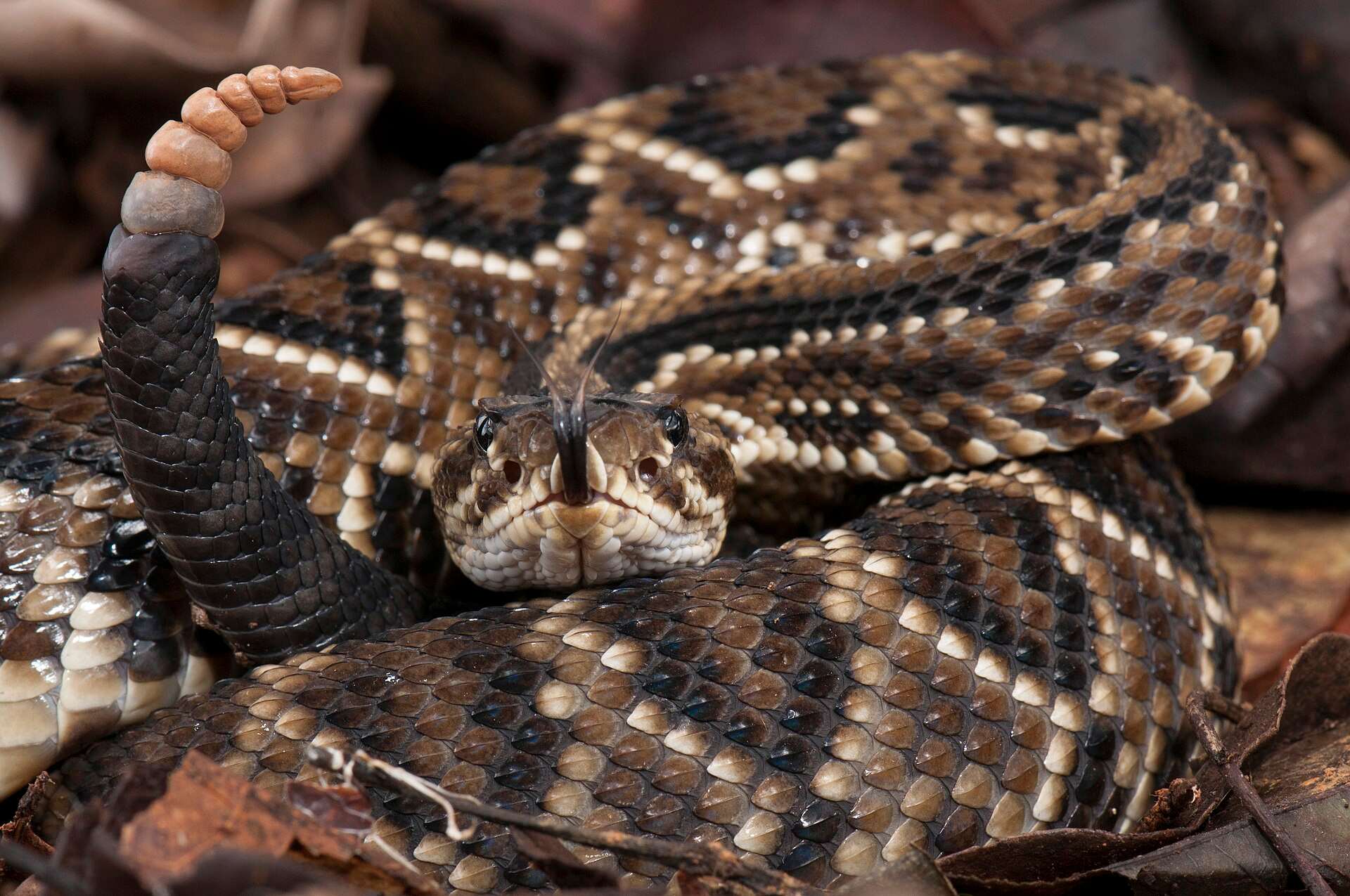
A heavy-bodied rattlesnake of open country in South America, brown with pale-edged dark diamonds, two dark stripes on the neck and a rattle on the tail. It is the cascavel of Brazil's Cerrado and Caatinga.

Is it dangerous?
Yes. Its venom can cause paralysis, severe muscle damage and kidney failure, often with little pain at the bite. Anyone bitten should go to hospital immediately.
Do not approach. If someone is bitten, go to a hospital now.
At a glance
- Length
- 1.1–1.47 m
- Active
- At night
- Found in
- South America
- Venom
- Neurotoxic and myotoxic
- Young
- Live young
- Habitat
- Savanna (Cerrado), Dry scrub (Caatinga), Grassland
- Diet
- Rodents, Marsupials, Lizards
Length shows a typical adult, then the largest recorded.
IUCN Red List status: Least Concern
Country guideSnakes of Brazil
True size
Painted coral snakeMedically significant
0.74 m at most
About half the height of a 1.7 m adult.
Usual range 0.52–0.74 m, the bar on the ruler.
South American rattlesnakeMedically significant
1.47 m at most
About three quarters of the height of a 1.7 m adult.
Usual range 1.1–1.47 m, the bar on the ruler.
JararacaMedically significant
1.6 m at most
About as long as a 1.7 m adult is tall.
Usual range 1.06–1.6 m, the bar on the ruler.
Mexican west coast rattlesnakeMedically significant
2.05 m at most
About 1 times the height of a 1.7 m adult.
Usual range 1.5–2.05 m, the bar on the ruler.
Western diamondback rattlesnakeMedically significant
2.29 m at most
About 1.5 times the height of a 1.7 m adult.
Usual range 1.2–2.29 m, the bar on the ruler.
TerciopeloMedically significant
2.5 m at most
About 1.5 times the height of a 1.7 m adult.
Usual range 1.5–2.5 m, the bar on the ruler.
Boa constrictorNon-venomous
4.45 m at most
About 2.5 times the height of a 1.7 m adult.
Usual range 2.5–4.45 m, the bar on the ruler.
Green anacondaNon-venomous
5.21 m at most
About 3 times the height of a 1.7 m adult.
Usual range 3.1–5.21 m, the bar on the ruler.
Each snake is drawn at the longest length in its profile, on the same scale as the adult. Length is to scale; thickness is not.
Identification
The South American rattlesnake is a heavy-bodied pit viper with a triangular head that is clearly wider than the neck, keeled scales, vertical pupils and a heat-sensing pit on each side of the face2,7. Its back carries a row of dark diamonds edged with pale scales, and a pair of dark stripes runs along the neck2. The tail ends in a rattle, which is the easiest way to recognise it14.
In north-eastern Brazil, mature rattlesnakes averaged about 1.1 m from snout to vent, and the largest measured 1.47 m, not counting the tail4. Males and females there were about the same size4.
Distribution
The Reptile Database lists the South American rattlesnake from Brazil, Venezuela, Colombia, Guyana, Suriname, French Guiana, Peru, Bolivia, Paraguay, northern Argentina and Uruguay1. It is patchily distributed, living in open country north and south of the Amazon rainforest and in isolated patches of savanna2.
Rattlesnakes from Mexico and Central America were once included in this species but are now treated as separate species, such as Crotalus simus1,11. The Aruba Island rattlesnake is also now a separate species, Crotalus unicolor1.
Habitat
In Brazil, the South American rattlesnake lives mainly in open habitats, including the Cerrado, Caatinga, Pampa, Pantanal and Araucaria forest, and in open areas within the Amazon and Atlantic Forest7. It also lives in pastures, crop fields and forest edges2, but it is rarely found on the coast or in marshes3. It can colonise land cleared of forest, which has helped it spread into new areas2,6.
Behaviour
This rattlesnake is most active from dusk until around midnight, and it rests by day in burrows or among grass and shrubs2. In a Cerrado study it was active mainly on the surface and was often found under bushes6. When a person approaches it usually flees, but it may also coil, turn its head towards them and shake its rattle, usually only when the person is within about a metre2. Males sometimes fight each other in ritual combat2.
Diet
The South American rattlesnake hunts mainly by waiting in ambush on the ground2. In a study of 452 rattlesnakes from central Brazil, about three-quarters of the prey found were rodents, and the rest were marsupials, other mammals and reptiles5. Lizards are taken in smaller numbers, and birds have been recorded in north-eastern Brazil2.
Reproduction
The South American rattlesnake gives birth to live young1,2. Litters average about 12 in south-eastern Brazil and range from 12 to 33 in north-eastern Brazil4. Females store sperm through the winter, and the young are born in summer and early autumn4. Newborns measure about 30 cm from snout to vent4.
Venom and medical significance
The South American rattlesnake is dangerously venomous, and the WHO places it in Category 1, the highest medical importance, in Brazil and most other countries where it lives11. The bite site often shows little pain or swelling, only tingling, but within hours the venom can cause drooping eyelids, blurred or double vision and a sleepy-looking face, followed by muscle pain and dark urine as muscles break down3,8. Blood clotting can also be affected, and acute kidney injury is the main complication3.
In Brazil in 2023, rattlesnakes caused 8% of reported snakebites but 17% of snakebite deaths, and a bite was more than twice as likely to be fatal as a bite by a lancehead7. It is treated with anticrotalic antivenom, given in hospital9. Anyone bitten should go to hospital immediately.
Conservation
The South American rattlesnake is listed as Least Concern on the IUCN Red List (published 2021)12. It has a wide range and is able to live in farmland and cleared areas2,6.
Similar species
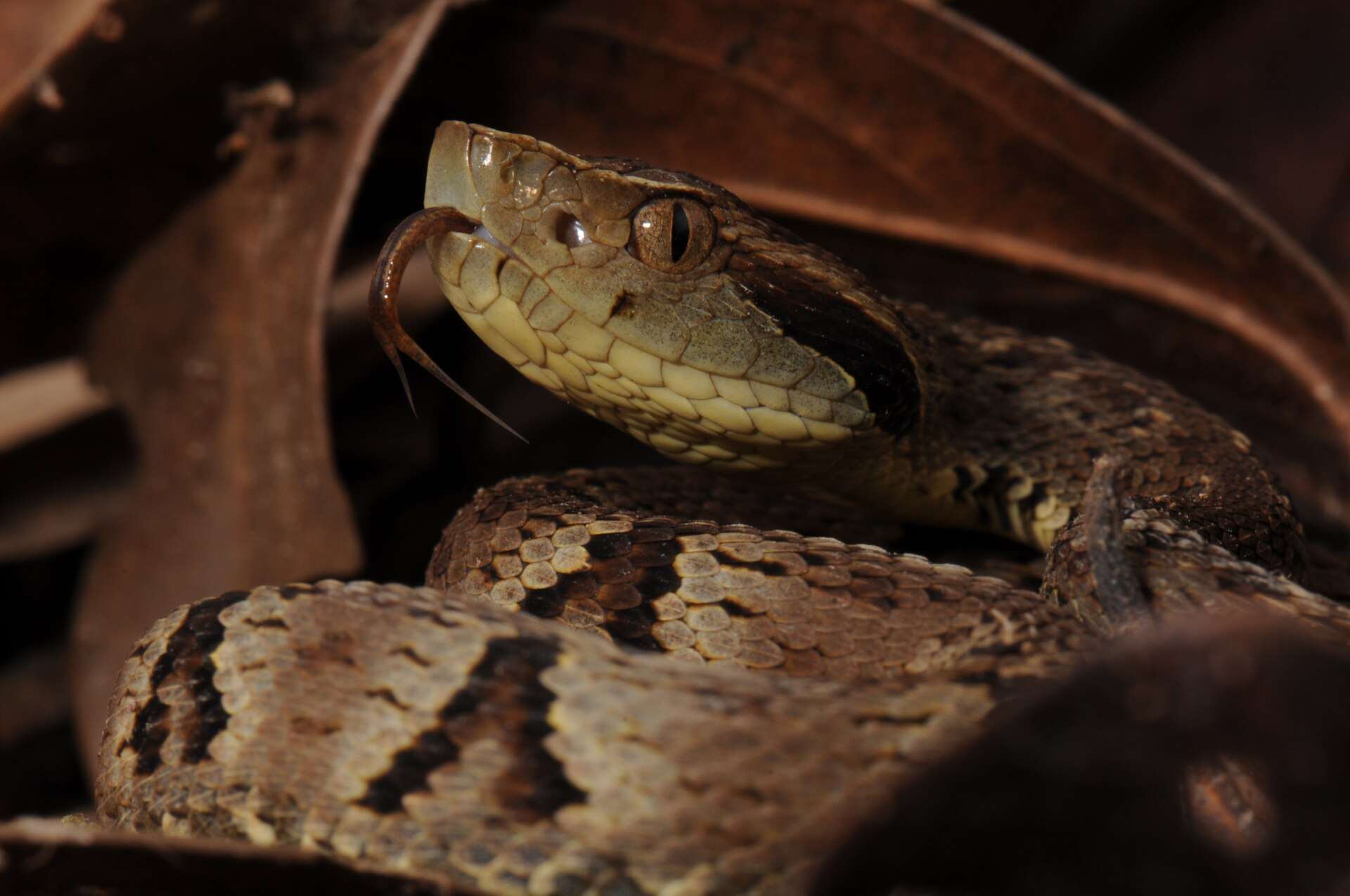
In Brazil, the rattle is the clearest sign of a rattlesnake14. The rattle can break or be lost, however10. A rattlesnake without its rattle could be mistaken for a lancehead such as the jararaca (Bothrops jararaca), which has dark triangular or trapezoid marks along its sides13. The rattlesnake has dark diamonds along the back and a pair of dark stripes on the neck2. These differences are not a safe basis for handling any snake. Keep your distance from every snake you cannot identify.
In captivity
The South American rattlesnake is a dangerously venomous snake and is not suitable as a pet. In Brazil, keeping venomous snakes is allowed only in research centres or for the pharmaceutical industry10. Its rattle grows a new segment each time it sheds, so the number of segments does not tell its age, and segments can break off10.
Look-alikes
Don’t confuse it with…
These snakes are often mistaken for each other. Use the differences to learn, never as a reason to handle a snake.
References
- 1
Uetz, P. et al. (eds.) (2026). Crotalus durissus Linnaeus, 1758. The Reptile Database. reptile-database.reptarium.cz
- 2
Pucca, M.B., Bernarde, P.S., Rocha, A.M., Viana, P.F., Farias, R.E.S., Cerni, F.A., Oliveira, I.S., Ferreira, I.G., Sandri, E.A., Sachett, J., Wen, F.H., Sampaio, V., Laustsen, A.H., Sartim, M.A. & Monteiro, W.M. (2021). Crotalus durissus ruruima: current knowledge on natural history, medical importance, and clinical toxinology. Frontiers in Immunology 12: 659515. doi.org
- 3
Frare, B.T., Silva Resende, Y.K., Dornelas, B.C., Jorge, M.T., Souza Ricarte, V.A., Alves, L.M. & Izidoro, L.F.M. (2019). Clinical, laboratory, and therapeutic aspects of Crotalus durissus (South American rattlesnake) victims: a literature review. BioMed Research International 2019: 1345923. doi.org
- 4
Barros, V.A., Sueiro, L.R. & Almeida-Santos, S.M. (2012). Reproductive biology of the neotropical rattlesnake Crotalus durissus from northeastern Brazil: a test of phylogenetic conservatism of reproductive patterns. Herpetological Journal 22: 97–104. thebhs.org
- 5
Hoyos, M.A. & Almeida-Santos, S.M. (2016). The South-American rattlesnake Crotalus durissus: feeding ecology in the central region of Brazil. Biota Neotropica 16(3): e20140027. doi.org
- 6
Tozetti, A.M. & Martins, M. (2008). Habitat use by the South-American rattlesnake (Crotalus durissus) in south-eastern Brazil. Journal of Natural History 42: 1435–1444. (Abstract in the FURG institutional repository.) repositorio.furg.br
- 7
Ministério da Saúde, Secretaria de Vigilância em Saúde e Ambiente (2024). Epidemiologia dos acidentes ofídicos no Brasil em 2023. Boletim Epidemiológico 55(15). gov.br
- 8
Ministério da Saúde (Brazil). Acidentes ofídicos: sintomas. gov.br
- 9
Ministério da Saúde (Brazil). Acidentes ofídicos: tratamento (anticrotalic antivenom, SACr, or combined antibothropic–anticrotalic antivenom, SABC). gov.br
- 10
Ministério da Saúde (Brazil). Acidentes ofídicos: perguntas frequentes. gov.br
- 11
World Health Organization (2017). Guidelines for the production, control and regulation of snake antivenom immunoglobulins. WHO Technical Report Series No. 1004, Annex 5, Appendix 1: Worldwide distribution of medically important venomous snakes. cdn.who.int
- 12
Cacciali, P., Caicedo, J.R., Carreira, S., Fitzgerald, L., Gutiérrez-Cárdenas, P., Kacoliris, F., Montero, R., Renjifo, J., Rivas, G., Rodríguez, J. & Scott, N. (2021). Crotalus durissus. The IUCN Red List of Threatened Species 2021: e.T178477A44954627. iucnredlist.org
- 13
Murphy, A. (2013). Bothrops jararaca. Animal Diversity Web, University of Michigan Museum of Zoology. animaldiversity.org
- 14
Ministério da Saúde (Brazil). Acidentes ofídicos (overview of the four types of venomous snakebite in Brazil). gov.br
Play
Play as the south american rattlesnake.
Its real pattern is a skin in Snake. Every run ends with a fact.