
Cottonmouth
Agkistrodon piscivorus (Lacépède, 1789)
Also called Water moccasin, Northern cottonmouth, Western cottonmouth
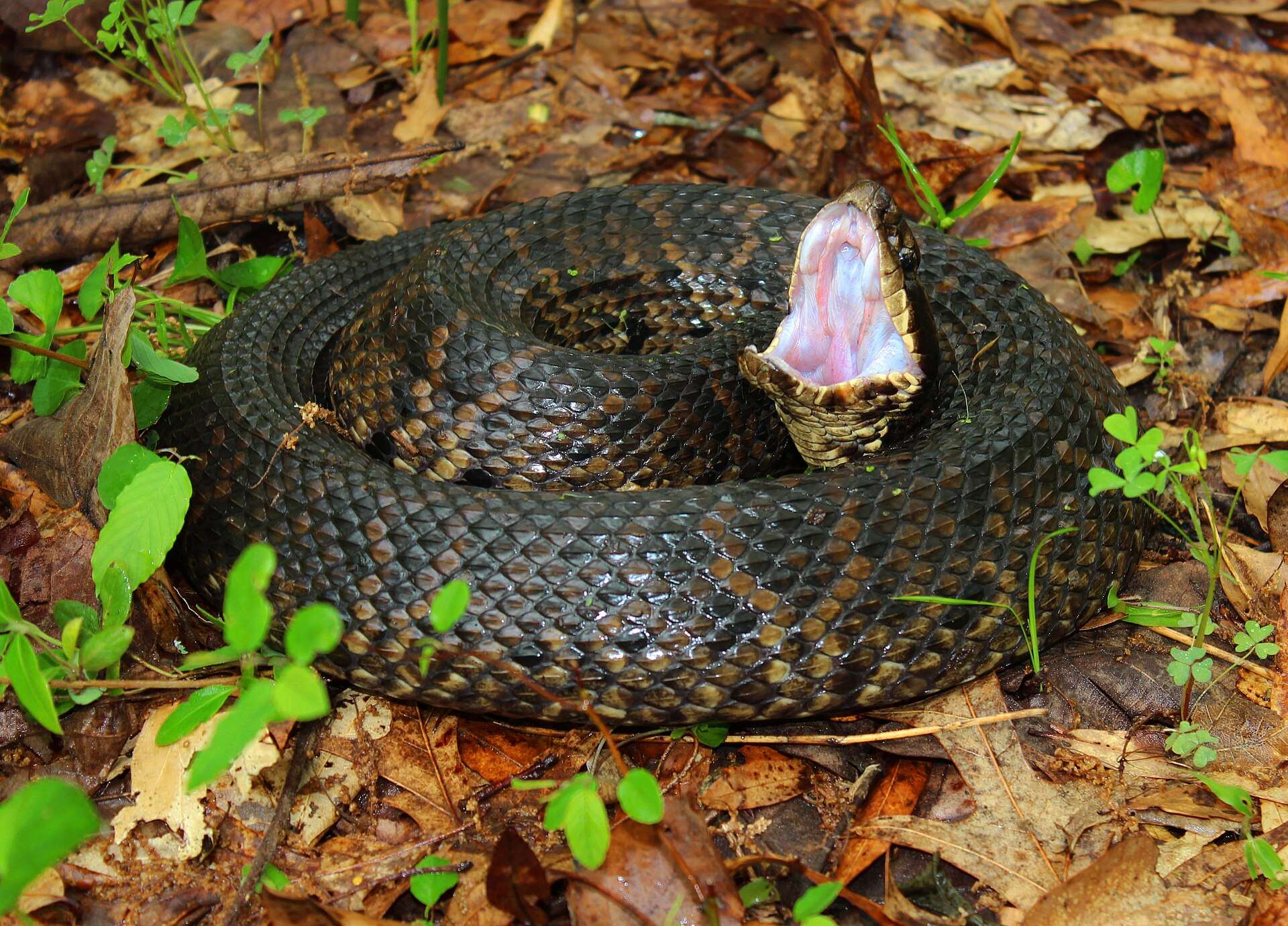
A heavy-bodied, semi-aquatic pit viper of wetlands in the south-eastern United States. Adults are dark olive, brown or nearly black with faint bands, and it may gape to show the white lining of its mouth.

Is it dangerous?
Yes. Its bite causes severe pain, swelling and tissue damage and can upset blood clotting. Get hospital care immediately if bitten.
Do not approach. If someone is bitten, go to a hospital now.
At a glance
- Length
- 0.9–1.88 m
- Active
- Day and night
- Found in
- South-eastern United States
- Venom
- Haemotoxic and cytotoxic
- Young
- Live young
- Habitat
- Swamps, River floodplains, Vegetated wetlands
- Diet
- Fish, Frogs, Snakes
Length shows a typical adult, then the largest recorded.
IUCN Red List status: Least Concern
Country guideSnakes of the United States
True size
Hump-nosed viperMedically significant
0.6 m at most
About a third of the height of a 1.7 m adult.
Usual range 0.48–0.6 m, the bar on the ruler.
Eastern coral snakeMedically significant
1.21 m at most
About three quarters of the height of a 1.7 m adult.
Usual range 0.65–1.21 m, the bar on the ruler.
CopperheadMedically significant
1.35 m at most
About three quarters of the height of a 1.7 m adult.
Usual range 0.75–1.35 m, the bar on the ruler.
Gaboon viperMedically significant
1.75 m at most
About as long as a 1.7 m adult is tall.
Usual range 1.0–1.75 m, the bar on the ruler.
CottonmouthMedically significant
1.88 m at most
About as long as a 1.7 m adult is tall.
Usual range 0.9–1.88 m, the bar on the ruler.
Mexican west coast rattlesnakeMedically significant
2.05 m at most
About 1 times the height of a 1.7 m adult.
Usual range 1.5–2.05 m, the bar on the ruler.
Western diamondback rattlesnakeMedically significant
2.29 m at most
About 1.5 times the height of a 1.7 m adult.
Usual range 1.2–2.29 m, the bar on the ruler.
TerciopeloMedically significant
2.5 m at most
About 1.5 times the height of a 1.7 m adult.
Usual range 1.5–2.5 m, the bar on the ruler.
Each snake is drawn at the longest length in its profile, on the same scale as the adult. Length is to scale; thickness is not.
Identification
The cottonmouth, also called the water moccasin, is a large, heavy-bodied pit viper with a broad, triangular head that is clearly wider than its neck4. Adults are dark olive, brown or nearly black, and their dark crossbands often fade until they are hard to see1,4. Young snakes are boldly banded in brown on a lighter grey, tan or reddish background and have a bright yellow-green tail tip4,10. The scales are keeled, giving a rough, matte look; like other cottonmouths it has vertical pupils and a heat-sensing pit between each nostril and eye4,5.
Average adults are about 76–114 cm long, and the maximum recorded is 188 cm1. Males grow larger than females4.
Distribution
The cottonmouth lives in the south-eastern United States, from south-eastern Virginia south through the Carolinas and Georgia, and west through Alabama, Mississippi and Louisiana to Texas, Oklahoma and Arkansas1,4. It also ranges up the Mississippi valley to southern Missouri, southern Illinois, Indiana, western Kentucky and western Tennessee1. In Texas it reaches the Rio Grande valley on the Mexican border1.
A 2015 genetic study split the cottonmouths into two species2. The cottonmouths of Florida and southern Georgia are now treated as the Florida cottonmouth (Agkistrodon conanti), and the two interbreed where their ranges meet, including in the Florida Panhandle3,5. The Reptile Database follows this split, but notes that another genetic study did not support it1.
Habitat
The cottonmouth is strongly tied to fresh water. It lives in cypress swamps, river floodplains, heavily vegetated wetlands and slow-moving streams4. It may also wander into nearby uplands, especially when dispersing, during droughts or while hunting at night4.
It often basks on banks, logs or low plants beside the water, but it seldom climbs high into trees4.
Behaviour
In hot weather the cottonmouth is mostly active at dusk and at night, but in cooler seasons it may be active by day4. It tends to rely on camouflage and warning displays rather than fleeing4. When threatened it coils, vibrates its tail and opens its mouth wide to show the white or pinkish lining that gives it its name4. This gape is a warning display, not a strike5.
Despite its reputation, it is not aggressive and does not chase people5. In field tests, 23 of 45 wild cottonmouths tried to escape when confronted, 28 of 36 used threat displays, and only 13 of 36 bit an artificial hand used in the tests6.
Diet
The cottonmouth hunts mainly by ambush but also forages actively on land and in water4. Its diet is broad and includes fish, frogs, salamanders, small turtles, snakes, birds and mammals4. Its scientific name, piscivorus, means “fish-eating”1.
Unusually for a snake, it readily scavenges dead animals4. Young cottonmouths use their yellow-green tail tip as a lure to attract prey4.
Reproduction
The cottonmouth gives birth to live young1,4. It starts breeding at two to three years old, and mating can take place in spring or autumn4. Females give birth in late summer or early autumn to litters of about 3–15 young, each 18–25 cm long, and they often do not breed every year4.
Some females stay near their newborns for a short time after birth4. Wild female cottonmouths have also been shown to produce young without mating, a process called facultative parthenogenesis7.
Venom and medical significance
The cottonmouth is dangerous to people. The World Health Organization lists it in Category 1, the highest medical importance, in the United States8. Its venom mainly destroys tissue and disrupts blood clotting, causing pain, swelling, clotting problems and sometimes local tissue death; nausea and low blood pressure can also occur4.
Deaths are rare when people get antivenom and supportive care promptly4. US treatment guidelines cover cottonmouth bites along with rattlesnake and copperhead bites, including when to give antivenom9. Anyone bitten should go to hospital immediately.
Conservation
The cottonmouth is listed as Least Concern on the IUCN Red List, based on an assessment published in 2007, before the 2015 split11. It is widespread and adaptable, but local declines have been recorded because of wetland loss, road deaths and killing by people who fear it or mistake other snakes for it4.
Similar species
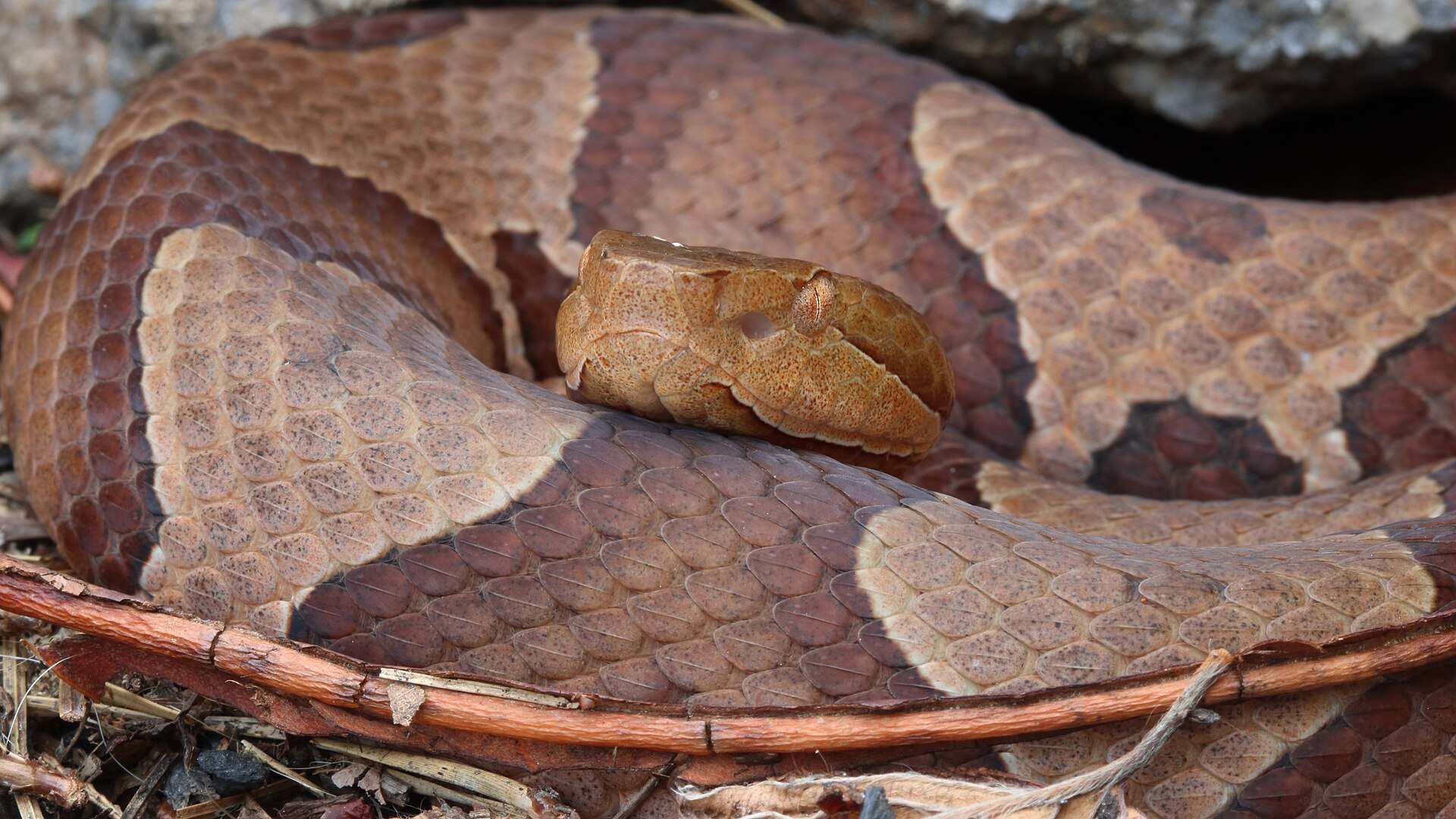
Harmless watersnakes (genus Nerodia) share the cottonmouth’s habitats, are often more common, and are frequently killed by people who mistake them for it5. Seen from directly above, a cottonmouth’s eyes cannot be seen; it also has vertical pupils and a heat pit, and lacks the thin dark vertical lines that watersnakes usually have on their lips, but head shape is not reliable because watersnakes often flatten their heads when alarmed5. Watersnakes usually flee into the water, and brown watersnakes often bask on branches high above it, while a cottonmouth seldom climbs high and often stands its ground and gapes4,12. Young cottonmouths can look like copperheads, but their bands are full of dark spots and a broad dark stripe runs through the eye5.
These differences are not a safe basis for handling any snake. Keep your distance from every snake you cannot identify.
In captivity
The cottonmouth is a dangerous venomous snake and is not suitable as a pet. Most bites happen when people try to handle, kill or harass it4. If you meet one, step back and give it room to leave.
Look-alikes
Don’t confuse it with…
These snakes are often mistaken for each other. Use the differences to learn, never as a reason to handle a snake.
References
- 1
Uetz, P. et al. (eds.) (2026). Agkistrodon piscivorus (Lacépède, 1789). The Reptile Database. reptile-database.reptarium.cz
- 2
Burbrink, F.T. & Guiher, T.J. (2015). Considering gene flow when using coalescent methods to delimit lineages of North American pitvipers of the genus Agkistrodon. Zoological Journal of the Linnean Society 173(3): 505–526. doi.org
- 3
Uetz, P. et al. (eds.) (2026). Agkistrodon conanti Gloyd, 1969. The Reptile Database. reptile-database.reptarium.cz
- 4
Savannah River Ecology Laboratory, University of Georgia. Cottonmouth / Water Moccasin (Agkistrodon piscivorus). Herpetology at SREL: Snakes of South Carolina and Georgia. srelherp.uga.edu
- 5
Florida Museum of Natural History. Florida Cottonmouth, Agkistrodon conanti. Florida Snake ID Guide. University of Florida. floridamuseum.ufl.edu
- 6
Gibbons, J.W. & Dorcas, M.E. (2002). Defensive behavior of cottonmouths (Agkistrodon piscivorus) toward humans. Copeia 2002(1): 195–198. doi.org
- 7
Booth, W., Smith, C.F., Eskridge, P.H., Hoss, S.K., Mendelson, J.R. & Schuett, G.W. (2012). Facultative parthenogenesis discovered in wild vertebrates. Biology Letters 8(6): 983–985. pmc.ncbi.nlm.nih.gov
- 8
World Health Organization (2017). Guidelines for the production, control and regulation of snake antivenom immunoglobulins. WHO Technical Report Series No. 1004, Annex 5, Appendix 1: Worldwide distribution of medically important venomous snakes. cdn.who.int
- 9
Lavonas, E.J., Ruha, A.M., Banner, W. et al. (2011). Unified treatment algorithm for the management of crotaline snakebite in the United States: results of an evidence-informed consensus workshop. BMC Emergency Medicine 11: 2. doi.org
- 10
Centers for Disease Control and Prevention, National Institute for Occupational Safety and Health (NIOSH). Venomous snakes (Outdoor workers). cdc.gov
- 11
Hammerson, G.A. (2007). Agkistrodon piscivorus. The IUCN Red List of Threatened Species 2007: e.T64298A12756313. iucnredlist.org
- 12
Savannah River Ecology Laboratory, University of Georgia. Brown Watersnake (Nerodia taxispilota). Herpetology at SREL: Snakes of South Carolina and Georgia. srelherp.uga.edu
Play
Play as the cottonmouth.
Its real pattern is a skin in Snake. Every run ends with a fact.