
Terciopelo
Bothrops asper (Garman, 1883)
Also called Fer-de-lance, Barba amarilla, Equis, Central American lancehead
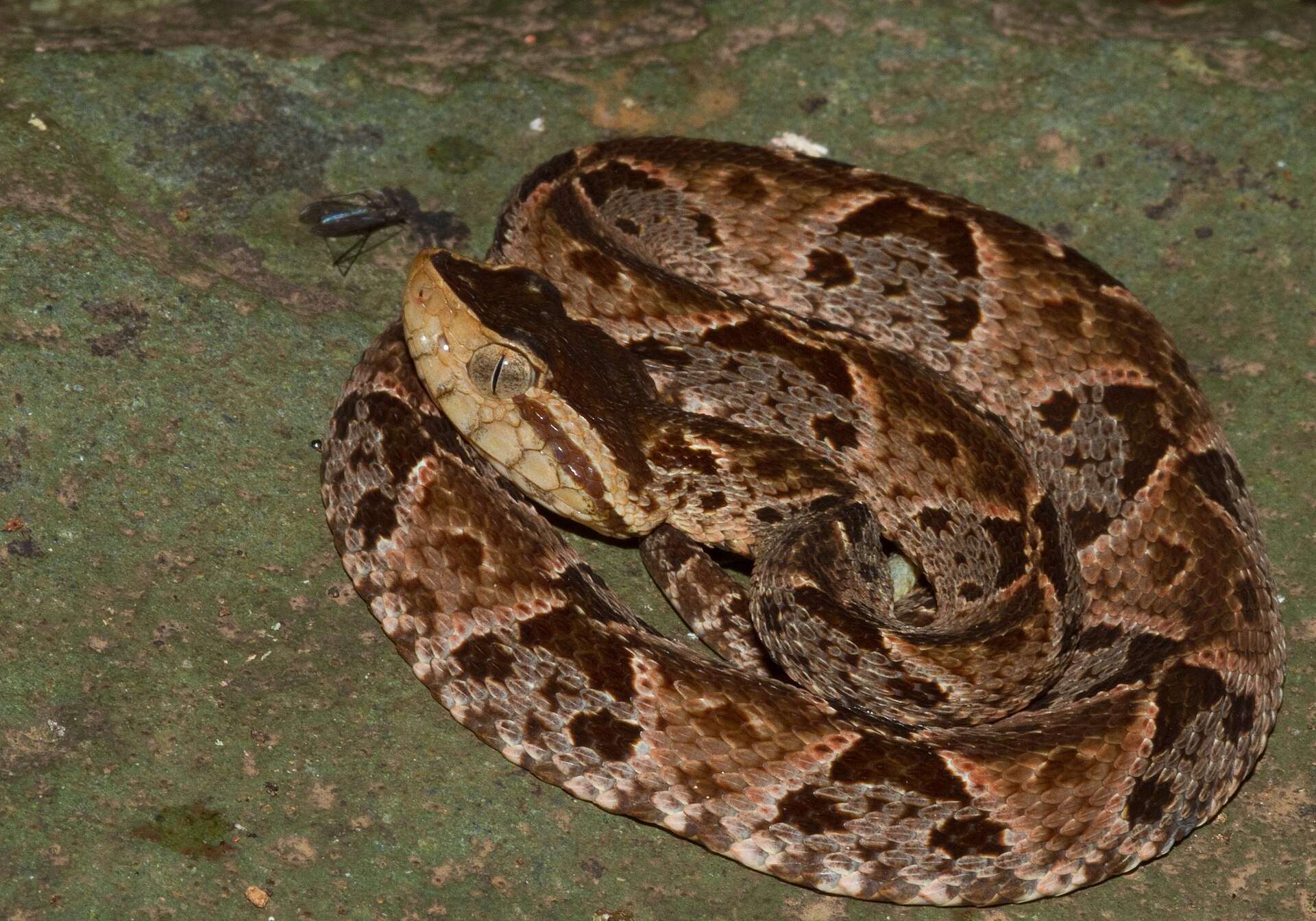
A large, heavy lancehead of humid lowland forest and farmland from Mexico to Ecuador. It is olive to brown with pale-edged dark triangles along its sides and a dark stripe behind the eye.

Is it dangerous?
Yes. It causes most serious snakebites in Central America, and its venom causes severe swelling, tissue damage and bleeding. Get hospital care immediately if bitten.
Do not approach. If someone is bitten, go to a hospital now.
At a glance
- Length
- 1.5–2.5 m
- Weight
- Up to 6 kg
- Active
- At night
- Found in
- Mexico to north-western South America
- Venom
- Haemotoxic and cytotoxic
- Young
- Live young
- Habitat
- Lowland rainforest, Swamp edges, Riverbanks
- Diet
- Rodents, Small mammals, Birds
- Lifespan
- 15–21 years in captivity
Length shows a typical adult, then the largest recorded.
IUCN Red List status: Least Concern
Country guideSnakes of Mexico
True size
CopperheadMedically significant
1.35 m at most
About three quarters of the height of a 1.7 m adult.
Usual range 0.75–1.35 m, the bar on the ruler.
South American rattlesnakeMedically significant
1.47 m at most
About three quarters of the height of a 1.7 m adult.
Usual range 1.1–1.47 m, the bar on the ruler.
JararacaMedically significant
1.6 m at most
About as long as a 1.7 m adult is tall.
Usual range 1.06–1.6 m, the bar on the ruler.
Mexican west coast rattlesnakeMedically significant
2.05 m at most
About 1 times the height of a 1.7 m adult.
Usual range 1.5–2.05 m, the bar on the ruler.
Western diamondback rattlesnakeMedically significant
2.29 m at most
About 1.5 times the height of a 1.7 m adult.
Usual range 1.2–2.29 m, the bar on the ruler.
TerciopeloMedically significant
2.5 m at most
About 1.5 times the height of a 1.7 m adult.
Usual range 1.5–2.5 m, the bar on the ruler.
Boa constrictorNon-venomous
4.45 m at most
About 2.5 times the height of a 1.7 m adult.
Usual range 2.5–4.45 m, the bar on the ruler.
Green anacondaNon-venomous
5.21 m at most
About 3 times the height of a 1.7 m adult.
Usual range 3.1–5.21 m, the bar on the ruler.
Each snake is drawn at the longest length in its profile, on the same scale as the adult. Length is to scale; thickness is not.
Identification
The terciopelo is a large pit viper with a broad, flattened head set clearly apart from the neck8. It is olive, grey, brown or nearly black, with 18–25 dark triangles edged in pale scales along each side; seen from above, these can form X or butterfly shapes1,8. A dark stripe runs from behind the eye to the corner of the mouth, the pupil is vertical, the chin is often yellow and the belly is cream1. Its back scales are strongly keeled, which gives the species its name: asper is Latin for “rough”1.
Adults typically measure 1.2–1.8 m and can weigh up to 6 kg8. Males reach about 1.6 m, while females are much bulkier and can reach about 2.5 m1,8.
Distribution
The terciopelo lives in the humid lowlands of Middle America and north-western South America2. In Mexico it ranges from southern Tamaulipas and San Luis Potosí south through Veracruz, Puebla, Oaxaca and Chiapas to the Yucatán Peninsula1,8. From there it continues through Guatemala, Belize, Honduras, Nicaragua, Costa Rica and Panama to Colombia and western Ecuador1.
It does not occur in El Salvador9. Older records from Trinidad and El Salvador came from confusion with the common lancehead, and the lanceheads of Venezuela are now placed in Bothrops colombiensis; records from north-western Peru still need confirmation1,6.
Habitat
The terciopelo is mainly a snake of tropical rainforest and evergreen forest, often near rivers and streams8. In Costa Rica, radio-tracked snakes of both sexes strongly preferred areas near swamps2. It also copes well with lightly disturbed land at the edge of farmland, so it is not rare to find one in or near houses2.
It is mostly found in the lowlands, but in Colombia it reaches about 1,500 m1.
Behaviour
The terciopelo is mainly active at night and lives alone8. Radio-tracking in Costa Rica showed that it usually makes short moves of less than 10 m between a daytime shelter and a night-time ambush site, with occasional longer moves to new hunting areas2. Its home range is small, averaging about 4–6 hectares2.
Young terciopelos sometimes climb into vegetation8. Despite popular belief, there is no evidence that its numbers in Costa Rica are increasing2.
Diet
The terciopelo is a generalist predator2. Young snakes eat mainly frogs and lizards, while adults increasingly take birds, rodents and other small mammals, as well as large frogs when warm-blooded prey is scarce2. Some of its prey are animals that farmers consider pests2.
Young terciopelos also use their differently coloured tail tip as a lure to attract prey8.
Reproduction
The terciopelo gives birth to live young1. Breeding is highly seasonal and tied to rainfall, so its timing differs between Costa Rica’s Caribbean and Pacific lowlands2. After a pregnancy of 6–8 months, females give birth to litters of 5 to 86 young, with larger females having more young8.
Litters of up to about 90 newborns have been recorded1.
Venom and medical significance
The terciopelo causes most snakebites in Central America and northern South America, mostly in young farm workers in rural areas3. Of the roughly 5,500 snakebites a year in Central America, most of the bites, and the most severe ones, are caused by this species4. The World Health Organization lists it in Category 1, the highest medical importance, in Mexico, Belize, Guatemala, Honduras, Nicaragua, Costa Rica, Panama, Colombia and Ecuador5.
Its bite can cause swelling, bruising, blisters, death of skin and muscle, failure of blood clotting, bleeding, low blood pressure and kidney problems3. Antivenom given into a vein is the main treatment, and antivenoms made in Brazil, Colombia, Costa Rica and Mexico have been tested in clinical trials3. Anyone bitten should go to hospital immediately.
Conservation
The terciopelo is listed as Least Concern on the IUCN Red List (published 2021)7. Despite persecution by people and large changes to its habitat, it is expected to persist well into the future2.
Similar species
The terciopelo was once treated as part of the common lancehead (Bothrops atrox) and is still often confused with it1,8. The common lancehead often has yellow or rusty tones and more rectangular or trapezoid blotches, and the two species live side by side only in parts of northern Colombia8.
These differences are not a safe basis for handling any snake. Keep your distance from every snake you cannot identify.
In captivity
The terciopelo is a dangerous venomous snake and is not suitable as a pet. In zoos it has lived for 15–21 years8. In the wild, give it plenty of space and let it move away.
References
- 1
Uetz, P. et al. (eds.) (2026). Bothrops asper (Garman, 1883). The Reptile Database. reptile-database.reptarium.cz
- 2
Sasa, M., Wasko, D.K. & Lamar, W.W. (2009). Natural history of the terciopelo Bothrops asper (Serpentes: Viperidae) in Costa Rica. Toxicon 54(7): 904–922. doi.org
- 3
Otero-Patiño, R. (2009). Epidemiological, clinical and therapeutic aspects of Bothrops asper bites. Toxicon 54(7): 998–1011. doi.org
- 4
Gutiérrez, J.M. (2014). Current challenges for confronting the public health problem of snakebite envenoming in Central America. Journal of Venomous Animals and Toxins including Tropical Diseases 20: 7. doi.org
- 5
World Health Organization (2017). Guidelines for the production, control and regulation of snake antivenom immunoglobulins. WHO Technical Report Series No. 1004, Annex 5, Appendix 1: Worldwide distribution of medically important venomous snakes. cdn.who.int
- 6
Saldarriaga-Córdoba, M., Parkinson, C.L., Daza, J.M., Wüster, W. & Sasa, M. (2017). Phylogeography of the Central American lancehead Bothrops asper (Serpentes: Viperidae). PLOS ONE 12(11): e0187969. doi.org
- 7
Bonilla, F., Sunyer, J., Porras, L.W., Chaves, G., Lamar, W., Solórzano, A., Rivas, G., Caicedo, J.R., Gutiérrez-Cárdenas, P. & Cisneros-Heredia, D.F. (2021). Bothrops asper. The IUCN Red List of Threatened Species 2021: e.T197464A2486766. iucnredlist.org
- 8
Brown, K. (2011). Bothrops asper. Animal Diversity Web, University of Michigan Museum of Zoology. animaldiversity.org
- 9
Gutiérrez, J.M., Castillo, L., de Naves, K.M.D., Masís, J. & Alape-Girón, A. (2020). Epidemiology of snakebites in El Salvador (2014–2019). Toxicon 186: 26–28. doi.org
Play
Play as the terciopelo.
Its real pattern is a skin in Snake. Every run ends with a fact.