
Mexican west coast rattlesnake
Crotalus basiliscus (Cope, 1864)
Also called Basilisk rattlesnake, Mexican green rattlesnake, Cascabel del Pacífico, Saye
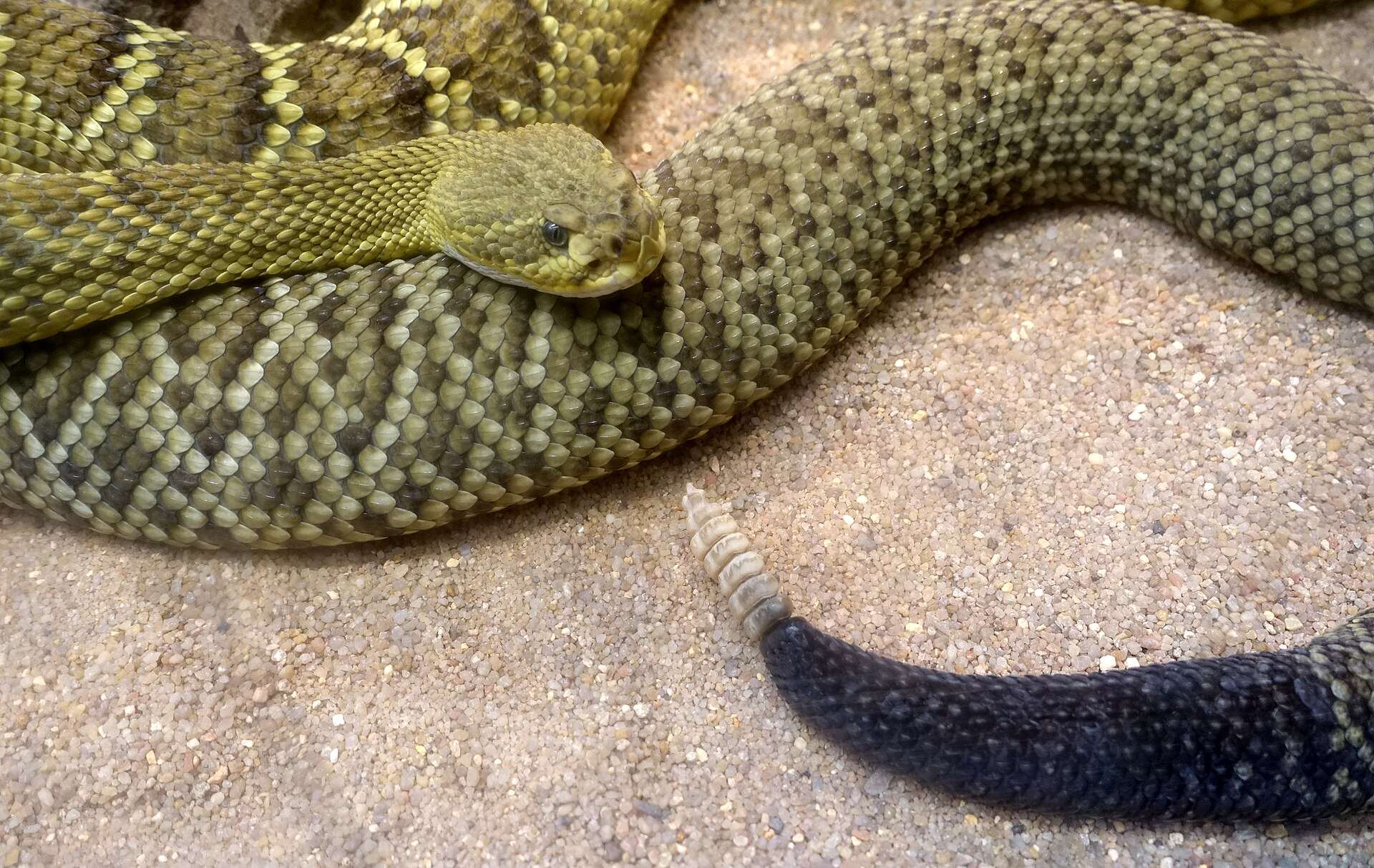
One of the largest rattlesnakes, found only in western Mexico. Young snakes are red-brown with dark diamonds, while adults are mostly olive green with faded diamonds and a dark tail ending in a rattle.

Is it dangerous?
Yes. It is a large rattlesnake whose venom damages tissue and, in some areas, contains nerve toxins. Get hospital care immediately if bitten.
Do not approach. If someone is bitten, go to a hospital now.
At a glance
- Length
- 1.5–2.05 m
- Active
- Day and night
- Found in
- Western Mexico
- Venom
- Haemotoxic, myotoxic and neurotoxic
- Young
- Live young
- Habitat
- Tropical deciduous forest, Tropical thorn forest, Arid tropical scrub
- Diet
- Small mammals, Reptiles
Length shows a typical adult, then the largest recorded.
IUCN Red List status: Least Concern
Country guideSnakes of Mexico
True size
Hump-nosed viperMedically significant
0.6 m at most
About a third of the height of a 1.7 m adult.
Usual range 0.48–0.6 m, the bar on the ruler.
CopperheadMedically significant
1.35 m at most
About three quarters of the height of a 1.7 m adult.
Usual range 0.75–1.35 m, the bar on the ruler.
South American rattlesnakeMedically significant
1.47 m at most
About three quarters of the height of a 1.7 m adult.
Usual range 1.1–1.47 m, the bar on the ruler.
Gaboon viperMedically significant
1.75 m at most
About as long as a 1.7 m adult is tall.
Usual range 1.0–1.75 m, the bar on the ruler.
CottonmouthMedically significant
1.88 m at most
About as long as a 1.7 m adult is tall.
Usual range 0.9–1.88 m, the bar on the ruler.
Mexican west coast rattlesnakeMedically significant
2.05 m at most
About 1 times the height of a 1.7 m adult.
Usual range 1.5–2.05 m, the bar on the ruler.
Western diamondback rattlesnakeMedically significant
2.29 m at most
About 1.5 times the height of a 1.7 m adult.
Usual range 1.2–2.29 m, the bar on the ruler.
TerciopeloMedically significant
2.5 m at most
About 1.5 times the height of a 1.7 m adult.
Usual range 1.5–2.5 m, the bar on the ruler.
Each snake is drawn at the longest length in its profile, on the same scale as the adult. Length is to scale; thickness is not.
Identification
The Mexican west coast rattlesnake is one of the largest rattlesnakes: adults longer than 1.5 m are not rare, and the largest reported are just over 2 m, including a captive-born female of 2.05 m2,5. It is heavy-bodied, with a clearly triangular head and strongly keeled scales5. Compared with the western diamondback and other large rattlesnakes, it has a prominent ridge along the spine and especially rough scales towards the tail2.
Its colour changes a great deal with age. Young snakes are bright red-brown with a row of 26–41 dark diamonds edged in cream, while fully grown adults become olive green with faded diamonds and a tail that is almost black above2. Newborns are about 33 cm long, and adults can grow very large rattles2.
Distribution
This rattlesnake is found only in Mexico5,7. It lives along the Pacific side of the country, from extreme southern Sonora through Sinaloa, Nayarit, Jalisco and Colima to western Michoacán3,6. The Reptile Database also lists records from Chihuahua, Zacatecas and Aguascalientes1, and in Zacatecas it is known only from the west and south-west of the state7.
It is mainly a lowland snake, and most records come from below 1,000 m3. A few have been found much higher, including one at 2,225 m in the mountains of Michoacán3.
Habitat
The Mexican west coast rattlesnake mainly lives in tropical thorn forest, tropical deciduous forest and arid tropical scrub3. It also enters the transition zone between tropical deciduous forest and pine-oak forest, and occasionally humid pine-oak forest higher up3,7. It shelters in the burrows of other animals, mainly mammals5.
Behaviour
Field observers have often found this rattlesnake active by day3. At Chamela, Jalisco, most were seen by day or at dusk, mainly in the dry season5. Elsewhere it seems most active during the summer rainy season, when many are found crossing roads, and in Sinaloa young rattlesnakes were often found at night on the highway3,4.
Herpetologists who studied it in the field described it as one of the gentlest of the Mexican rattlesnakes3.
Diet
The Mexican west coast rattlesnake feeds on small mammals and reptiles5. Its venom changes as it grows: young snakes have more lethal venom, with more crotamine and crotoxin, while adults have more of the enzymes that damage tissue9.
Reproduction
The Mexican west coast rattlesnake gives birth to live young1,5. Its reproductive activity runs from late spring to early autumn, both sexes can store sperm until the following season, and females usually breed every year6.
In Chamela, mating seems to happen in June of the year before the birth, and litters of 24–35 young are born at the start of the rainy season5. In Sinaloa, a group of 20 recently born young was found sunning near a burrow in late July4.
Venom and medical significance
This rattlesnake is dangerous to people. The World Health Organization lists it in Category 2 in Mexico, meaning a highly venomous snake that can cause illness, disability or death but is less often involved in bites or has fewer clinical data10. About two-thirds of its venom is made up of metalloproteinases, which cause bleeding and tissue damage; in mice, most of the venom’s lethal effect comes from phospholipases that also damage nerves and muscle8.
Its venom also varies from place to place: most snakes tested from Zacatecas, Sinaloa and Michoacán lacked the nerve toxin crotoxin, while those from other areas had it9. Its venom is used, together with terciopelo venom, to make one of Mexico’s antivenoms, which neutralised its lethal effects in laboratory tests8,9. Anyone bitten should go to hospital immediately.
Conservation
The IUCN Red List classifies the Mexican west coast rattlesnake as Least Concern, based on an assessment published in 200711. In Mexico it is listed as subject to special protection (Pr) under the official list of species at risk, NOM-059-SEMARNAT-20105.
Its main threats are the clearing of the Pacific slope’s tropical dry forests and killing by people who fear venomous snakes5.
Similar species
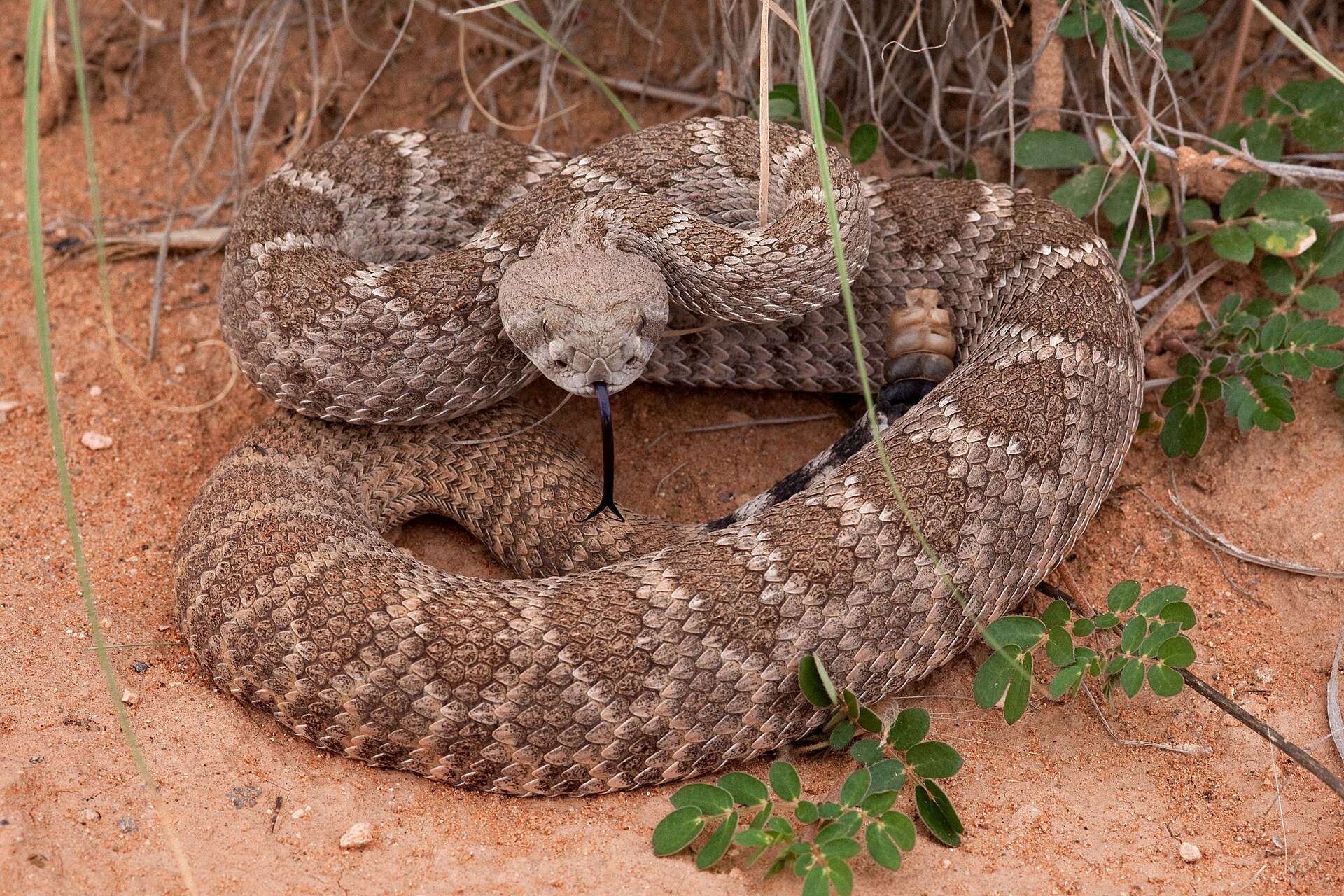
It is easily mistaken for black-tailed rattlesnakes (Crotalus molossus and its relatives), which live mostly further north and east but meet it in a few areas, where the two may interbreed6,7. The western diamondback (Crotalus atrox) also occurs nearby in southern Sonora3; the Mexican west coast rattlesnake has a more prominent spinal ridge and rougher scales2. In the Sierra de Coalcomán it lives close to the Neotropical rattlesnake Crotalus culminatus, which has clear dark stripes on the neck, whereas the Mexican west coast rattlesnake’s neck pattern is faint2,3.
These differences are not a safe basis for handling any snake. Keep your distance from every snake you cannot identify.
In captivity
The Mexican west coast rattlesnake is a dangerous venomous snake and is not suitable as a pet. In Mexico it is a legally protected species5. Rattlesnakes of this species were once shipped from Colima to dealers in the United States and sold as “Mexican green rattlesnakes”2.
Look-alikes
Don’t confuse it with…
These snakes are often mistaken for each other. Use the differences to learn, never as a reason to handle a snake.
References
- 1
Uetz, P. et al. (eds.) (2026). Crotalus basiliscus (Cope, 1864). The Reptile Database. reptile-database.reptarium.cz
- 2
Klauber, L.M. (1952). Taxonomic studies of the rattlesnakes of mainland Mexico. Bulletins of the Zoological Society of San Diego 26: 1–143. (Crotalus basiliscus basiliscus, pp. 79–84.) archive.org
- 3
Armstrong, B.L. & Murphy, J.B. (1979). The natural history of Mexican rattlesnakes. University of Kansas Museum of Natural History Special Publication 5. archive.org
- 4
Hardy, L.M. & McDiarmid, R.W. (1969). The amphibians and reptiles of Sinaloa, Mexico. University of Kansas Publications, Museum of Natural History 18(3): 39–252. archive.org
- 5
Ramírez Bautista, A. & Hernández Ibarra, X. (2004). Ficha técnica de Crotalus basiliscus. CONABIO species account, via EncicloVida (Comisión Nacional para el Conocimiento y Uso de la Biodiversidad, Mexico). enciclovida.mx
- 6
Castro-Bastidas, H.A., Velarde-Urías, H., Jacobo-González, J.D. & Serrano, J.M. (2025). First record of mating between a pair of putative Crotalus basiliscus and Crotalus nigrescens suggests the potential for hybridisation areas in the Sierra Madre Occidental, Mexico. The Herpetological Bulletin 172: 24–26. doi.org
- 7
Lara-Galván, J.L., Martínez-Montoya, J.F., Sigala-Rodríguez, J.J. et al. (2020). Rattlesnake (Crotalus spp.) distribution and diversity in Zacatecas, Mexico. ZooKeys 1005: 103–132. doi.org
- 8
Segura, Á., Herrera, M., Reta Mares, F. et al. (2017). Proteomic, toxicological and immunogenic characterization of Mexican west-coast rattlesnake (Crotalus basiliscus) venom and its immunological relatedness with the venom of Central American rattlesnake (Crotalus simus). Journal of Proteomics 158: 62–72. doi.org
- 9
Colis-Torres, A., Neri-Castro, E., Strickland, J.L. et al. (2022). Intraspecific venom variation of Mexican West Coast Rattlesnakes (Crotalus basiliscus) and its implications for antivenom production. Biochimie 192: 111–124. doi.org
- 10
World Health Organization (2017). Guidelines for the production, control and regulation of snake antivenom immunoglobulins. WHO Technical Report Series No. 1004, Annex 5, Appendix 1: Worldwide distribution of medically important venomous snakes. cdn.who.int
- 11
Ponce-Campos, P. & García Aguayo, A. (2007). Crotalus basiliscus. The IUCN Red List of Threatened Species 2007: e.T64312A12763909. iucnredlist.org
Play
Play as the mexican west coast rattlesnake.
Its real pattern is a skin in Snake. Every run ends with a fact.