
North Philippine temple pit viper
Tropidolaemus subannulatus (Gray, 1842)
Also called Bornean keeled green pit viper, Banded temple viper, Philippine temple pit viper
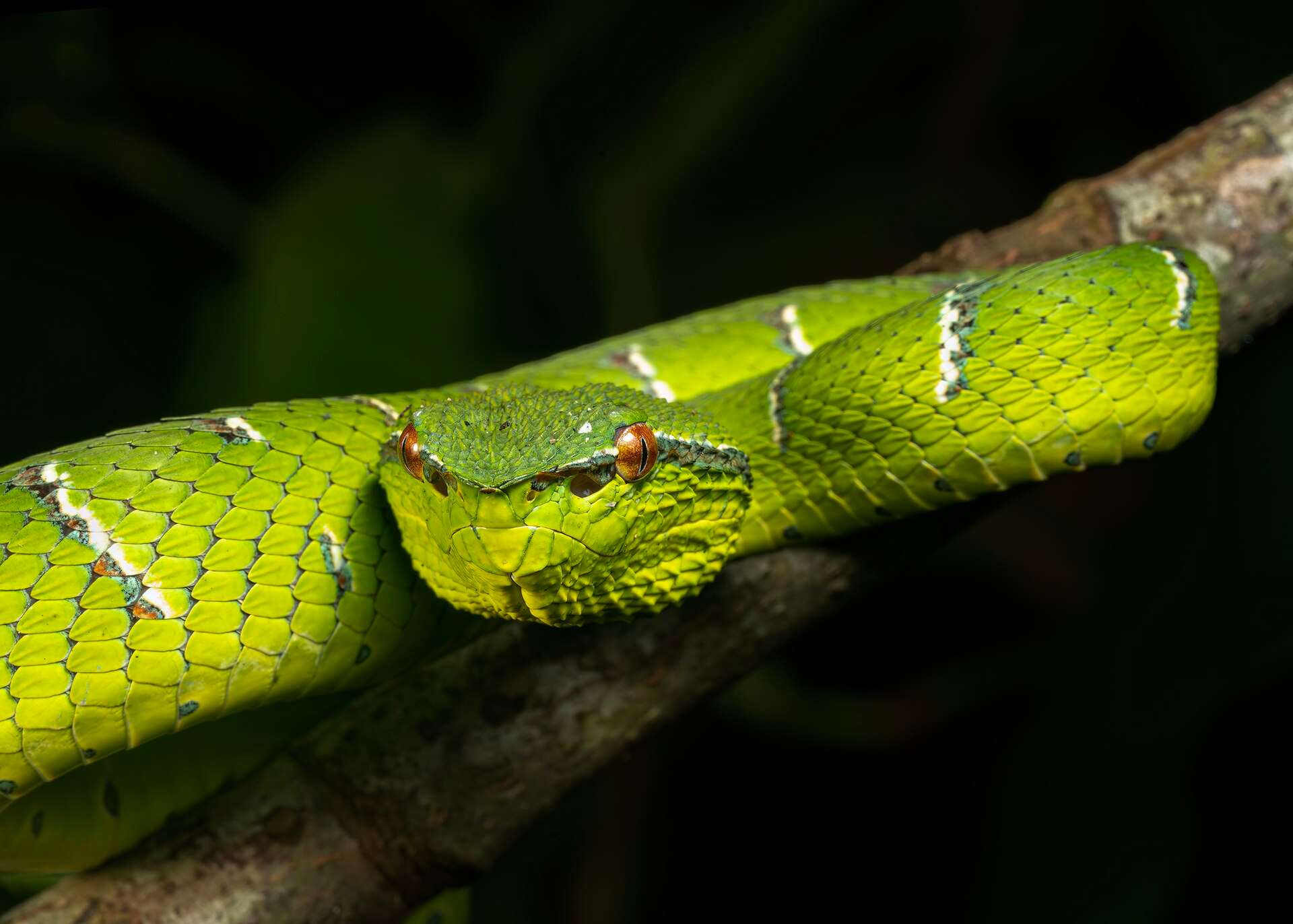
A green or blue tree-dwelling pit viper of the Philippines, Borneo and Sulawesi, with strongly keeled head scales. Females are much larger than males and often banded with turquoise or white.

Is it dangerous?
Yes. It is a venomous pit viper listed by WHO as medically important, though most recorded bites caused only local pain and swelling. Anyone bitten should go to hospital.
Do not approach. If someone is bitten, go to a hospital now.
At a glance
- Length
- 0.5–0.96 m
- Active
- Day and night
- Found in
- Philippines, Borneo and Sulawesi
- Venom
- Mainly local (pain and swelling)
- Young
- Live young
- Habitat
- Rainforest, Trees and shrubs, Plantations
- Diet
- Rodents, Birds, Lizards
Length shows a typical adult, then the largest recorded.
IUCN Red List status: Least Concern
Country guideSnakes of IndonesiaSnakes of the Philippines
True size
Hump-nosed viperMedically significant
0.6 m at most
About a third of the height of a 1.7 m adult.
Usual range 0.48–0.6 m, the bar on the ruler.
Malayan pit viperMedically significant
0.87 m at most
About half the height of a 1.7 m adult.
Usual range 0.7–0.87 m, the bar on the ruler.
White-lipped pit viperMedically significant
0.9 m at most
About half the height of a 1.7 m adult.
Usual range 0.5–0.9 m, the bar on the ruler.
North Philippine temple pit viperMedically significant
0.96 m at most
About half the height of a 1.7 m adult.
Usual range 0.5–0.96 m, the bar on the ruler.
Puff adderMedically significant
1.9 m at most
About as long as a 1.7 m adult is tall.
Usual range 0.8–1.9 m, the bar on the ruler.
Banded kraitMedically significant
2.25 m at most
About 1.5 times the height of a 1.7 m adult.
Usual range 1.35–2.25 m, the bar on the ruler.
Indian rat snakeNon-venomous
3 m at most
About 2 times the height of a 1.7 m adult.
Usual range 1.8–3.0 m, the bar on the ruler.
Reticulated pythonNon-venomous
7.67 m at most
About 4.5 times the height of a 1.7 m adult.
Usual range 2.5–7.67 m, the bar on the ruler.
Each snake is drawn at the longest length in its profile, on the same scale as the adult. Length is to scale; thickness is not.
Identification
This is a pit viper, with a heat-sensing pit on each side of the head between the eye and nostril3,7. The scales on the top of its head and on its chin are strongly keeled3. Its colour is variable3. Females are green or blue, often with crossbands of blue and white or red and white, and a pale stripe behind the eye3,4. Males and young snakes are green, with white or red spots and a white or red stripe behind the eye3,4. In some populations on Negros, even the males are blue3.
Males stay small, growing to about 0.5 m3,4. Females are much larger: the largest female reported by Vogel and colleagues was 0.96 m long, while the largest male was only 0.46 m3.
Distribution
This pit viper lives in the Philippines, on Borneo (Sabah, Sarawak, Brunei and Kalimantan), and in Indonesia on Sulawesi, Buton, the Sangihe Islands and Belitung1,3. In the Philippines it is known from Luzon, the Visayas, Palawan, parts of Mindanao and the Sulu Archipelago1,5. Until 2007 it was included in Wagler’s temple pit viper (Tropidolaemus wagleri)2. A revision that year restricted T. wagleri to southern Thailand, Peninsular Malaysia and Sumatra, used T. subannulatus for snakes from Borneo, Sulawesi, the Sulu Archipelago and the Philippines, and recognised T. philippensis on Mindanao2. Its authors expected that T. subannulatus might itself be split further3.
Habitat
On Luzon and in the Visayas it is common and widespread in forest, from sea level to mid-mountain elevations6. It lives in trees and seldom comes down to the ground3. In Malaysia, temple pit vipers are generally found in wet lowland rainforest from sea level up to about 400 m4. In Malaysia, people have been bitten by temple pit vipers while picking fruit in orchards, gardening, weeding and farming, and in forests and oil palm plantations4.
Behaviour
Temple pit vipers are not considered aggressive4,5. They usually strike only when provoked, disturbed or accidentally stepped on, and most people bitten in a Malaysian study were bitten only once4. In that study, the hand or arm was bitten in 57% of cases4.
Diet
Temple pit vipers feed on small animals, especially birds, frogs, lizards, mice and other rodents4. In the Philippines it has been described as useful to people, because it eats agricultural pests, including rodents and even large rats5.
Reproduction
The North Philippine temple pit viper gives birth to live young rather than laying eggs1. Young temple pit vipers are slender and green with white and red spots, and the sexes only take on their different adult colours as they grow4.
Venom and medical significance
All pit vipers are venomous, and the World Health Organization lists this species in its Category 2 of medically important snakes, meaning it can cause illness or death but clinical data are lacking4,7. In practice, recorded bites have been mild. A study of 190 bites by this species in Sabah and Sarawak, together with bites by its close relative T. wagleri, found mainly local pain and some swelling4. Almost all patients had only minimal local effects, antivenom was not needed in any case, and no one died4. Its venom does not affect blood clotting, and no specific antivenom has been made4. The study’s authors suggested it should be removed from the WHO Category 2 list in Malaysia4. Even so, anyone bitten should go to hospital immediately.
Conservation
The North Philippine temple pit viper is listed as Least Concern on the IUCN Red List (assessed in 2022)8. In the Philippines it is common and widespread in forest6.
Similar species
In the Philippines, green pit vipers of the genus Trimeresurus, such as the Philippine pit viper (Trimeresurus flavomaculatus), have smooth scales on the head and chin, while this species has strongly keeled ones3. On Mindanao, Leyte and Samar the related Tropidolaemus philippensis also occurs; it has fewer scale rows around the body (18–19 rather than 21–29)3. These differences are not a safe basis for handling any snake. Keep your distance from every snake you cannot identify.
In captivity
This is a venomous snake and is not suitable as a pet. Bites mostly happen when people disturb one by accident, for example while picking fruit or gardening4. Leave any pit viper you find alone. It should never be caught or kept by private individuals.
References
- 1
Uetz, P. et al. (eds.) (2026). Tropidolaemus subannulatus (Gray, 1842). The Reptile Database. reptile-database.reptarium.cz
- 2
Vogel, G., David, P., Lutz, M., van Rooijen, J. & Vidal, N. (2007). Revision of the Tropidolaemus wagleri-complex (Serpentes: Viperidae: Crotalinae). I. Definition of included taxa and redescription of Tropidolaemus wagleri (Boie, 1827). Zootaxa 1644: 1–40. doi.org
- 3
Leviton, A.E., Brown, R.M. & Siler, C.D. (2014). The dangerously venomous snakes of the Philippine Archipelago, with identification keys and species accounts. In: Williams, G.C. & Gosliner, T.M. (eds.), The Coral Triangle: The 2011 Hearst Philippine Biodiversity Expedition. California Academy of Sciences, San Francisco, pp. 473–530. cameronsiler.com
- 4
Ismail, A.K., Abd Hamid, M.N.H., Ariff, N.A., Frederic Ng, V.E.R., Goh, W.C., Abdul Samat, N.S., Osman, A.M.Z., Safferi, R.S., Mohamed@Ismail, Z. & Hodgson, W. (2023). Frequency, clinical characteristics and outcomes of Tropidolaemus species bite envenomations in Malaysia. PLOS Neglected Tropical Diseases 17(1): e0010983. doi.org
- 5
Leviton, A.E., Siler, C.D., Weinell, J.L. & Brown, R.M. (2018). Synopsis of the snakes of the Philippines. Proceedings of the California Academy of Sciences, Series 4, 64(14): 399–568. cameronsiler.com
- 6
Brown, R.M., Siler, C.D., Oliveros, C.H., Welton, L.J., Rock, A., Swab, J., Van Weerd, M., van Beijnen, J., Jose, E., Rodriguez, D., Jose, E. & Diesmos, A.C. (2013). The amphibians and reptiles of Luzon Island, Philippines, VIII: the herpetofauna of Cagayan and Isabela Provinces, northern Sierra Madre Mountain Range. ZooKeys 266: 1–120. doi.org
- 7
Castillo, D.A.E., Seneci, L., Chowdhury, A., Rimando, M.G. & Fry, B.G. (2025). Bite first, bleed later: how Philippine Trimeresurus pit viper venoms hijack blood clotting. Toxins 17(4): 185. pmc.ncbi.nlm.nih.gov
- 8
Auliya, M., Dehling, M., Inger, R.F., Iskandar, D., Vogel, G., Diesmos, A.C. & Sy, E. (2022). Tropidolaemus subannulatus. The IUCN Red List of Threatened Species 2022: e.T192241A217770117. iucnredlist.org
Play
Play as the north philippine temple pit viper.
Its real pattern is a skin in Snake. Every run ends with a fact.