
Puff adder
Bitis arietans (Merrem, 1820)
Also called Pofadder
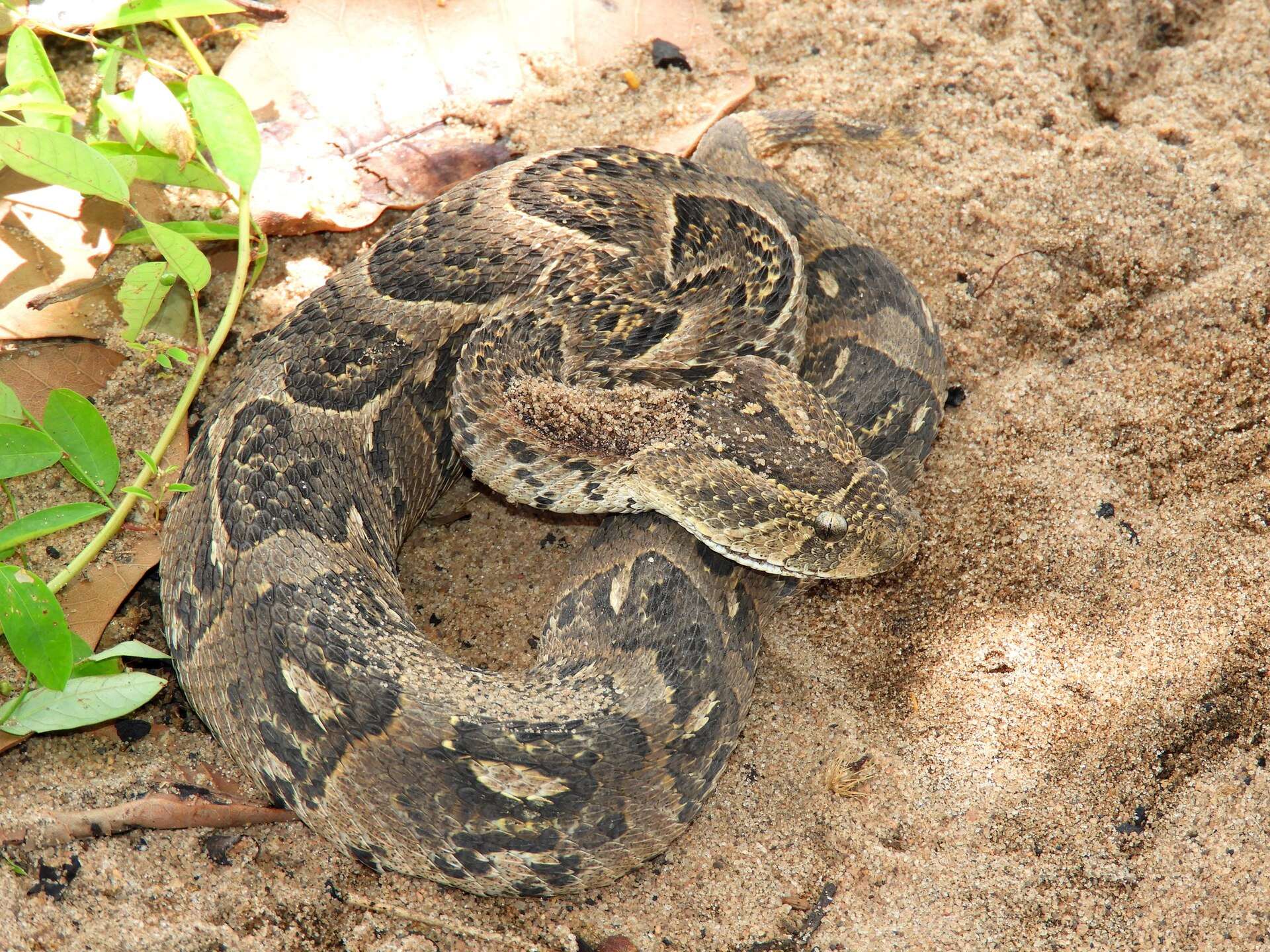
A thick-bodied, well-camouflaged viper with pale, dark-edged chevrons along its back. It is Africa's most widespread viper and a leading cause of serious snakebite across much of the continent.

Is it dangerous?
Yes. Its venom causes severe pain, swelling and tissue damage, and it bites many people who step on it by accident. Anyone bitten should go to hospital immediately.
Do not approach. If someone is bitten, go to a hospital now.
At a glance
- Length
- 0.8–1.9 m
- Active
- At night
- Found in
- Sub-Saharan Africa and Arabia
- Venom
- Cytotoxic and haemotoxic
- Young
- Live young
- Habitat
- Savanna, Grassland, Open woodland
- Diet
- Rodents, Frogs and toads, Birds
Length shows a typical adult, then the largest recorded.
IUCN Red List status: Least Concern
Country guideSnakes of KenyaSnakes of NigeriaSnakes of South Africa
True size
West African carpet viperMedically significant
0.7 m at most
About a third of the height of a 1.7 m adult.
Usual range 0.4–0.7 m, the bar on the ruler.
Gaboon viperMedically significant
1.75 m at most
About as long as a 1.7 m adult is tall.
Usual range 1.0–1.75 m, the bar on the ruler.
Mozambique spitting cobraMedically significant
1.8 m at most
About as long as a 1.7 m adult is tall.
Usual range 1.2–1.8 m, the bar on the ruler.
Ball pythonNon-venomous
1.83 m at most
About as long as a 1.7 m adult is tall.
Usual range 1.2–1.83 m, the bar on the ruler.
Puff adderMedically significant
1.9 m at most
About as long as a 1.7 m adult is tall.
Usual range 0.8–1.9 m, the bar on the ruler.
Black-necked spitting cobraMedically significant
2.2 m at most
About 1.5 times the height of a 1.7 m adult.
Usual range 1.25–2.2 m, the bar on the ruler.
BoomslangMedically significant
2.3 m at most
About 1.5 times the height of a 1.7 m adult.
Usual range 1.3–2.3 m, the bar on the ruler.
Black mambaMedically significant
4.5 m at most
About 2.5 times the height of a 1.7 m adult.
Usual range 2.5–4.5 m, the bar on the ruler.
Each snake is drawn at the longest length in its profile, on the same scale as the adult. Length is to scale; thickness is not.
Identification
The puff adder is a heavy, thick-bodied viper with a flattened, broad head, upward-pointing nostrils, keeled scales and a very short tail2,3. Its eyes have vertical pupils3. It may be almost black, brown, reddish or even orange above, with distinctive pale, black-edged U- or V-shaped marks along the back that become rings around the tail; the belly is pale with blackish marks2.
Adults average about 0.8 m7. In southern Africa most are under 1 m from snout to vent, but some East African populations grow to more than 1.8 m3, and WHO gives a maximum total length of more than 190 cm2. Its fangs are 16–18 mm long8.
Distribution
The puff adder is the most widespread and abundant viper in Africa3. It occurs across most of sub-Saharan Africa, from Senegal and Mauritania to Somalia and south to the Cape, and also in Morocco and Western Sahara, south-western Saudi Arabia and Oman1. The Reptile Database notes that it is not found in Liberia, Algeria or Equatorial Guinea1.
Two subspecies are recognised: the widespread B. a. arietans and B. a. somalica of Somalia and northern Kenya1, which has keeled scales under its tail2. WHO notes that the puff adder is probably a complex of more than one species2.
Habitat
The puff adder lives in a wide variety of habitats, especially savanna and open grassland2. It is absent only from true desert, rainforest and high mountain grassland2,3. In the West African savanna it is one of the commonest causes of serious snakebite, and farm workers are among the people most often bitten2.
Behaviour
The puff adder is an extreme ambush hunter3. It relies on camouflage and is reluctant to move; when hiding, it often does not hiss or strike as a person approaches, because this would give away its position5. Wild puff adders usually move less than 10 m a day and may wait in the same ambush spot for weeks3.
It is also hidden from smell: in tests, trained dogs and meerkats easily found other snakes by scent but could not pick out puff adders4. When threatened, it inflates its body and gives a loud hiss by blowing air out through its nostrils2. Most people are bitten at night when they step on one by accident, although bites also happen by day when the snake is basking6.
Diet
The puff adder eats mammals, frogs and toads, birds and reptiles, with rodents and frogs the most important prey3. One study cited by the Reptile Database found that rodents made up 76% of its prey1. It lures prey by wiggling its tongue or tail tip3,5.
It needs little food: in a captive study, puff adders kept a steady weight on about 63% of their body weight in rodents a year, yet could eat up to 10 rodents at one sitting when food was plentiful3. A puff adder that has fattened up could probably go about two years without eating3.
Reproduction
The puff adder gives birth to live young1,7. Mating has been reported from October to December, with the young born around April7. A litter usually holds 20–40 young, each about 23.5–25.5 cm long at birth7. Puff adders have been recorded hybridising with the Gaboon viper in the wild1.
Venom and medical significance
The puff adder is thought to cause most serious snakebites in Africa as a whole, and it is the main cause of serious envenoming in eastern and southern Africa2. It accounted for up to 75% of snakebites in one Zimbabwean study8. Its venom is strongly cytotoxic and also haemotoxic, causing severe pain, swelling that can spread up the whole limb to the trunk, blistering and tissue death that may lead to amputation2,6. Fluid lost into the swollen limb can cause dangerous shock, and some patients have bleeding or blood-clotting problems2,8.
Antivenoms that cover the puff adder include the South African (SAVP) polyvalent antivenom and EchiTAb-Plus-ICP2. Anyone bitten should go to hospital immediately.
Conservation
The puff adder is listed as Least Concern on the IUCN Red List (assessed in 2021)9. It remains widespread and common3. As a major predator of rodents, it may help to control rodent outbreaks that damage crops3.
Similar species
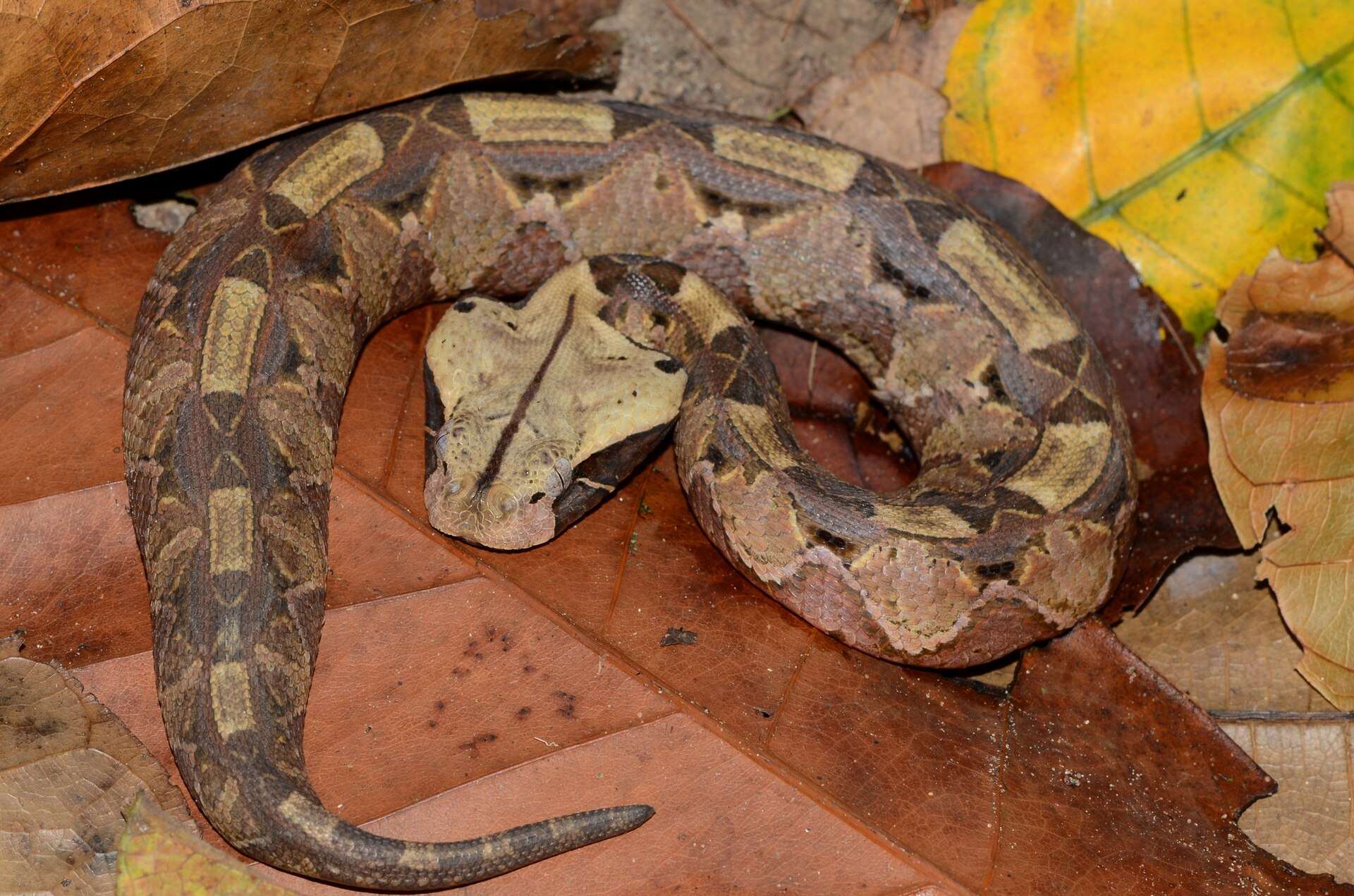
Where forest and savanna meet, the puff adder can be confused with the Gaboon viper (Bitis gabonica) and the rhinoceros viper (B. rhinoceros)2. These forest vipers have small horn-like scales on the nose, dark triangles below the eyes and a geometric pattern of pale rectangles and triangles, while the puff adder has simple pale, black-edged U- or V-shaped marks2. The puff adder is also absent from rainforest, where the Gaboon vipers live2. These differences are not a safe basis for handling any snake. Keep your distance from every snake you cannot identify.
In captivity
The puff adder is dangerously venomous and is not suitable as a pet. Captive puff adders have lived for almost 16 years7. In a 2025 review, more than half of the puff adder bites described in detail in the medical literature were from captive snakes8.
Look-alikes
Don’t confuse it with…
These snakes are often mistaken for each other. Use the differences to learn, never as a reason to handle a snake.
References
- 1
Uetz, P. et al. (eds.) (2026). Bitis arietans (Merrem, 1820). The Reptile Database. reptile-database.reptarium.cz
- 2
World Health Organization, Regional Office for Africa (2010). Guidelines for the prevention and clinical management of snakebite in Africa. WHO/AFR/EDM/EDP/10.01, Brazzaville. (Sections 2.1.2, 2.3.8, 3.1, 7.9, 7.10, 13.5 and Annex 1.) iris.who.int
- 3
Alexander, G.J. (2025). Factorial scope of ingestion and the potential functional response of puff adders (Bitis arietans) to high prey abundance. Scientific Reports 15: 16579. doi.org
- 4
Miller, A.K., Maritz, B., McKay, S., Glaudas, X. & Alexander, G.J. (2015). An ambusher's arsenal: chemical crypsis in the puff adder (Bitis arietans). Proceedings of the Royal Society B 282: 20152182. doi.org
- 5
African Snakebite Institute. Puff Adder (Bitis arietans) species account. africansnakebiteinstitute.com
- 6
African Snakebite Institute (2024). Snakebite profile: Puff Adder, Bitis arietans. africansnakebiteinstitute.com
- 7
Brown, A. (2019). Bitis arietans. Animal Diversity Web, University of Michigan Museum of Zoology. animaldiversity.org
- 8
Tianyi, F.-L., Ngari, C., Wilkinson, M. et al. (2025). Clinical features of puff adder envenoming: case series of Bitis arietans snakebites in Kenya and a scoping review of the literature. PLoS Neglected Tropical Diseases 19(2): e0012845. doi.org
- 9
Wagner, P., Wilms, T., Luiselli, L., Penner, J., Rödel, M.-O. et al. (2021). Bitis arietans. The IUCN Red List of Threatened Species 2021: e.T197461A2485974. iucnredlist.org
Play
Play as the puff adder.
Its real pattern is a skin in Snake. Every run ends with a fact.