
Care guide
Ball python care
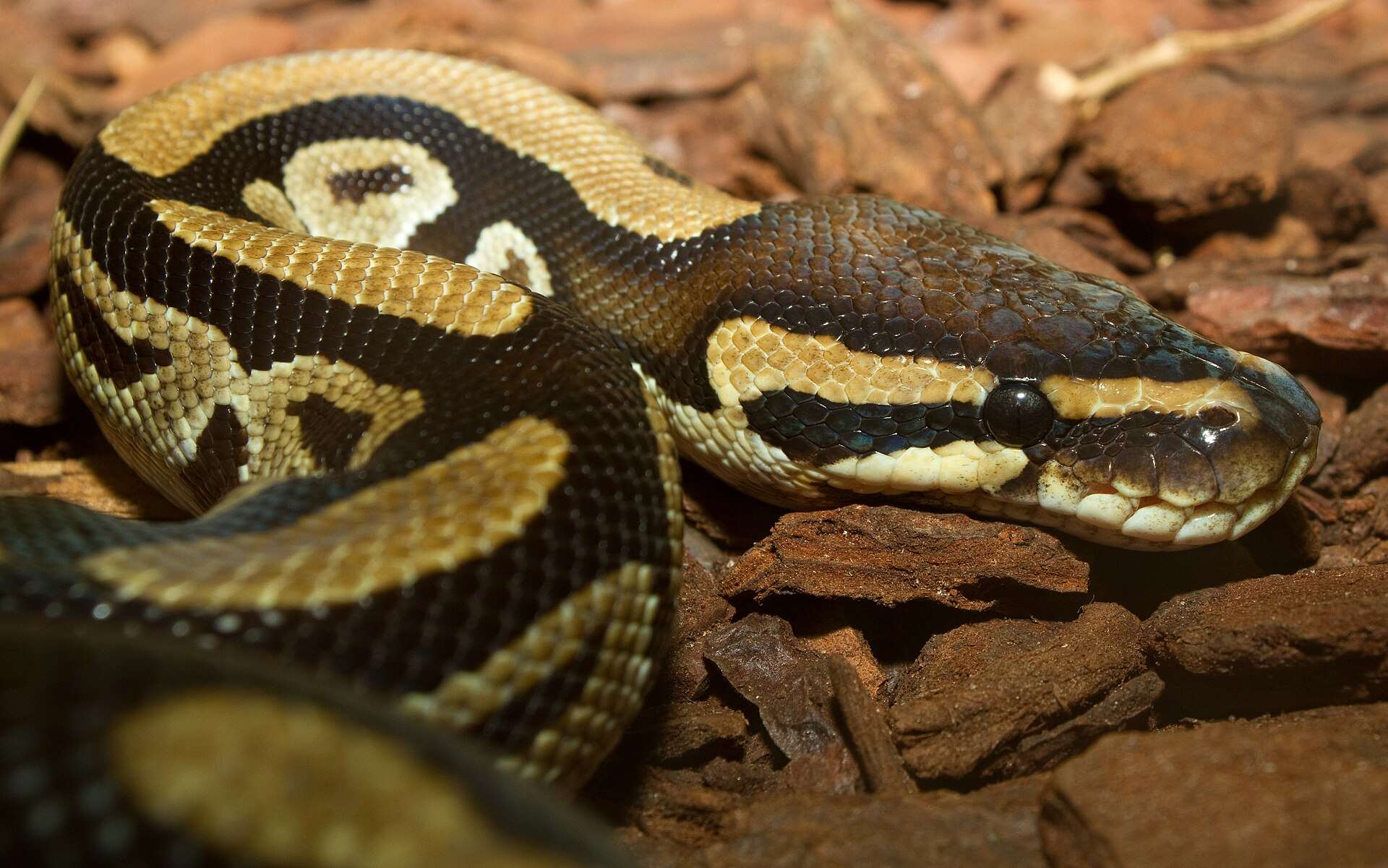
Ball pythons, also called royal pythons, are calm snakes that can live for more than 20 years. They need room to stretch and explore, a warm-to-cool gradient, steady humidity and thawed prey.
Every fact is sourced · draft, pending review by a reptile vet
At a glance
- Adult size
- 1–1.5 m; females are larger than males7
- Enclosure for an adult
- At least as long as the snake, and a third of its length wide and high1
- Warm side
- Basking zone 30–32 °C1
- Cool side
- 24–26 °C1
- Humidity
- 50–60%1
- Feeding an adult
- A thawed rodent slightly wider than the snake, every 7–14 days1
- Lifespan in captivity
- Can be more than 20 years1
Before you get one
A ball python can live for more than 20 years in captivity, and the Royal Veterinary College gives up to 25 years1,2. A veterinary manual lists 15–20 years as the average, while zoo records run past 40 years5,7. Choose a captive-bred snake, because captive-bred reptiles are less likely than wild-caught ones to bite, refuse food or carry parasites5. Ball pythons are the most traded CITES-listed live animal exported from Africa, and trade records from Benin, Ghana and Togo show a switch from mostly wild-caught to mostly “ranched” snakes, which are taken from the wild as eggs or young and reared for export12. Researchers say little is known about their welfare during capture, transport and breeding, and the RSPCA opposes wild-caught animals in the pet trade13,15. Some colour morphs carry health problems, such as the inherited neurological “wobble syndrome” of the spider morph, and keeping pythons is prohibited in many areas, so check the morph and your local laws first14,5.
Enclosure
Sources differ on size: the RSPCA asks for a vivarium at least as long as the snake, with a width and height of at least a third of its length, such as 120 × 40 × 40 cm for a 1.2 m snake1. The Royal Veterinary College’s absolute minimum for an adult is 122 × 61 × 61 cm, one veterinary hospital gives 91 × 61 × 46 cm, and the MSD Veterinary Manual asks for at least 0.6 m² of floor per metre of snake and as much space as possible2,6,3. When the same 35 ball pythons were moved from rack tubs to furnished terrariums, they could bask, climb, burrow and bathe only in the terrariums, and almost all abnormal behaviour was seen in the racks8. A review of snake welfare concludes that snakes need room to stretch out fully, and the UK government’s Animal Welfare Committee advises that even a vivarium one snake-length long is acceptable only for short-term display10,9. Owners reported fewer signs of ill health in snakes kept in enclosures longer than the snake, yet a study of more than 5,000 ball pythons at pet expos and in online videos found that breeders and sellers typically kept them in enclosures too small to stretch out in20,11. Ball pythons are stressed by large, bare spaces, so give several hides at both ends, sturdy branches and a soil substrate to burrow in1,2.
Heat and light
Put the heat source at one end so the snake can move between warm and cool areas1. The RSPCA recommends a basking zone of 30–32 °C and a cool end of 24–26 °C, and the Royal Veterinary College a basking maximum of about 32 °C, a cool end of about 24 °C and nights no cooler than about 24 °C1,2. Other veterinary sources differ slightly: the MSD Veterinary Manual gives a preferred air range of 25–30 °C with basking spots about 5 °C warmer, and one hospital warns that temperatures above 33 °C (92 °F) can cause serious illness4,6. Run every heater through a thermostat, guard bulbs, check both ends with a thermometer every day, keep under-tank heaters to no more than 30% of the floor and never use “hot rocks”, which can burn1,16. Ball pythons are mostly active at night, but a low-level UVB lamp giving about UVI 1.0 in the basking zone and none in the shade is still recommended, on a 12-hour day2,1.
Humidity and water
The RSPCA recommends 50–60% humidity measured at the cool end, misted up to about 80% at times and allowed to fall in between, and the Royal Veterinary College also gives 50–60%1,2. The MSD Veterinary Manual’s range is wider, at 50–80%, and one veterinary hospital advises about 70% while a snake is shedding4,6. A hide with damp moss gives the snake a humid retreat1. Do not cut ventilation to hold humidity: damp, stale air causes skin and respiratory disease, and the RSPCA says respiratory infections in royal pythons are usually caused by high humidity and poor ventilation3,1. Provide a water bowl big enough to soak in, and change the water at least daily1,2.
Feeding
Feed frozen rodents that have been thawed and warmed to about body temperature, 37 °C, and offer them with tongs2,1. Live rodents are not advised, and feeding them is illegal in many countries, because live prey can badly injure a snake3,17. Choose prey slightly wider than the widest part of the snake’s body; young snakes eat about every 5–7 days and adults every 7–14 days, depending on their weight1,6. Weigh the snake regularly, because ball pythons can become underweight or obese1,6. Ball pythons are known for going off their food, sometimes with the seasons, but a stressful set-up or illness can also cause it, so see a reptile vet if a snake stops feeding suddenly1.
Handling
Ball pythons usually become docile with careful handling, although hatchlings are shyer and more likely to strike1. Scoop the snake up with one hand near the head and the other nearer the tail, support its whole body and never grab it1. If it pulls its neck back into an S shape, it feels threatened, so leave it for another time1. Keep sessions to about 10–15 minutes, wait 48 hours after a meal and avoid handling during a shed1. Wash your hands before handling if you have touched prey, and afterwards too, because reptiles can carry Salmonella1,2.
Health and when to see a vet
Take a new snake for a veterinary check, book a health check every year, and keep any new snake apart from others for 3–6 months19,3. See a reptile vet if you notice:
- wheezing, a whistling breath, open-mouth breathing, or loss of coordination and “star gazing”9,1;
- swelling around the mouth or face, which can be a sign of mouth rot9,1;
- stuck shed or retained eye caps, which should never be forced off9,17;
- mites, seen as tiny black specks or as a snake soaking for long periods1;
- weight loss, diarrhoea, constipation or regurgitation1,6;
- burns, often caused by heat mats or bulbs without a thermostat or guard6,17.
Inclusion body disease, caused by a reptarenavirus, affects boas and pythons; pythons usually develop severe neurological disease and most die within days or weeks of the first signs18. It spreads through body fluids, including during breeding and fights, and through snake mites18.
Questions people ask
- How big do ball pythons get?
- Most adults are 1–1.5 m long, and females grow larger than males. A few wild ball pythons have been reported at about 1.8 m.
- What size enclosure does a ball python need?
- Sources differ. The RSPCA asks for an enclosure at least as long as the snake and a third of its length wide and high, and the Royal Veterinary College's minimum for an adult is 122 × 61 × 61 cm. Welfare research supports giving more space, not less.
- How long do ball pythons live?
- Often more than 20 years with good care. Veterinary sources give 15–20 years as average and up to about 25 years, and zoo records run past 40 years.
- How often should you feed a ball python?
- Young snakes eat about every 5–7 days and adults every 7–14 days, depending on their weight. Offer a thawed rodent slightly wider than the widest part of the snake.
- Why won't my ball python eat?
- Ball pythons are known for fasting, sometimes with the seasons, but a poor set-up or illness can also cause it. Check the temperatures and humidity, and see a reptile vet if it stops suddenly or loses weight.
References
- 1
RSPCA. Royal python care (care sheet). Royal Society for the Prevention of Cruelty to Animals, accessed 2026. rspca.org.uk
- 2
RVC Exotics Service, Beaumont Sainsbury Animal Hospital (2024). Royal python care (factsheet, reviewed December 2024). Royal Veterinary College. rvc.ac.uk
- 3
Divers, S.J. & Comolli, J.R. (2025). Management and husbandry of reptiles. MSD Veterinary Manual, professional version. msdvetmanual.com
- 4
Divers, S.J. & Comolli, J.R. (2025). Table: Important husbandry requirements for selected reptiles. MSD Veterinary Manual. msdvetmanual.com
- 5
Divers, S.J. (2020, updated 2026). Selecting a reptile. MSD Veterinary Manual, pet owner version. msdvetmanual.com
- 6
Chicago Exotics Animal Hospital. Ball python care (veterinary care sheet), accessed 2026. exoticpetvet.com
- 7
Graf, A. (2011). Python regius. Animal Diversity Web, University of Michigan Museum of Zoology. animaldiversity.org
- 8
Hollandt, T., Baur, M. & Wöhr, A.-C. (2021). Animal-appropriate housing of ball pythons (Python regius): behavior-based evaluation of two types of housing systems. PLOS ONE 16(5): e0247082. doi.org
- 9
Animal Welfare Committee (2023). Opinion on the space requirements for snakes in vivaria within pet selling establishments. Defra, UK Government. assets.publishing.service.gov.uk
- 10
Warwick, C., Arena, P. & Steedman, C. (2019). Spatial considerations for captive snakes. Journal of Veterinary Behavior 30: 37–48. doi.org
- 11
D'Cruze, N. et al. (2020). Dropping the ball? The welfare of ball pythons traded in the EU and North America. Animals 10(3): 413. doi.org
- 12
Harrington, L.A. et al. (2020). Snakes and ladders: a review of ball python production in West Africa for the global pet market. Nature Conservation 41: 1–24. doi.org
- 13
Green, J. et al. (2020). Blind trading: a literature review of research addressing the welfare of ball pythons in the exotic pet trade. Animals 10(2): 193. doi.org
- 14
Rose, M.P. & Williams, D.L. (2014). Neurological dysfunction in a ball python (Python regius) colour morph and implications for welfare. Journal of Exotic Pet Medicine 23(3): 234–239. doi.org
- 15
RSPCA. Our concerns about exotic pets. Royal Society for the Prevention of Cruelty to Animals, accessed 2026. rspca.org.uk
- 16
Divers, S.J. (2020, updated 2026). Providing a home for a reptile. MSD Veterinary Manual, pet owner version. msdvetmanual.com
- 17
Divers, S.J. & Comolli, J.R. (2025). Environmental diseases and traumatic injuries of reptiles. MSD Veterinary Manual, professional version. msdvetmanual.com
- 18
Divers, S.J. & Comolli, J.R. (2025). Viral diseases of reptiles. MSD Veterinary Manual, professional version. msdvetmanual.com
- 19
Divers, S.J. (2020, updated 2024). Routine health care of reptiles. MSD Veterinary Manual, pet owner version. msdvetmanual.com
- 20
Cargill, B.M., Benato, L. & Rooney, N.J. (2022). A survey exploring the impact of housing and husbandry on pet snake welfare. Animal Welfare 31(2): 193–208. doi.org