
Gaboon viper
Bitis gabonica (Duméril, Bibron & Duméril, 1854)
Also called Gaboon adder, Central African Gaboon viper
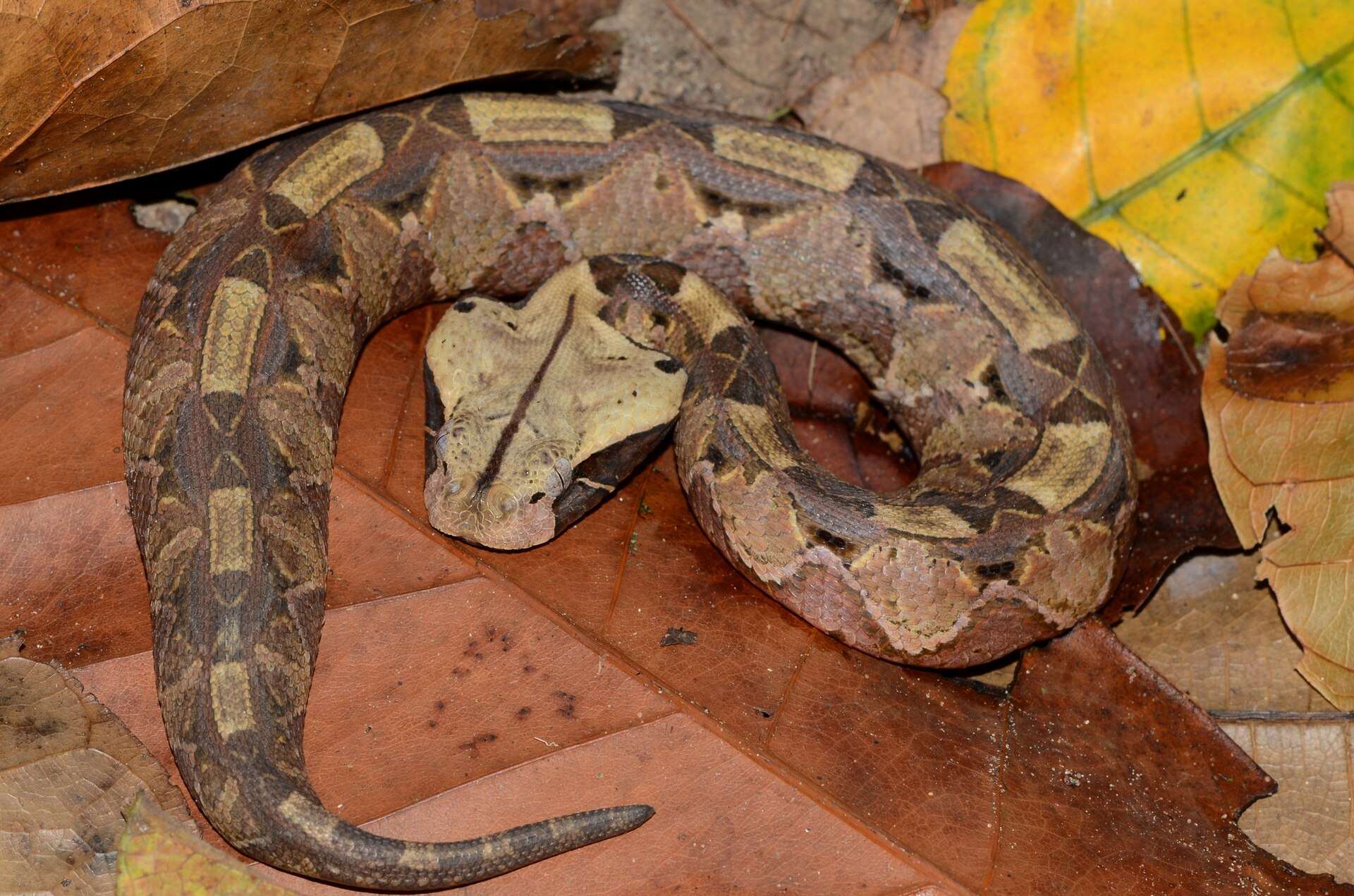
A huge, heavy-bodied forest viper with a broad, pale head and a geometric pattern of buff, brown and purple that hides it in fallen leaves. It is placid and slow, and lies in ambush for days.

Is it dangerous?
Yes. It has very long fangs and a large venom yield, and its bite causes severe swelling, bleeding and tissue damage. Anyone bitten should go to hospital immediately.
Do not approach. If someone is bitten, go to a hospital now.
At a glance
- Length
- 1.0–1.75 m
- Active
- At night
- Found in
- Central, East and south-eastern Africa
- Venom
- Cytotoxic and haemotoxic
- Young
- Live young
- Habitat
- Lowland rainforest, Coastal forest, Montane forest
- Diet
- Rodents, Other small mammals, Birds
Length shows a typical adult, then the largest recorded.
IUCN Red List status: Vulnerable
Country guideSnakes of KenyaSnakes of NigeriaSnakes of South Africa
True size
Brown house snakeNon-venomous
1.5 m at most
About three quarters of the height of a 1.7 m adult.
Usual range 0.6–1.5 m, the bar on the ruler.
Gaboon viperMedically significant
1.75 m at most
About as long as a 1.7 m adult is tall.
Usual range 1.0–1.75 m, the bar on the ruler.
Mozambique spitting cobraMedically significant
1.8 m at most
About as long as a 1.7 m adult is tall.
Usual range 1.2–1.8 m, the bar on the ruler.
Ball pythonNon-venomous
1.83 m at most
About as long as a 1.7 m adult is tall.
Usual range 1.2–1.83 m, the bar on the ruler.
Puff adderMedically significant
1.9 m at most
About as long as a 1.7 m adult is tall.
Usual range 0.8–1.9 m, the bar on the ruler.
Black-necked spitting cobraMedically significant
2.2 m at most
About 1.5 times the height of a 1.7 m adult.
Usual range 1.25–2.2 m, the bar on the ruler.
BoomslangMedically significant
2.3 m at most
About 1.5 times the height of a 1.7 m adult.
Usual range 1.3–2.3 m, the bar on the ruler.
Black mambaMedically significant
4.5 m at most
About 2.5 times the height of a 1.7 m adult.
Usual range 2.5–4.5 m, the bar on the ruler.
Each snake is drawn at the longest length in its profile, on the same scale as the adult. Length is to scale; thickness is not.
Identification
The Gaboon viper is a large, very heavy-bodied viper with a broad, triangular, pale head9,10, and a pair of horn-like scales on the tip of its snout10. Its back has a geometric pattern of pale buff or yellowish rectangles linked by darker hourglass shapes on a brown or purplish background, with dark triangles along the sides, which hides it well among fallen leaves10. A thin dark line runs down the middle of the head10. It has two dark triangles below each eye, while the closely related western Gaboon viper has only one1,6.
Adults average about 1 m long, and the largest reach about 1.75 m5. In southern Africa they average 90–120 cm4.
Distribution
The Reptile Database lists the Gaboon viper from Nigeria, Cameroon, Equatorial Guinea, Gabon, the two Congos, the Central African Republic, Chad and South Sudan east to Uganda, western Kenya, Rwanda and eastern Tanzania, and south to Angola, Zambia, Malawi, Mozambique, eastern Zimbabwe and Zululand in South Africa1. Gaboon vipers from Guinea to Ghana and Togo in West Africa, once a subspecies, are now treated as a separate species, the western Gaboon viper (Bitis rhinoceros)2,3. In South Africa this snake is found only in the far north-east of KwaZulu-Natal, from Mtunzini northwards along the coast4,7.
Habitat
Gaboon vipers live mainly in rainforest and other moist forest, where they lie hidden in the leaf litter on the forest floor10. They also occur in coastal and montane forest and in savanna5. In South Africa they depend on coastal forest, much of it inside the iSimangaliso Wetland Park, where radio-tracked snakes chose spots with dense undergrowth close to trees and shrubs12. In the cooler months they moved to more open areas, probably to keep warm12.
Behaviour
The Gaboon viper is mainly active at night, although it often basks at the edges of forests4. It hunts by ambush10,12. Radio-tracked snakes in South Africa often stayed still at one ambush site for weeks, frequently within a metre of an antelope trail, and one stayed in a single spot for 87 days in winter12. It is surprisingly placid4. If threatened, it may raise the front of its body and give a series of long, drawn-out hisses4.
Diet
In southern Nigeria, a study of 524 Gaboon vipers found that they ate mainly small mammals, followed by birds, lizards and occasionally frogs11. Young snakes ate more newborn mice and lizards than adults did11. In South Africa, Gaboon vipers have been recorded taking prey close to their own body weight, such as a red duiker, a small forest antelope12.
Reproduction
The Gaboon viper gives birth to live young1,10. Litters of about 20 to 50 young have been reported, and newborns are up to about 30 cm long and already show the adult pattern10. Females grow larger than males11. In South Africa, both sexes moved around most at the start of the breeding season, in March12.
Venom and medical significance
The Gaboon viper’s venom is strongly cytotoxic and also haemotoxic, causing severe pain, spreading swelling, bleeding from the fang punctures, blistering and tissue damage7. It is credited with the longest fangs of any snake in the world9, at more than 4 cm8, and a large Gaboon viper can deliver about twice as much venom as a puff adder7. Bites are rare because it is placid and seldom met, and in South Africa almost all known bites have been to people keeping captive snakes7,9. In a review of five bites from captive Gaboon vipers, patients had progressive swelling, local tissue death and slow blood clotting, and one person died after being unable to call for help13. The World Health Organization ranks it as of highest medical importance (Category 1) in countries such as Nigeria, Cameroon, the Democratic Republic of the Congo, Uganda and Zambia, and South Africa’s SAVP polyvalent antivenom has covered its venom since 19383,14. Anyone bitten should go to hospital immediately.
Conservation
The Gaboon viper is listed as Vulnerable on the IUCN Red List (assessment published in 2021)16. In South Africa it is threatened by habitat destruction and has been assessed as Near Threatened4. A study of the South African population suggested that it is doing better than was once thought, but that the coastal dune forest it relies on needs long-term protection12.
Similar species
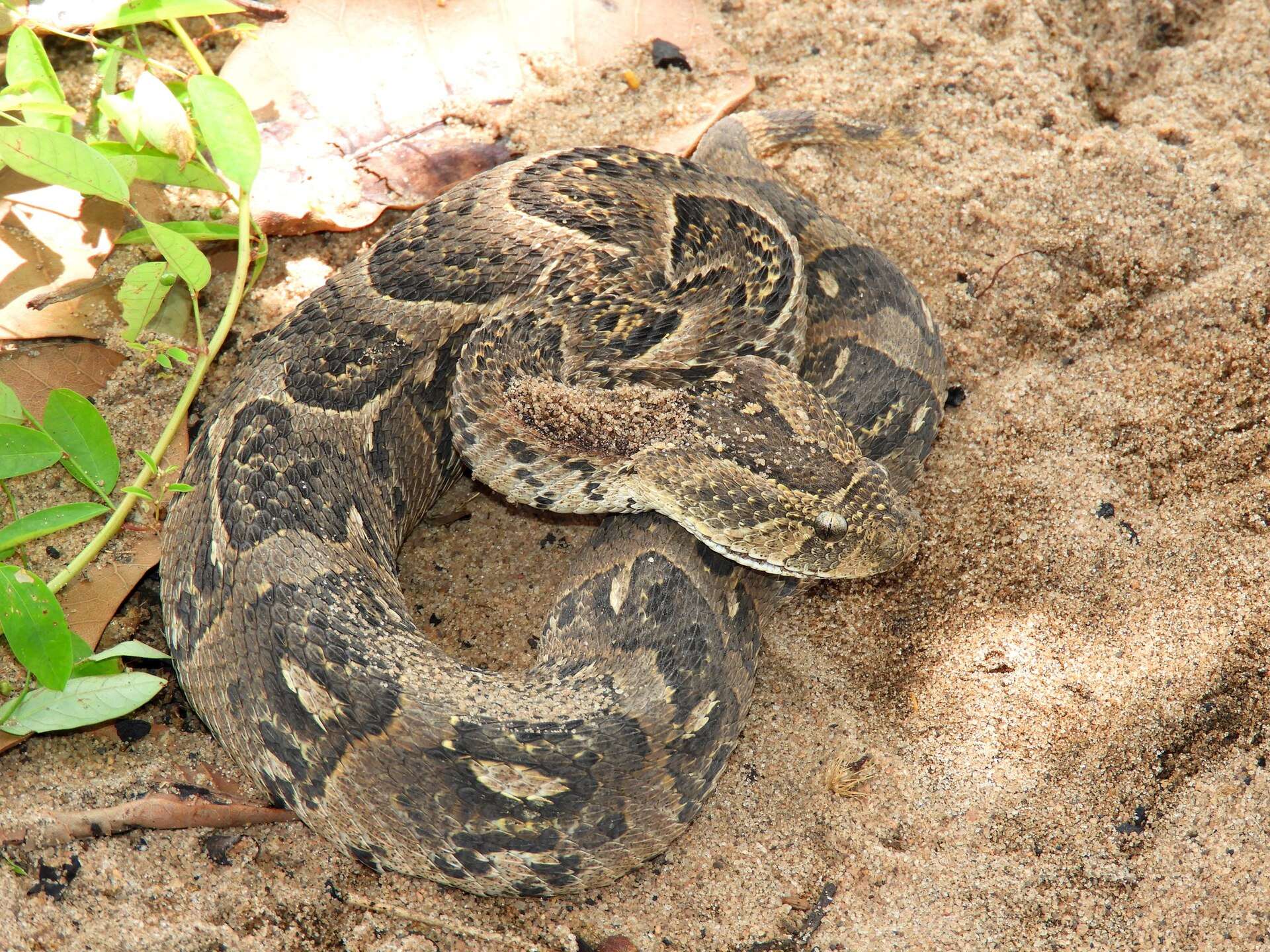
The puff adder (Bitis arietans) is another heavy-bodied ambush adder15, and the two species have been recorded hybridising in the wild1. The Gaboon viper’s large, pale head with a dark central line, and its pattern of pale rectangles and hourglass shapes, help to tell it apart9,10. In West Africa, the western Gaboon viper (Bitis rhinoceros) has a single dark triangle below each eye rather than two, and usually a more obvious pair of horns on the nose6.
These differences are not a safe basis for handling any snake. Keep your distance from every snake you cannot identify.
In captivity
The Gaboon viper is a dangerous venomous snake and is not suitable as a pet. Bites from captive Gaboon vipers have caused serious injury and at least one death, and doctors have warned of the dangers of keeping exotic African snakes13. In South Africa, almost all recorded bites have been to snake keepers7.
Look-alikes
Don’t confuse it with…
These snakes are often mistaken for each other. Use the differences to learn, never as a reason to handle a snake.
References
- 1
Uetz, P. et al. (eds.) (2026). Bitis gabonica (Duméril, Bibron & Duméril, 1854). The Reptile Database. reptile-database.reptarium.cz
- 2
Uetz, P. et al. (eds.) (2026). Bitis rhinoceros (Schlegel, 1855). The Reptile Database. reptile-database.reptarium.cz
- 3
World Health Organization (2017). Guidelines for the production, control and regulation of snake antivenom immunoglobulins. WHO Technical Report Series No. 1004, Annex 5. cdn.who.int
- 4
African Snakebite Institute. Gaboon Adder (Bitis gabonica) species account, southern Africa. africansnakebiteinstitute.com
- 5
African Snakebite Institute (2019). Gaboon Adder – Africa (Bitis gabonica). africansnakebiteinstitute.com
- 6
African Snakebite Institute (2019). Western Gaboon Adder – Africa (Bitis rhinoceros). africansnakebiteinstitute.com
- 7
African Snakebite Institute (2024). Snakebite profile: Gaboon Adder, Bitis gabonica. africansnakebiteinstitute.com
- 8
African Snakebite Institute (2024). Teeth and fangs. africansnakebiteinstitute.com
- 9
Iziko Museums of South Africa. Bitis gabonica (Gaboon adder). Biodiversity Explorer. biodiversityexplorer.info
- 10
Howard, J. (2006). Bitis gabonica (Gaboon viper). Animal Diversity Web, University of Michigan Museum of Zoology. animaldiversity.org
- 11
Luiselli, L. & Akani, G.C. (2003). Diet of sympatric Gaboon Vipers (Bitis gabonica) and Nose-horned Vipers (Bitis nasicornis) in southern Nigeria. African Journal of Herpetology 52(2): 101–106. doi.org
- 12
Warner, J.K. (2009). Conservation biology of the Gaboon Adder (Bitis gabonica) in South Africa. MSc thesis, University of the Witwatersrand, Johannesburg. hdl.handle.net
- 13
Marsh, N., DeRoos, F. & Touger, M. (2007). Gaboon viper (Bitis gabonica) envenomation resulting from captive specimens: a review of five cases. Clinical Toxicology 45(1): 60–64. doi.org
- 14
African Snakebite Institute (2025). Understanding snake venom and antivenom. africansnakebiteinstitute.com
- 15
African Snakebite Institute. Puff Adder (Bitis arietans) species account. africansnakebiteinstitute.com
- 16
Luiselli, L., Beraduccii, J., Howell, K., Msuya, C.A., Ngalason, W., Chirio, L., Kusamba, C., Gonwouo, N.L., LeBreton, M., Zassi-Boulou, A.-G. & Chippaux, J.-P. (2021). Bitis gabonica. The IUCN Red List of Threatened Species 2021: e.T13300893A13300904. iucnredlist.org
Play
Play as the gaboon viper.
Its real pattern is a skin in Snake. Every run ends with a fact.