
Boomslang
Dispholidus typus (Smith, 1828)
Also called Tree snake
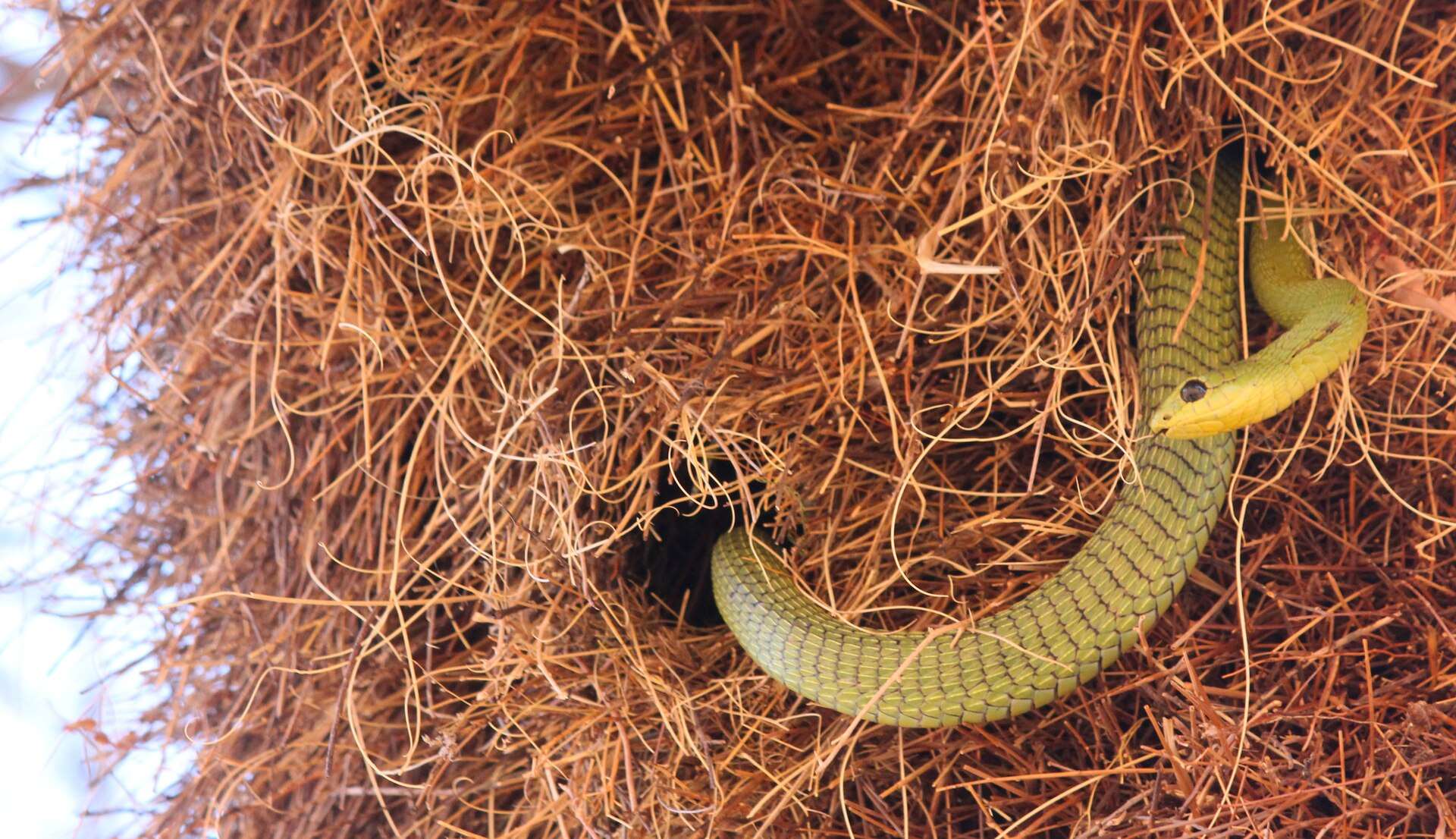
A long, slender tree snake with rough, keeled scales, a short head and very large eyes. Males are often green and females brown. It is shy and rarely bites, but its venom is dangerous.

Is it dangerous?
Yes. It is rear-fanged, but its venom stops the blood from clotting and symptoms can take hours to appear. Anyone bitten should go to hospital immediately.
Do not approach. If someone is bitten, go to a hospital now.
At a glance
- Length
- 1.3–2.3 m
- Active
- By day
- Found in
- Sub-Saharan Africa
- Venom
- Haemotoxic
- Young
- Lays eggs
- Habitat
- Savanna, Lowland forest, Grassland
- Diet
- Chameleons, Other lizards, Nestling birds
Length shows a typical adult, then the largest recorded.
IUCN Red List status: Least Concern
Country guideSnakes of KenyaSnakes of NigeriaSnakes of South Africa
True size
West African carpet viperMedically significant
0.7 m at most
About a third of the height of a 1.7 m adult.
Usual range 0.4–0.7 m, the bar on the ruler.
Gaboon viperMedically significant
1.75 m at most
About as long as a 1.7 m adult is tall.
Usual range 1.0–1.75 m, the bar on the ruler.
Mozambique spitting cobraMedically significant
1.8 m at most
About as long as a 1.7 m adult is tall.
Usual range 1.2–1.8 m, the bar on the ruler.
Ball pythonNon-venomous
1.83 m at most
About as long as a 1.7 m adult is tall.
Usual range 1.2–1.83 m, the bar on the ruler.
Puff adderMedically significant
1.9 m at most
About as long as a 1.7 m adult is tall.
Usual range 0.8–1.9 m, the bar on the ruler.
Black-necked spitting cobraMedically significant
2.2 m at most
About 1.5 times the height of a 1.7 m adult.
Usual range 1.25–2.2 m, the bar on the ruler.
BoomslangMedically significant
2.3 m at most
About 1.5 times the height of a 1.7 m adult.
Usual range 1.3–2.3 m, the bar on the ruler.
Black mambaMedically significant
4.5 m at most
About 2.5 times the height of a 1.7 m adult.
Usual range 2.5–4.5 m, the bar on the ruler.
Each snake is drawn at the longest length in its profile, on the same scale as the adult. Length is to scale; thickness is not.
Identification
The boomslang is a long, slender snake with heavily keeled scales that give its body a rough look6,14. It has a short, egg-shaped head and very large eyes, said to be the largest of any snake in Africa6,7,8. Most adult males are bright green, but in the Western Cape and much of the Eastern Cape many are black above with yellow or greenish sides, and females are usually brown or olive-brown4,6.
Young boomslangs are grey to brown above with a yellow to orange throat and a huge emerald-green eye, and they change to adult colours at about 1 m long4,6. Adults average about 1.3 m8, and the largest reach around 2.3 m6.
Distribution
The boomslang lives across much of sub-Saharan Africa1. The Reptile Database lists it from Senegal and Gambia in the west to Sudan, Eritrea, Ethiopia and Somalia in the east, and south through East and Central Africa to Angola, Namibia, Botswana, Zimbabwe, Mozambique, Eswatini and South Africa1. Old reports from Gabon are thought to be mistakes1. In southern Africa it is widespread but avoids the dry, treeless west6.
The Reptile Database now treats the spotted boomslang of Angola, the Democratic Republic of the Congo, Zambia and Malawi as a separate species, Dispholidus punctatus2, and the boomslang of Pemba Island, Tanzania, as Dispholidus pembae3.
Habitat
The boomslang uses a wide range of habitats, including lowland forest, savanna, grassland, fynbos and Karoo scrub8. It is mainly a tree snake and is usually found in trees or small shrubs4,8. It comes down to the ground to bask or to catch prey4,6. Within its habitats it tends to favour the moister areas and avoids very dry, desert-like country7.
Behaviour
The boomslang is active by day7. It is shy and very reluctant to bite, and in a tree it poses little threat to people4. If spotted, it usually moves quickly higher into the branches5. When threatened it inflates its neck to look bigger and opens its mouth7,8. Most bites happen when a basking snake is stepped on or grabbed by accident, or when someone handles it5.
Diet
Boomslangs feed mainly on chameleons and other tree lizards, and also take nestling birds and eggs1. Frogs are eaten too7,8. Like other back-fanged snakes, the boomslang hangs onto its prey while venom runs down grooves in fangs at the back of its mouth13.
Reproduction
The boomslang lays eggs1. Unlike most snakes, it can mate in trees as well as on the ground7,8. A female usually lays 8 to 14 eggs in late spring or early summer, in an old bird’s nest or on the ground near a tree8. Clutches of up to 27 eggs have been recorded7. The eggs hatch after about two to three months, and the hatchlings measure about 29–38 cm7.
Venom and medical significance
The boomslang is rear-fanged, but it can open its jaws to about 170 degrees and easily bite an arm or a leg13. Its haemotoxic venom uses up the blood’s clotting factors, so the blood stops clotting and bleeding can follow from the bite, the gums, the nose and inside the body5,9,10. Symptoms usually appear 6 to 36 hours after a bite, so a person may feel well at first, although a young man in the Northern Cape who was bitten twice died within about eight hours9.
Bites are uncommon: in a five-year review at one KwaZulu-Natal hospital, only four of 879 snakebite patients needed boomslang antivenom9. The World Health Organization ranks the boomslang as a snake of secondary medical importance (Category 2) in many African countries, including South Africa and Kenya, and a specific monovalent antivenom is made for its bites by the South African Vaccine Producers (SAVP)5,11,12. Anyone bitten should go to hospital immediately, even if they feel well.
Conservation
The boomslang is listed as Least Concern on the IUCN Red List (2021 version)16. It has a very large range across sub-Saharan Africa1 and is widespread in southern Africa6.
Similar species
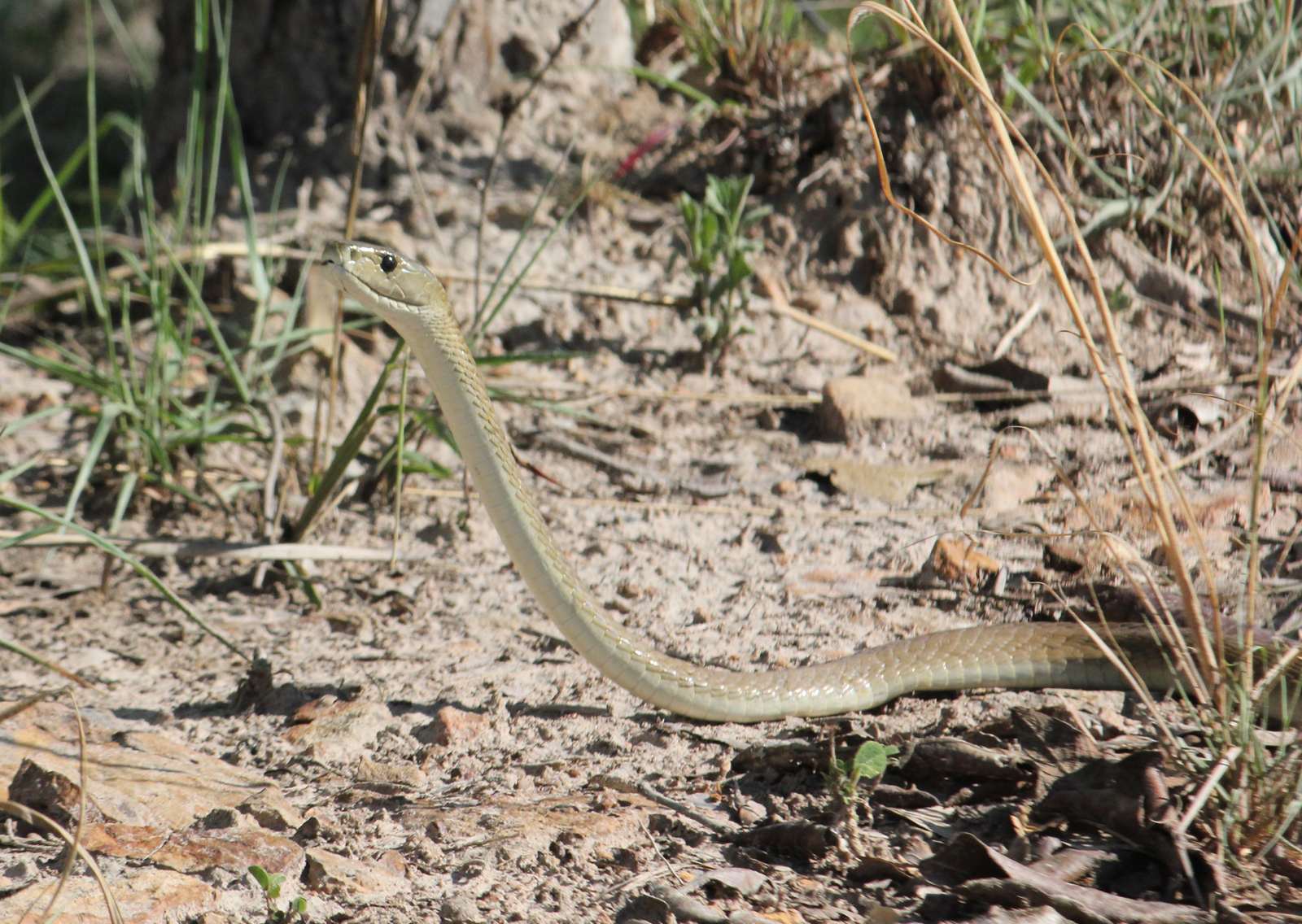
A brown female boomslang can be confused with a black mamba (Dendroaspis polylepis), which has smooth scales, a long coffin-shaped head, dark eyes and a black mouth lining, unlike the boomslang’s rough scales, short head and large eyes14. A green boomslang can be mistaken for a green mamba (Dendroaspis angusticeps), which has a long, coffin-shaped head and lacks the small loreal scale between the nostril and the eye that boomslangs have6. Harmless green bush snakes (Philothamnus) are smaller, and any green snake under 80 cm is very unlikely to be a boomslang, while young boomslangs are easily confused with twig snakes, which have also caused deaths6,13,15.
These differences are not a safe basis for handling any snake. Keep your distance from every snake you cannot identify.
In captivity
The boomslang is a dangerous venomous snake4 and is not suitable as a pet. Many bites happen to people who handle or catch the snake5,8. The herpetologist Karl P. Schmidt died after a bite from a young boomslang, when the species was thought to be only mildly venomous1,13. He kept notes on his symptoms as he was dying1.
Look-alikes
Don’t confuse it with…
These snakes are often mistaken for each other. Use the differences to learn, never as a reason to handle a snake.
References
- 1
Uetz, P. et al. (eds.) (2026). Dispholidus typus (Smith, 1828). The Reptile Database. reptile-database.reptarium.cz
- 2
Uetz, P. et al. (eds.) (2026). Dispholidus punctatus Laurent, 1955. The Reptile Database. reptile-database.reptarium.cz
- 3
Uetz, P. et al. (eds.) (2026). Dispholidus pembae Hughes, 2021. The Reptile Database. reptile-database.reptarium.cz
- 4
African Snakebite Institute. Boomslang (Dispholidus typus) species account. africansnakebiteinstitute.com
- 5
African Snakebite Institute (2024). Snakebite profile: Boomslang, Dispholidus typus. africansnakebiteinstitute.com
- 6
African Snakebite Institute (2024). The 6 common green snakes of South Africa. africansnakebiteinstitute.com
- 7
Coffey, K. & Robinson, A. (2012). Dispholidus typus (boomslang). Animal Diversity Web, University of Michigan Museum of Zoology. animaldiversity.org
- 8
Iziko Museums of South Africa. Dispholidus typus (Boomslang). Biodiversity Explorer. biodiversityexplorer.info
- 9
Krüger, H.J. & Lemke, F.G. (2019). Fatal Boomslang bite in the Northern Cape. African Journal of Emergency Medicine 9(1): 53–55. doi.org
- 10
Corbett, C., Pillay-Fuentes Lorente, V., Muller, G. & van Rensburg, R. (2020). Boomslang (Dispholidus typus) envenomation in a patient on warfarin therapy. South African Medical Journal 110(10): 999. doi.org
- 11
World Health Organization (2017). Guidelines for the production, control and regulation of snake antivenom immunoglobulins. WHO Technical Report Series No. 1004, Annex 5. cdn.who.int
- 12
African Snakebite Institute (2025). Antivenom 'crisis'. africansnakebiteinstitute.com
- 13
African Snakebite Institute (2024). Teeth and fangs. africansnakebiteinstitute.com
- 14
African Snakebite Institute (2019). Snake comparison: Black Mamba vs Boomslang. africansnakebiteinstitute.com
- 15
African Snakebite Institute (2019). Snake comparison: Twig Snake vs Juvenile Boomslang. africansnakebiteinstitute.com
- 16
Luiselli, L., Jallow, M., Trape, J.-F., Chirio, L., Johnny, J., Segniagbeto, G., Howell, K., Msuya, C.A. & Ngalason, W. (2021). Dispholidus typus. The IUCN Red List of Threatened Species 2021: e.T190603A15357215. iucnredlist.org
Play
Play as the boomslang.
Its real pattern is a skin in Snake. Every run ends with a fact.