
Coastal taipan
Oxyuranus scutellatus (Peters, 1867)
Also called Taipan, Eastern taipan, New Guinea taipan, Papuan taipan
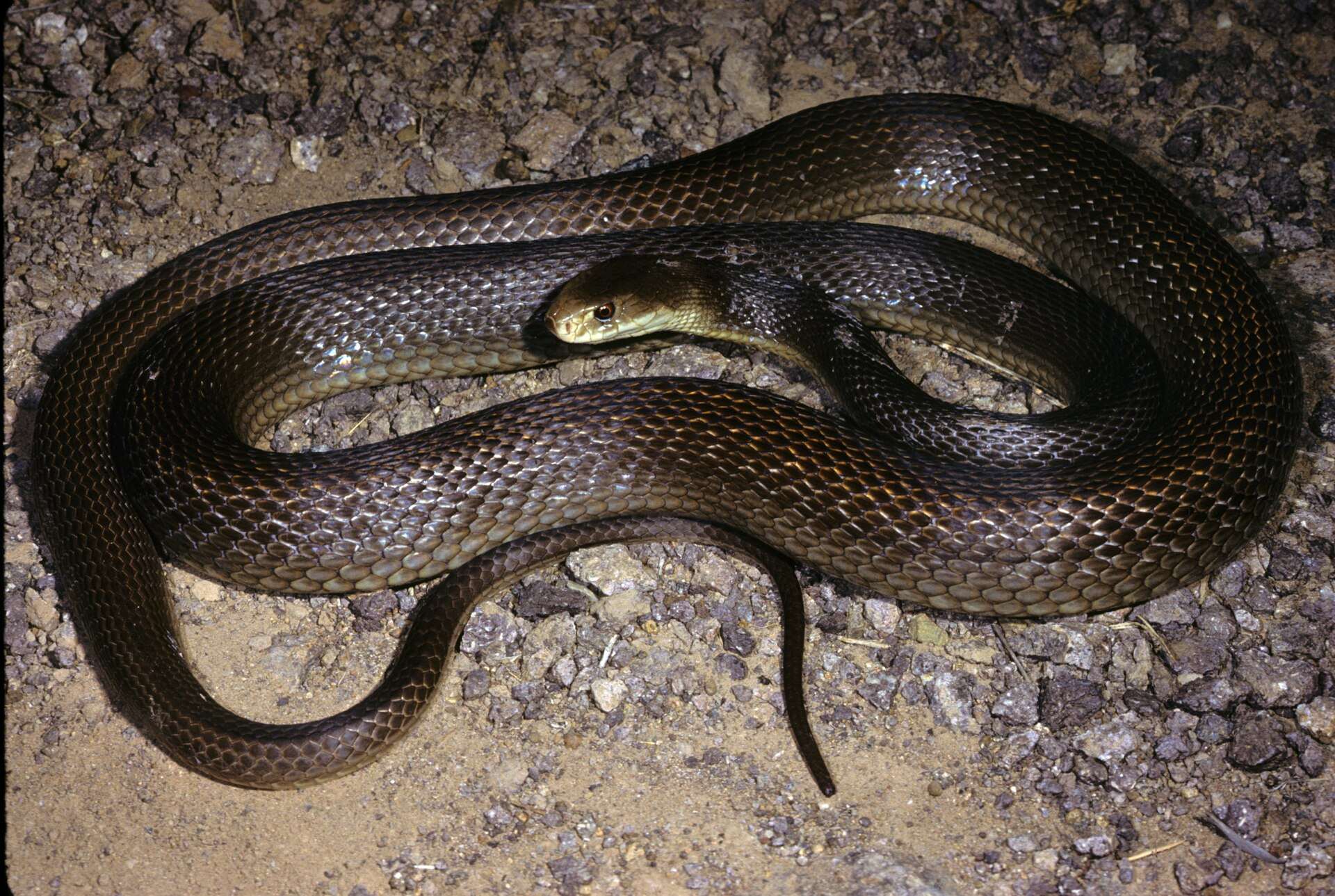
A large, slender brown snake of northern and eastern Australia and southern New Guinea, with a long rectangular head and a noticeably pale face and snout. It hunts rats in grassland, woodland and cane fields.

Is it dangerous?
Yes. Its venom can cause paralysis, bleeding and kidney damage, and serious effects can start quickly. Anyone bitten should go to hospital immediately.
Do not approach. If someone is bitten, go to a hospital now.
At a glance
- Length
- 2.0–2.9 m
- Active
- By day
- Found in
- Northern and eastern Australia, southern New Guinea
- Venom
- Neurotoxic, haemotoxic and myotoxic
- Young
- Lays eggs
- Habitat
- Monsoon forest, Sclerophyll forest and woodland, Grassland
- Diet
- Rats and mice, Bandicoots, Birds
Length shows a typical adult, then the largest recorded.
IUCN Red List status: Least Concern
Country guideSnakes of AustraliaSnakes of Indonesia
True size
Common death adderMedically significant
1 m at most
About two thirds of the height of a 1.7 m adult.
Usual range 0.5–1.0 m, the bar on the ruler.
Eastern brown snakeMedically significant
2.01 m at most
About 1 times the height of a 1.7 m adult.
Usual range 1.5–2.01 m, the bar on the ruler.
Banded kraitMedically significant
2.25 m at most
About 1.5 times the height of a 1.7 m adult.
Usual range 1.35–2.25 m, the bar on the ruler.
Tiger snakeMedically significant
2.4 m at most
About 1.5 times the height of a 1.7 m adult.
Usual range 1.2–2.4 m, the bar on the ruler.
Inland taipanMedically significant
2.5 m at most
About 1.5 times the height of a 1.7 m adult.
Usual range 2.0–2.5 m, the bar on the ruler.
Red-bellied black snakeMedically significant
2.5 m at most
About 1.5 times the height of a 1.7 m adult.
Usual range 1.5–2.5 m, the bar on the ruler.
Coastal taipanMedically significant
2.9 m at most
About 1.5 times the height of a 1.7 m adult.
Usual range 2.0–2.9 m, the bar on the ruler.
Carpet pythonNon-venomous
4 m at most
About 2.5 times the height of a 1.7 m adult.
Usual range 2.0–4.0 m, the bar on the ruler.
Each snake is drawn at the longest length in its profile, on the same scale as the adult. Length is to scale; thickness is not.
Identification
The coastal taipan is a medium to large snake with a deep, rectangular head that is clearly wider than its slender neck1. Its back may be yellowish, reddish-brown, dark brown or almost black, while the head, and especially the snout, is noticeably paler than the body1. The belly is yellowish to cream with scattered orange blotches, and the large eyes have an orange-brown iris and a round pupil1. Adults average about 2 m long, and males grow slightly larger than females1. Lengths of over 3 m have been reported, but the largest wild museum specimen reliably measured had a head-and-body length of 2.26 m, and a captive-bred taipan given to the Queensland Museum measured 2.9 m in total1.
Distribution
The coastal taipan lives in northern and eastern Australia and in southern New Guinea2. The Australian subspecies, Oxyuranus scutellatus scutellatus, ranges in an arc from north-eastern New South Wales through Queensland and across the north of the Northern Territory to northern Western Australia1,2. The Papuan taipan, O. s. canni, lives in southern Papua New Guinea, and The Reptile Database also lists the species from Indonesian New Guinea2. Genetic studies found little difference between Australian and New Guinea taipans, but the Papuan taipan is still kept as a separate subspecies because its colour pattern is consistently different2. The name ‘taipan’ comes from the Wik-mungkan people of Cape York, and it was brought into general use by the anthropologist Donald Thomson1.
Habitat
The coastal taipan lives in warm, wetter coastal regions, from temperate to tropical1. Its habitats include monsoon forest, wet and dry sclerophyll forest and woodland, and grassy places such as grazing paddocks, disused rubbish tips and sugarcane fields, where rats are often plentiful1. Thickets of introduced lantana are also favoured1. It shelters in abandoned animal burrows, hollow logs and piles of vegetation and litter1.
Behaviour
The coastal taipan is mainly active by day, mostly in the early to mid-morning, but it may become active at night in hot weather1. It is active all year and is most often seen in late winter and spring1. It changes colour with the seasons, becoming darker in winter and paler in summer, which probably helps it warm up in cool months and avoid overheating in hot ones1. It is a nervous, alert snake that usually slips away quietly if given the chance1. If surprised or cornered, it raises its head and forebody, flattens its body from side to side and may strike several times very quickly1.
Diet
In the wild the coastal taipan eats only warm-blooded prey, such as rats, mice, bandicoots and birds1. It hunts by sight, often travelling with its head raised, and when it spots prey it freezes, then lunges forward and bites one or more times1. It then lets the prey go and later follows its scent trail with its tongue, which keeps the snake safe from the teeth of a struggling rat1.
Reproduction
The coastal taipan lays eggs2. Mating peaks in late winter and early spring, and wild taipans have been seen in what appears to be male combat1. Two to three months after mating, the female lays 3 to 21 eggs, 11 on average, in a hollow log, under tree roots or in a cavity in the ground1. The eggs hatch after two to three months, and the young are about 46 cm long1. Taipans hatched in captivity can grow to over 1 m in their first year1.
Venom and medical significance
The coastal taipan has the longest fangs of any Australian elapid snake, up to 12 mm, and injects a large amount of highly toxic venom deep into the flesh1. The venom affects the nerves and blood clotting and can cause headache, vomiting, collapse, convulsions, paralysis, internal bleeding, muscle damage and kidney injury1. In a study of 40 confirmed taipan bites in Australia, 33 people were envenomed, most often with paralysis, clotting problems, kidney injury and muscle damage, and early antivenom was linked to fewer of these complications5. The World Health Organization places it in its highest category of medical importance in Papua New Guinea, where, in a study of 166 people bitten by Papuan taipans, most of those envenomed developed bleeding problems and paralysis, and antivenom stopped the bleeding but usually did not reverse the paralysis3,4. Before a specific taipan antivenom was introduced in 1956, a taipan bite was nearly always fatal1. Anyone bitten should go to hospital immediately.
Conservation
The coastal taipan is listed as Least Concern on the IUCN Red List, based on an assessment published in 20186. Young taipans are eaten by birds of prey and goannas, but few predators would take on a large adult1. People still routinely kill taipans on sight1.
Similar species
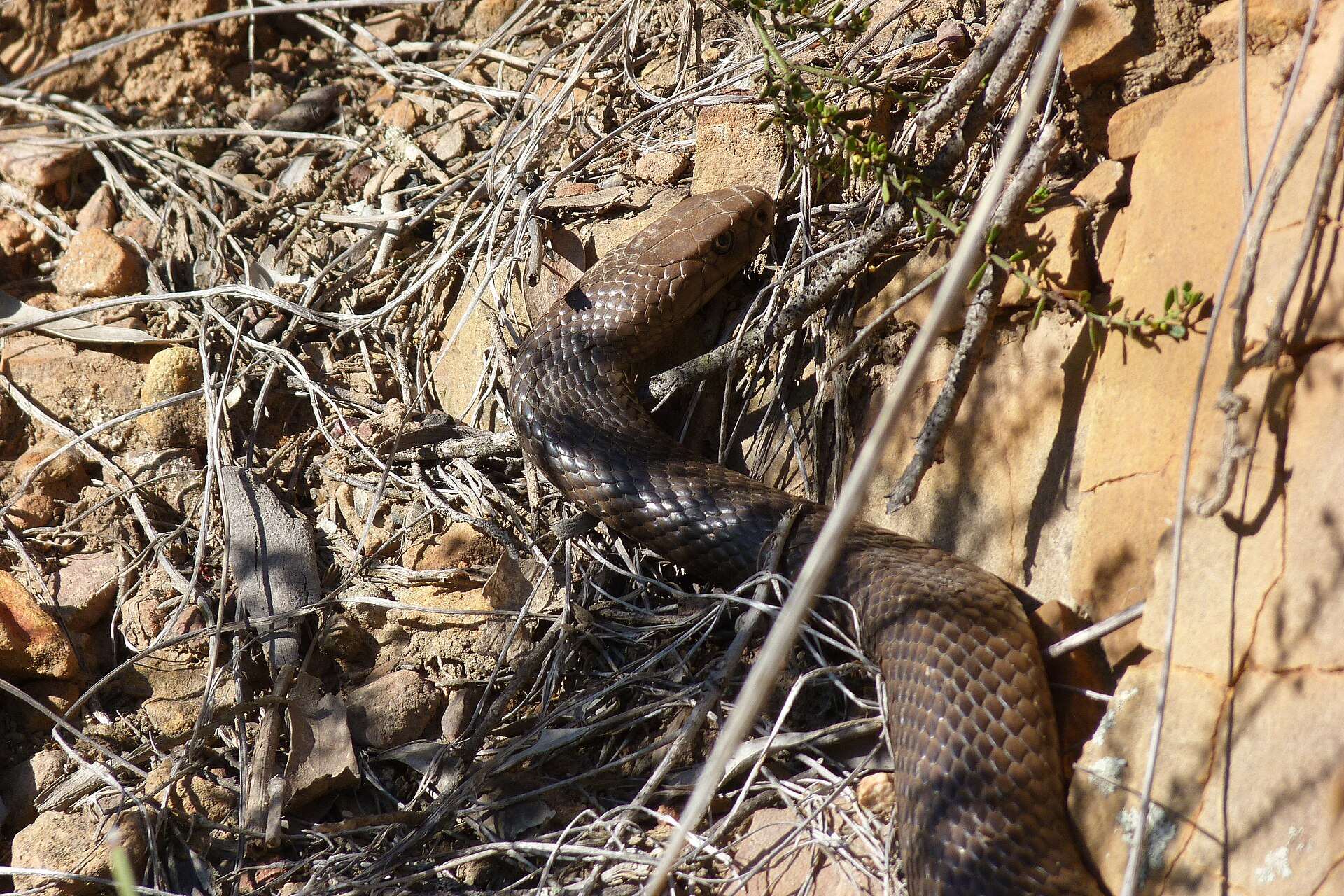
The coastal taipan is sometimes confused with large brown-coloured snakes, such as the eastern brown snake (Pseudonaja textilis), other brown snakes and the mulga snake (Pseudechis australis)1. A taipan usually has a pale face and snout, a large head and a slender neck, while in brown snakes and mulga snakes the snout is the same colour as the body or darker and the smaller head is barely wider than the neck1,7. Its close relative, the inland taipan (Oxyuranus microlepidotus), lives on the floodplains of the Channel Country in inland Queensland and South Australia, far from the coastal taipan’s range8. These differences are not a safe basis for handling any snake. Keep your distance from every snake you cannot identify.
In captivity
The coastal taipan is dangerously venomous and is not suitable as a pet. Captive taipans can be encouraged to breed almost all year round, and snake handlers made up 21 of the 40 confirmed taipan bites in one Australian study1,5. In New South Wales, keeping venomous native reptiles requires an advanced reptile keeper licence and references confirming experience in handling them9.
Look-alikes
Don’t confuse it with…
These snakes are often mistaken for each other. Use the differences to learn, never as a reason to handle a snake.
References
- 1
Beatson, C. (2026). Coastal Taipan. Australian Museum. australian.museum
- 2
Uetz, P. et al. (eds.) (2026). Oxyuranus scutellatus (Peters, 1867). The Reptile Database. reptile-database.reptarium.cz
- 3
World Health Organization (2017). Guidelines for the production, control and regulation of snake antivenom immunoglobulins. WHO Technical Report Series No. 1004, Annex 5, Appendix 1: Worldwide distribution of medically important venomous snakes. cdn.who.int
- 4
Lalloo, D.G., Trevett, A.J., Korinhona, A., Nwokolo, N., Laurenson, I.F., Paul, M., Black, J., Naraqi, S., Mavo, B., Saweri, A., Hutton, R.A., Theakston, R.D.G. & Warrell, D.A. (1995). Snake bites by the Papuan taipan (Oxyuranus scutellatus canni): paralysis, hemostatic and electrocardiographic abnormalities, and effects of antivenom. American Journal of Tropical Medicine and Hygiene 52(6): 525–531. (Abstract, PubMed) pubmed.ncbi.nlm.nih.gov
- 5
Johnston, C.I., Ryan, N.M., O'Leary, M.A., Brown, S.G.A. & Isbister, G.K. (2017). Australian taipan (Oxyuranus spp.) envenoming: clinical effects and potential benefits of early antivenom therapy — Australian Snakebite Project (ASP-25). Clinical Toxicology 55(2): 115–122. (Abstract, PubMed) pubmed.ncbi.nlm.nih.gov
- 6
Tallowin, O., Parker, F., O'Shea, M., Hoskin, C., Vanderduys, E., Amey, A. & Couper, P. (2018). Oxyuranus scutellatus. The IUCN Red List of Threatened Species 2018: e.T42493166A42493177. iucnredlist.org
- 7
Beatson, C. (2026). Eastern Brown Snake. Australian Museum. australian.museum
- 8
Beatson, C. (2026). Inland Taipan. Australian Museum. australian.museum
- 9
NSW Government, Environment and Heritage (2026). Reptile keeper licences. environment.nsw.gov.au
Play
Play as the coastal taipan.
Its real pattern is a skin in Snake. Every run ends with a fact.